EU ICS2 and ENS Requirements for Shipping from China

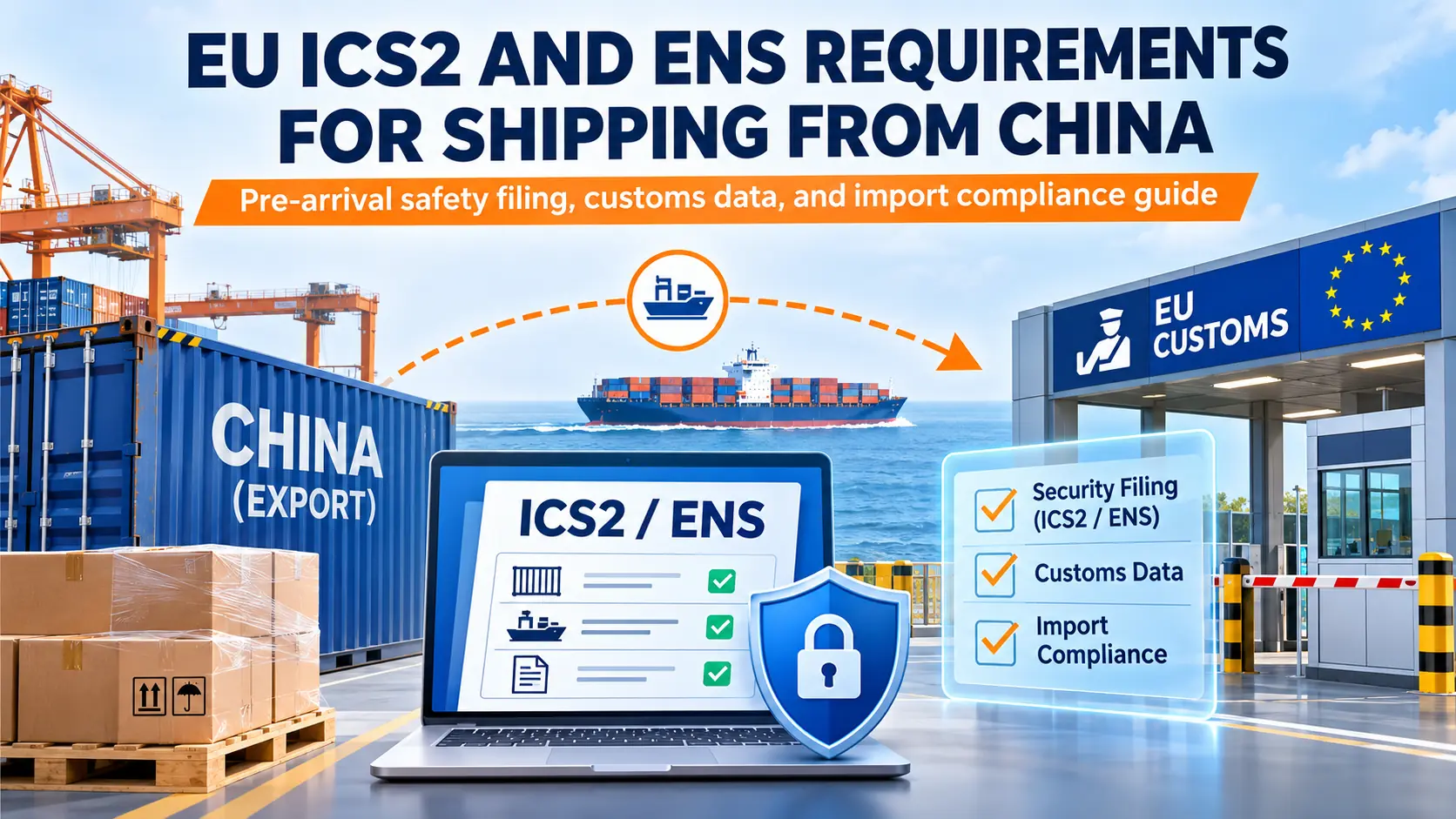
Shipping goods from China to the EU requires advance safety and security filing under the Import Control System 2 (ICS2). The Entry Summary Declaration (ENS) provides customs authorities with essential shipment information before goods arrive.

Learn about ENS filing responsibilities, required shipment data, deadlines for sea, air, rail and road freight, and how to avoid customs delays through accurate documentation and timely submission.

ICS2 & ENS Filing

ENS Data Requirements

Filing Deadlines

EU ICS2 and ENS requirements for shipping goods from China to the European Union
10,000+ international shipments handled    Global sea, air & DDP shipping solutions    24/7 shipment tracking & customer support

Table of Contents

What Are ICS2 and ENS?

ICS2 and ENS are closely related but serve different purposes in the EU’s customs security process.

What Is the Import Control System 2 (ICS2)?

The Import Control System 2 (ICS2) is the European Union’s advance cargo information system. It collects shipment data before goods enter or transit through the EU customs territory.

EU customs authorities use this information to conduct safety and security risk assessments, identify potentially high-risk shipments and determine whether additional inspections are necessary.

ICS2 applies to economic operators involved in bringing goods into or transiting through the EU, including carriers, freight forwarders and other parties responsible for providing shipment information.

What Is an Entry Summary Declaration (ENS)?

An Entry Summary Declaration (ENS) is an electronic declaration containing advance information about goods transported into the EU.

It provides customs authorities with details about the shipment, including:

  • Shipper and consignee information.

  • Description and classification of the goods.

  • Cargo weight and package details.

  • Transport document references.

  • Transport route and relevant carrier information.

The ENS must be submitted within the applicable deadline before the goods arrive in the EU. For certain transport modes, additional pre-loading requirements also apply.

ENS vs. Import Customs Declaration

An ENS is not the same as an import customs declaration.

The ENS provides advance safety and security information for customs risk assessment. An import customs declaration is used to place goods under an applicable customs procedure and determine duties, import VAT and other import requirements.

Submitting an ENS does not complete customs clearance or mean that import duties and taxes have been paid. Both procedures must be handled separately when applicable.

Do ICS2 and ENS Apply to Shipments from China?

Yes. Goods entering or transiting through the EU customs territory from China are generally subject to ICS2 and ENS requirements, regardless of whether they arrive by sea, air, rail or road.

The requirements cover different types of commercial cargo, including:

ICS2 was rolled out in stages. Since 1 September 2025, Release 3 has covered all transport modes across EU Member States, including road and rail.

Another important date is 1 June 2026. From this date, the temporary derogations related to NCTS Phase 6 and ICS2 ENS filing ended. Consignments entering the EU must have a valid ENS submitted directly through ICS2 or included in a combined transit declaration through NCTS-P6 in countries that have adopted the opt-in approach.

For road and rail shipments, the filing arrangement may therefore depend on the transit system used by the relevant countries. Importers should confirm the applicable procedure with their carrier or customs representative before dispatch.

Who Is Responsible for Filing an ENS?

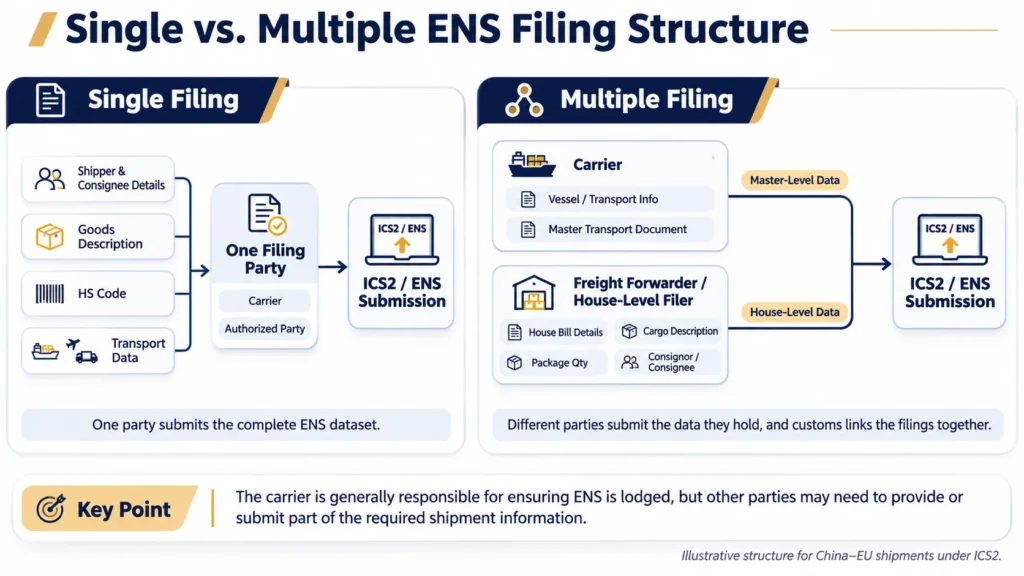
The carrier bringing goods into the EU customs territory is generally responsible for lodging the ENS. However, other businesses involved in the supply chain may also need to provide or submit specific shipment information.

The Carrier's ENS Filing Responsibility

The carrier is normally responsible for ensuring that the required ENS is submitted within the applicable deadline.

For example, a shipping line carrying a container from China to Rotterdam must ensure that the relevant safety and security information is available for filing before the vessel departs.

However, the carrier may not hold every detail about the goods, particularly when a shipment involves several suppliers, freight forwarders or house bills of lading.

Single Filing vs. Multiple Filing

ICS2 supports both single and multiple ENS filing arrangements, depending on the transport mode, business model and information available to each party.

  • Single filing: One responsible party submits the complete ENS dataset.

  • Multiple filing: Different parties submit separate parts of the required information based on the data they hold.

For example, a carrier may submit master-level transport information, while a freight forwarder provides house-level shipment details.

The parties must coordinate the relevant identification numbers and transport document references so that customs authorities can link the separate filings correctly.

The Role of Freight Forwarders and EU Importers

Freight forwarders often hold important information that carriers need to complete an ENS filing. This may include house bill of lading details, cargo descriptions, package quantities and shipper or consignee information.

Importers and other supply chain participants may also need to provide missing information when they hold data required for the declaration.

Businesses should confirm the filing responsibility with their carrier or freight forwarder before shipment. They should also clarify whether a single filing or multiple filing arrangement will be used.

An EORI number is required for economic operators carrying out relevant customs activities, including lodging ENS declarations or acting as a carrier. The exact EORI requirements depend on the role of each party.

What Information Is Required for an ICS2 ENS Filing?

An accurate ENS filing requires detailed information about the goods, the parties involved and the transportation arrangements. The exact data requirements depend on the transport mode and filing model.

The following information should generally be prepared before shipment.

Consignor, Consignee, Buyer and Seller Details

The declaration may require information identifying the parties involved in the transaction and transportation.

These details can include:

  • Full legal names of the consignor and consignee.

  • Registered business addresses.

  • Buyer and seller information, where required.

  • Relevant EORI or other identification numbers.

  • Contact information when applicable.

The information should be consistent with the commercial documents and transport records. Incorrect company names, incomplete addresses or missing identification details can create filing problems.

Goods Description and HS Code

A clear and accurate goods description is one of the most important parts of an ENS filing.

Descriptions such as “general cargo,” “parts,” “accessories” or “unknown” do not provide sufficient information about the actual products.

For example, instead of using “metal products,” a more specific description would be “stainless steel kitchen sinks.”

The relevant six-digit HS code should also be prepared for commercial goods where required. Different products with different HS codes should be identified separately rather than combined under an overly broad description.

Transport and Cargo Details

Depending on the shipment and transport mode, the ENS may require:

  • Cargo weight and package quantities.

  • Type of packaging and shipping marks.

  • Transport mode and identification of the means of transport.

  • Departure, routing and destination information.

  • Estimated arrival details.

  • Master and house transport document references.

The information should match the relevant shipping documents, including the bill of lading, air waybill, rail consignment note or road transport document.

Master and House-Level Shipment Data

Shipments involving consolidation may require information at both master and house levels.

For example, an LCL shipment from China may involve a master bill of lading covering a consolidated container and several house bills of lading covering individual shipments.

The carrier and freight forwarder should coordinate these records to ensure that the required information is submitted and correctly linked in ICS2.

When Must ENS Be Submitted for Different Transport Modes?

The ENS filing deadline depends on the transport mode, cargo type and journey duration. For shipments from China to the EU, businesses must ensure that the required information is submitted before the applicable deadline.

ICS2 ENS Filing Deadlines by Transport Mode

Transport ModeENS Filing Deadline
Sea Freight – Containerized CargoAt least 24 hours before loading onto the vessel bringing the goods into the EU
Sea Freight – Bulk or Break-Bulk CargoAt least 4 hours before arrival at the first EU port
Air Freight – Minimum DataBefore loading onto the aircraft
Air Freight – Flights Under 4 HoursComplete ENS by the actual departure of the aircraft
Air Freight – Flights of 4 Hours or LongerComplete ENS at least 4 hours before arrival at the first EU airport
Rail Freight1 hour before arrival if the journey from the last third-country train formation station to the first EU customs office takes less than 2 hours; otherwise, 2 hours before arrival
Road FreightAt least 1 hour before arrival at the EU border
Inland Waterway TransportAt least 2 hours before arrival

Important Filing Considerations

For most containerized sea freight shipments from China, the 24-hour rule is particularly important. The ENS must be submitted before the goods are loaded onto the vessel that will bring them into the EU customs territory.

For air freight, submitting the minimum dataset before loading does not replace the requirement to complete the full ENS within the applicable deadline.

Certain maritime routes also have specific exceptions. For example, goods arriving from specified regions, including the Mediterranean, Baltic Sea and Morocco, may be subject to a two-hour pre-arrival deadline instead of the standard sea freight deadlines.

Businesses should confirm the applicable filing requirements with their carriers or freight forwarders, especially when shipments involve transshipment, multiple transport modes or different customs procedures.

How Does the ICS2 Filing Process Work for China–EU Shipments?

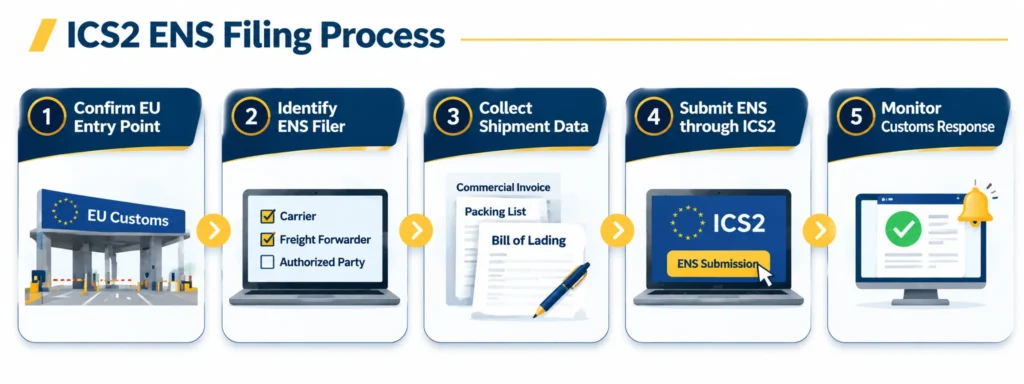
Although the filing arrangement varies by transport mode, the general process involves several steps.

  1. Confirm the EU first point of entry: Identify the first EU customs office where the goods enter the customs territory. This may differ from the final delivery destination.

  2. Identify the responsible ENS filer: Confirm whether the carrier, freight forwarder or another authorized party will submit the declaration. Determine whether single or multiple filing applies.

  3. Collect shipment information: Gather commercial invoices, packing lists, transport documents, goods descriptions, HS codes and relevant party details.

  4. Submit ENS data: The responsible economic operator submits the required information through the ICS2 Shared Trader Portal, Shared Trader Interface or an authorized IT service provider. Where applicable, road and rail ENS data may be included in an NCTS-P6 transit declaration in opt-in countries.

  5. Monitor filing status: Check registration responses and any customs notifications. If additional information or screening is requested, the responsible party must respond before the risk assessment can proceed.

Completing these steps before the relevant deadline helps businesses reduce the risk of shipment interruptions at the EU border.

ICS2 ENS filing process infographic showing five steps for shipments from China to the EU, from confirming the EU entry point to monitoring customs responses.

What Happens If ENS Data Is Missing or Inaccurate?

Incomplete or incorrect ENS information can affect customs risk assessment and delay the transportation process.

Depending on the circumstances, EU customs authorities may take several actions.

  • Declaration rejection: Incomplete or invalid data may prevent the ENS from being accepted.

  • Additional information requests: Customs may request clarification or supporting shipment information.

  • Cargo screening: Shipments identified as requiring further checks may undergo additional security inspections.

  • Do Not Load instructions: Customs may issue a Do Not Load request when a shipment presents a specific security concern or does not meet applicable requirements.

  • Cargo delays: Missing information or unresolved customs referrals can delay loading, entry or onward transportation.

  • Administrative penalties: Non-compliance may result in enforcement action under applicable EU and national rules.

These outcomes are not automatic for every filing error. However, businesses should not assume that an incomplete declaration can be corrected without affecting the shipment schedule.

Common ICS2 and ENS Filing Mistakes to Avoid

Most ICS2 filing problems result from incomplete shipment information, incorrect cargo details or poor coordination between the parties involved. Importers and freight forwarders should pay attention to the following mistakes before submitting an ENS.

Inaccurate or Vague Goods Descriptions

Using general terms such as “general cargo,” “parts” or “accessories” makes it difficult for customs authorities to identify the actual goods. Provide specific product descriptions that clearly explain the nature of the cargo.

Incorrect HS Codes

Missing or incorrect HS codes can affect the accuracy of ENS data. Check that the applicable six-digit HS code matches the actual goods and their description before submission.

Inconsistent Shipper and Consignee Information

Differences in company names, addresses or identification details across shipping documents can cause verification problems. Check the information against the commercial invoice, packing list and transport documents.

Missing House-Level Shipment Information

For consolidated shipments, master and house transport document details must be properly coordinated. Missing house-level data or incorrect document references can result in incomplete ENS filings.

Late ENS Submission

Each transport mode has its own filing deadline. Waiting until cargo is ready for departure to collect shipment information can leave insufficient time for submission and correction.

To avoid these problems, businesses should verify cargo details, confirm filing responsibilities and provide complete shipment information to the responsible carrier or freight forwarder well before the applicable deadline.

How Can a Freight Forwarder Help with ICS2 Compliance?

Managing ICS2 requirements involves more than submitting an electronic declaration. Shipment information must be collected, checked and coordinated between different businesses in the supply chain.

A freight forwarder can help importers organize these activities by:

  • Collecting commercial and transport information from suppliers.

  • Checking shipment details against invoices and packing lists.

  • Coordinating master and house transport document information.

  • Communicating with carriers about ENS filing responsibilities.

  • Helping identify missing shipment information before departure.

  • Monitoring transportation progress and coordinating responses to operational issues.

Tonlexing provides international freight forwarding services for businesses shipping goods from China to Europe. By coordinating cargo collection, shipping arrangements and transportation documentation, Tonlexing helps importers manage the logistics process more efficiently.

Before shipment, businesses should confirm who is responsible for the actual ICS2 submission and ensure that all required data is provided to the designated filing party on time.

Frequently Asked Questions