

The question “how many containers can a cargo ship carry at most” is one of the most frequently searched topics in the container shipping industry. As global trade expands and modern container ships continue to grow in size, the number of shipping containers a single cargo ship can carry has reached unprecedented levels.
Today, the largest container ships operate as floating logistics hubs, transporting tens of thousands of cargo containers on a single voyage. However, the exact number of containers a ship can carry depends on how container ship capacity is measured, the type of shipping containers used, and the real-world limits imposed by ship design, safety regulations, and shipping operations.
This guide provides a complete and practical explanation of container ship capacity, from basic definitions to real maximum limits, helping importers, exporters, and logistics planners clearly understand how many containers a cargo ship can actually carry.
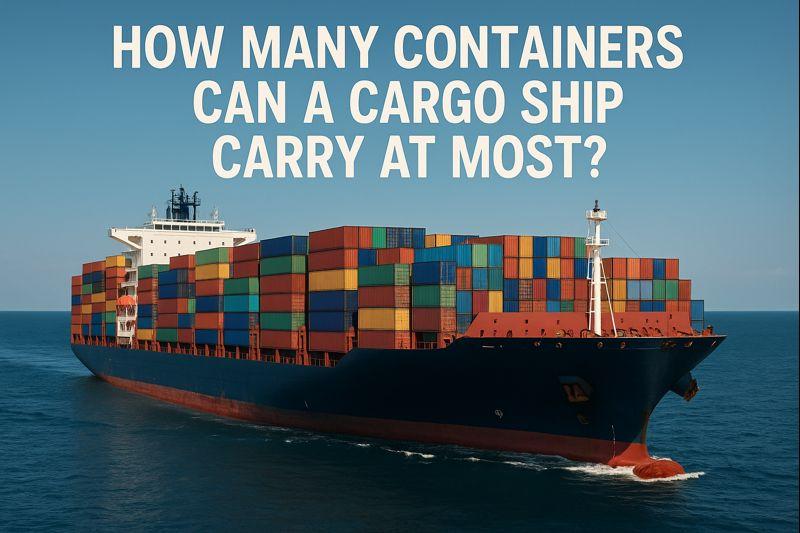
What Is Container Ship Capacity?
Container ship capacity refers to the maximum number of standardized shipping containers a vessel can safely carry. Instead of counting physical boxes, the shipping industry uses a standardized unit called TEU.
What Is a TEU?
- 1 TEU = one 20-foot container
- 1 × 40-foot container = 2 TEUs
- Most ships carry a mix of 20ft and 40ft containers
TEU allows shipping companies to compare vessel sizes consistently, regardless of container mix.
How Many Containers Can a Cargo Ship Carry at Most?
At present, the maximum container ship capacity in commercial operation exceeds 24,000 TEU.
This means the world’s largest container ships can carry the equivalent of:
- More than 24,000 twenty-foot shipping containers, or
- Approximately 12,000 forty-foot containers, or
- A mixed configuration of container sizes depending on cargo requirements
These vessels are commonly referred to as ultra large container ships or ultra large container vessels, and they represent the current upper limit of container ship size and capacity.
Why the Number of Containers Is Not Always the Same as TEU Capacity
Although TEU capacity is the standard measurement, the number of containers a ship actually carries can differ from its rated capacity.
There are several reasons for this difference:
- Most shipments use 40ft containers, which take up two TEU slots
- Some cargo requires high cube containers, which affect weight and stability
- Oversized cargo may use flat rack containers, reducing usable container slots
- Heavy cargo may cause a ship to reach its deadweight tonnage limit before filling all TEU positions
As a result, a ship with a rated capacity of 24,000 TEU may carry fewer physical containers, even though it is operating at full capacity.
Shipping Containers Used on Modern Container Ships
Modern container ships are designed to carry many different types of shipping containers, not just standard boxes.
Common container types include:
- Standard ISO containers (20ft and 40ft)
- High cube containers, which are taller and often used for light but bulky cargo
- Refrigerated containers for perishable goods
- Flat rack containers for oversized machinery or vehicles
Each container type affects how many containers a ship can carry, how containers are stacked, and how cargo weight is distributed across the vessel.
Container Capacity vs Cargo Carrying Capacity
It is important to distinguish between container capacity and cargo carrying capacity.
- Container capacity refers to how many container slots a ship has (measured in TEUs)
- Cargo carrying capacity refers to how much total weight the ship can safely transport
A container ship may have available container slots but still be unable to load more cargo if it has reached its maximum weight limit. This is why cargo mix plays a critical role in determining how many containers a ship can carry on any given voyage.
Container Ship Sizes and How Capacity Ranges by Ship Type
Not all container ships are built the same. The number of shipping containers a ship can carry depends heavily on ship size, vessel design, and the trade routes it serves. To understand container ship capacity in practice, it is essential to look at the major container ship size categories used in the shipping industry.
From smaller feeder ships to ultra large container vessels, each ship type is designed for a specific role within global trade networks.
Feeder Ships and Smaller Container Ships
Feeder ships are the smallest category of container ships commonly used in international shipping. These smaller container ships operate on regional routes and connect secondary ports to major container hubs.
Typical characteristics of feeder ships:
- Capacity ranging: approximately 300 to 2,000 TEUs
- Operate at smaller container ports with limited draft and crane reach
- Support regional and short-distance shipping methods
Because feeder ships serve ports that cannot accommodate larger vessels, they play a critical role in the container shipping industry despite their smaller size. The number of containers a feeder ship can carry is limited, but their flexibility makes them essential.
Panamax Ships and Canal-Based Capacity Limits
Panamax ships are container ships designed to fit through the original locks of the Panama Canal. For many years, Panamax ships represented the upper limit of container ship size.
Key features of Panamax ships:
- Typical TEU capacity: 3,000 to 5,000
- Beam and draft restricted by Panama Canal dimensions
- Widely used on intercontinental shipping routes
Although Panamax ships are smaller than modern mega-ships, they remain common due to their ability to transit the Panama Canal and access a wide range of container ports.
New Panamax Ships and Expanded Capacity
After the expansion of the Panama Canal, a new category emerged: new panamax ships.
These vessels are larger than traditional Panamax ships and offer significantly higher container ship capacity.
- Typical capacity: 5,000 to 14,000 TEUs
- Designed to pass through the expanded Panama Canal
- Balance size efficiency with route flexibility
New Panamax ships allow shipping companies to carry more containers while still maintaining access to critical canal routes, making them a popular choice for trans-Pacific and global trade lanes.
Post Panamax Ships and the Shift to Larger Vessels
Post panamax ships exceed the size limits of the original Panama Canal and are built specifically for high-volume international shipping routes.
Typical characteristics of post panamax ships include:
- Container ship capacity: approximately 6,000 to 10,000+ TEUs
- Wider beams allowing more containers stacked across the deck
- Optimized for long-haul routes between major container ports
Post panamax ships marked a major turning point in the shipping industry, enabling carriers to transport more shipping containers per voyage and reduce unit shipping costs.
Very Large Container Ships
Very large container ships represent the next step in vessel scaling beyond post panamax designs.
- Typical capacity: 10,000 to 14,000+ TEUs
- Operate primarily between major global hubs
- Require advanced port infrastructure and deep-water berths
These ships are commonly deployed on high-demand routes where container volumes are consistently high.
Ultra Large Container Ships and Ultra Large Container Vessels
At the top end of the scale are ultra large container ships, also known as ultra large container vessels (ULCVs). These are the largest container ships ever built.
Key characteristics include:
- TEU capacity: 14,000 to more than 25,000 TEUs
- Length approaching 400 meters
- Designed for Asia–Europe and other high-volume international trade lanes
These vessels define the current upper limit of container ship capacity and answer the question of how many containers a cargo ship can carry at most in real-world commercial operations.
Container Ship Capacity Comparison by Ship Size
To better understand how capacity scales with ship size, the table below compares typical container ship sizes and the number of containers they can carry.
| Ship category | Typical TEU capacity | Approx. 20ft containers | Approx. 40ft containers |
|---|---|---|---|
| Feeder ships | 300–2,000 | 300–2,000 | 150–1,000 |
| Panamax ships | 3,000–5,000 | 3,000–5,000 | 1,500–2,500 |
| New Panamax ships | 5,000–14,000 | 5,000–14,000 | 2,500–7,000 |
| Post Panamax ships | 6,000–10,000+ | 6,000–10,000+ | 3,000–5,000+ |
| Very large container ships | 10,000–14,000+ | 10,000–14,000+ | 5,000–7,000+ |
| Ultra large container vessels | 14,000–25,000+ | 14,000–25,000+ | 7,000–12,500+ |
This comparison shows clearly how container ship sizes determine the number of containers a ship can carry, with ultra large container ships setting the maximum benchmark.
Why Bigger Ships Can Carry More Containers
Larger vessels are able to carry more shipping containers due to:
- Wider beams that allow more container rows
- Stronger hull structures to support containers stacked higher
- Improved stability systems for heavy container loads
- Optimized deck and hold layouts
However, increasing ship size also increases reliance on major container ports and specialized infrastructure.
Why Real Container Loads Are Often Lower Than Maximum Capacity
Although modern container ships are designed with impressive container ship capacity, ships in real-world operations rarely sail with every available container slot fully loaded. This difference between theoretical capacity and actual loading is an important part of understanding how many containers a cargo ship can truly carry.
In practice, carry depends on multiple operational, physical, and regulatory factors rather than ship size alone.
Deadweight Tonnage: The Primary Weight Limit
One of the most important constraints on container ship capacity is deadweight tonnage (DWT).
Deadweight tonnage represents the maximum total weight a ship can safely carry, including:
- Cargo containers and their contents
- Fuel and lubricants
- Fresh water and ballast
- Crew provisions and stores
A container ship may still have empty container slots available but be unable to load additional cargo because it has reached its deadweight tonnage limit. This is especially common when transporting heavy dry cargo, machinery, or dense industrial goods.
Container Mix and Cargo Weight Distribution
The number of containers a ship can carry is heavily influenced by the mix of container types onboard.
Factors that affect container ship capacity include:
- Ratio of 20ft containers to 40ft containers
- Use of high cube containers, which affect weight and stability
- Presence of flat rack containers for oversized cargo
- Quantity of refrigerated containers carrying perishable goods
Because different container types have different weights and stowage requirements, the actual number of shipping containers loaded often differs from the vessel’s TEU capacity rating.
Port Infrastructure and Container Ports
Another critical limitation is port infrastructure. Only well-equipped container ports can handle very large container ships and ultra large container vessels.
Key port-related constraints include:
- Crane outreach and lifting capacity
- Berth depth and quay strength
- Yard space for high container volumes
- Terminal productivity and turnaround speed
As a result, the largest container ships typically call only at major global hubs and the world’s busiest container port locations, while smaller ports rely on feeder ships to connect to the global network.
Canal Restrictions and Shipping Routes
Shipping routes and canals also influence container ship capacity in practice.
- The Panama Canal restricts ship dimensions, shaping Panamax and New Panamax designs
- Larger post panamax and ultra large container ships may bypass canals entirely
- Route selection affects how ships are loaded and where containers are discharged
These routing considerations often reduce the number of containers loaded for multi-port services.
Stability, Containers Stacked, and Rough Seas
Container ships stack containers high above the deck to maximize space, but stability remains a critical concern.
Operational safety factors include:
- Center of gravity limits
- Wind resistance on containers stacked high
- Stress on lashing systems during heavy weather
- Performance in rough seas
To ensure safety, shipping operations may require lower stack heights or reduced loads in certain weather conditions, limiting container ship capacity on specific voyages.
Shipping Operations and Schedule Planning
Modern shipping operations are optimized for network efficiency, not just maximum load.
Shipping companies plan vessel loads based on:
- Port rotation sequences
- Scheduled discharge volumes at each port
- Balance between cargo intake and schedule reliability
- Minimizing container re-handling
This means a ship may sail with unused capacity to ensure smooth operations across multiple ports, even when demand is strong.
Learn more:
- How Long Does It Take to Ship from China
- How to Import and Ship Container Houses from China
- How Much does a Shipping Container Cost
- Top Tips for Container Shipping from China in 2025
- Understanding Container VGM in International Shipping
- What are the Advantages and Differences Between SOC and COC Containers?
Transporting Goods Efficiently vs Maximizing Capacity
In global logistics, the goal is not always to load the maximum number of containers possible. The priority is to transport goods efficiently, safely, and on schedule.
Shipping companies balance:
- Cargo capacity
- Transit time
- Fuel costs
- Port congestion risks
As a result, a slightly lower container load may produce better overall performance across the shipping network.
Why “How Much Cargo” Varies by Voyage
When asking how much cargo a container ship carries, the answer varies by voyage because of:
- Cargo density
- Destination mix
- Regulatory constraints
- Seasonal demand
- Weather patterns
Two voyages by the same ship may carry very different numbers of containers even though the ship’s maximum capacity remains unchanged.
Container Ships Compared With Other Cargo Ships
It is also important to distinguish container ships from other vessel types.
- Container ships carry standardized cargo containers
- Bulk carriers transport unpackaged dry cargo such as grain or ore
- General cargo ships carry mixed, non-containerized freight
Only container ships are designed to optimize container trade efficiency at scale.
The World’s Largest Container Ships in Operation Today
When discussing how many containers a cargo ship can carry at most, real-world examples from the largest container ships provide the clearest answer. Over the past decade, shipping companies have introduced a new generation of vessels that push container ship capacity to record-breaking levels.
These ships are designed specifically to maximize TEU capacity while maintaining safety, fuel efficiency, and operational reliability on major international shipping routes.
Record-Breaking Container Ships and Their Capacity
Several record breaking ships currently define the upper limit of container ship size:
- MSC Irina / MSC Tessa
Capacity: approximately 24,300 TEUs
These vessels are widely recognized as some of the largest container ships ever built. - OOCL Spain-class container ships
Capacity: approximately 24,000 TEUs
Designed for high-volume Asia–Europe services. - Ever Ace
Capacity: nearly 24,000 TEUs
Known for setting capacity records at the time of launch.
Each of these ships demonstrates how far modern container ship design has advanced and clearly answers how many containers a cargo ship can carry at most in today’s shipping industry.
How Shipping Companies Use Ultra Large Container Ships
Major shipping companies deploy ultra large container vessels primarily on routes where demand is consistent and port infrastructure can support their size.
Typical characteristics of routes served by these vessels include:
- High container volumes
- Calls at major container ports only
- Strong hinterland connections for inland transport
By using ultra large container ships, shipping companies can move more containers per voyage, reduce unit shipping costs, and improve overall network efficiency.
Shipbuilding and Engineering Behind Huge Container Ships
The ability to build such huge ships depends on advanced shipbuilding technology and engineering expertise. Leading shipyards, including companies such as Samsung Heavy Industries, have played a key role in constructing modern container ships capable of carrying more containers than ever before.
Key engineering advancements include:
- Reinforced hull structures
- High-capacity engines optimized for fuel efficiency
- Advanced stability and ballast control systems
- Improved lashing systems for containers stacked high on deck
These innovations allow modern ships to safely operate at extreme scales.
Why Bigger Ships Do Not Mean Unlimited Growth
Although container ships have grown rapidly, there are clear limits to how large vessels can become.
Limiting factors include:
- Port infrastructure constraints
- Canal and route restrictions
- Risk concentration from carrying too much cargo on a single ship
- Operational challenges during disruptions
As a result, the shipping industry now focuses on optimizing vessel size rather than pursuing unlimited growth in ship dimensions.
Ships in the World: Container Ships vs the Global Fleet
Among the many ships in the world, container ships represent only one category—but they are among the most visible and economically significant.
While bulk carriers and general cargo ships remain essential for transporting raw materials and specialized goods, container ships dominate the movement of manufactured products in global trade.
Their standardized use of cargo containers has reshaped how goods are produced, transported, and distributed worldwide.
Final Answer: How Many Containers Can a Cargo Ship Carry at Most?
To answer the question clearly and accurately: The maximum number of containers a cargo ship can carry today exceeds 24,000 TEUs.
This means that the largest container ships currently in operation can carry the equivalent of more than 24,000 twenty foot shipping containers, depending on container size, cargo weight, and operational conditions. These vessels represent the current upper limit of container ship capacity in the global container shipping industry.
However, it is important to understand that this figure refers to TEU capacity, not necessarily the physical number of boxes loaded on every voyage.
Why the Maximum Is a Practical Upper Limit
While shipbuilders and shipping companies have pushed vessel size to historic extremes, the practical upper limit of container ship capacity is now shaped by several realities:
- Port infrastructure limitations
- Canal and route restrictions
- Safety requirements for containers stacked high
- Risk concentration from carrying extremely large volumes on a single ship
As a result, the industry focus has shifted from simply building bigger ships to optimizing fleet deployment, port efficiency, and shipping operations.
Typical Container Ship vs Maximum Capacity
To put the maximum figure into context:
- A typical container ship carries between 2,000 and 15,000 TEUs, depending on ship size and route
- Only ultra large container vessels exceed 20,000 TEUs
- Most ships operate well below their theoretical maximum on a regular basis
This distinction helps explain why real-world container loads vary widely even within the same vessel class.
How Container Ship Capacity Affects Shipping Costs
Container ship capacity directly influences shipping costs in international shipping.
Larger vessels allow shipping companies to:
- Spread operating costs across more containers
- Reduce cost per unit on high-volume routes
- Improve fuel efficiency per TEU
However, these benefits are realized only when routes, ports, and cargo volumes support such large ships. On smaller routes, feeder ships and mid-sized vessels often remain more efficient.
Container Shipping Capacity and Global Supply Chains
The ability of container ships to carry large volumes of cargo containers is fundamental to modern international trade. Containerization allows goods to move seamlessly from factories to consumers using standardized shipping containers across ships, trucks, and rail.
Without the massive container ship capacity available today, global supply chains would be slower, more expensive, and far less reliable.
FAQs
How many shipping containers can a ship carry?
A ship can carry anywhere from a few hundred containers on feeder ships to over 24,000 TEUs on the largest container ships, depending on ship size and cargo mix.
How many containers does a typical cargo ship carry?
Most container ships carry between 2,000 and 15,000 TEUs. Only a small number of ultra large container vessels operate above this range.
Is TEU the same as the number of containers?
No. TEU (twenty foot equivalent unit) is a standardized measurement. A 40ft container equals 2 TEUs, so the physical number of containers on a ship is often lower than the TEU figure.
Why don’t ships always carry the maximum number of containers?
Actual container loads depend on weight limits, container types, port rotations, safety requirements, and shipping operations. Maximum capacity is rarely achieved on every voyage.
Will container ships keep getting bigger?
Container ships may increase slightly in size, but infrastructure limits and operational risks suggest that current ultra large container ships are close to the practical upper limit.