Related Guide
Guide to Importing and Shipping Vehicles from China
China is now a global leader in vehicle manufacturing and exports, becoming the largest automobile exporter in 2023 with over 5.22 million vehicl...
Read guide →

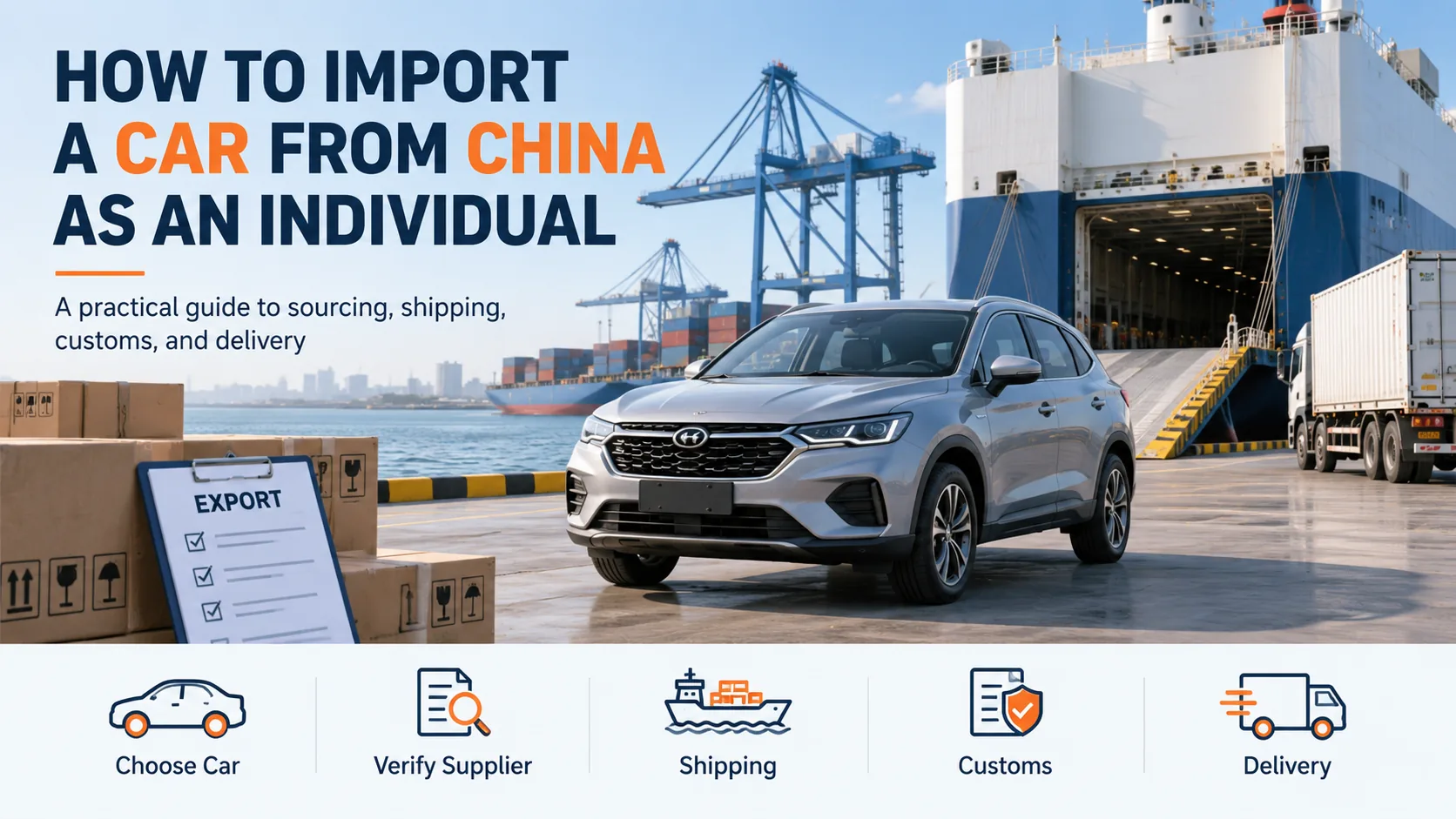
Importing a car from China as an individual is possible in many countries, but buyers must first confirm that the exact model can meet local import, safety, and registration requirements.
This guide covers vehicle checks, seller verification, landed costs, required paperwork, RoRo and container shipping, customs clearance, EV considerations, and final registration.
Import Requirements
RoRo & Container Shipping
Customs & Registration
The most expensive mistakes usually happen before the car ever reaches the port. A buyer may find an attractive price in China, complete the purchase, and only later discover that the model cannot be registered locally or needs expensive technical modifications.
Before buying, make sure you understand both the import rules and the registration requirements in the country where the car will ultimately be used.
Rules for importing cars from China vary by destination. New and used cars may be treated differently, and some countries also impose restrictions based on age, steering position, emissions, safety certification, or original market specification.
Depending on the country, you may need to confirm:
safety and emissions standards
age limits for used cars
left-hand-drive or right-hand-drive rules
type approval or conformity requirements
technical inspection or homologation
modifications required before registration
The key is to check the exact model and specification, not only the brand.
A manufacturer may sell one version of a model in China and another for export. Two cars with the same model name may use different lighting systems, software, charging interfaces, safety equipment, or certification.
A seller saying that the car “can be exported from China” therefore does not prove that it can be registered in your country.
Once you know that the model is potentially acceptable, verify the actual car you are buying. This is especially important when purchasing remotely from a Chinese dealer or exporter.
Ask for the VIN or chassis number, manufacturing year, exact model, specification sheet, and clear photos or videos. For a used car, the seller should also provide mileage and any available ownership, accident, repair, or previous-registration information.
A third-party inspection can be useful when you cannot inspect the car yourself. It can help confirm the car’s identity and condition before payment and reduce the risk of receiving something different from what was advertised.
The VIN shown on the car should also match the sales invoice and the records prepared for export.
The company selling the car is not always the same company that will handle the export from China. A dealer may arrange the sale while a separate trading or export company completes the customs formalities.
Before transferring money, clarify who is responsible for each part of the transaction. In particular, confirm who owns the car, who receives payment, who issues the commercial invoice, and who handles the Chinese export declaration.
Use a traceable payment method and make sure the companies involved can provide consistent business and transaction records. If the payment recipient, seller, and exporter are different entities, understand why before proceeding.
For an individual buyer, the cost of importing a car from China can add several thousand dollars on top of the vehicle price. Based on typical logistics, port handling, and compliance expenses, a practical planning range may be around USD 3,500–15,000+ before import duties and taxes, depending on the route, shipping method, and destination-country requirements.
The total cost is usually made up of four main parts:
| Cost Area | Typical Planning Range |
|---|---|
| China inland transport & export handling | USD 300–1,000 |
| RoRo or container shipping | USD 800–4,500 |
| Destination port & customs charges | USD 500–1,500 |
| Compliance / modification | USD 1,000–5,000+ |
These are only broad budgeting figures, not fixed shipping rates. A car close to a major export port, shipped by RoRo to a straightforward destination, may cost much less than a vehicle requiring container shipping, transshipment, or significant technical modification.
The biggest variable is often import duty and local tax. These depend on the destination country, customs value, vehicle type, and current trade policy. A China-market model may also need testing or changes before it can be registered locally.
The paperwork required to import a car from China depends on the destination country, whether the car is new or used, and whether it is gasoline-powered, hybrid, or electric.
On the China side, the seller or exporter will normally need to prepare the commercial and export records associated with the transaction. The exact package varies, but it may include:
commercial invoice and sales contract
VIN and model information
ownership or registration records
Chinese export declaration information
certificate of origin where applicable
Once the car is shipped, the carrier will issue a bill of lading or equivalent transport record.
At destination, customs or the registration authority may also ask for proof of purchase and value, importer identification, an import permit where required, conformity records, or inspection certificates.
The safest approach is to obtain the final document list from the relevant local authority or customs broker before the car leaves China. Missing paperwork is much easier to correct before shipment than after the car has already arrived overseas.
Most cars from China are shipped by sea, usually by RoRo (Roll-on/Roll-off) or container shipping. The better option depends on the car, route, destination port, and how much protection you want during transit.
Before booking, confirm the vehicle dimensions, weight, fuel or battery type, pickup location in China, and destination port. These details affect carrier acceptance, routing, and shipping costs.
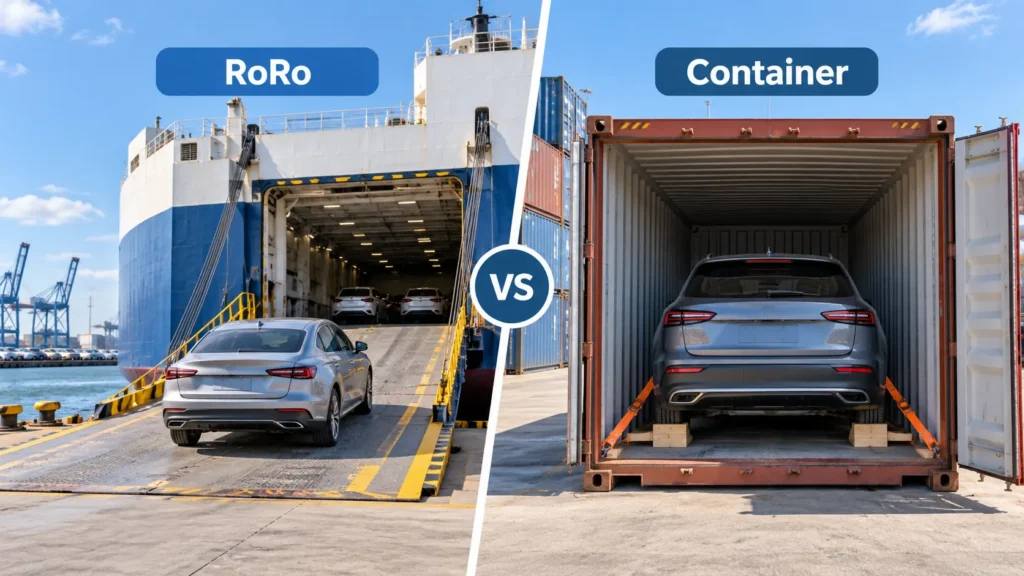
RoRo is often the simplest option for a standard running car. The vehicle is driven onto a specialized vessel at the departure port and driven off after arrival.
It is commonly suitable for passenger cars, SUVs, vans, and other operable vehicles. Because the car does not need to be loaded into a container, handling can be relatively straightforward.
However, RoRo service is not available on every route. Carriers may also have rules covering:
fuel level
battery condition
alarms and immobilizers
personal items left inside the car
whether the vehicle can move under its own power
For individual buyers, RoRo is usually worth checking first when a suitable service exists.
Container shipping is often chosen when the car is higher-value, needs more protection, or is moving to a destination without convenient RoRo service.
A car is loaded into a container and secured to prevent movement during the voyage. A standard passenger car can often fit inside a 20-foot container, subject to its dimensions and the loading plan.
Compared with RoRo, container shipping normally involves more handling and securing work, but it offers a more enclosed transport environment.
| Shipping Method | Better For | Main Consideration |
|---|---|---|
| RoRo | Standard running cars | Depends on route availability |
| Container | Higher-value or protected cars | More loading and securing work |
Before the car is delivered to the port, record its condition. Check the VIN, mileage, exterior, interior, keys, accessories, and any existing scratches or damage.
Keep dated photos or videos before handover. If damage is found after delivery, these records provide a useful reference for the car’s condition before shipping.
For most individual imports, the choice between RoRo and container shipping comes down to route availability, cost, vehicle value, and the level of protection required.
Importing an EV involves a few additional checks that do not apply in the same way to conventional cars.
The first is shipping acceptance. Carriers may handle standard production EVs differently from damaged, defective, accident-involved, or prototype electric cars. Always provide the exact model and battery condition before booking.
Charging compatibility also needs to be checked before purchase. A Chinese domestic-market model may not use the same charging interface or communication standard as the version sold in your country.
Before buying an EV, confirm:
charging connector and protocol
local charging-network compatibility
app and OTA availability
regional software restrictions
overseas warranty coverage
local spare-parts and service support
Software can be just as important as hardware. Navigation, connected services, mobile apps, language settings, and OTA functions may behave differently outside China.
Warranty coverage should also be confirmed in advance. A warranty issued by a Chinese dealer or manufacturer may not automatically apply to a privately imported car overseas.
Arrival at the destination port is not the end of the import process. The car normally has to clear customs first and may then need technical approval before it can be registered.
The exact procedure differs by country, but the general order is usually straightforward.
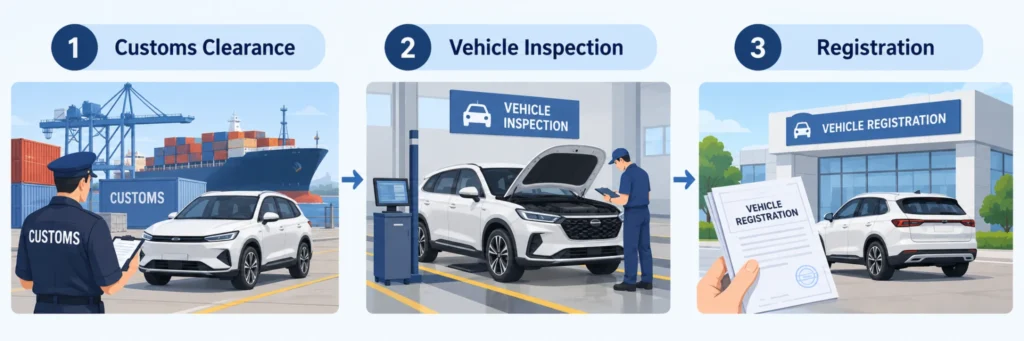
The importer or appointed customs broker submits the entry declaration and supporting paperwork. Customs may check the commercial invoice, declared value, VIN, tariff classification, country of origin, bill of lading, and any required import permits.
Applicable import duties and taxes generally need to be paid before the car is released.
Customs may also inspect the car or request additional information if there are questions about its value, origin, identity, or import eligibility.
For an individual who has never imported a car before, using a licensed customs broker can make the process easier, particularly when tariff classification, tax calculation, or local entry requirements are complex.
Customs release does not necessarily mean that the car is ready to drive on public roads.
Depending on the destination, the next stage may involve a technical inspection, emissions test, safety check, homologation, individual approval, or modifications needed to meet local standards.
Once these requirements are completed, the buyer can proceed with registration. The authority may request items such as proof of ownership, customs release records, insurance, identification, inspection approval, and evidence that the relevant taxes have been paid.
This is why registration requirements should be checked before purchase rather than after the car arrives.
Importing cars from China can be straightforward when the compliance, purchase, and shipping arrangements are checked in the right order. Most serious problems come from committing to the car too early.
The main risks include buying a model that cannot be registered locally, receiving inconsistent VIN or sales paperwork, or working with an exporter that cannot properly complete the Chinese export process.
Other problems may include:
unexpected import duties or destination port charges
costly modifications required after arrival
delays caused by missing paperwork
EV charging or software compatibility issues
limited warranty, spare-parts, or local service support
A successful import is not simply a car that reaches the destination port. It is one that can be cleared, registered, maintained, and used legally at a total cost that still makes sense.
Yes. Individuals can buy cars from China through dealers or exporters in many markets. Before paying, however, confirm that the exact model is eligible for import and registration in the destination country.
There is no single global price. The total cost depends on the purchase price, inland transport in China, shipping costs, insurance, import duties, taxes, destination charges, inspection, possible modifications, and registration.
Shipping a car from China typically takes around 4–8 weeks, depending on the route, shipping method, vessel schedule, and customs clearance. If the car requires homologation, technical modifications, or individual approval after arrival, the overall process can take several months longer.
Common paperwork includes a commercial invoice, proof of purchase, VIN and model information, bill of lading, export records, and any import permits, conformity records, or inspection certificates required by the destination country.
RoRo is often practical for standard running cars on routes with suitable service. Container shipping provides a more enclosed transport option and may be preferable for higher-value cars or destinations without regular RoRo service.
Useful freight, customs and importing resources related to this shipping guide.
China is now a global leader in vehicle manufacturing and exports, becoming the largest automobile exporter in 2023 with over 5.22 million vehicl...
Read guide →
Sea freight is the most cost effective shipping method for large volumes and container load cargo. It is ideal for businesses looking to reduce s...
Read guide →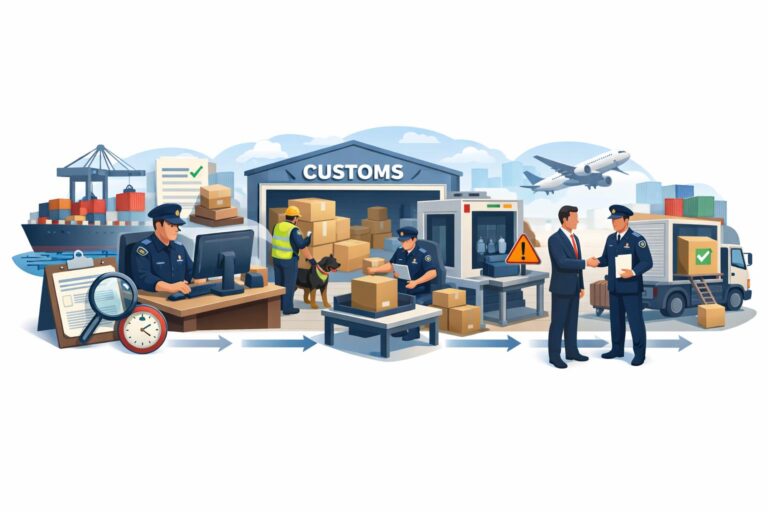
Customs Clearance Step by Step: The Complete Process Verified & Reviewed · Last updated February 2026 Customs clearance step by step helps intern...
Read guide →
Importing goods from China can be highly profitable—but only when you understand the necessary documents and import requirements. Whether you’re...
Read guide →Customs Broker vs Freight Forwarder Verified & Reviewed · Last updated April 2026 Customs broker vs freight forwarder is a common question for im...
Learn more → Useful Resource How to Import and Ship Lithium Batteries from ChinaImporting and shipping lithium batteries from China requires more preparation than moving ordinary cargo. Lithium batteries are regulated as dang...
Learn more →WhatsApp us