Related Guide
How to import stationery and office supplies from china
How to import stationery and office supplies from China is a question asked by thousands of businesses worldwide looking for affordable, high-qua...
Read guide →

Reliable & Cost-Effective Shipping from China
Tailored Logistics Solutions for Your Business
China remains the world’s largest toy exporter, manufacturing everything from plush animals to electronic toys, action figures, and educational sets. For entrepreneurs, retailers, and toy distributors worldwide, importing toys from China continues to be one of the most profitable and scalable product strategies in 2025.
In fact, China plays a crucial role in the global toy industry, with imports reaching $426.885 billion in 2023.
Whether you’re a startup sourcing your first shipment or an established company expanding your toy line, understanding how to navigate Chinese suppliers, ensure product safety compliance with compliance standards, and choose the right freight forwarding method is key to success.
In this complete guide, we’ll walk you through:
The most popular toy categories being exported from China
How to identify trustworthy toy suppliers and manufacturers
Toy safety standards and testing requirements for your destination country
Best shipping methods for toys (including air freight and sea freight)
A step-by-step overview of customs clearance, documentation, and cost breakdown
If you’re ready to tap into the booming global toy market with high-margin products and competitive sourcing, this guide is for you.

China’s toy industry is known for its versatility, offering thousands of SKUs across various price points, age groups, and materials. Whether you’re targeting infants, school-aged kids, or collectors, there’s a profitable category for you.
It’s important to offer a variety of toys for boys and girls, as high-tech electronic toys with interactive features are particularly appealing to children.
Here are some of the top toy categories importers are sourcing in 2025:
Soft, safe, and always in demand, plush toys remain a best-seller for toddlers and gift shops alike. From branded animals to custom mascots, they’re cost-effective and easy to ship in bulk.
Parents increasingly favor educational toys that help children learn STEM, problem-solving, and social skills. Think building blocks, Montessori toys, and activity sets for different ages.
From remote control cars (RC toys) to interactive robots and musical keyboards, electronic toys dominate sales in the 6–12 age range. They require special handling and compliance testing for batteries and radiation safety.
Baby toys must meet strict safety standards but are highly lucrative in global markets. Popular items include rattles, teething toys, and soft play gyms.
Eco-friendly and durable, wooden toys appeal to buyers in the EU and North America. Building blocks, puzzles, and pull-along animals are frequent import picks.
China manufactures a large number of licensed toys under agreements with global brands (e.g., Disney, Marvel). Importers should ensure the supplier has verified licensing rights before purchasing.
Creative kits, diy toys, and art supplies are rising in popularity as educational yet entertaining products for kids aged 5 and above.
By selecting the right niche—especially those with low domestic competition and high online search demand—importers can gain a competitive edge in their home markets.
You can also refer to the summary chart below for a quick visual guide:
Toy Category | Examples |
|---|---|
STEM Educational Toys | Coding kits, magnet building blocks |
Sensory Toys | Fidget spinners, pop-its, squishy sets |
RC Toys | Remote control cars, drones |
Licensed Toys | Anime figures, Marvel, Peppa Pig |
Plush & Baby Toys | Interactive plush animals, teethers |
Wooden Montessori Toys | Shape sorters, stacking blocks |
DIY Craft Kits | Slime kits, bracelet making kits |

When it comes to sourcing, China’s toy supply chain is well-developed, with factories, trading companies, and wholesale markets covering nearly every product category and price point. China exports toys to various different countries around the world, making it a dominant player in the toy manufacturing industry. Here’s where importers can find the best Chinese toy manufacturers in 2025:
Shantou (Guangdong Province)
Known as “Toy City,” Shantou is home to over 10,000 toy-related businesses. It’s ideal for sourcing plastic toys, electronic toys, and action figures.
Yiwu (Zhejiang Province)
Yiwu houses the world’s largest wholesale market, offering everything from plush toys to budget-friendly DIY toys. Great for small MOQs and variety.
Dongguan, Shenzhen & Chenghai
These cities focus on innovation and technology-based toys like RC cars, robots, and smart learning products. Also strong in licensed toys.
Yangzhou & Qingdao
Specialize in plush toys, baby toys, and traditional wooden toys. Often used by European importers seeking high safety compliance.
Alibaba – The most popular platform for finding toy suppliers in China, offering price comparison, supplier reviews, and trade assurance.
Made-in-China.com and Global Sources – Excellent alternatives with filters for verified Chinese manufacturers and ISO-certified exporters.
If you’re unfamiliar with the local landscape, hiring a toy sourcing agent in China can save time and money. They help you:
Vet reliable suppliers
Negotiate prices
Handle factory visits and QC
Manage contracts in Mandarin
Agents typically charge 3–7% of the order value but can prevent costly sourcing mistakes.
Attend shows like Canton Fair, HK Toys & Games Fair, or Shenzhen Toys Expo to meet suppliers directly.
Visit local toy markets in Guangzhou or Yiwu for immediate product samples and supplier scouting.
With thousands of toy factories across China, it’s easy to get overwhelmed. Choosing the right chinese supplier can mean the difference between success and costly mistakes—especially when it comes to toy safety, certifications, and on-time delivery.
A thoughtful supplier selection process is crucial in ensuring reliability and quality in manufacturing, helping to avoid issues like delayed shipments and defective products.
Here’s how to spot a trustworthy toy supplier in 2025:
Check if the supplier is a registered manufacturer with a valid Chinese business license.
Ask for certifications like ISO9001, BSCI, or Sedex, which signal ethical and professional operations.
For toys exported to the USA, ask for a Children’s Product Certificate (CPC) issued after third-party testing.
For Europe, ensure EN71, CE marking, and Toy Safety Directive 2009/48/EC compliance.
For UAE or GCC countries, request G-mark and radiation test reports for electronic items.
These documents prove the products comply with required toy safety standards and won’t face clearance delays.
Ask for:
Production line videos
List of export countries
MOQ (minimum order quantity)
Examples of licensed toys or brands they’ve worked with
Also check whether they allow third-party quality inspections or audits before shipment.
A reliable supplier should reply promptly, answer questions clearly, and not hesitate to show certifications or past shipment records. If they resist or delay document sharing—take that as a red flag.
While Alibaba is a great sourcing tool, not all listings are created equal. Look for Gold Suppliers, Verified Manufacturers, and those with a history of exporting to your destination country. Still, consider using a sourcing agent for final verification if ordering in large volume.
Toy safety is not optional—it’s mandatory. Importers must prepare for compliance to avoid issues. Importing non-compliant toys can lead to rejected shipments, fines, or worse: harm to consumers and brand damage. That’s why importers must understand the toy safety standards required by their destination country.
Proper labeling is crucial to avoid potential compliance problems that could arise during safety evaluations and recalls.
Here’s a breakdown of key compliance requirements for different markets:
All toys intended for children under 12 must comply with Consumer Product Safety Commission (CPSC) rules.
Products must be tested by a third party lab accredited by the CPSC.
A Children’s Product Certificate (CPC) must accompany the shipment, listing test results and the responsible party.
Toys must also meet ASTM F963 standards for flammability, lead, sharp points, and choking hazard warnings.
Toys must comply with the Toy Safety Directive 2009/48/EC.
Mandatory EN71 testing (Parts 1, 2, 3) for mechanical, chemical, and flammability safety.
CE marking is required on the product, packaging, or instructions.
Electronic toys must also meet EMC and RoHS directives to ensure they don’t emit dangerous radiation.
UAE requires G-mark certification and conformity with Emirates Conformity Assessment Scheme (ECAS) for toys.
Products like RC toys, talking dolls, or smart toys may also require radiation and electromagnetic field testing.
Regardless of destination:
Conduct third party lab testing before shipping
Label toys with age recommendations and safety icons
Ensure materials are non-toxic, especially for baby toys or toys for toddlers
Verify packaging includes product safety warnings
Ignoring safety can delay customs clearance, cause bans, or result in costly recalls. Always prioritize supplier compliance, even if it adds to upfront sourcing cost.

Once your toys are packed and ready to go, the next critical decision is: how should you ship them? The two most common shipping methods for importing toys from China are air freight and sea freight. Each has its own pros, cons, and ideal use cases.
Effective transportation coordination is crucial for ensuring a smooth import process. Having a reliable partner can help manage logistics, pre-shipment inspections, and customs clearance seamlessly.
Air freight is perfect for:
Small or medium-sized shipments (45–300 kg)
Time-sensitive orders like new product launches or holiday stock
High-value goods (e.g. smart toys, licensed products)
Transit time is usually 3–7 days, including customs clearance. However, cost is charged per chargeable weight (whichever is higher between gross and volume weight), making it more expensive for bulky items.
Ideal for:
Emergency orders
E-commerce fulfillment
Lightweight plush toys, RC cars, or licensed toys
Sea freight is the go-to option for:
Large-volume shipments
Toys with lower per-unit value
Businesses with flexible delivery timelines
Transit time ranges from 25 to 40 days, depending on the route. You can ship as FCL (Full Container Load) or LCL (Less than Container Load).
Common toys shipped by sea:
Wooden toys, building blocks, DIY sets, educational toys
To ship by sea, you’ll need:
Shipping documents: Packing list, commercial invoice, bill of lading, etc.
Cargo insurance to cover damage or loss
Help from experienced freight forwarders to book container space and handle customs
Feature | Air Freight | Sea Freight |
|---|---|---|
Speed | 3–7 days | 25–40 days |
Cost | $$$ (higher) | $ (lower) |
Ideal for | Urgent, small loads | Bulk, non-urgent |
Risk | Low | Medium |
Documentation | Air Waybill (AWB) | Bill of Lading |
Whether you choose air or sea, working with a professional freight forwarder ensures compliance, competitive rates, and timely delivery.
Once your toys leave the factory, the next challenge is ensuring smooth customs clearance in both China and your destination country. Whether you’re importing into the USA, Europe, Middle East, or Africa, you’ll need to understand local import regulations, documentation, and duties.
Freight forwarders play a crucial role in managing logistics and overseeing transport to guarantee that shipments reach their intended destinations safely.
Before leaving China, your supplier must provide:
Commercial Invoice
Packing List
Export Customs Declaration
HS code classification (to match toy category)
Factory registration with Chinese customs
Your freight forwarder or supplier usually handles this, but it’s crucial to confirm accuracy, especially when dealing with licensed toys, battery-powered goods, or educational electronics.
Each country has its own import duty rates and product classifications. Most toys fall under HS Code 9503 and are subject to:
5–20% customs duty, depending on country
Value Added Tax (VAT) or Sales Tax
Excise tax, if applicable to electronics or specific toys
Environmental/recycling fees in some EU countries
If you’re importing into the USA:
You may need a customs bond (single or annual) if shipment value exceeds $2,500
Work with a licensed customs broker to avoid misclassification
CPSC (Consumer Product Safety Commission) rules apply to most children’s toys
Bill of Lading (for sea freight) or Air Waybill (for air)
Commercial Invoice with declared value and incoterms
Packing List with accurate quantities
Certificates of origin and safety (e.g., EN71, CPC)
Import license (if required by local regulations)
In some regions, you’ll need to show proof of third-party lab testing and age labeling, especially for baby toys, rc toys, or educational kits.
To avoid delays or unexpected costs:
Partner with an experienced customs broker
Or use a DDP (Delivered Duty Paid) freight service, where the freight forwarder handles all duties, clearance, and final delivery
Knowing your exact costs is the key to setting competitive prices and maintaining profit margins when importing toys from China. Here’s a realistic breakdown of what you can expect to pay from factory to final delivery.
Aligning your product offerings with market demand can significantly improve profitability, ensuring that your investments yield the best returns.
Basic unit price per toy (negotiable)
EXW (Ex-works): You handle pickup, export, and freight
FOB (Free on Board): Supplier delivers to port and clears Chinese customs
Most competitive prices for toys range from:
$0.30–$1.50/unit for plush, plastic, and small educational toys
$2–$8/unit for electronic, RC, or licensed toys
Tip: Order in large quantities to reduce cost per unit and secure better rates from suppliers and shippers.
Based on shipping method (air freight or sea freight)
Billed by chargeable weight or container size
Freight forwarders typically offer better consolidated rates than express couriers
Example:
Air freight (100kg): $3.50–$5.50/kg
Sea freight (LCL): $60–$150/CBM
FCL (20ft container): $800–$1,600 from China to US/EU ports
Import duty: 5–20% (based on destination country)
Brokerage fee: $50–$150 per shipment
Documentation fees, security charges, etc.
Cargo insurance protects against loss/damage in transit
Usually 0.3–0.6% of cargo value
Required by many freight companies and marketplaces
If required: $100–$500 depending on product type
Especially necessary for children’s product certificate, EN71, or US CPSC compliance
Agents charge 3–7% of total order value
They can help you purchase toys, find trustworthy suppliers, inspect goods, and manage shipment details
Cost Item | Estimate (USD) |
|---|---|
Product cost (1,000 pcs) | $1,000 |
Sea freight (LCL, 1 CBM) | $150 |
Insurance | $6 |
Customs duties (10%) | $100 |
QC & lab testing | $200 |
Documentation & handling | $50 |
Total Estimate | $1,506 |
Always factor in currency exchange rates, lead time, peak season surcharges, and local VAT when calculating your final landed cost.
To find out about shipping costs from China to the rest , you can click:
20FT & 40FT Container Shipping Rates from China to USA
Cost of Shipping 20ft & 40ft Containers from China to UAE
20ft & 40ft Container Shipping Costs from China to the UK
Shipping Costs for 20ft & 40ft Containers from China to Russia
Shipping Costs for 20FT and 40FT Containers from China to Canada
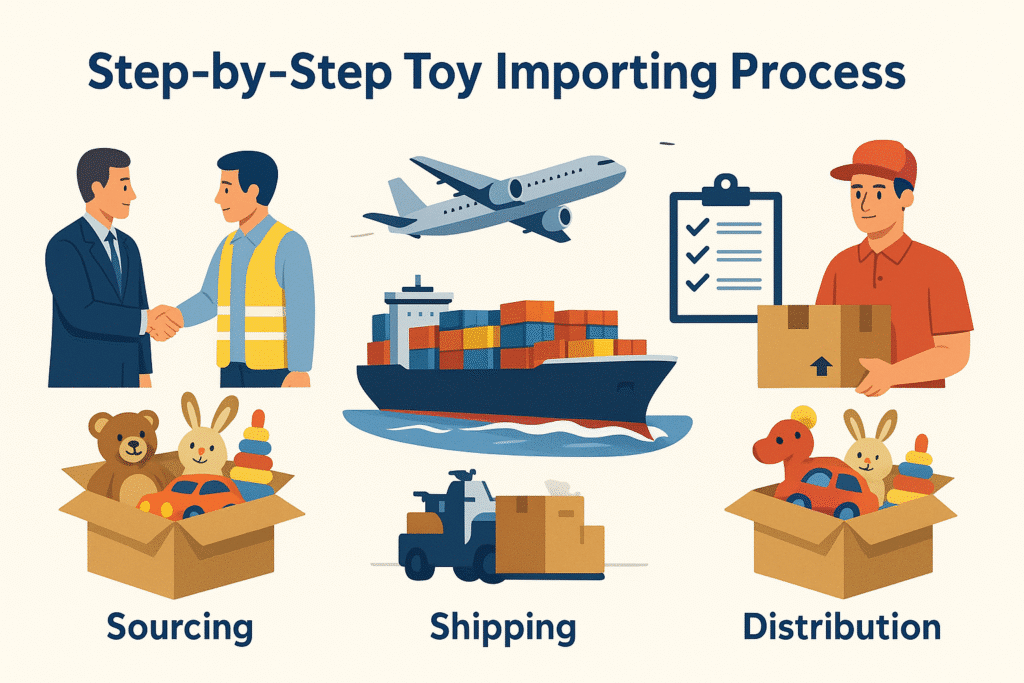
Importing toys from China isn’t complicated if you follow a clear, step-by-step shipping process. Here’s how to manage your order efficiently—from sourcing to delivery:
Keep in mind potential delays and preparation time when estimating arrival times for shipments.
Find trustworthy toy suppliers via Alibaba, sourcing agents, or trade fairs
Request quotes, MOQs, samples, and safety certificates
Choose between FOB or EXW pricing depending on how much logistics you want to handle
Tip: Use a professional freight forwarder for full-service support.
Ensure products comply with required toy safety standards
Arrange third party lab testing (if needed)
Check age labels, packaging, and certification marks
Timeline: 3–7 days for testing and report issuing
Confirm product specs, colors, packaging, delivery terms
Pay deposit (usually 30%) and begin production
Timeline: 10–25 days (varies by toy complexity and volume)
Choose air freight for small/urgent orders, or sea freight for bulk
Your reliable freight forwarder will handle:
Pickup
Export clearance from China
Booking space or flights
Cargo insurance and documentation
Timeline:
Air freight: 3–7 days to destination
Sea freight: 25–40 days
Your shipment arrives, and your broker/freight agent clears it through customs
You or your forwarder pays duties and VAT
Goods are delivered to your warehouse or 3PL
Timeline: 1–3 days for clearance, 1–2 days for final delivery
Phase | Estimated Time |
|---|---|
Sourcing & samples | 7–10 days |
Production | 10–25 days |
Freight (air or sea) | 3–40 days |
Customs & final delivery | 2–5 days |
Total Time Range | 22–80+ days |
Each country has different import regulations, but the core flow stays the same. Having a reliable, professional freight forwarder ensures every step is handled legally and efficiently. Ensuring compliance with labeling rules is crucial for enhancing safety and facilitating responses to potential recalls that could arise in the future.
Yes! Many factories specialize in custom toys, allowing you to create unique designs, branding, and packaging. Always confirm MOQs, mold charges, and IP protection clauses before starting production.
RC cars fall under the toy category but may require electromagnetic compatibility (EMC) and battery safety certifications, especially in the EU and GCC markets. Always label them correctly and test through a third-party lab.
Common shipping documents include:
Commercial Invoice
Packing List
Bill of Lading or Air Waybill (AWB)
Children’s Product Certificate (CPC) or EN71 test reports
Certificates of origin (if needed for customs)
Ensure your freight forwarder or customs broker reviews them before departure.
Generally, classic toys can be imported freely, but they still must meet modern safety standards. Even nostalgic items like wooden trains or marbles must include age labels and pass physical hazard tests (e.g., choking hazard warnings).
Absolutely! Many successful toys importers start small—ordering from Chinese toy suppliers via Alibaba or sourcing agents. With platforms like Amazon, Shopify, and social media, it’s now easier than ever to build a profitable toy business from imported goods.
Useful freight, customs and importing resources related to this shipping guide.
How to import stationery and office supplies from China is a question asked by thousands of businesses worldwide looking for affordable, high-qua...
Read guide →
Introduction: Why Import Clothes from China? China has become the global epicenter for clothing and textile manufacturing. With its vast producti...
Read guide →
Importing electronics from China has become a lucrative business opportunity for companies and individuals worldwide. China is the global leader...
Read guide →
China has long been a leading global supplier of a wide range of products, including carpets and rugs. As one of the oldest and most well-establi...
Read guide →Introduction: Why Import Packaging Supplies from China How to import and ship packaging supplies from China is a question many businesses ask whe...
Learn more → Useful Resource How to Verify a Chinese Supplier Before You PayHow to Verify a Chinese Supplier Before You Pay Verified & Reviewed · Last updated July 2026 Before you pay a Chinese supplier, do not rely only...
Learn more →WhatsApp us