Related Guide
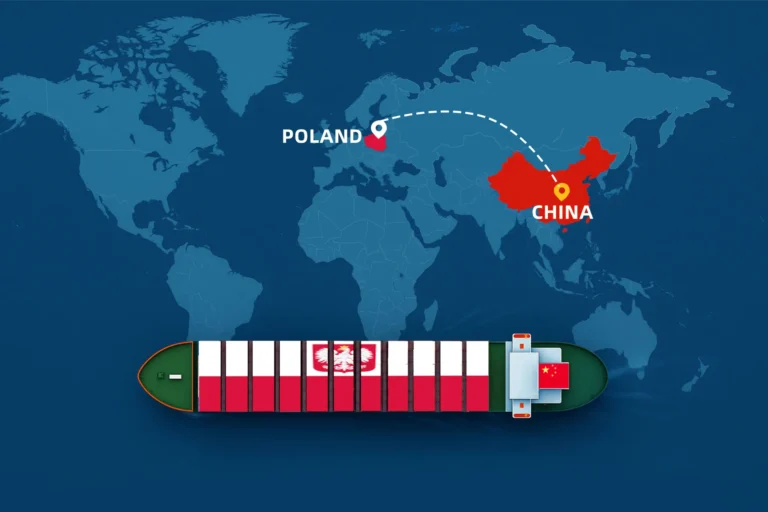
Shipping from China to Poland
Shipping from China to Poland – Rail, Sea & Door-to-Door in 2026 Fast, reliable shipping from China to Poland for B2B importers, eCommerce seller...
Read guide →

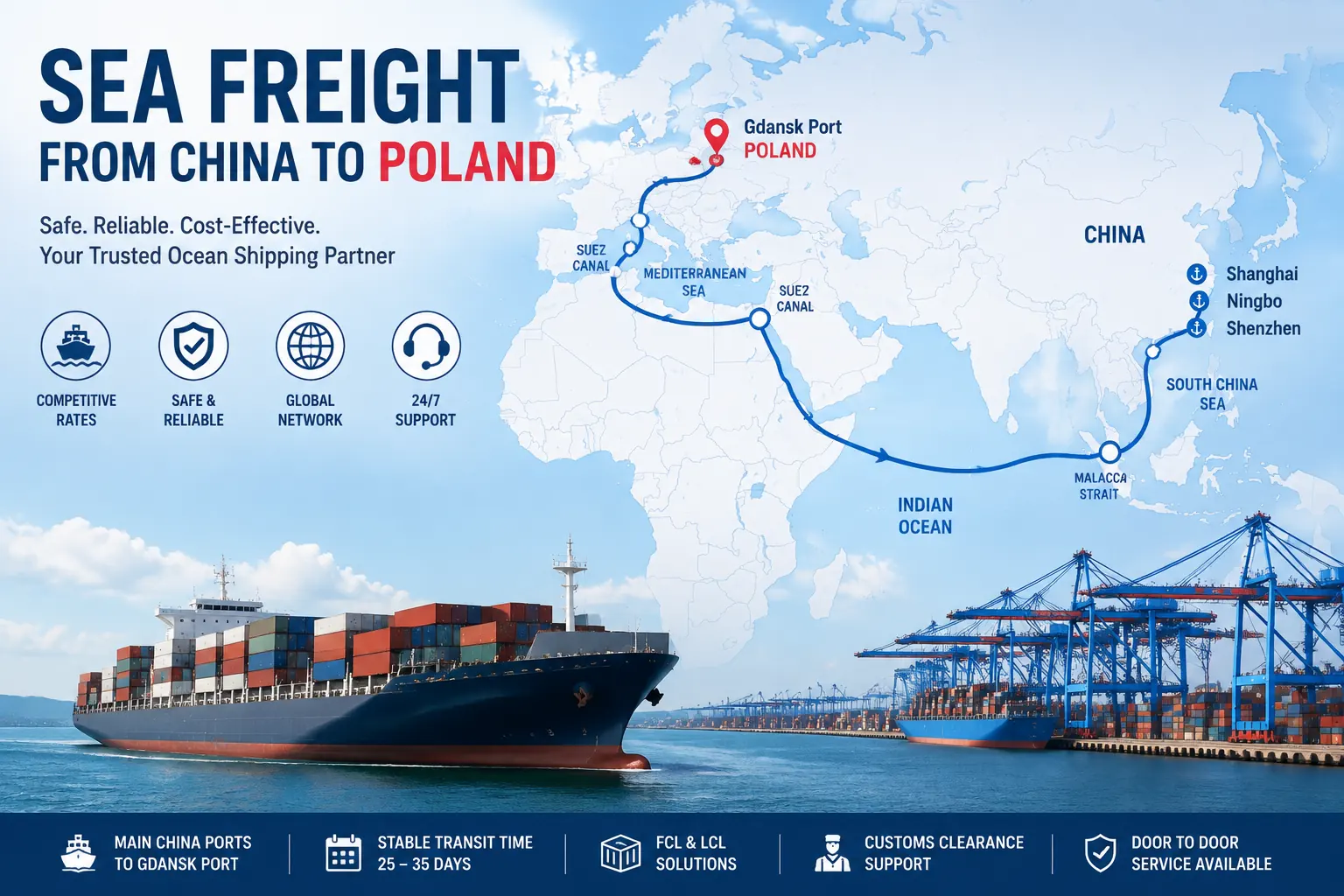
Shipping goods from China to Poland by sea is a cost-effective solution for importers handling commercial cargo, machinery, electronics, and other bulk shipments. Sea freight usually takes around 30–45 days, depending on the departure port, shipping route, customs clearance, and final delivery location.
This guide covers sea freight costs, FCL and LCL options, major ports such as Shanghai and Gdańsk, transit times, and customs requirements for importing from China to Poland.
Shipping Cost & Rates
Transit time range
FCL / LCL Shipping
| Shipping Option | Transit Time | Best For |
|---|---|---|
| Sea Freight | 30–45 days | Large and heavy commercial cargo |
| Rail Freight | 14–22 days | Faster China-Europe transportation |
| Air Freight | 5–7 days | Urgent and high-value shipments |
| Express Shipping | 2–5 days | Small and time-sensitive deliveries |
Sea freight is generally the preferred option for importers who need to balance transportation costs and delivery time. A freight forwarder can help arrange cargo pickup, export customs clearance, ocean transportation, and final delivery in Poland.
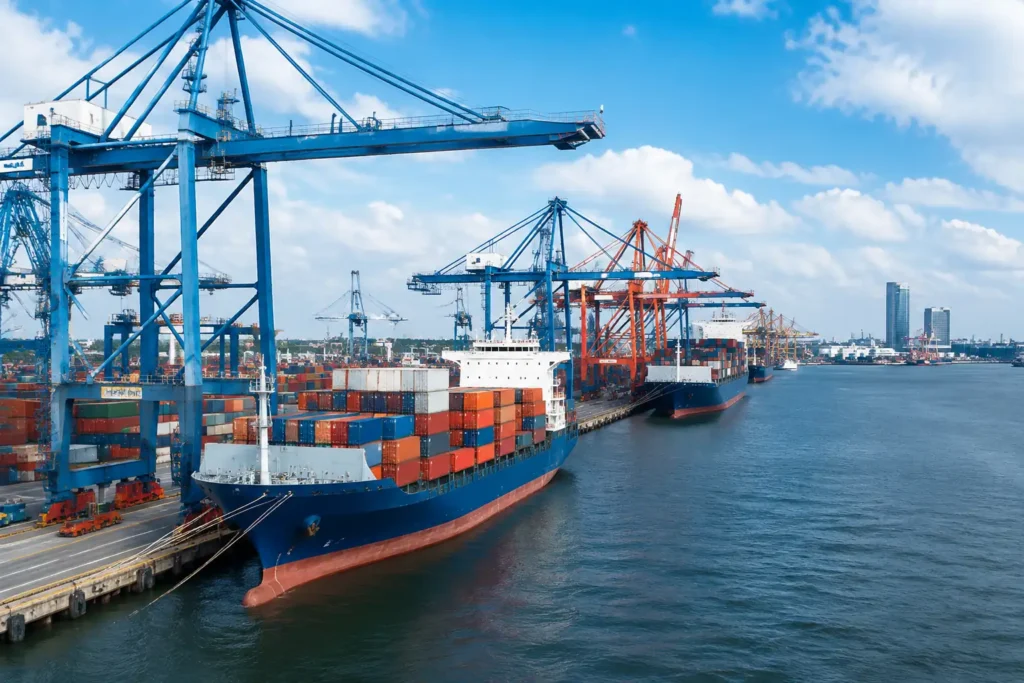
The cost of sea freight from China to Poland depends on several factors, including container size, departure port, cargo volume, shipping season, fuel prices, and destination services.
For container shipments, importers usually choose between FCL (Full Container Load) and LCL (Less than Container Load). FCL is suitable for larger shipments that require a dedicated container, while LCL allows smaller shipments to share container space.
| Shipping Method | Estimated Cost | Suitable For |
|---|---|---|
| LCL Shipping | Around USD 35–60/CBM | Smaller shipments that do not fill a container |
| 20GP Container | USD 2,970–3,630 | Medium-volume cargo |
| 40HQ Container | USD 4,860–5,940 | Large commercial shipments |
The final shipping cost may vary based on the actual shipment details, including cargo dimensions, gross weight, origin location, and delivery requirements.
Main factors affecting ocean freight rates include:
Container availability and carrier capacity
Seasonal demand changes
Fuel price fluctuations
Port congestion
Inland trucking distance in China and Poland
Customs clearance requirements
Importers should also consider additional supply chain costs, including cargo insurance, local handling charges, customs fees, and inland transportation when calculating the total landed cost.
The average sea freight transit time from China to Poland is around 30–45 days. The actual shipping duration depends on the selected Chinese port, ocean route, transshipment arrangements, customs clearance speed, and inland transportation after arrival.
Most cargo moves from major Chinese export ports to Poland through international ocean shipping routes. After arriving at the destination port, shipments may require additional time for customs clearance and delivery to warehouses or business locations.
| Route | Average Transit Time |
|---|---|
| Shanghai to Poland | 30–38 days |
| Ningbo to Poland | 32–40 days |
| Shenzhen/Guangzhou to Poland | 35–45 days |
| China to Poland Door-to-Door | 45–60 days |
Factors that may influence transit times include:
Port congestion
Weather conditions
Customs inspection
Cargo documentation accuracy
Inland trucking arrangements
For importers who need faster delivery, rail freight from China to Poland can reduce transportation time, while air freight is suitable for urgent or high-value shipments.
Sea freight from China to Poland usually involves transportation from major Chinese export ports to Polish container ports, followed by inland delivery to the final destination. The selected origin port and destination port can affect ocean freight rates, transit times, and overall shipping efficiency.
Most shipments from China move through established Asia-Europe ocean routes. Importers usually select ports based on supplier location, cargo volume, available shipping schedules, and final delivery requirements in Poland.
China has several major container ports that provide regular ocean freight services to Poland and other European destinations.
Shanghai Port is one of the largest container ports in the world and a major gateway for exports from eastern China. It is commonly used for shipments of machinery, electronics, industrial equipment, and consumer goods.
Ningbo Port serves a large manufacturing area in Zhejiang Province and nearby regions. It is a popular choice for exporters shipping commercial cargo from eastern China.
Shenzhen and Guangzhou are important export hubs in southern China, serving manufacturers of electronics, furniture, hardware, and other products from Guangdong Province.
Qingdao Port provides another shipping option for cargo from northern China and nearby manufacturing areas, especially for exporters located closer to northern production regions.
Poland mainly receives ocean shipments through several major ports connected with European logistics networks.
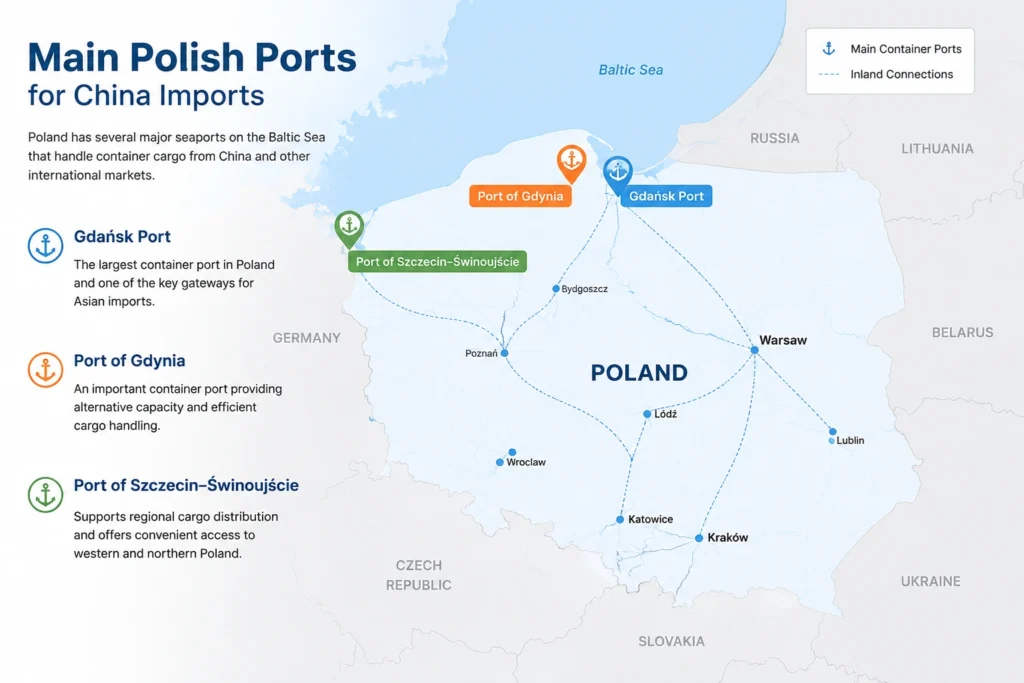
Gdańsk Port is the largest container port in Poland and one of the key gateways for Asian imports. It handles a significant amount of container cargo from China and provides connections to Poland’s inland transportation network.
Gdynia is another important Polish container port. It provides an alternative option for importers shipping goods from China, especially when considering available capacity and delivery location.
Szczecin serves regional cargo distribution needs and can be combined with inland trucking solutions for deliveries in western and northern Poland.
The best shipping route depends on several factors, including supplier location, cargo volume, container type, delivery requirements, and budget.
Key considerations include:
Supplier location in China
Container availability and shipping schedules
Cargo volume and container type
Final delivery city in Poland
Required transit time and transportation budget
For example, shipments from factories in eastern China may use Shanghai or Ningbo, while cargo from southern manufacturing areas may be more suitable through Shenzhen or Guangzhou.
After arriving at the Polish destination port, cargo can be transported by inland trucking to warehouses, factories, or distribution centers across Poland and the wider European Union market.
Choosing between FCL and LCL depends mainly on shipment volume, cargo characteristics, and delivery requirements.
FCL means the importer books an entire container for one shipment. It is usually recommended for larger shipments that can efficiently use a 20GP, 40GP, or 40HQ container.
Advantages of FCL shipping include:
Less cargo handling during transportation
Lower risk of damage caused by consolidation
Faster container processing after arrival
More control over loading and delivery arrangements
FCL is commonly used for machinery, furniture, building materials, automotive parts, and large commercial shipments.
LCL allows multiple shippers to share container space. It is suitable for smaller shipments that do not require a full container.
Advantages of LCL shipping include:
Lower upfront transportation costs
Suitable for smaller import volumes
Flexible option for testing new suppliers or products
However, LCL shipments may require additional consolidation and deconsolidation time before and after ocean transportation.
| Feature | FCL | LCL |
|---|---|---|
| Container Usage | Dedicated container | Shared container space |
| Best For | Large shipments | Smaller shipments |
| Cargo Handling | Less handling | More handling |
| Transit Time | Usually faster | May require additional processing |
| Cost Advantage | Better for high volume | Better for low volume |
Different shipping modes from China to Poland provide different advantages depending on shipment size, urgency, and budget.
| Shipping Method | Transit Time | Cost Level | Suitable For |
|---|---|---|---|
| Sea Freight | 30–45 days | Lowest | Bulk and regular shipments |
| Rail Freight | 14–22 days | Medium | Faster China-Europe transportation |
| Air Freight | 5–7 days | Higher | Urgent and high-value cargo |
| Express Shipping | 2–5 days | Highest | Small parcels and urgent deliveries |
Rail transport provides a balance between speed and cost. It is faster than ocean freight but generally more affordable than air transportation.
China-Europe rail routes connect major Chinese cities with Poland through important rail terminals, making Poland an important logistics hub in Central and Eastern Europe.
Rail freight is commonly used for:
Electronics
Industrial components
Automotive parts
Time-sensitive commercial goods
Air freight is suitable when delivery speed is more important than transportation costs.
Typical air freight advantages include:
Shorter transit times
Better for high-value cargo
Suitable for urgent deliveries
Common air cargo gateways include:
Beijing Capital International Airport
Shanghai Pudong International Airport
Shenzhen Bao’an International Airport
Warsaw Chopin Airport
Air freight shipments usually require proper documentation, including an air waybill, especially for time-sensitive shipments.
Customs clearance is an important part of sea freight from China to Poland. Since Poland is a member of the European Union, imported goods must comply with EU customs regulations before they can enter the Polish market.
Importers should understand Polish customs procedures, prepare correct customs documentation, and complete electronic customs declarations before cargo release.
A smooth customs clearance process depends on accurate shipment information, correct HS codes, complete documentation, and proper import declarations.
Most commercial shipments from China to Poland require:
Commercial invoice
Packing list
Bill of lading
HS code information
EORI number
Import customs declaration
The commercial invoice should clearly show the product description, quantity, value, and transaction details. The packing list helps customs authorities verify shipment details, including carton numbers, dimensions, and gross weight.
Import duties in Poland are determined based on the HS code classification and the EU TARIC database. Importers should confirm the correct product classification before shipping to estimate customs duty rates accurately.
Important factors affecting import charges include:
Product type and HS code
Declared customs value
Country of origin
Applicable EU trade regulations
Poland generally applies a 23% VAT rate on imported goods, while customs duty rates vary depending on the product.
Door-to-door services provide a complete transportation solution from the supplier’s factory in China to the final delivery location in Poland.
Instead of coordinating multiple logistics providers, businesses can use one freight forwarder to manage the entire process.
A typical door-to-door sea freight service includes:
Pickup from supplier’s factory in China
Export customs clearance in China
Ocean transportation to Poland
Import customs clearance
Inland trucking to the final destination
This option is suitable for:
Companies importing regularly from China
Businesses without experience handling international shipping
Buyers who need predictable delivery arrangements
Ocean freight schedules and container availability can change depending on carrier capacity, seasonal demand, fuel costs, and port conditions. Although sea freight from China to Poland is generally a reliable transportation option, importers should plan shipments in advance to secure suitable sailing schedules and avoid unexpected delays.
During peak shipping periods, limited space availability and increased cargo demand may affect booking arrangements. Port congestion, weather conditions, and customs processing can also influence the final delivery timeline.
To improve shipping efficiency, importers should consider:
Booking container space early, especially during peak seasons
Preparing cargo and export documents before the shipping date
Confirming packaging, dimensions, and cargo details in advance
Choosing suitable ports based on supplier location and delivery requirements
An experienced freight forwarder can help monitor shipping schedules, arrange container booking, and provide alternative solutions when capacity changes or delays occur.
Choosing the right freight forwarder can significantly affect shipping reliability, customs efficiency, and overall transportation costs. A professional logistics partner should understand both Chinese export procedures and Polish import requirements to ensure smooth transportation from origin to destination.
When selecting a logistics partner for sea freight from China to Poland, importers should consider:
Experience with China-Europe shipping routes
Transparent pricing without unexpected charges
Knowledge of customs clearance procedures
Ability to provide shipment tracking and updates
Flexible solutions for FCL, LCL, air, rail, and door delivery
A reliable freight forwarder can help manage shipping arrangements, documentation, customs procedures, and inland transportation after the cargo arrives in Poland.
Tonlexing provides international logistics services from China, including:
Sea freight from China to Poland
Air freight and rail freight solutions
FCL and LCL shipping
Customs clearance support
Door-to-door delivery services
Our team can help importers choose suitable transportation solutions based on cargo volume, delivery requirements, and budget.
For an accurate quotation, provide:
Product name and HS code if available
Number of cartons, pallets, or containers
Package dimensions and gross weight
Total CBM
Pickup city in China
Delivery location in Poland
Required shipping method
Sea freight costs depend on container size, departure port, cargo volume, and current shipping conditions. LCL shipments may cost around USD 35–60 per CBM, while container shipping rates vary depending on route and season.
Sea freight from China to Poland usually takes around 30–45 days. Door-to-door delivery may take approximately 45–60 days depending on customs clearance and inland transportation.
The main Chinese departure ports include Shanghai, Ningbo, Shenzhen, Guangzhou, and Qingdao. In Poland, the main receiving ports are Gdańsk, Gdynia, and Szczecin.
FCL is usually better for larger shipments that can fill a container because it reduces handling and provides more control. LCL is suitable for smaller shipments that do not require a full container.
Common documents include a commercial invoice, packing list, bill of lading, HS code, EORI number, and customs declaration.
Useful freight, customs and importing resources related to this shipping guide.
Shipping from China to Poland – Rail, Sea & Door-to-Door in 2026 Fast, reliable shipping from China to Poland for B2B importers, eCommerce seller...
Read guide → Shipping Cost from China to Poland (2026 Guide) Verified & Reviewed · Last updated May 2026 Shipping cost from China to Poland in 2026 typically...
Read guide →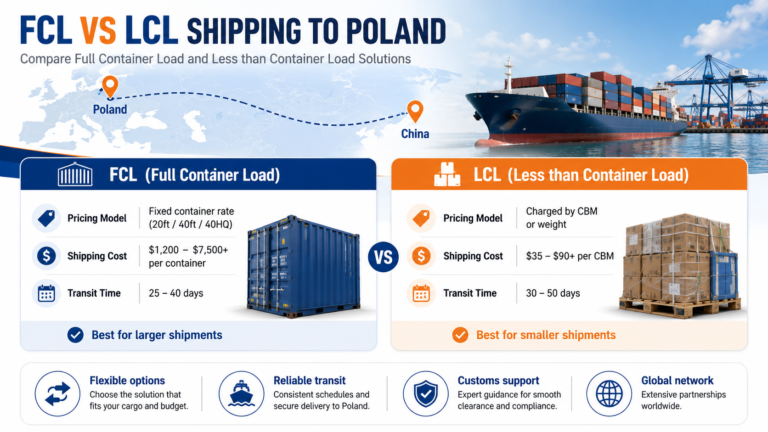
FCL vs LCL Shipping to Poland Verified & Reviewed · Last updated June 2026 FCL vs LCL Shipping to Poland from China is one of the most common que...
Read guide →
20ft 40ft Container Shipping Costs from China to Poland Verified & Reviewed · Last updated May 2026 20ft and 40ft container shipping costs from C...
Read guide →Railway freight has become an increasingly popular shipping solution for businesses looking to transport goods from China to Europe. The rise of...
Learn more → Useful Resource Door to Door Shipping from ChinaDoor to door shipping from China by air, sea, rail or express. Compare DDP vs DAP, costs, transit times, customs clearance and final delivery.
Learn more →WhatsApp us