Related Guide
Shipping from China to Poland
Shipping from China to Poland – Rail, Sea & Door-to-Door in 2026 Fast, reliable shipping from China to Poland for B2B importers, eCommerce seller...
Read guide →

FCL vs LCL Shipping to Poland from China is one of the most common questions importers ask when deciding how to transport cargo. The right choice depends on your cargo volume, budget, transit time, and the level of control you need during the shipping process.
This guide explains the key differences between Full Container Load and Less than Container Load shipping to Poland, including container space, shipping costs, transit time, customs clearance, and how to choose the right method for your cargo.
FCL vs LCL Shipping
Cost & Transit Time
Customs Clearance Poland
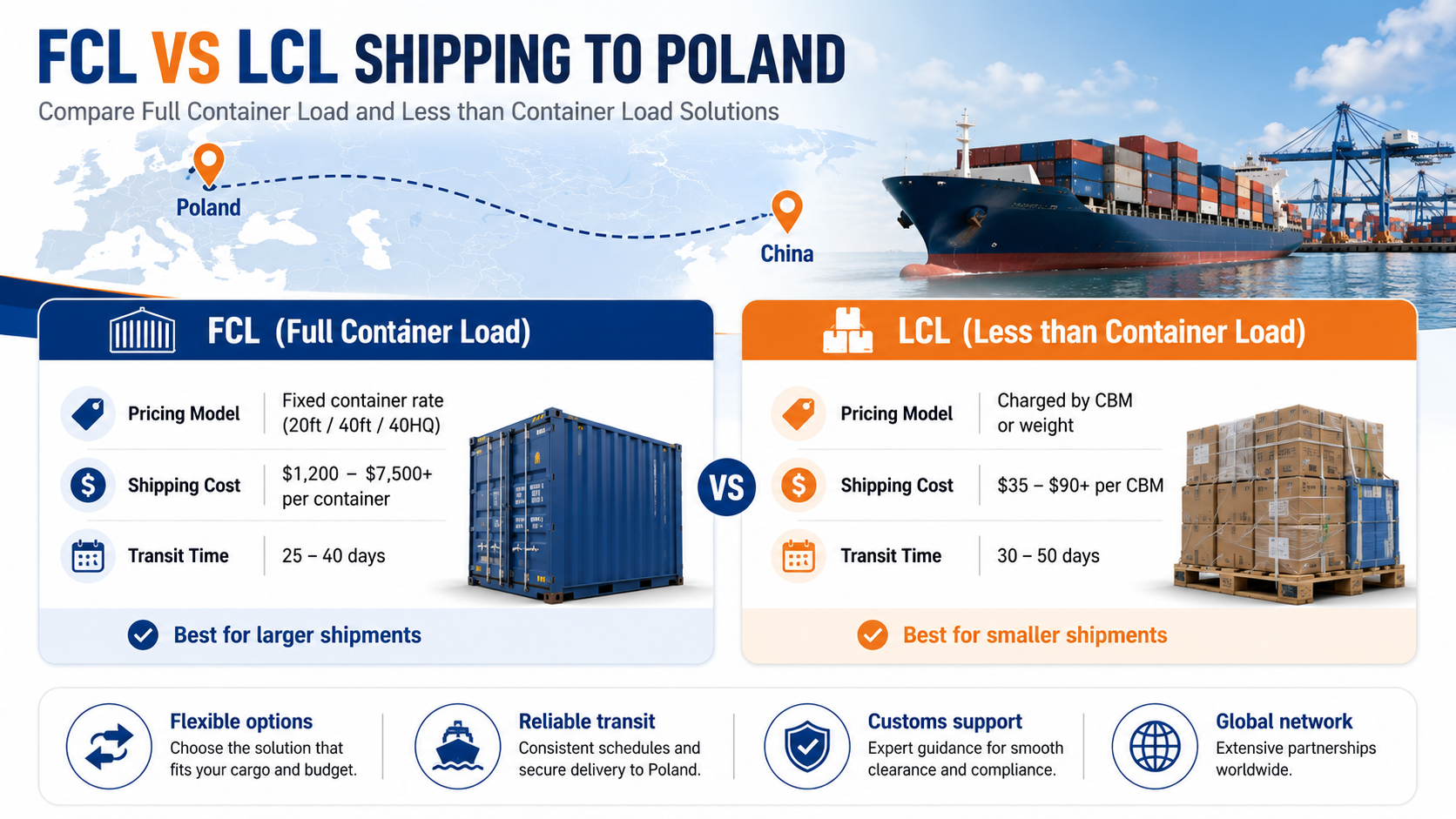
FCL shipping stands for Full Container Load shipping. It means one shipper uses an entire container for one shipment, without sharing space with others. The cargo is loaded into a 20ft, 40ft, or 40HQ container and usually remains sealed until arrival.
This shipping method is commonly used for larger commercial shipments that require stable transit and better cargo protection.
FCL shipping is suitable for:
Large volume shipments
Machinery and furniture
Industrial or bulky cargo
Because the container is not shared, FCL shipping usually offers faster transit time, lower handling risk, and better cost efficiency for large loads.
LCL shipping means Less than Container Load. It is used when cargo volume is too small to fill a full container. Multiple shipments from different importers are consolidated into one container.
A freight forwarder manages the consolidation at origin and separation at destination. Cost is calculated based on CBM or chargeable weight.
LCL shipping is suitable for:
Small shipments
Sample orders
Low volume cargo
It is flexible and cost effective for smaller loads, but usually takes longer due to consolidation and deconsolidation processes.
When shipping goods from China or other origins to Poland, FCL and LCL are the two most common ocean freight options. The main difference is whether you use a full container or share container space with other shippers.
FCL shipping is generally more suitable for larger shipments that can fill or nearly fill a container. It offers better speed, stability, and cargo control. LCL shipping is designed for smaller shipments that do not require a full container and helps reduce upfront shipping costs.
| Factor | FCL Shippin | LCL Shipping |
|---|---|---|
| Container usage | One shipper uses full container | Multiple shippers share one container |
| Best for | Large shipments | Small shipments |
| Cost structure | Fixed container rate | Pay by CBM or weight |
| Transit time | Usually faster | Usually slower |
| Handling | Less handling | More handling |
| Risk level | Lower risk | Higher handling exposure |
| Cost efficiency | Better for large volume | Better for small volume |
FCL is the better choice when shipment volume is high and stability is important. LCL is more suitable when cargo volume is small and flexibility is needed.
FCL and LCL shipping to Poland differ not only in cost structure but also in transit time. FCL shipping uses a dedicated container, while LCL shipping shares container space with other shipments. This difference affects both pricing efficiency and delivery speed.
| Factor | FCL (Full Container Load) | LCL (Less than Container Load) |
|---|---|---|
| Pricing Model | Fixed container rate (20ft / 40ft / 40HQ) | Charged by CBM or weight |
| Freight Cost | $1,200 – $7,500+ per container | $35 – $90+ per CBM |
| Transit Time | 25 – 40 days | 30 – 50 days |
| Handling | Lower handling, fewer stops | More handling due to consolidation |
| Speed Factor | Faster direct movement | Slower due to warehouse processing |
FCL shipping is generally faster because the container moves directly without waiting for consolidation or deconsolidation. LCL shipping takes longer due to additional handling at origin and destination warehouses.
From a cost perspective, FCL becomes more efficient when cargo volume is high, while LCL is more suitable for smaller shipments where flexibility is more important than speed.

Customs clearance in Poland is required for all imported goods entering the EU market. Both FCL and LCL shipments must go through the same regulatory process, including document verification, HS code classification, and tax calculation. The main difference is that LCL shipments may require additional time due to cargo separation at destination warehouses.
To complete clearance in Poland, importers need standard shipping and commercial documents before arrival. These documents support product valuation and EU import compliance.
Common documents include:
Commercial invoice with product details and value
Packing list with shipment breakdown
Bill of lading for transport confirmation
HS code for tariff classification
EORI number for EU import registration
Certificates or permits for regulated products
Accurate documentation helps reduce inspection risk and speeds up the clearance process.
Importing goods into Poland involves several standard cost components. These are calculated based on product type, declared value, and CIF value (Cost + Insurance + Freight).
Customs Duties (Tariffs): Typically 0% – 15%+, depending on HS code and product category
VAT (Value Added Tax): Standard rate is 23%, applied to CIF value plus customs duties
Brokerage Fees: Usually $125 – $350 per shipment, depending on complexity and number of HS codes
These costs apply to most commercial shipments and should be included when calculating total landed cost.
FCL shipments are usually easier to clear because the container belongs to one shipper, meaning one set of documents applies to the entire cargo. This reduces coordination and simplifies customs processing.
LCL shipments involve multiple shippers sharing one container. After arrival, goods must be separated before final clearance, which can add extra processing time.
FCL: faster processing, fewer document issues
LCL: more handling, possible delays during deconsolidation
Both: subject to EU customs rules and VAT requirements
Shipping routes to Poland mainly depend on the origin country, cargo type, cost requirements, and final delivery destination. Most international shipments from China and other Asian countries move through ocean freight, combined with inland transport by truck or rail inside Europe.
For FCL and LCL shipments, Poland is usually served via major European ports, followed by short-distance inland delivery. This allows flexible routing options depending on transit time and budget.
Most loads to Poland do not arrive directly at inland cities. Instead, goods move to major European ports and then continue to Poland by truck or rail.
Common routing options include:
Direct ocean freight to Polish ports such as Gdańsk and Gdynia
Sea freight to nearby European hubs such as Hamburg, Rotterdam, or Antwerp, then truck delivery to Poland
Combined sea and inland transport based on carrier schedules and cost efficiency
These routes are widely used for both FCL and LCL shipments, especially for containerized goods from Asia.
In addition to sea freight, rail and truck transport are commonly used for inland distribution to Poland. These methods are often part of multimodal shipping solutions.
Rail freight from China to Central Europe can shorten transit time compared to sea freight
Truck delivery is commonly used for final delivery within Poland and neighboring countries
Combined rail + truck solutions are used for faster inland distribution
This is especially useful for time-sensitive cargo that does not require air freight but needs faster delivery than traditional ocean freight routes.
Tonlexing provides complete FCL and LCL shipping solutions to Poland, covering the full logistics chain from pickup in China to final delivery. The service is designed to help importers reduce shipping complexity, control costs, and ensure smoother customs clearance in the EU.
We support both full container load and less than container load shipments based on cargo volume, budget, and delivery requirements.
Tonlexing offers flexible shipping options depending on shipment size and logistics needs. FCL is recommended for larger or full container shipments, while LCL is suitable for smaller or mixed cargo volumes.
Key services include:
FCL shipping for full container cargo (20ft / 40ft / 40HQ)
LCL consolidation for smaller or multi-supplier shipments
Route optimization based on cost and transit time
Flexible carrier selection for different shipping schedules
We manage the entire shipping process to ensure smooth coordination between origin and destination. This helps reduce delays, avoid documentation issues, and improve overall logistics efficiency.
Core support includes:
Supplier pickup and cargo handling in China
Export customs clearance and documentation
Ocean freight booking (FCL & LCL)
EU customs clearance support in Poland
Final delivery to warehouse, business address, or distribution center
Tonlexing helps importers simplify FCL and LCL shipping to Poland by integrating transportation, customs, and delivery into one coordinated logistics solution.
Choose FCL if your shipment is large, valuable, or needs faster transit time. Choose LCL if you have smaller shipments that do not need a full container and want more flexible freight costs.
LCL is usually cheaper for smaller volumes because you only pay for the container space used. FCL becomes more cost effective when cargo volume is high and the full container cost can be spread across more goods.
Yes. FCL is usually faster because it uses a single container with fewer handling points and more direct routing. LCL shipments take longer because they involve consolidation and deconsolidation.
FCL is often suitable for shipments over 15 CBM. For shipment volume around 10–13 CBM, compare FCL and LCL based on total cost, transit time, and handling risk.
Yes, LCL can be safe when goods are packed well and handled by a reliable freight forwarder. For fragile or high value goods, FCL is usually safer because goods remain sealed with lower risk during transport.
Useful freight, customs and importing resources related to this shipping guide.
Shipping from China to Poland – Rail, Sea & Door-to-Door in 2026 Fast, reliable shipping from China to Poland for B2B importers, eCommerce seller...
Read guide → Shipping Cost from China to Poland (2026 Guide) Verified & Reviewed · Last updated May 2026 Shipping cost from China to Poland in 2026 typically...
Read guide →
20ft 40ft Container Shipping Costs from China to Poland Verified & Reviewed · Last updated May 2026 20ft and 40ft container shipping costs from C...
Read guide →
FCL Shipping from China: Full Container Load Guide for Importers Verified & Reviewed · Last updated May 2026 FCL shipping from China is a reliabl...
Read guide →Learn how LCL shipping and consolidated shipments help reduce shipping costs for smaller cargo from China.
Learn more → Useful Resource DDP Shipping from China to PolandDDP Shipping from China to Poland Verified & Reviewed · Last updated May 2026 Shipping costs for DDP shipments from China to Poland vary dependin...
Learn more →WhatsApp us