
Sea Freight Transit Time from China to USA

Sea freight transit time from China to USA depends on the shipping route, destination coast, carrier schedule, and overall logistics process.

This guide explains typical sea freight transit times from China to the USA, including West Coast, East Coast, and Gulf Coast routes. It also covers port-to-port and door-to-door transit, customs clearance, inland delivery, and how to choose between sea freight, air freight, and express shipping.

Shipping method

FCL / LCL shipping

West Coast / East Coast

Sea Freight Transit Time China to USA-Shipping Times, Costs, Routes, and the Right Shipping Method
10,000+ international shipments handled    Global sea, air & DDP shipping solutions    24/7 shipment tracking & customer support

Table of Contents

What Sea Freight Transit Time China to USA Means

The phrase sea freight transit time China to USA usually refers to the time cargo spends moving between the departure port in China and the arrival destination port in the United States. In logistics terms, this is the port to port transit time.

However, many importers care more about the full delivery timeline. In practice, the total transit time may include:

  • factory pickup

  • inland transport to the origin port

  • warehouse receiving

  • document preparation

  • export clearance

  • vessel loading

  • ocean transit

  • terminal discharge

  • customs clearance

  • final delivery to the warehouse or other final destination

This is why door to door timelines are always longer than basic port to port schedules. If you only look at the vessel transit, you may underestimate the real shipping window by several days or even more.

Typical Sea Freight Transit Times from China to the USA

The destination in the United States is one of the biggest factors affecting shipping times. In most cases, shipments to the West Coast move faster, while shipments to the East Coast and Gulf Coast usually require a longer transit window.

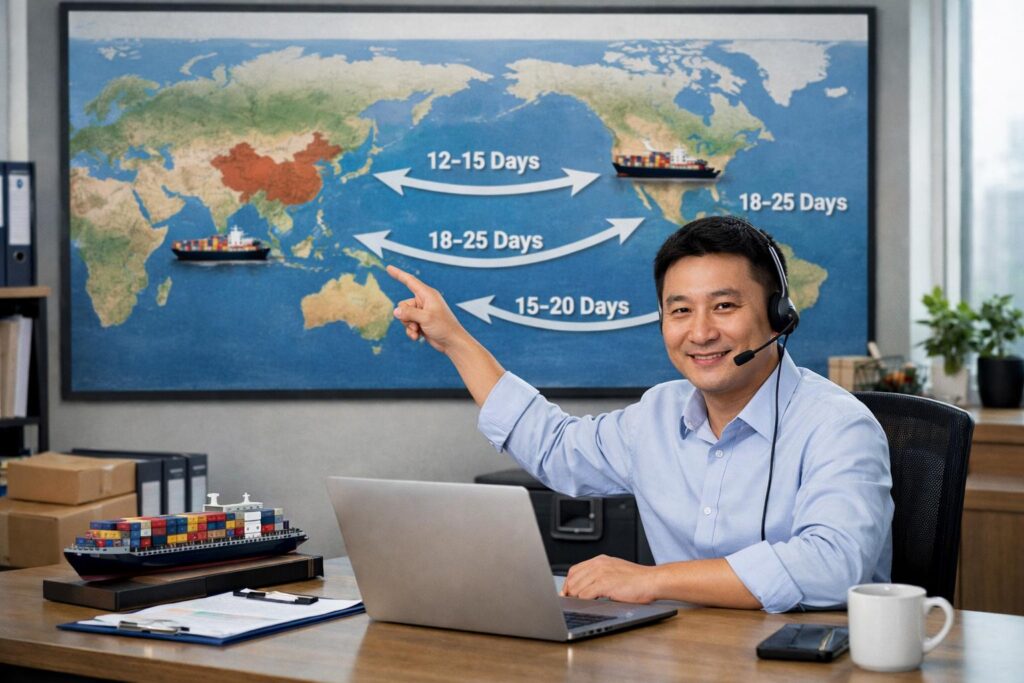
For West Coast destinations, standard freight transit times are typically around 13 to 20 days. For the East Coast, transit is usually around 30 to 35 days, while some services may extend to 30 to 45+ days depending on routing, carrier schedules, and congestion. Shipments to the Gulf Coast are often in a similar range and may take even longer in some cases.

As a general planning reference, sea freight from China to the USA typically takes around 20 to 45+ days for port-to-port shipping. This broader range is more useful than a single fixed estimate because actual sea freight transit times can change with service patterns, vessel schedules, and market conditions.
Port-to-Port Transit Time

The table below shows common shipping routes from China to the United States and their typical port-to-port transit times.

RouteTypical Port-to-Port Transit TimeNotes
Shanghai to Los Angeles13–18 daysFast and popular West Coast route
Ningbo to Long Beach14–20 daysCommon option for Southern California
Shenzhen to Los Angeles14–19 daysFrequently used for South China exports
Qingdao to New York30–38 daysLonger transit to the East Coast
Shanghai to Savannah30–40 daysSuitable for Southeast U.S. delivery
China to Houston30–45+ daysGulf Coast routes are usually longer

These are standard planning estimates rather than guaranteed schedules. Actual freight transit times may be affected by peak seasons, vessel space, and port operations at both origin and destination.

West Coast, East Coast, and Gulf Coast Shipping Times

Choosing the U.S. arrival region directly affects speed, cost, and inventory planning.

West Coast

The West Coast is usually the fastest entry point for us ocean freight from China. West Coast ports such as Los Angeles, Long Beach, Oakland, and Seattle generally offer shorter transit times and more frequent sailings.

East Coast

The East Coast is slower because the distance is longer and services often require more complex routing. In many cases, East Coast shipments take 30–45+ days, especially during busy periods.

Gulf Coast

Gulf Coast services are also longer than many West Coast lanes. These routes can still work well depending on the inland delivery plan and final destination, but they usually require a larger timing buffer.

For many importers, the main difference is simple: West Coast services are faster, while East and Gulf Coast routes often add 10 to 20 days.

Port to Port vs Door to Door Shipping

Many buyers ask only about ocean schedules, but full delivery time matters more for planning.

Port to port shipping only includes the movement from one port to another. Door to door shipping includes origin pickup, export handling, ocean transit, arrival processing, and final delivery.

A full door to door shipment may include:

  • supplier pickup

  • origin warehouse handling

  • export documents

  • vessel loading

  • ocean transit

  • arrival discharge

  • customs clearance

  • trucking or rail delivery

Because of these extra stages, door to door transit often takes longer than published vessel schedules. In many normal cases, a full shipment may take more than 45 days, especially for inland U.S. destinations.

FCL vs LCL Shipping: Speed, Cost, and Container Planning

One of the most important choices in ocean freight is whether the cargo should move as Full Container Load or LCL shipping.

Full Container Load

Full Container Load, or full container load, means your goods use the entire container. This is usually the best option for businesses moving larger cargo volumes.

Benefits of FCL include:

  • fewer handling steps

  • better cargo protection

  • more stable timing

  • faster processing at origin and destination

  • better for larger shipments

In many cases, FCL is faster because there is no consolidation or deconsolidation.

LCL Shipping

LCL shipping means multiple shippers share one container. This is often more practical for smaller shipments and lower cargo volumes.

Benefits of LCL include:

  • lower upfront cost

  • flexibility for smaller orders

  • useful when shipping only a few pallets or limited cubic meter

However, an LCL shipment usually takes longer than FCL because cargo must be grouped and separated with other shipments.

Sea Freight vs Air Freight vs Express Shipping

Choosing the right shipping method depends on urgency, cargo type, shipment size, and budget.

Sea Freight

Sea freight is the most common option for shipping goods from China to the USA. It is usually the most cost effective method for bulk orders, retail replenishment, machinery, and regular commercial cargo.

Best for:

  • bulk cargo

  • regular inventory movement

  • larger shipments

  • businesses focused on lower shipping costs

Air Freight

Air freight is much faster and works best for urgent shipments and time sensitive shipments. It is often used when delays would cause stock shortages or missed sales opportunities.

Best for:

  • urgent commercial cargo

  • high-value products

  • low-volume goods with tight deadlines

At the same time, air freight costs are much higher than sea freight costs, especially for heavy cargo.

Express Shipping

Express shipping is ideal for documents, samples, and very small parcels. For low-volume urgent cargo, it is usually the fastest practical choice.

Best for:

  • samples

  • small boxes

  • urgent business documents

  • fast parcel delivery through express couriers

For many importers, the key is not asking which mode is always best. The key is choosing the right shipping method for the shipment itself.

Sea Freight Transit Time from China to USA

Shipping Costs, Freight Costs, and Landed Cost

When shipping from China to the USA, many importers only compare the quoted freight rate. In reality, that is only one part of the total cost. To control budget and protect profit, it helps to separate three different layers of expense: freight costs, shipping costs, and landed cost.

Freight Costs

Freight costs are the basic transportation charges for moving cargo from one port or airport to another. In ocean shipping, this usually means the main sea freight charge plus common surcharges. In air shipping, it refers to the airline transport cost and related air freight charges.

Freight costs are mainly affected by:

  • the shipping method

  • cargo weight and volume

  • route and destination port

  • market demand and available container space

  • fuel and carrier surcharges

This is the narrowest cost layer. It tells you the price of transport itself, but not the full cost of getting goods delivered.

Shipping Costs

Shipping costs are broader than freight costs. They include the transport charge as well as the main logistics expenses before and after the international movement.

Typical shipping costs may include:

  • freight charges

  • supplier pickup or inland transport

  • export handling and export clearance

  • terminal handling charges

  • customs clearance

  • port or warehouse handling

  • final delivery to the warehouse or other final destination

  • cargo insurance

  • temporary storage or warehousing costs if needed

This means two shipments with similar freight rates may still have very different total shipping costs.

Landed Cost

Landed cost is the most complete number. It represents the real total cost of getting goods imported into the United States and ready for sale, storage, or use.

Landed cost usually includes:

  • product cost

  • total shipping costs

  • import duties

  • taxes and tariffs

  • customs and admin fees

  • other import-related charges

In simple terms:

Landed Cost = Product Cost + Shipping Costs + Duties and Taxes + Other Import Fees

This is the number that matters most for pricing, margin, and purchasing decisions.

Customs Clearance, Customs Delays, and Documentation

Customs clearance is one of the most important steps in shipping from China to the USA. Even if the vessel arrives on time, cargo cannot move to the next stage until customs processing is completed.

To avoid problems, importers usually need key documents such as:

For some shipments, additional compliance documents may also be needed depending on the product type.

Common reasons for customs delays include:

  • incorrect or incomplete documents

  • wrong HS code or product description

  • value declaration problems

  • customs inspections

  • missing compliance information

A small document error can delay release by several days, and inspections may take longer. That is why accurate paperwork is essential. Working with an experienced customs broker or freight forwarder can help reduce delays and make the clearance process smoother.

What Causes Delays in Shipping from China to the USA

Even when the booked schedule looks normal, actual shipping times from China to the USA can still be extended by several operational factors. In most cases, delays happen because of congestion, seasonality, weather, route disruption, or document problems.

The most common causes include:

  • Port congestion
    Busy gateways such as Los Angeles and Long Beach may face vessel waiting time, slower unloading, chassis shortages, or delayed container pickup. This can add several days or even longer during heavy traffic periods.

  • Peak seasons and holiday pressure
    Before Chinese New Year and other busy shipping periods, factories rush orders, ports become more crowded, and vessel space tightens. Some carriers may also reduce sailings, which can push cargo to a later departure.

  • Weather and route disruptions
    Typhoons in Asia, Pacific storms, and other route disruptions can slow vessels or force schedule changes. On longer routes, global shipping disruptions may also affect transit stability.

  • Documentation errors and customs issues
    Incorrect paperwork, missing details, or product declaration problems can lead to customs delays. Even small mistakes may delay cargo release after arrival.

In short, delays are not always caused by the ocean transit itself. In many cases, the biggest impact comes from what happens at the port, during customs processing, or before the shipment even departs.

How to Optimize Transit Time and Plan Shipments Better

If you want to optimize transit time, planning early is the best strategy.

Practical ways to improve shipment performance include:

  • plan shipments before peak demand periods

  • choose direct sailings where possible

  • use FCL if timing matters more than minimum initial cost

  • prepare documents before cargo reaches the port

  • confirm appointment and delivery needs early

  • use tracking tools for visibility

  • work with a trusted logistics partner

It is also smart to secure space early if you expect busy market conditions.

Why Working with Freight Forwarders Matters

Experienced freight forwarders can make the entire shipping process easier and more predictable.

A strong logistics provider can help with:

  • route selection

  • carrier booking

  • cargo coordination

  • document review

  • customs support

  • inland delivery planning

  • shipment updates

A reliable freight forwarder does more than book transport. They help compare services, evaluate shipping routes, estimate realistic freight transit times, and reduce avoidable mistakes.

They can also help you choose among reliable carriers and major ocean carriers, which is important when schedule reliability matters as much as price.

Choosing the Right Shipping Method for Your Cargo

There is no single answer for every shipment. The right shipping method depends on what you are moving, where it is going, and how quickly it must arrive.

Use sea freight when:

  • cost control matters most

  • cargo volume is large

  • the business can accept longer transit

  • the shipment is part of routine inventory planning

Use air freight when:

  • the cargo is urgent

  • the goods are high value

  • stock shortages would be expensive

  • the shipment deadline is strict

Use express shipping when:

  • cargo volume is very small

  • delivery must be extremely fast

  • the shipment is a sample or document

The best decision is the one that balances time, reliability, and total landed cost.

Frequently Asked Questions

Get a Sea Freight Transit Time Quote from China to USA

  • Estimated transit time by U.S. destination

  • Port-to-port and door-to-door options

  • Shipping advice for FCL, LCL, and urgent cargo

Get route-based transit estimates, shipping options, and practical support for your shipment from China to the USA.