Related Guide
Shipping from China to the USA
Shipping from China to the USA includes air freight, sea freight, and DDP shipping options. Compare shipping costs, transit times, and US customs...
Read guide →

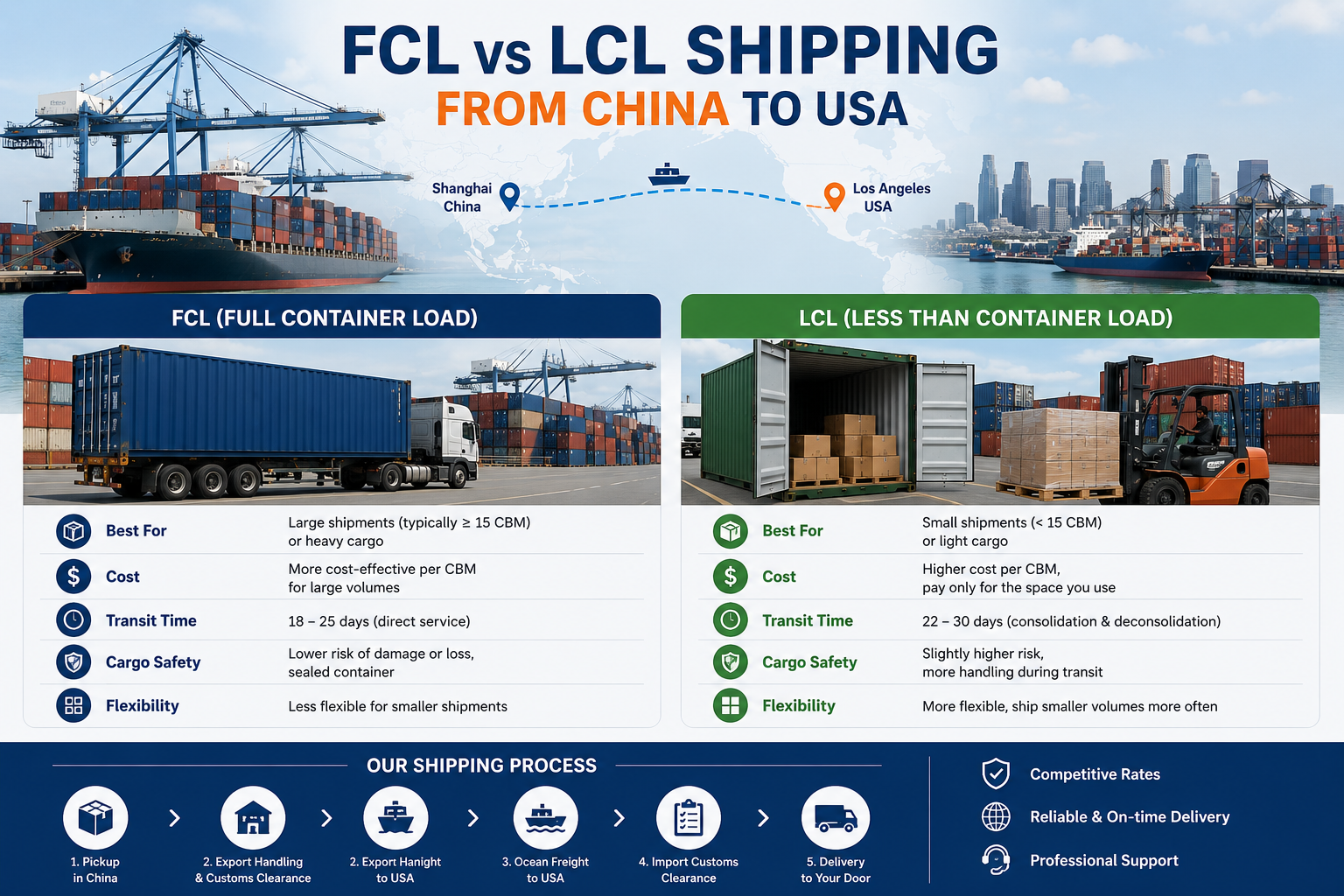
FCL vs LCL shipping from China to USA depends on your cargo volume, shipping cost, transit time, and handling requirements.
This guide compares FCL and LCL shipping costs, transit times, container sizes, Amazon FBA requirements, and explains when to choose LCL for shipments under 13 CBM or FCL for 15 CBM and above.
FCL / LCL Comparison
Cost & Transit Time
Container Sizes
To choose the right method, you must understand exactly how your cargo is handled from the factory in China to your warehouse in the US.
FCL (Full Container Load) means you book an entire ocean container exclusively for your business; Full Container Load FCL means you do not share the space with any other shippers.
The container is brought directly to your supplier’s factory or warehouse in China, where one shipper loads and seals the same container with a heavy-duty bolt seal for the trip. It remains untouched until it arrives at your US destination port (e.g., Los Angeles, Long Beach, New York, or Houston) unless flagged for a random US Customs inspection, which reduces handling because the cargo is not mixed with other cargo.
LCL (Less than Container Load) means your goods share container space with cargo from other importers, allowing multiple shippers to share space in one container. If you are shipping a few pallets or cartons that cannot fill an entire container, LCL is typically used for smaller volumes, and a freight forwarder will combine your goods with other shipments heading to the same destination.
This process requires a CFS (Container Freight Station). Your goods are sent to a CFS at the origin port in China to be consolidated into a container. When the container arrives at the US port, it is hauled to a destination CFS to be deconsolidated (unpacked) before individual shipments are released for final truck delivery.
Instead of comparing every detail, the most important differences between FCL and LCL shipping from China to the USA are cost structure, shipment volume, transit time, and handling process.
| Feature | FCL Shipping | LCL Shipping |
|---|---|---|
| Container Use | Full container (exclusive) | Shared container |
| Cost Structure | Flat container rate | Charged by CBM |
| Best For | 15+ CBM shipments | Small shipments (1–13 CBM) |
| Transit Time | Faster & more stable | Slower due to consolidation |
| Handling | Less handling | More handling steps |
The biggest difference is not only price, and any real cost comparison also has to account for shipment size, handling, and how predictable delivery needs to be. FCL shipments tend to offer more stable timing, while LCL gives you more flexibility for smaller shipments.
Understanding standard container sizes is essential when choosing FCL shipping from China to the USA. Different container types are designed for different cargo volumes, weight limits, and product types, which directly affect shipping cost and loading efficiency.
Most international shipments use three main container types: 20ft, 40ft, and 40HQ containers.
| Container Type | Internal Dimensions (L × W × H) | Capacity (CBM) |
|---|---|---|
| 20ft Container (20GP) | 5.9m × 2.35m × 2.39m | 28–33 CBM |
| 40ft Container (40GP) | 12.03m × 2.35m × 2.39m | 56–67 CBM |
| 40HQ Container | 12.03m × 2.35m × 2.69m | 60–76 CBM |
Each container type is suitable for different shipment characteristics, and these choices matter most for high volume shipments. Choosing the correct container helps optimize shipping cost and avoid wasted space or overweight issues.
20ft container: Best for heavy cargo such as machinery, metal parts, and dense goods
40ft container: Suitable for general cargo with medium volume
40HQ container: Ideal for bulky but lightweight products such as furniture, textiles, and e-commerce inventory
The cost difference between FCL and LCL shipping from China to the USA depends mainly on container type, cargo volume, destination port, and seasonal market fluctuations. This is the main cost comparison for imported goods, since FCL is charged as a fixed container rate, while LCL is calculated based on volume (CBM).
In general, FCL becomes more cost-efficient as shipment volume increases, while LCL is more flexible for smaller shipments but often includes additional handling charges. The goal is to optimize costs based on shipment size, handling, and routing.
FCL shipping uses a fixed pricing model per container, regardless of how much space is used inside. However, rates can vary depending on port congestion, fuel surcharges, and seasonal demand.
20ft Container (20GP): USD 2,000 – 5,500
Suitable for heavy cargo and medium-volume shipments
40ft High Cube (40HQ): USD 3,500 – 8,000
Common for large-volume commercial goods and e-commerce cargo
FCL pricing may increase during peak seasons such as Q4 and pre–Chinese New Year due to tight vessel capacity and higher demand.
LCL shipping is priced based on cargo volume or weight, making it suitable for small shipments that do not require a full container.
Base ocean freight: typical LCL quotes are about USD 75–110 per CBM
Additional charges may apply depending on origin and destination services
Although LCL base rates appear low, importers should always consider the full landed cost for LCL shipments.
Important cost factors include:
CFS (Container Freight Station) consolidation fees
Destination deconsolidation charges
Documentation and handling fees
Fixed destination CFS fee, usually around USD 150–250
These extra costs can increase the final price by approximately 30%–50% compared to the base ocean freight rate.
The main difference between FCL and LCL shipping cost is not only the ocean freight rate, but also how many handling steps are required.
FCL shipments: fewer handling stages, single container cost
LCL: cargo is mixed into a whole container of shared freight, with multiple handling points and potentially more warehouse fees
This is why LCL is often cheaper for small volumes but becomes less competitive as shipment size increases, while FCL often works out better on a per unit basis as volume rises.
Transit time is one of the most important factors when choosing between FCL and LCL shipping from China to the USA. In most cases, FCL shipping is faster and more stable because the container moves directly from origin to destination without additional cargo handling, which simplifies the shipping process.
On average, FCL is about 3–5 days faster than LCL, depending on the route and port conditions, and it usually benefits from more direct routing than LCL.
Under normal shipping conditions, the typical transit time is:
FCL shipping: 14–30 days (port-to-port)
LCL shipping: 18–35 days (port-to-port)
The time difference is mainly caused by LCL consolidation and deconsolidation processes, where cargo must be sorted, grouped, and processed at Container Freight Stations (CFS) before final delivery.
Transit time also varies depending on the destination region in the United States.
| Destination Region | FCL Transit Time | LCL Transit Time | Major Ports |
|---|---|---|---|
| US West Coast | 14–18 days | 18–23 days | Los Angeles, Long Beach, Seattle, Oakland |
| US East Coast | 25–30 days | 30–35 days | New York, New Jersey, Savannah, Norfolk |
| US Gulf Coast | 28–32 days | 33–38 days | Houston, New Orleans, Miami |
FCL shipping has a shorter transit time because the entire container is handled as a single shipment. There is no waiting time for consolidation, and fewer handling steps are required throughout the logistics process.
In contrast, LCL shipping requires additional warehouse operations, which naturally extend delivery time.
Main reasons FCL is faster:
No consolidation at origin
No deconsolidation at destination
Fewer handling points in transit
More direct shipping schedule
Choosing between FCL and LCL is not just about counting your boxes; it is a strategic decision that affects your cash flow, inventory turnover, and supply chain security. Below is the operational breakdown of exactly when to choose each shipping method.
FCL shipping is the better option when your shipment is large enough to justify using an entire container or when you need more control over cargo handling and transit stability. It is best for high volume shipments where the cargo shipped can justify a dedicated container.
You should choose FCL shipping if:
Your shipment volume is 15 CBM or more
You have heavy or high-density cargo (e.g., machinery, metal parts)
You are shipping fragile, high-value, or branded goods
You need faster and more predictable transit time, since FCL shipments tend to be faster and more predictable
You want to reduce handling and damage risk
You are shipping bulk inventory for wholesalers or Amazon FBA
FCL becomes especially cost-effective when your cargo fills a significant portion of a container, because the cost per CBM decreases as volume increases and improves cost efficiency on a per-unit basis once volume rises.
LCL shipping is more suitable for smaller shipments that do not require a full container, and it is designed for smaller quantities when booking an entire container would be unnecessary. It is widely used by small businesses, e-commerce sellers, and importers testing new products.
You should choose LCL shipping if:
Your shipment volume is below 13 CBM
You are shipping small batches or trial orders
You want to reduce upfront shipping cost
You do not need a full container
You can accept longer transit time due to consolidation
You are importing from multiple suppliers in China
LCL allows you to share container space, which makes it flexible and cost-efficient for low-volume shipments, and businesses often choose it when they want to share space rather than book one full container themselves.

All Amazon FBA shipments must follow strict inbound requirements before arriving at fulfillment centers in the United States. These rules apply regardless of whether you choose FCL or LCL shipping.
Instead of correcting errors at destination, For most Amazon FBA shipments, sellers should complete labeling, packaging, and prep work before cargo is handed over for international shipping.
Key requirements include:
All units must be labeled with FNSKU before shipping
Products must be fully retail-ready and properly packaged
Carton weight is generally limited to 50 lbs (22.6 kg)
Standard pallet size is 48” × 40” GMA pallet
Heavy cartons require proper warning labels
Pallet height and weight must meet Amazon inbound limits
Failure to comply with these requirements may result in shipment delays, additional handling fees, or rejection at Amazon fulfillment centers.
Shipping costs can vary significantly based on seasonality, shipping method, cargo volume, and route selection. To optimize expenses and improve cost efficiency, importers should adopt strategic shipping practices. Below are key ways to minimize shipping costs when importing from China to the USA.
One of the best ways to secure lower shipping rates is to plan ahead and book in advance—at least 3-4 weeks before departure.
Avoid Last-Minute Price Surges: Carriers often increase rates for last-minute bookings, especially during peak seasons.
Reserve Space During High-Demand Periods: Shipping demand spikes before Chinese New Year (January-February) and Q4 (September-December), making early booking essential.
Tip: If your business follows a predictable supply chain, pre-schedule shipments to lock in lower rates with freight forwarders; planning early also helps secure space with the shipping line and avoid avoidable delays.
To reduce per-unit shipping costs, ensure that every cubic meter (CBM) of container space is used efficiently.
For FCL:
Use High Cube Containers (40HQ) – Provides extra space without significantly increasing costs.
Palletize Efficiently – Arrange goods to maximize container capacity while maintaining stability.
For LCL:
Reduce Wasted Space – Pack items tightly in cartons to avoid paying for unused volume.
Consider Consolidation – Group multiple shipments from different suppliers into one container to reduce costs.
Tip: Freight forwarders can optimize packing plans to fit more cargo in fewer containers, helping you save on LCL pricing.
Freight rates fluctuate based on market demand. To reduce costs, schedule shipments outside of peak periods:
| Season | Shipping Demand | Cost Impact |
|---|---|---|
| Chinese New Year (Jan-Feb) | High | Higher rates, booking congestion |
| Q2 (April-June) | Low | Lower freight costs, available capacity |
| Peak Retail Season (Sept-Dec) | Very High | Increased rates, risk of delays |
| Post-Holiday (Jan-March) | Moderate | Some delays, but declining rates |
Tip: If possible, avoid shipping during Q4 and before Chinese New Year to secure better container rates.
Partnering with a trusted freight forwarder can significantly reduce shipping costs and risks.
Negotiate Better Rates: Freight forwarders buy bulk shipping space, giving them leverage to secure discounted rates, and they can compare FCL pricing with LCL quotes to help you choose the better option.
Handle Customs Clearance Efficiently: Avoid costly delays by ensuring all documentation is in order.
Offer LCL Consolidation Services: Forwarders can group multiple shipments into one container to lower per-unit costs.
Tip: Work with a freight forwarder like Tonlexing, which specializes in China-USA shipping, to manage logistics and secure cost-effective FCL and LCL solutions through container shipping, the standard sea-freight method for moving imported goods in global trade.
FCL is usually cheaper per CBM when your shipment volume is large enough, especially above 15 CBM. LCL is cheaper for small shipments because you only pay for the space you use.
The common break-even point is around 13–15 CBM. If your shipment is close to this range, compare both LCL and 20ft FCL before booking.
Yes. LCL shipping is usually slower because cargo needs consolidation in China and deconsolidation in the USA. FCL is more direct and usually has a more stable transit time.
FCL is generally safer because the container is used only for your cargo and involves fewer handling steps. LCL cargo is handled more often and shares space with other shipments.
For small shipments below 13 CBM, LCL shipping is usually the best sea freight option. If the cargo is very urgent or very small, air freight may be better.
Useful freight, customs and importing resources related to this shipping guide.
Shipping from China to the USA includes air freight, sea freight, and DDP shipping options. Compare shipping costs, transit times, and US customs...
Read guide →
Break down shipping costs from China to the USA, including air freight, sea freight, and delivery times for different shipment sizes.
Read guide →
Sea Freight Shipping from China to the USA Verified & Reviewed · Last updated June 2026 Sea freight shipping from China to the USA is one of the...
Read guide →
20ft & 40ft Container Shipping Rates from China to USA Verified & Reviewed · Last updated June 2026 20ft and 40ft container shipping rates from C...
Read guide →Bulk Shipping from China to USA : Costs, Transit Times, Routes, and Customs Verified & Reviewed · Last updated March 2026 Bulk shipping from Chin...
Learn more → Useful Resource DDP Shipping from China to USADDP Shipping from China to USA Verified & Reviewed · Last updated June 2026 DDP Shipping from China to USA is a duty-paid door-to-door shipping s...
Learn more →WhatsApp us