Related Guide
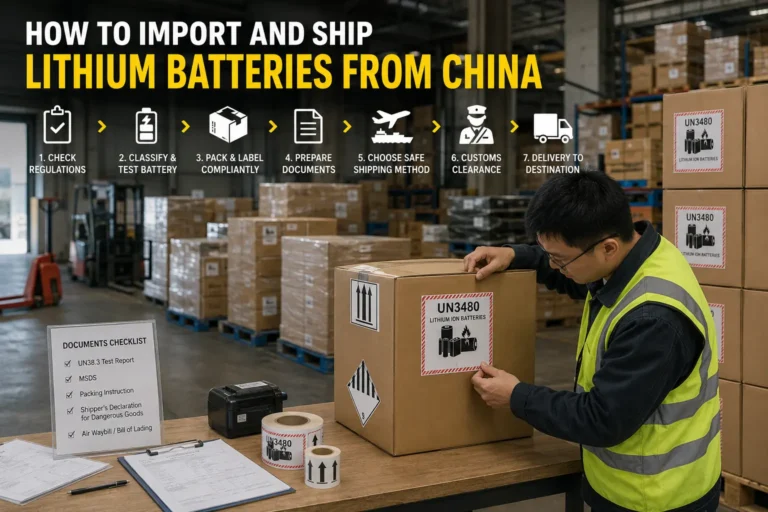
How to Import and Ship Lithium Batteries from China
Importing and shipping lithium batteries from China requires more preparation than moving ordinary cargo. Lithium batteries are regulated as dang...
Read guide →

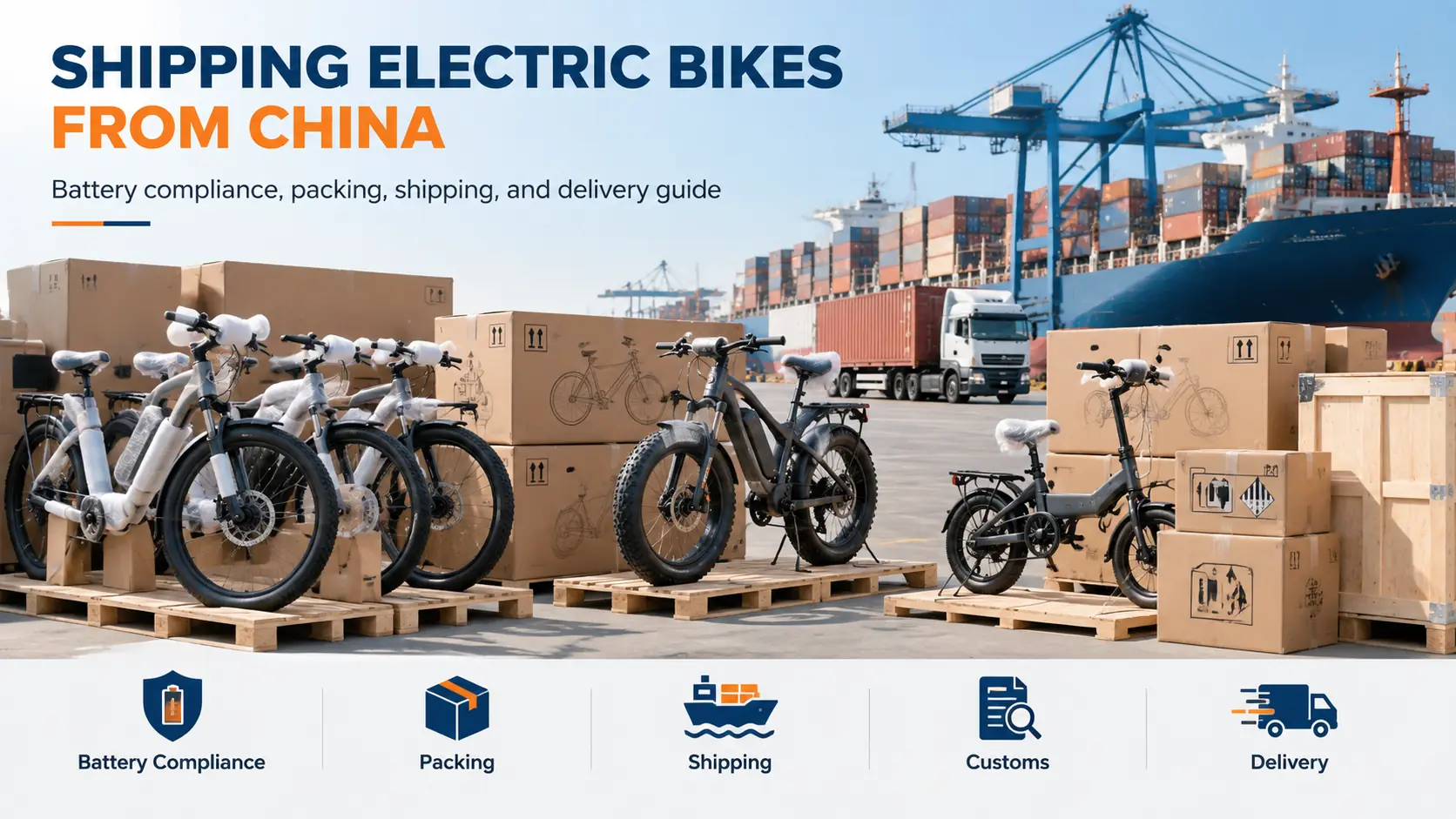
Shipping electric bikes from China requires careful planning because e-bikes are bulky, heavy, and powered by lithium-ion batteries subject to dangerous goods regulations. The best shipping method depends on order size, battery specifications, destination, cost, and delivery time.
This guide covers sea freight, air freight, DDP shipping, lithium battery requirements, shipping costs, packaging, customs clearance, and the key steps for importing e-bikes from China.
Shipping Cost
Lithium Battery Rules
Shipping Methods
For most wholesalers, distributors and other commercial buyers, sea freight is usually the most economical option. Small orders can move by LCL, while larger shipments are generally better suited to FCL container shipping. Air freight is faster, but it is mainly practical for samples, replacement units or time-sensitive orders.
The table below provides a simple starting point.
| Shipment Type | Recommended Method | Cost Level | Best For |
|---|---|---|---|
| One e-bike or sample | Approved air cargo or specialized service | High | Samples and urgent orders |
| Small commercial shipment | LCL sea freight | Medium | Low-volume importers |
| Bulk order | FCL container shipping | Lower per unit | Wholesalers and distributors |
| Door-to-door shipment | DDP shipping | Medium–High | Buyers wanting simplified logistics |
These are general recommendations rather than fixed rules. A compact folding e-bike may be practical to move by air, while a large fat-tire model can generate a very high volumetric weight. The battery configuration must also be checked before the final shipping method is selected.
An ordinary bicycle is mainly a bulky general cargo item. An electric bike combines the bicycle frame with a motor, controller, charger and rechargeable power source, which creates additional transport and compliance requirements.
The three issues that normally have the greatest impact are the lithium batteries, the size and weight of the packed bike, and the regulations that apply in the importing country.
Most e-bikes use rechargeable lithium ion batteries because they provide relatively high energy density without adding excessive weight. During transportation, however, these batteries are regulated because damaged, defective or short-circuited cells can overheat and may lead to thermal runaway.
Before a freight forwarder can recommend a route, the supplier should normally provide basic technical information about the power system. Important details include:
Battery chemistry and model
Voltage and capacity
Watt-hour rating
Manufacturer information
UN 38.3 documentation
SDS or MSDS
How the power unit is packed for transport
The final point is especially important. A complete e-bike with its power source installed may be handled differently from a battery packed alongside the bike or shipped separately.
For buyers sourcing batteries separately, Tonlexing also provides a detailed guide to shipping lithium batteries from China.
Electric bikes are generally heavier than conventional bicycles because of the motor, reinforced frame and electrical system. Many common models weigh around 20–35 kg before export packaging, while cargo bikes, fat-tire models and other heavy designs can weigh considerably more.
The packed dimensions can have just as much impact as the actual weight. Shipping companies may consider:
Gross weight
Carton dimensions
Total CBM
Volumetric or chargeable weight
Number of cartons
Pallet size where applicable
For ocean transportation, volume is particularly important for LCL shipments. For air cargo, a large box can produce a high chargeable weight even when the bike itself is relatively light.
Factories often reduce carton size by removing the front wheel and pedals or repositioning the handlebar. Importers should therefore request the final export carton size and gross weight before asking for a shipping quote.
A product that can be exported from China is not automatically legal for import or sale in every country. Different markets have their own definitions of an e-bike and may regulate motor power, assisted speed limits, braking performance, electrical systems and product labeling differently.
Before placing a large order, importers should check requirements relating to:
Maximum motor power
Speed limits
Mechanical bicycle safety
Electrical-system safety
Charger compatibility
Product labels and warnings
Local conformity or certification requirements
Transport compliance and product compliance are separate issues. A carrier may be willing to move the goods even though the product does not satisfy the rules for sale in the destination market.
Confirming these requirements before production can help avoid customs delays, storage charges or the need to re-export non-compliant goods.
Lithium-powered cargo should be reviewed before the supplier delivers it to an export warehouse. Correct classification influences the documents, labels, carrier approval and handling procedures required for the shipment.
One common mistake is to assume that every electric bike automatically moves under the same UN number. In practice, the correct classification depends on how the bike and its power source are presented for transportation.
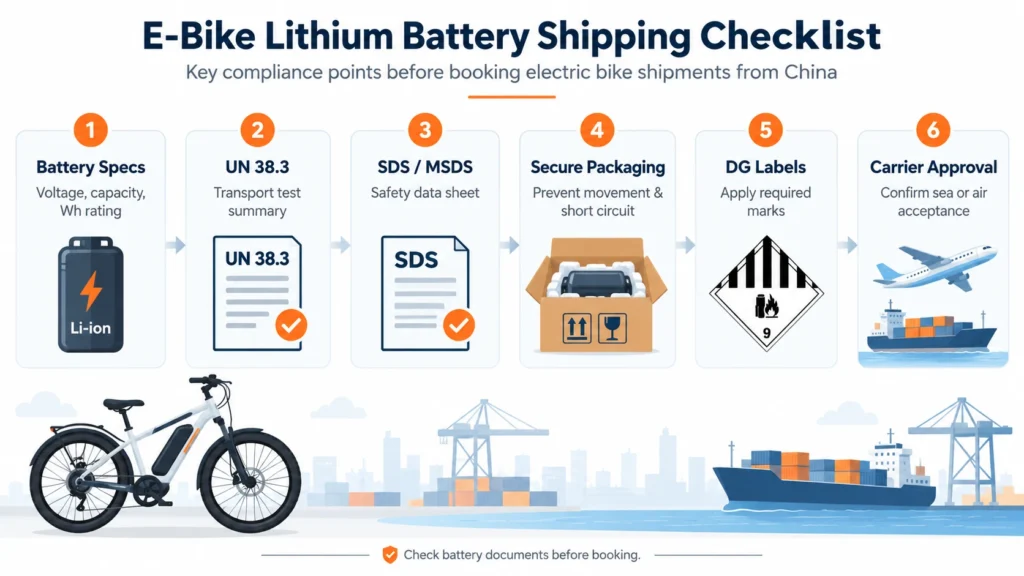
Lithium batteries are regulated dangerous goods for international transportation. Complete vehicles powered by lithium-ion batteries are also covered by specific dangerous goods provisions.
Under IATA’s 2026 guidance, vehicles whose principal source of power is a lithium-ion battery are listed as UN 3556 – Vehicle, lithium ion battery powered. Separate batteries or batteries packed in another configuration may use a different classification.
Before booking, the forwarder should therefore establish whether the shipment contains:
A complete e-bike with the traction power source installed
A power pack packed with the equipment
Separate spare batteries
A combination of the bike and additional batteries
This distinction affects carrier acceptance, packaging, hazard labels and documentation. It is better to resolve the classification while the goods are still at the factory than after they arrive at a cargo terminal.
The supplier should prepare transport documents that correspond to the actual model being exported. The manufacturer name, model number, voltage and capacity shown on different documents should be consistent.
Commonly requested documents include:
UN 38.3 Test Summary, supporting compliance with applicable transport testing requirements.
SDS or MSDS, providing information about composition, hazards, handling and emergency measures.
Technical specification sheet, showing model, voltage, capacity and Wh rating.
Commercial Invoice and Packing List, identifying the goods, quantity, value, dimensions and weight.
Dangerous Goods Declaration, where required by the transport mode and classification.
An SDS/MSDS is particularly useful when carriers or warehouses need to review the chemical and safety characteristics of the cargo. Tonlexing’s guide to preparing an MSDS explains the document in more detail.
For air shipments that require a shipper’s declaration, buyers can also review our guide to the Dangerous Goods Declaration for air freight.
These documents should ideally be reviewed before the shipping company issues a final booking confirmation. A mismatched model number or technical specification can delay carrier approval.
Air transportation generally applies stricter conditions than ordinary ocean shipping. Battery-powered vehicles can also be subject to specific state-of-charge requirements.
IATA’s 2026 guidance states that vehicles powered by batteries exceeding 100 Wh must generally be offered for air transport with the battery at no more than 30% state of charge, or within the applicable alternative indicated-capacity limit, unless the required approvals are obtained.
For many full-size e-bikes, the power system exceeds 100 Wh. Importers should therefore confirm:
Watt-hour rating
Current state of charge
Carrier-specific restrictions
Required marks and labels
Whether additional approval is necessary
These rules should not be generalized to every lithium battery shipment. The applicable requirement depends on the cargo classification, packing configuration and mode of transport.
Individual airlines, ocean carriers and warehouses may also impose stricter shipping restrictions than the basic international rules. Carrier acceptance must therefore be confirmed for the actual shipment.
The main international shipping options are sea freight, air freight and door-to-door services such as DDP. Each method serves a different type of importer, and the lowest headline price is not always the best solution.
Order quantity, delivery deadline, carton size and dangerous goods acceptance should all be considered before choosing a route.
For commercial orders, sea freight from China is usually the most practical method. E-bike cartons occupy a large amount of space, and container shipping can handle this volume much more economically than air cargo.
Sea transportation is available as LCL or FCL. The choice normally depends on the total CBM of the order and whether the selected carrier and consolidation service can accept the relevant dangerous goods classification.
LCL, or Less than Container Load, allows several shippers to share one container. It is useful when the order does not occupy enough space to justify booking a full container.
LCL can be suitable for smaller commercial orders because the importer pays for only part of the container space. However, the final cost may include:
Origin handling
CBM-based ocean charges
Dangerous goods handling
Documentation fees
Destination handling charges
Not every ordinary LCL consolidation service accepts lithium-powered vehicles. Before using a standard LCL quotation, confirm that the warehouse, consolidator and ocean carrier all accept the specific cargo.
This is one reason e-bike LCL shipping may cost more than general cargo of the same size.
FCL, or Full Container Load, is generally more suitable when the order is large enough to use a significant portion of a container. Common equipment includes 20GP, 40GP and 40HQ containers.
The main advantages of FCL for bulk e-bike orders include:
Lower transportation cost per unit at larger volumes
Less cargo mixing with unrelated shipments
More control over loading
Easier planning for wholesale quantities
There is no reliable universal figure for the number of electric bikes that fit into a 20ft or 40ft container. A folding model may use much less space than a large cargo or fat-tire bike.
The correct loading quantity should be calculated from the final carton dimensions supplied by the factory. In some cases, improving the packaging design can reduce CBM enough to produce meaningful savings.
Air freight from China can be useful when delivery speed is more important than cost. Typical examples include samples, replacement units, product launches and urgent small orders.
Air transport is usually most suitable when:
Only a small number of bikes are being shipped
The delivery deadline is short
The product value justifies higher logistics costs
The airline accepts the dangerous goods classification
The main cost issue is chargeable weight. Because an e-bike carton is large, volumetric weight can be considerably higher than actual weight.
Carrier acceptance is equally important. Technical documents, battery capacity, state of charge and packaging should be reviewed before relying on an air quotation. Tonlexing also provides dangerous goods air freight from China for eligible shipments.
DDP shipping from China can be useful for buyers who want a logistics provider to coordinate more of the transportation process.
Depending on the destination and available service, a DDP shipment can combine several stages:
Supplier pickup → export handling → international transport → import procedures → duty and tax arrangement → final delivery
This is especially convenient for smaller importers that do not have their own customs broker or logistics department.
DDP does not eliminate product compliance or dangerous goods requirements. The e-bike must still be transportable, correctly documented and acceptable for import into the destination country.
The cost of shipping an electric bike from China depends on the shipping method, route, carton size, weight and lithium battery requirements. A single e-bike usually has a higher cost per unit, while bulk container shipping becomes more economical as order volume increases.
| Shipping Option | Typical Cost |
|---|---|
| Single e-bike by sea | $300–$600+ |
| Single e-bike by air | $600–$1,000+ |
| 20ft container | $2,500–$4,500+ |
| 40ft / 40HQ container | $3,500–$6,500+ |
These prices are only general references. Actual rates vary by route, carrier capacity, season and dangerous goods surcharges.
The final shipping cost is mainly affected by:
Carton dimensions and gross weight
LCL or FCL shipping
Lithium battery handling
Origin and destination
Customs and final delivery charges
Large e-bike cartons can also increase CBM for sea freight and volumetric weight for air freight.
Good packaging needs to achieve two things at the same time: protect the bicycle during handling and keep the lithium-powered system secure throughout transportation.
Export packaging should also avoid unnecessary volume. Oversized boxes can significantly increase both LCL charges and air cargo costs.
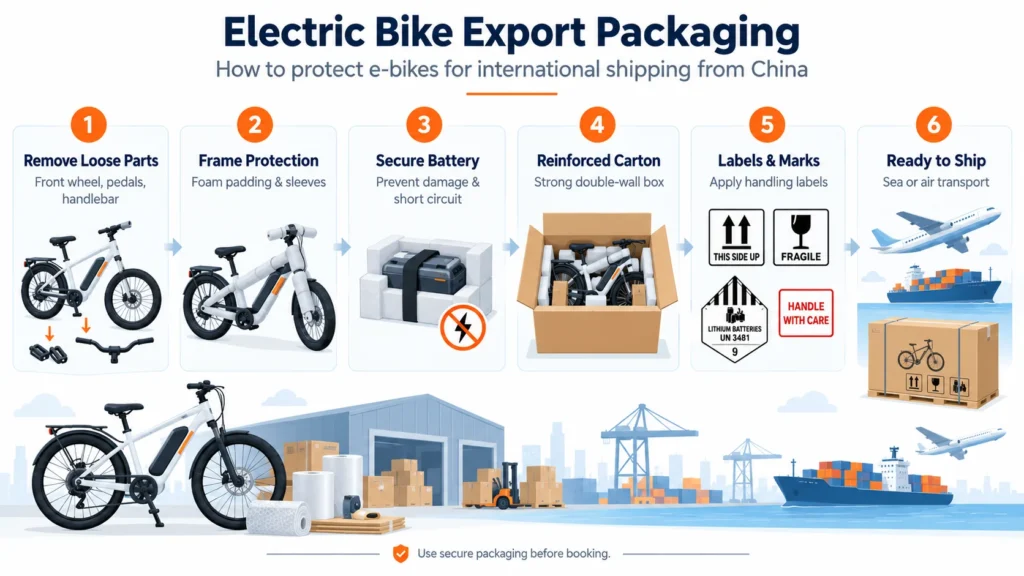
Factories commonly partially disassemble the bike before packing. The front wheel, pedals or handlebar may be removed or repositioned so that the carton is smaller and the components are less likely to move during transit.
A typical export package may use:
Reinforced corrugated boxes
Foam padding
Frame sleeves
Internal supports
Protective material around the display and motor
Secure fixing for loose components
Bubble wrap can protect surfaces from scratching, but it should not replace structural support. A heavy wheel, pedal or charger should not be able to move freely inside the box.
For bulk shipments, palletization may also make warehouse handling easier. The final packing method should balance cargo protection with efficient use of container space.
The lithium-ion power system must be protected from physical damage, movement and short circuits. Required packaging and labels depend on the actual dangerous goods classification.
Before the shipment leaves the factory, check whether:
The power source is securely installed or packed
Terminals are protected where applicable
Accidental activation is prevented
Required hazard marks or labels are applied
The outer packaging matches the selected transport method
A normal retail box should not automatically be assumed suitable for international shipping.
The supplier and forwarder should review the final packaging together, particularly when the bike is being transported by air or through a dangerous goods LCL service.
Customs clearance is an important part of shipping electric bikes from China because import duties, product classification and compliance requirements vary by destination. Before shipment, importers should confirm the applicable HS code, required documents and any additional tariffs or product standards in the destination market.
The United States and the European Union are two major e-bike markets, but their customs and import requirements are different.
For U.S. imports, electric bicycles are generally classified under HTS headings covering cycles with an electric motor. Some e-bikes may fall under HTS 8711.60, although the exact classification should be confirmed according to the product specifications.
Chinese-origin products under certain 8711.60 classifications may also be subject to additional Section 301 tariffs, so importers should check the current HTSUS and applicable Chapter 99 provisions before calculating landed cost.
Importers should pay attention to:
Correct HTS classification
Current import duties and additional tariffs
Importer of Record requirements
Customs entry and bond requirements where applicable
Electrical and mechanical product safety standards
The former U.S. $800 duty-free de minimis treatment should no longer be relied on. CBP states that duty-free de minimis treatment for covered shipments from all countries was suspended effective August 29, 2025.
Electric bikes imported from China into the European Union may face additional trade measures beyond normal customs duty. The EU currently maintains definitive anti-dumping duties on certain pedal-assisted electric bicycles originating in China, so the applicable rate can depend on the manufacturer and exporter.
Importers should also confirm the relevant EU product requirements, including:
CE marking where applicable
EN 15194 requirements for EPAC electric bicycles
Product labeling and documentation
Battery and electrical safety requirements
Applicable anti-dumping or other trade measures
Because tariff treatment can vary by supplier, the importer should confirm the current TARIC classification and duty rate before placing a large commercial order.
Regardless of destination, customs authorities normally require a complete and consistent set of shipping documents. The exact requirements vary by country, but a typical e-bike shipment may include:
Commercial Invoice
Packing List
Bill of Lading or Air Waybill
Certificate of Origin, where required
UN 38.3 Test Summary
SDS/MSDS
Dangerous Goods Declaration, where applicable
Product compliance certificates required by the destination market
The product description, quantity, value, weight and model information should be consistent across the commercial invoice, packing list and transport documents.
For commercial imports, it is best to confirm customs requirements before the goods leave China. Correct classification and complete documentation can help reduce inspections, clearance delays and unexpected destination charges.
Shipping an e-bike from China is easier when the product details, battery documents and transport plan are confirmed before the cargo leaves the factory. A clear process helps reduce booking delays, repacking costs and customs problems.
Start by collecting the basic cargo information from the supplier. The freight forwarder will normally need the bike model, motor power, battery voltage and capacity, watt-hour rating, carton dimensions and gross weight.
Make sure the supplier provides the final export packing size, because shipping costs are calculated from the packed cargo rather than the product dimensions shown in a catalog.
Before booking, confirm that the supplier can provide the required lithium battery documents for the actual model being shipped.
These commonly include:
UN 38.3 Test Summary
SDS or MSDS
Battery specification sheet
Dangerous Goods Declaration when required
The model number, capacity and manufacturer information should be consistent across the documents.
The best shipping method depends on the quantity, delivery time and destination.
Small commercial orders may use LCL sea freight, while larger orders are usually more economical by FCL container shipping. Air freight is mainly suitable for samples or urgent shipments, and DDP may be available for buyers who prefer door-to-door delivery.
Before the bikes are delivered to the export warehouse, check that the packaging is suitable for international transportation and that the selected carrier accepts the lithium-powered cargo.
The bike should be securely packed, while the power system should be protected against movement, damage and short circuits. Required dangerous goods marks or labels should also be applied where necessary.
Once the booking is confirmed, the freight forwarder can arrange supplier pickup or provide warehouse delivery instructions.
At this stage, the cargo is prepared for export, shipping documents are checked, and any required dangerous goods procedures are completed before departure from China.
After arrival, the shipment must complete the destination country’s customs procedures. The importer may need to provide the commercial invoice, packing list, transport document and relevant product or battery certificates.
Once customs release is completed, the bikes can be delivered to the buyer’s warehouse, distributor, retailer or other final destination.
Following these steps in order helps keep the shipping process more predictable and reduces the risk of discovering document or carrier problems after the goods are already in transit.
A company that regularly moves ordinary general cargo may not necessarily have the experience required for lithium-powered products. An e-bike freight forwarder should be able to identify potential problems before the shipment is booked.
When comparing providers, look for experience with:
Lithium-powered and dangerous goods cargo
UN 38.3 and SDS/MSDS document review
Carrier acceptance and DG booking
LCL and FCL container transportation
Air cargo restrictions
Import procedures and final delivery
Price transparency is also important. Ask whether the quotation includes origin charges, dangerous goods handling, international transportation, destination fees, customs services and delivery.
A very low initial quote may not be cheaper after all additional charges are included. For e-bike shipping, a clear and complete logistics plan is usually more valuable than the lowest headline rate.
Tonlexing Logistics provides international shipping services for electric bicycles, lithium-powered products and other commercial cargo from China to global destinations.
Before arranging transportation, our team can review the key cargo information, including the bike specifications, UN 38.3 Test Summary, SDS/MSDS, packing method, carton dimensions and gross weight. This helps determine which routes and carriers are suitable before the goods move.
Depending on your shipment and destination, Tonlexing can coordinate:
LCL and FCL container shipping
Air cargo for eligible e-bike shipments
Dangerous goods transportation
DDP door-to-door solutions
Supplier pickup and export handling
Import support and final delivery
We do not recommend the same shipping method for every order. A sample, a small retail order and a full container of e-bikes have very different cost structures and logistics requirements.
For a customized quote, send us your pickup city, destination, number of bikes, carton dimensions, gross weight, voltage, capacity and Wh rating, together with any available UN 38.3 and SDS/MSDS documents.
There is no fixed price. Shipping costs depend on the route, packed dimensions, gross weight, quantity, transport method and dangerous goods requirements. A single bike generally has a higher cost per unit, while LCL or FCL sea transportation becomes more economical for commercial orders.
In many cases, yes. However, a complete lithium-ion battery-powered vehicle may be classified differently from a separate power pack. The correct dangerous goods classification, packing requirements and carrier acceptance should be confirmed before booking.
Yes, provided the airline accepts the shipment and the applicable dangerous goods requirements are satisfied. Air transport is generally more suitable for samples or urgent orders because large carton dimensions and special handling can make it expensive.
Common documents include the UN 38.3 Test Summary, SDS/MSDS and technical specification sheet. Commercial invoices and packing lists are also required for normal export and import procedures. Additional dangerous goods declarations may be necessary depending on the shipping configuration.
Lithium batteries are regulated dangerous goods during international transportation. Complete lithium-powered vehicles are also subject to specific transport provisions. The exact classification depends on how the bike and power source are presented for shipping.
Useful freight, customs and importing resources related to this shipping guide.
Importing and shipping lithium batteries from China requires more preparation than moving ordinary cargo. Lithium batteries are regulated as dang...
Read guide →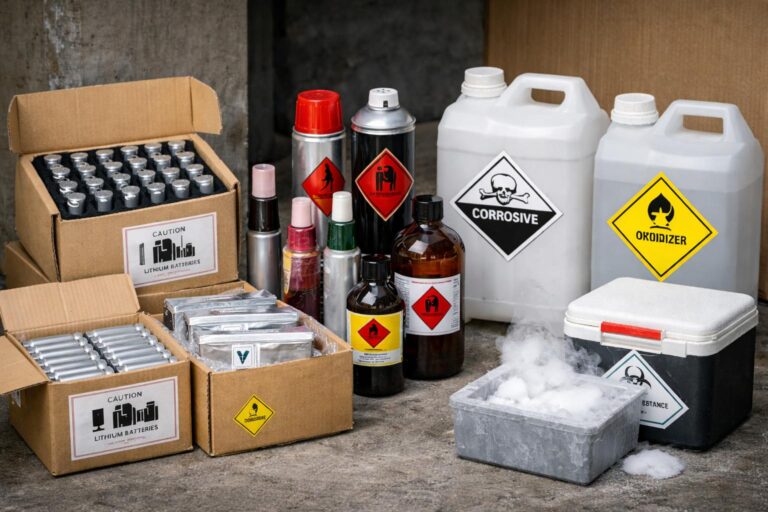
Shipping Dangerous Goods From China Verified & Reviewed · Last updated February 2026 Shipping dangerous goods from China requires strict complian...
Read guide →
Sea freight is the most cost effective shipping method for large volumes and container load cargo. It is ideal for businesses looking to reduce s...
Read guide →
Air freight from China is the best option for time sensitive and high value shipments. It offers fast delivery, reliable transit times, and effic...
Read guide →Importing goods from China can be highly profitable—but only when you understand the necessary documents and import requirements. Whether you’re...
Learn more → Useful Resource Shipping Oversized Cargo from ChinaShipping Oversized Cargo from China Verified & Reviewed · Last updated February 2026 Shipping oversized cargo from China depends on cargo dimensi...
Learn more →WhatsApp us