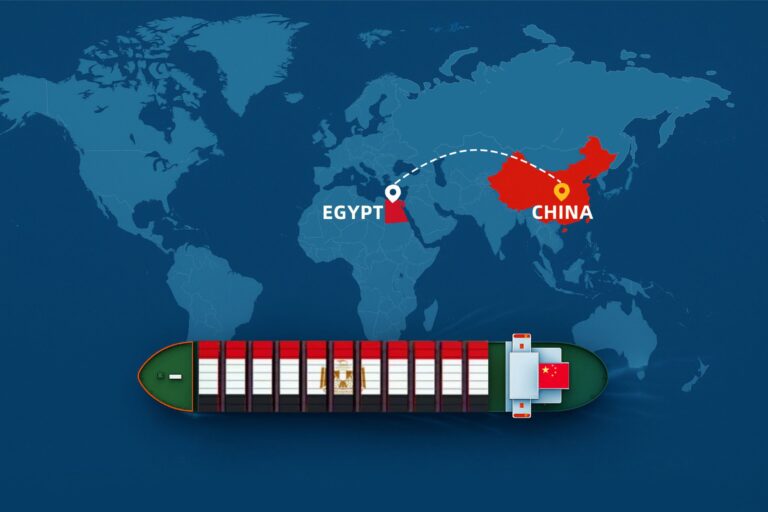
Related Guide
Shipping from China to Egypt
Shipping from China to Egypt – Sea, Air & DDP in 2026 Fast, reliable shipping from China to Egypt for B2B importers,industrial cargo, and general...
Read guide →

20ft 40ft Container Shipping Costs from China to Egypt vary depending on container size, sea freight rates, transit time, cargo volume, and total shipping charges.
This guide explains 20ft and 40ft container shipping costs from China to Egypt, including FCL and LCL options, major Egyptian ports such as Alexandria, Port Said, Damietta, and Sokhna, plus customs clearance, shipping documents, and destination charges.
Shipping rates
Transit time range
FCL / LCL shipping
The cost to ship a container from China to Egypt depends on the container size, shipping route, cargo details, carrier space, destination port, and local charges in Egypt. A 20ft container is usually cheaper in total price, but a 40ft container often provides better value when the shipment volume is large.
The following average price ranges can be used as a rough estimate for standard port-to-port container shipping:
| Container Type | Estimated Ocean Freight Cost | Approx. Capacity | Common Cargo Types | Estimated Transit Time |
|---|---|---|---|---|
| 20ft Container | $3,000 – $3,700 | Around 28 CBM / 25–28 tons | Machinery, tiles, hardware, metal parts, building materials | 25–40 days |
| 40ft Container | $4,000 – $4,850 | Around 56 CBM / 28–30 tons | Furniture, textiles, consumer goods, packaging products | 25–40 days |
| 40ft High Cube Container | $4,100 – $4,950 | Around 68 CBM / 28–30 tons | Bulky but lightweight cargo | 25–40 days |
These prices mainly refer to ocean freight. The total shipping cost may be higher once supplier pickup, export documentation, customs clearance, import duties, VAT, destination port charges, container inspection, cargo insurance, and final delivery are included.
A container shipping cost calculator can help importers make a rough estimate before booking. However, calculator results are only a reference because the actual cost may vary depending on cargo weight, cargo volume, route, shipping company, peak season, and destination charges.
Choosing between a 20ft and 40ft container is not only about price. In real shipping practice, the right choice depends on cargo weight, cargo volume, loading efficiency, and total landed cost in Egypt. A wrong container decision can lead to higher shipping cost or wasted space.
In general, a 20ft container is more suitable for heavy and compact cargo, while a 40ft container is better for larger volume shipments where space utilization matters more than weight. For importers shipping from China to Egypt, understanding this difference helps improve both cost control and container utilization.
A 20ft container is commonly used when cargo is heavy but does not take up much space. Because it reaches weight limits earlier, it is often chosen for industrial or construction-related goods.
Typical cargo suitable for a 20ft container includes:
Machinery and mechanical equipment
Tiles, stone products, and ceramics
Steel parts and metal materials
Tools and hardware products
Construction and building materials
Auto parts and dense industrial cargo
In these cases, the shipment may not fully fill a 40ft container, so using a 20ft container can help avoid paying for unused space.
A 40ft container is more suitable for shipments where volume is the main factor. Even though the total freight cost is higher than a 20ft container, the cost per CBM is usually lower, which makes it more efficient for large shipments.
Typical cargo suitable for a 40ft container includes:
Furniture and home goods
Textiles and garments
Packaging materials and cartons
Consumer goods and retail products
Plastic products and light industrial items
E-commerce and mixed cargo shipments
For importers shipping regular commercial goods, a 40ft container often provides better space efficiency and more stable unit cost.
A 40ft High Cube container offers additional height, making it suitable for bulky but lightweight cargo. It is commonly used when standard containers cannot fully optimize loading space.
It is ideal for:
Large furniture items
Foam products and soft goods
Display racks and exhibition equipment
Plastic and lightweight industrial goods
This option is slightly more expensive but can improve loading efficiency for high-volume cargo.
In real shipping decisions, the choice is usually based on CBM and weight balance rather than container type alone. A simple way to decide is:
If cargo is heavy but small in volume → 20ft container
If cargo is large in volume → 40ft container
If cargo is bulky but light → 40ft High Cube container
For shipments close to 15–18 CBM, it is often worth comparing both LCL and FCL pricing, because sometimes booking a full container becomes more cost effective than paying LCL per CBM rates.
Importers shipping from China to Egypt usually choose between FCL shipping and LCL shipping. The right shipping method depends on shipment size, budget, cargo type, and delivery requirements.
FCL means Full Container Load shipping. It means one importer uses the entire container for one shipment. This is the most common option for larger commercial cargo because the container is sealed after loading and moves through the shipping process with less handling.
FCL shipping is often preferred when the shipment volume is large enough to use most of a 20ft or 40ft container. It usually offers more predictable transit time, better cargo security, and lower average cost per CBM.
FCL is especially suitable for:
Machinery and industrial equipment
Furniture and household goods
Textiles and garments
Building materials
Large-volume commercial cargo
For importers who need stable delivery and better supply chain efficiency, FCL is usually more reliable than LCL.
LCL shipping is used when the shipment is too small to fill a full container. In this case, cargo from multiple importers is consolidated into one container and separated at the destination port.
LCL shipping costs are usually calculated based on CBM (cubic meter) rather than container size. For shipments from China to Egypt, LCL rates typically range from $80 to $150 per CBM, depending on cargo type, route, and destination charges.
LCL is suitable for:
Small shipments and trial orders
Sample products
Low-volume commercial cargo
Cost-sensitive shipments that do not require full container usage
However, LCL shipments may involve additional handling steps, including consolidation in China and deconsolidation in Egypt, which can result in longer transit times compared to FCL.
Sea freight transit time from China to Egypt usually ranges from 25 to 40 days. Faster direct services may take around 18 to 30 days, while transshipment routes or delayed services may take longer.
Transit time depends on the port of loading, destination port, shipping route, carrier schedule, transshipment hub, port congestion, weather, and customs clearance. For time-sensitive cargo, importers should confirm the latest vessel schedule before booking.
| Route Type | Estimated Transit Time |
|---|---|
| Direct or faster sea freight routes | 18–30 days |
| Standard sea freight shipping | 25–40 days |
| Transshipment or delayed services | 40–77 days |
Direct routes are usually faster and more predictable, but they may cost more. Transshipment routes may offer lower freight rates, but they can increase handling time and delay risk.
Delays may happen when ports are congested, documents are incomplete, customs inspection is required, or vessel schedules change. To reduce delay risks, importers should prepare shipping documents before departure and keep close communication with the freight forwarder.
Container shipping costs from China to Egypt are not fixed. Even for the same route, prices can change based on shipping conditions, cargo details, and market demand.
Different routes can have different pricing. For example, shipping to Alexandria, Port Said, or Damietta may result in different ocean freight rates depending on carrier schedules and port congestion.
Alexandria: more stable but sometimes higher demand
Port Said / Damietta: can be slightly more competitive depending on space
Sokhna: often used for inland delivery efficiency
The ocean freight only covers port-to-port shipping. Once the container arrives in Egypt, additional costs apply.
Typical destination charges include:
Terminal handling charges (THC)
Customs clearance fees
Documentation fees
These fees directly affect the total shipping cost, especially for FCL shipments.
Shipping rates are not stable throughout the year. During peak seasons, space becomes limited and prices usually increase.
Peak season = higher container rates
Off-season = more stable pricing
Holiday periods = possible rate spikes
Booking early often helps secure better freight rates.
Different shipping companies may offer different container shipping prices for the same route. Fuel price changes can also impact the final ocean freight cost through surcharges.
Carrier space availability affects pricing
Fuel adjustment (BAF) impacts final rate
Direct vs transshipment routes also change cost level
Shipping containers from China to Egypt requires proper documentation and smooth customs clearance. Missing or incorrect documents can lead to delays, storage charges, or additional inspection costs at Egyptian ports.
To ensure smooth clearance, importers should prepare all basic shipping documents before the container arrives in Egypt.
Common documents include:
Commercial Invoice
Bill of Lading (B/L)
Import license or permits (if required)
These documents are used by customs to verify cargo details, calculate import duties, and confirm shipment compliance.
Customs clearance in Egypt is handled after the container arrives at the destination port. The process may vary depending on cargo type and document accuracy.
In general, the process includes:
Document submission and review
HS code verification and duty calculation
Customs inspection (if required)
Tax payment and clearance approval
Container release for delivery
Any inconsistency in cargo description or declared value may result in delays or additional inspections.
Import duties in Egypt depend on the product category and HS code. Rates can vary widely depending on the type of goods being shipped.
Some products: 0% duty
General goods: moderate tax rates
Restricted categories: higher duties or extra requirements
Importers should confirm duty rates with a licensed customs broker before shipment to avoid unexpected costs.
Reducing container shipping costs is not only about choosing the lowest ocean freight rate. A cheaper rate may result in longer transit time, higher destination charges, or more risk of delay. A better approach is to compare the full shipping plan, including route, port, container size, customs clearance, and inland delivery.
Booking early is one of the easiest ways to control freight costs. Last-minute bookings are more likely to face higher prices, limited space, or less flexible sailing schedules, especially during peak season.
Importers can also reduce costs by improving cargo loading. Better packaging and carton planning can reduce wasted space and help choose the right container size. For bulky cargo, calculating CBM before booking is important because volume often determines whether LCL, 20ft, 40ft, or 40ft High Cube is the best option.
Useful cost-saving methods include:
Compare FCL and LCL before booking
Choose the destination port based on total landed cost
Prepare shipping documents early
Avoid unnecessary storage, demurrage, and detention
Use cargo insurance for valuable or fragile goods
Work with an experienced freight forwarder for transparent pricing
A reliable freight forwarder can also coordinate with suppliers, compare shipping methods, check container availability, arrange export documentation, and provide updates throughout the shipping process.
Choosing the right freight forwarder is just as important as selecting the right shipping method. A reliable logistics partner can help control costs, reduce delays, and ensure smooth customs clearance from China to Egypt.
Tonlexing provides end-to-end container shipping solutions covering FCL and LCL shipments from major Chinese ports such as Shanghai, Ningbo, Shenzhen, Qingdao, Guangzhou, Xiamen, and Tianjin to key Egyptian ports including Alexandria, Port Said, Damietta, and Sokhna.
We offer flexible sea freight solutions based on different shipment sizes and cargo types. Whether you are shipping full container loads or smaller consolidated cargo, we help you choose the right shipping method for your budget and delivery timeline.
FCL shipping for full container cargo
LCL shipping for smaller shipments
Door-to-door delivery solutions when required
Flexible routing based on cost and transit time
Customs clearance is a key part of shipping to Egypt. Our team helps coordinate required documents and supports compliance with local import regulations to reduce clearance risks and delays.
Support with shipping documents
Coordination with customs brokers
HS code and duty guidance
Reduced risk of inspection delays
We help importers understand the full shipping cost structure, including ocean freight, origin charges, and destination fees. This allows better planning and avoids hidden costs during delivery.
Clear freight rate breakdown
Route and port comparison support
Cost optimization for FCL and LCL shipments
Better control of total shipping cost
With competitive pricing, transparent pricing, and reliable shipping service, Tonlexing helps importers improve delivery planning, reduce extra costs, and support long-term customer satisfaction.
In 2026, shipping a 20ft container from China to Egypt usually costs around $3,000 to $3,700. A 40ft container generally costs around $4,000 to $4,850. The final cost depends on container size, cargo type, origin port, destination port, customs clearance, and local charges in Egypt.
The cost to ship a container to Egypt depends on whether you use a 20ft container, 40ft container, 40ft High Cube container, or special equipment such as a flat rack container. Standard FCL sea freight from China to Egypt usually starts from around $3,000 for a 20ft container.
A 20ft container from China to Egypt usually costs around $3,000 to $3,700 for standard port-to-port ocean freight. Extra charges may apply for supplier pickup, customs clearance, import taxes, destination port handling, and inland delivery.
Container shipping from China to Egypt usually takes 25 to 40 days by sea freight. Direct routes may be faster, while transshipment routes or congested ports may extend the transit time.
Common shipping documents include commercial invoice, packing list, bill of lading, certificate of origin, HS code, and import permits if required. Egypt may also require ACI-related information before shipment.
Useful freight, customs and importing resources related to this shipping guide.
Shipping from China to Egypt – Sea, Air & DDP in 2026 Fast, reliable shipping from China to Egypt for B2B importers,industrial cargo, and general...
Read guide →
Shipping Cost from China to Egypt (2026 Guide) Verified & Reviewed · Last updated April 2026 Shipping cost from China to Egypt typically ranges f...
Read guide →
How long does it take to ship from China to Egypt? This is a crucial question for importers, freight forwarders, and businesses involved in inter...
Read guide →
Sea freight is the most cost effective shipping method for large volumes and container load cargo. It is ideal for businesses looking to reduce s...
Read guide →Air freight from China to Egypt is the fastest way to move commercial cargo between the two countries. When you cannot wait for long sea freight...
Learn more → Useful Resource DDP Shipping from ChinaDDP shipping from China includes customs clearance, import duties, and final delivery. It is a convenient door to door service with clear and pre...
Learn more →WhatsApp us