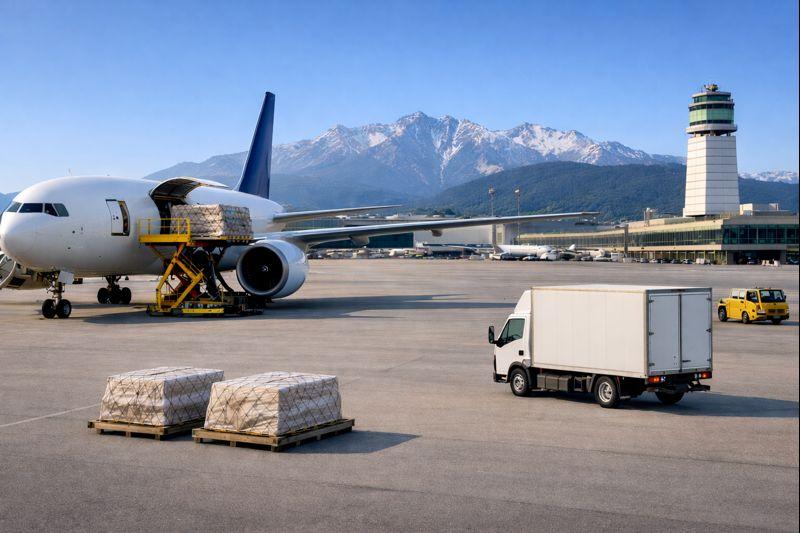
Air Freight from China to Austria is one of the fastest and most controllable shipping methods for international trade, especially for urgent shipments and high-value goods. Compared with other shipping options, air transport offers shorter transit time and more predictable delivery schedules. Actual shipping time is mainly influenced by airline capacity, export readiness at origin, and the efficiency of import clearance after arrival in Austria.
Air freight shipping costs are calculated based on chargeable weight, which is the higher of actual weight and volumetric weight. For light but bulky cargo, volumetric weight often becomes the main cost driver, meaning carton dimensions and packing efficiency can directly affect the final air freight cost. Understanding how chargeable weight is calculated helps importers better estimate shipping budgets and avoid unexpected surcharges.
For most importers, Vienna International Airport serves as the primary air cargo gateway into Austria and the main hub for customs procedures and onward delivery to major Austrian cities. When air freight is not the most suitable option, rail freight and sea freight remain practical alternatives with longer transit times. These methods are generally more cost effective for heavier cargo, larger shipment volumes, container load planning, and full container load shipments.

Quick answer for China to Austria shipping
- Shipping time: Air freight is chosen for faster delivery times. Timing mainly depends on flight space and customs clearance.
- Shipping costs: Charges follow chargeable weight, the higher of actual weight and volumetric weight.
- Main gateway: Most shipments arrive via Vienna International Airport for customs procedures and final delivery.
- Other shipping methods: Sea freight and rail freight are slower, but more cost effective for heavier cargo and larger volumes.
Chart: compare shipping methods from China to Austria
Use this chart to pick the right shipping options based on shipping time, cost level, and shipment size.
| Shipping methods | Typical shipping time | Cost level | Best for |
|---|
| Air freight | 2 to 8 days | Medium to high | Urgent shipments, high value goods, stable planning |
| Express shipping | 2 to 5 days | High | Very small shipments, tight timelines, fast door to door delivery |
| Rail freight | 18 to 30 days | Medium | Balanced cost efficiency, planned replenishment |
| Sea freight | 30 to 45 days | Low | Heavy cargo, planned inventory |
Many shippers use a mixed plan. Air freight covers urgent shipments. Sea freight covers the main volume. Rail transport can be a middle option when timing allows.
Key points for China to Austria planning
China to Austria shipments follow EU import rules, so international trade details matter. If you also ship to other countries, keep product naming and values consistent to avoid rework later.
Key points to confirm early:
- Confirm cargo size, cartons, and weight before comparing quotes
- Compare competitive rates only after the service scope is the same
- Choose transportation modes based on urgency and volume
- A mixed plan can combine different transportation modes for better control
- Aim for predictable schedules, not only the lowest headline price
What air freight from China to Austria means in practice
Air freight is the movement of shipping goods through air cargo networks from a China airport to an Austria airport. A freight forwarder typically manages booking, handling, documents, and the overall shipping process across multiple parties.
In practice, air freight is usually arranged as airport to airport shipping or door to door services. Some door to door delivery plans also include delivery appointment support, which helps when the final destination has strict receiving windows.
If you want end to end control and fewer handoffs, door to door services are usually the easiest option for China to Austria shipping. If you already have a broker and local trucking in Austria, airport to airport shipping can be more cost effective.
Air cargo vs express shipping for China to Austria
Many buyers mix these two services, so it helps to separate them.
Air cargo
- Designed for commercial shipments
- Best for cartons, pallets, and B2B freight
- Better fit for repeat shipments and stable handling
Express shipping
- Runs on courier service networks
- Best for small parcels, samples, and documents
- Often higher cost per kg and stricter product limits
Simple rule
Use air cargo for regular business freight. Use express shipping when you need the fastest, simplest option for small shipments.
Shipping time and transit times for air freight China to Austria
Typical transit times you will see
Air freight can look fast on paper, but real shipping time includes export handling in China, airport processing, and customs clearance after arrival. In many normal cases, a practical working range for air freight from China to Austria is 2–8 days.
Express shipping is often 2–5 days, but results still depend on the pickup city, the service level, and the last mile delivery area. Door to door air freight may add time for pickup and final delivery, but it is often simpler because one forwarder controls the full plan from origin to final destination.
What affects shipping time the most
Transit times usually change because of a few operational factors:
- Flight space and airline schedule
- Export readiness in China
- Customs clearance speed in Austria
- Final delivery capacity and appointment timing
A short flight does not help if the shipment waits before departure or sits after arrival.
Typical air freight prices from China to Austria
Air freight is usually quoted in USD per kg based on chargeable weight. Prices are not fixed. They move with season, flight space, origin airport, and cargo type.
For planning purposes, a common reference range for the air linehaul portion is:
- 45–99 kg: 3.0–6.0 USD per kg
- 100–299 kg: 2.3–5.0 USD per kg
- 300–499 kg: 1.9–4.5 USD per kg
- 500 kg and above: 1.5–4.0 USD per kg
These are planning ranges for comparison. Final pricing depends on chargeable weight, routing, service scope, and any special handling requirements for regulated goods.
Chargeable weight and cost efficiency
Air freight is priced by chargeable weight, meaning the airline bills whichever is higher: actual weight or volumetric weight. This is why a shipment that feels “light” can still be expensive when the cartons take up a lot of space.
A common rule used in air cargo is: Volumetric weight (kg) = length × width × height (cm) ÷ 6000
If cartons are large but light, volumetric weight becomes the driver and increases the billable weight. That makes packaging one of the most direct cost levers in international logistics. Tighter carton sizing, fewer voids, and a clean pallet layout can improve cost efficiency without reducing product quantity.
How to reduce air freight shipping costs without losing speed
Optimize carton size and pallet layout
Cut empty space and avoid oversized cartons. Use strong cartons that fit the product and stack cleanly on pallets. Better packaging often reduces chargeable weight, which lowers shipping costs without changing the shipping time.
Consolidate smaller shipments
If you ship weekly, combine orders into fewer departures when possible. Consolidation can improve pricing tiers, reduce handling touches, and make shipping routes more stable for repeat international shipments.
Use stable shipping routes
The cheapest shipping routes can create delays through missed connections or weak handling. Delays can trigger extra storage and handling charges. A stable routing plan often protects delivery times and keeps total shipping costs lower.
Avoid document errors
Document mistakes create the most avoidable costly delays. Keep commercial invoices and the packing list consistent, and make sure quantities, weights, and descriptions match. Clean documents reduce customs clearance holds and help cargo move faster after arrival.
Shipping routes for air freight China to Austria
Most air freight to Austria moves in one of these ways:
- China → Vienna (VIE) direct or near-direct
Fastest when space is available, but direct capacity is not always stable. - China → EU hub → Vienna (VIE)
Common hubs include major airports in Germany, the Netherlands, France, and other large European gateways. This route often has better flight frequency, but adds transfer handling. - China → Middle East hub → Vienna (VIE)
Used when pricing or space is better through hub airports in the region. It can be reliable, but transit time depends on connection speed.
For time-sensitive freight, the best route is the one with confirmed space and a clean connection, not the one that looks shortest on a map.
Explore more shipping guides:
Main China departure airports for shipping to Austria
Common departure choices depend on where your supplier is and which airport has stable lift for your cargo type:
- Shanghai (PVG): strong international cargo capacity and frequent flights
- Guangzhou (CAN): good for South China factory cargo
- Shenzhen (SZX): works well for electronics and general cargo from South China
- Beijing (PEK/PKX): useful for North China pickup areas
- Hong Kong (HKG): strong international network, often used for special cargo and flexible schedules
Other airports can also work if they match your factory location and airline space plan.
Austria arrival airports and how to choose
Most China to Austria air freight is planned around Vienna International Airport. Vienna International Airport is the main gateway for import handling and nationwide delivery planning. If you need the simplest setup for China to Austria, Vienna International Airport is usually the default.
Other airports can work when the final destination is closer:
- Linz Airport (LNZ)
Linz Airport can be practical for Upper Austria receivers. Linz Airport is usually used when the airline plan and handling match your cargo type. - Salzburg Airport (SZG)
Salzburg Airport may fit western Austria delivery needs. Salzburg Airport is less common for cargo, so confirm space and handling before choosing Salzburg Airport. - Graz Airport (GRZ)
Graz Airport can be used for specific receivers in southern Austria when service is available.
How to choose the best arrival airport
- Your final delivery city in Austria
- Airline schedule and space reliability
- Customs clearance plan and broker readiness
- Total cost after destination handling and trucking
- Cargo type restrictions and handling capability
Step by step shipping process for China to Austria
A clear shipping process reduces delays and improves cost efficiency.
Step 1: Confirm shipment data
Collect the details that drive pricing and clearance: product name, carton count, carton dimensions, gross weight, photos, declared value, and the final destination address in Austria.
Step 2: Choose shipping methods and service scope
Select air freight or express shipping, then confirm the scope. Airport to airport shipping is simpler on cost. Door to door services are simpler on coordination. If the receiver has strict receiving hours, add delivery appointment support.
Step 3: Pickup and export handling in China
Cargo is picked up from the Chinese supplier and moved to the origin handling point. Export procedures, security screening, and airline acceptance are completed before departure.
Step 4: Air transport on the confirmed shipping routes
Cargo flies on the selected shipping routes, either direct to Vienna (VIE) or via a hub connection, depending on space and schedule.
Step 5: Arrival handling and customs clearance in Austria
After landing, cargo enters destination handling and customs procedures. Customs clearance speed depends on proper documentation, clear product descriptions, and readiness to pay import taxes.
Step 6: Release and final delivery
Once released, cargo is delivered to the receiver in Austria. Final delivery timing depends on inland trucking distance and receiving windows across Austrian cities.
Customs clearance in Austria and EU customs rules
Customs clearance is where many international shipments lose time. Austria follows EU customs frameworks, so most checks focus on three core items: HS classification, declared value, and importer readiness. When product descriptions are vague, values look inconsistent, or the category is regulated, Austrian customs may request supporting evidence and the release can slow down.
The best way to protect timelines is simple. Keep documents clean, keep data consistent, and make sure the importer can respond fast when questions come in. When paperwork matches the cargo and the importer is reachable, customs clearance is usually much more predictable.
Customs procedures that speed up clearance
These steps are basic, but they prevent most avoidable holds:
- Use specific product descriptions and consistent naming
- Match quantities, weights, and carton counts across all documents
- Keep declared value consistent and defensible
- Confirm importer identification details before departure
- Prepare certificates if EU regulations require them
Documents required for China to Austria air freight
Most shipments start with three core documents:
For regulated categories, additional documents may be required under EU rules. Common examples include compliance paperwork for certain electronics, battery-contained products, chemicals, or branded items. Preparing these files before departure reduces inspection risk and helps avoid costly delays after arrival.
Duties, import taxes, customs duties, and value added tax
A shipment can arrive on time and still be held if payments are not ready. Austria assesses customs duties and value added tax based on HS code, origin, and declared value. To avoid delays, confirm who pays and make sure the payer can settle import charges immediately once assessed.
Restricted goods and compliance checks
Some categories receive extra review during air transport and import processing, including:
- Batteries and battery-contained products
- Liquids, powders, chemicals, cosmetics
- Magnets and items that trigger screening checks
- Branded goods that may require authorization proof
If your cargo is sensitive or regulated, disclose it before booking so the correct routing and documents can be prepared in advance.
Considerations Before Booking Air Freight
Air freight is best for high-value, time-sensitive, or smaller-volume goods because it offers fast delivery times but usually comes with higher shipping costs. It also has a higher carbon footprint compared with sea freight or rail freight, so some shippers use air only for urgent shipments and move the main volume by ocean freight or rail transport.
Before booking, confirm your cargo can fly. Ensure all shipping goods meet IATA regulations and airline safety rules, especially for batteries, liquids, powders, chemicals, and magnets. If your cargo is regulated, prepare proper documentation early to avoid customs clearance holds and costly delays after arrival.
How to choose a freight forwarder for China to Austria
A freight forwarder is more than a booking agent. They run the shipping workflow end to end, keep documents aligned, and handle exceptions when something changes during China to Austria international shipping.
What reliable freight forwarders do
- Define scope clearly
Confirm what is included, what is excluded, and what triggers extra charges. - Check documents before cargo moves
Catch invoice and packing list issues early to reduce holds and rework. - Prepare the import side early
Align HS code, declared value, and importer details before departure. - Track milestones and communicate updates
Pickup, airline acceptance, departure, arrival, release, and final delivery. - Offer practical options
Air freight, express shipping, sea freight, and rail freight, based on your timeline and volume.
What the right freight forwarder will ask before quoting
- Cargo data: cartons, dimensions, weight, photos, product description, declared value
- Addresses: pickup location in China and final destination in Austria
- Timing and scope: target timeline, airport to airport or door to door services
If these questions are not asked, the quote is usually not reliable.
Why experience matters
An experienced freight forwarder helps you avoid routing mistakes, prevent avoidable delays, and keep delivery times predictable across repeat shipments.
If you want an execution-first plan for China to Austria, Tonlexing can support with clear scope and stable delivery outcomes.
FAQ for shipping from China to Austria
What is the most common arrival airport
Vienna International Airport is the most common arrival gateway. Vienna International Airport is the main hub for customs clearance and onward final delivery.
Can I use Linz Airport or Salzburg Airport
Yes. Linz Airport and Salzburg Airport can be used when routing supports them. Tonlexing evaluates Linz Airport and Salzburg Airport based on schedule, handling, and delivery location.
How do I reduce customs clearance delays
Use proper documentation. Keep product descriptions clear. Confirm who pays import taxes. Ensure customs duties and value added tax can be paid quickly.
What are the best shipping methods for heavy cargo
Sea freight is usually the best shipping method for heavy cargo, especially for entire container moves and full container load planning.
What are other shipping methods if I do not need speed
Sea freight and rail freight are common other shipping methods for China to Austria shipping.
Can I ship batteries or battery-contained products by air
Yes, but these shipments are regulated and must follow airline and IATA rules. Provide battery type, watt-hour rating if applicable, and required documents early so the shipment does not face acceptance or screening delays.
Should I choose airport to airport or door to door services
Choose airport to airport if you already have a broker and local trucking in Austria. Choose door to door services if you want fewer handoffs and one controlled workflow from pickup to final delivery.