Related Guide
Shipping from China to Australia
Shipping from China to Australia includes reliable sea freight and fast air shipping. Compare delivery time, shipping costs, and logistics option...
Read guide →

Customs clearance from China to Australia requires accurate shipping documents, import declarations, payment of applicable customs duties and GST, and compliance with Australian biosecurity regulations.
This 2026 guide covers the Australian customs clearance process, required documents, import duties, 10% GST, ChAFTA tariff benefits, biosecurity inspections, and clearance times for sea and air freight. Learn how to avoid customs delays and arrange smooth delivery to Australi
Required Documents
Import Duties & GST
Biosecurity Requirements
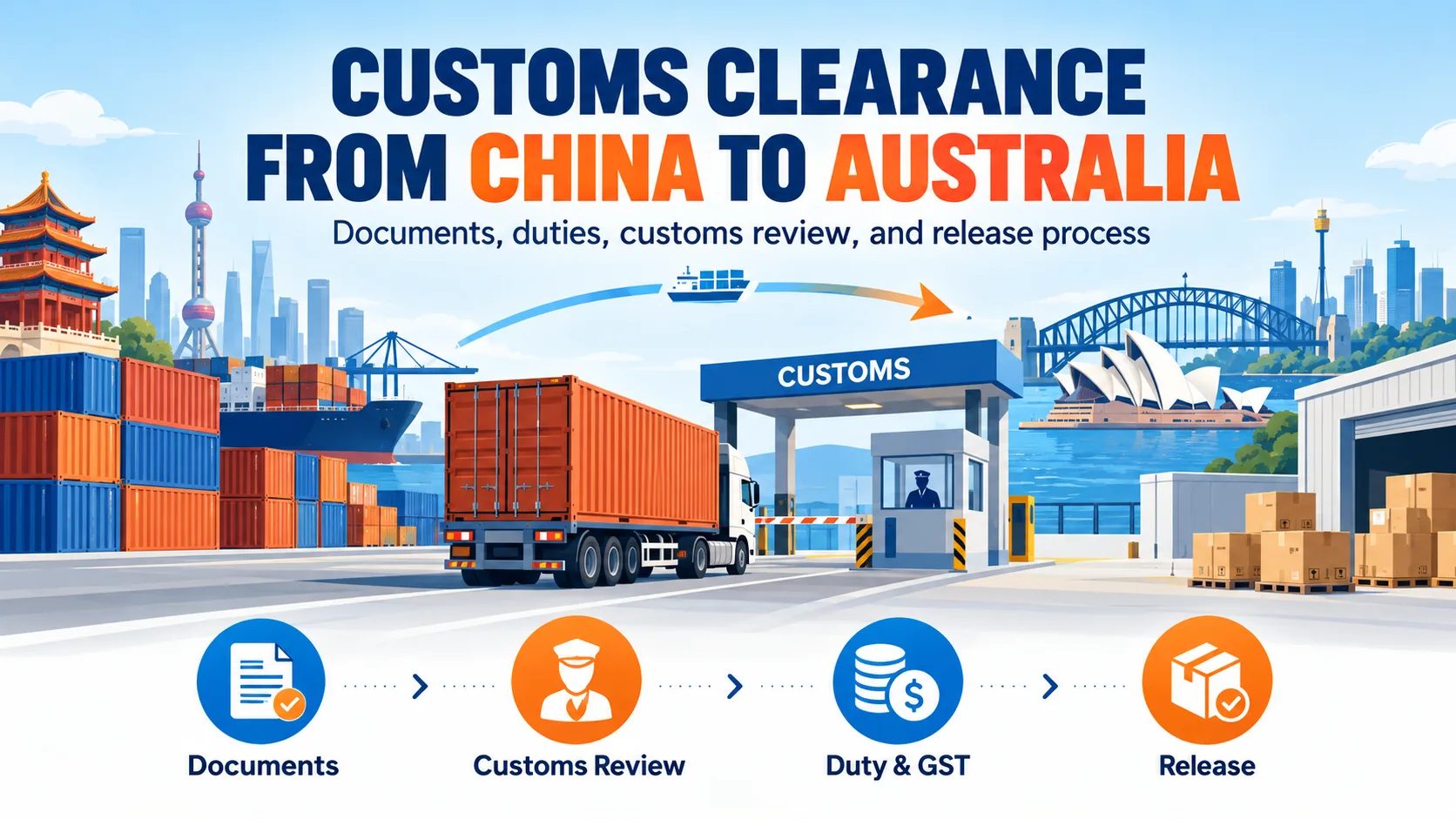
Customs clearance in Australia involves verifying imported goods, submitting the required declarations, assessing duties and taxes, and obtaining permission to release cargo.
The process is supervised by two main authorities:
Australian Border Force (ABF): Handles customs declarations, tariff classification, customs valuation, duties, GST, and border compliance
Department of Agriculture, Fisheries and Forestry (DAFF): Manages biosecurity controls, import permits, quarantine inspections, and treatment requirements
Both authorities may need to clear a shipment before the goods can be delivered.
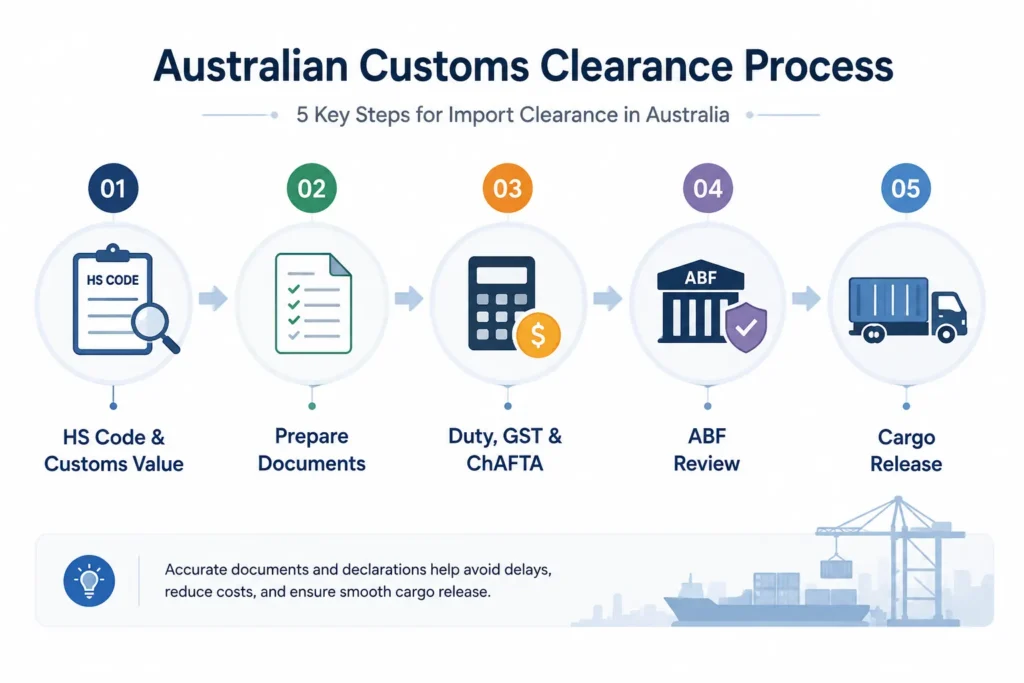
The standard import process generally follows these steps:
Check import requirements: Confirm the product’s HS code, import restrictions, and applicable biosecurity conditions.
Prepare shipping documents: Obtain the commercial invoice, packing list, transport document, and any required certificates.
Submit customs information: The importer or licensed customs broker lodges the appropriate declaration through Australia’s Integrated Cargo System (ICS).
Assess duties and GST: Customs determines the applicable tariff treatment, taxable value, and government charges.
Complete inspections if required: ABF or DAFF may request documents, examine goods, or order biosecurity treatment.
Obtain cargo release: Once all customs and biosecurity requirements are satisfied, the cargo can proceed to collection and delivery.
For most commercial consignments valued above AUD 1,000, a Full Import Declaration (N10) is required.
Goods valued at AUD 1,000 or less and arriving by sea or air cargo generally use a Self-Assessed Clearance (SAC) declaration, subject to applicable exceptions.
Importers should begin document preparation before the shipment leaves China rather than waiting for its arrival in Australia.
Accurate documentation is essential for customs clearance from China to Australia. Missing certificates, inconsistent cargo descriptions, or incorrect declared values can result in inspections and additional charges.
Most commercial shipments require the following documents:
Commercial Invoice: Identifies the buyer, seller, product descriptions, quantities, prices, currency, and agreed Incoterms
Packing List: Provides package quantities, carton dimensions, gross and net weights, and packaging details
Bill of Lading (B/L): Confirms the transportation details for sea freight shipments
Air Waybill (AWB): Provides the transport and consignment details for air cargo
Import Declaration: Records the goods, customs value, tariff classification, importer information, and applicable duties
Certificate of Origin: Supports a claim for preferential tariff treatment under ChAFTA when required
The information across the commercial invoice, packing list, and transport documents should be consistent.
Importers preparing their first commercial shipment can also review the documents required to import from China before arranging cargo collection.
Depending on the product category and shipping method, Australian authorities may require additional documentation.
Common examples include:
Packing Declaration: Required for relevant containerised sea freight to declare packaging materials and container cleanliness
Import Permit: Required for certain regulated or biosecurity-sensitive commodities
Treatment Certificate: May be necessary for timber packaging or products requiring approved treatment
Product Compliance Documents: May include test reports, safety certifications, or other evidence required under applicable Australian regulations
Not every shipment needs every certificate. The correct documentation depends on the imported product, packaging materials, country of origin, and relevant import conditions.
The cost of clearing goods imported from China into Australia depends on their customs value, tariff classification, origin, declaration requirements, and biosecurity status.
The main government-related costs may include customs duty, Goods and Services Tax (GST), import processing charges, and applicable biosecurity fees.
Australia applies different customs duty rates depending on the imported goods and their tariff classification.
Many ordinary manufactured products have general tariff rates of 0% or 5%, although other rates and special duties may apply.
Under the China–Australia Free Trade Agreement (ChAFTA), qualifying Chinese-origin goods can benefit from preferential tariffs.
To claim preferential treatment, importers should:
Determine the correct Australian tariff classification
Confirm that the product meets the relevant ChAFTA rules of origin
Obtain an appropriate Certificate of Origin or other qualifying origin documentation
Ensure the preferential duty claim is correctly entered in the import declaration
Goods shipped from China do not automatically qualify as Chinese-origin goods.
ChAFTA preferential treatment also does not eliminate applicable GST, import processing fees, biosecurity charges, or separate trade remedies such as anti-dumping duties.
Australia generally applies 10% GST to taxable imported goods.
GST is calculated using the Value of the Taxable Importation (VoTI), which normally includes the customs value, applicable customs duty, international transport, and insurance costs not already included in the customs value.
Import GST = (Customs Value + Customs Duty + International Freight and Insurance) × 10%
Additional taxes or adjustments may apply to certain goods.
For example, consider a commercial shipment imported from China:
| Cost Component | Amount (AUD) |
|---|---|
| Customs value | $8,000 |
| International freight and insurance | $1,000 |
| Customs duty under an eligible 0% tariff | $0 |
| GST calculation base | $9,000 |
| Import GST (10%) | $900 |
In this example, the importer pays AUD 900 in import GST, assuming the goods qualify for zero customs duty and no other taxes affect the calculation.
The government import processing charge and any applicable brokerage, biosecurity, or local handling fees are additional.
Eligible GST-registered businesses may also be able to use Australia’s Deferred GST Scheme, subject to approval and scheme requirements.
The Australian Border Force applies Import Processing Charges (IPC) when qualifying import declarations are lodged.
For standard electronic import declarations, the published charges are:
| Shipment Type | Estimated Time | Key Considerations |
|---|---|---|
| Express Parcels (≤ AUD 1,000) | Within hours to 1 business day | Simplified clearance for eligible goods |
| Air Freight | 1–2 business days | Documentation, customs assessment, and cargo availability |
| Sea Freight (FCL) | 1–3 business days | Container release, customs checks, and biosecurity clearance |
| Sea Freight (LCL) | 3–7 business days | Includes container unloading, CFS deconsolidation, and cargo availability |
These are government import processing charges, not the complete cost of customs clearance.
Additional expenses may include:
Licensed customs broker service fees
DAFF biosecurity assessment or inspection charges
Fumigation or other approved treatment costs when required
Port, terminal, storage, and cargo handling fees
Local delivery and transport charges
Before shipping, request a breakdown showing government fees separately from brokerage and logistics services.
Tonlexing can help coordinate a China–Australia freight quotation that identifies the applicable customs clearance arrangements and destination charges.
Australia maintains strict biosecurity controls to protect its agriculture, environment, and local industries from pests and diseases.
Importers must consider biosecurity compliance separately from customs duties and GST.
The Department of Agriculture, Fisheries and Forestry uses the Biosecurity Import Conditions system (BICON) to determine whether goods are permitted, need special documentation, require treatment, or must have an import permit.
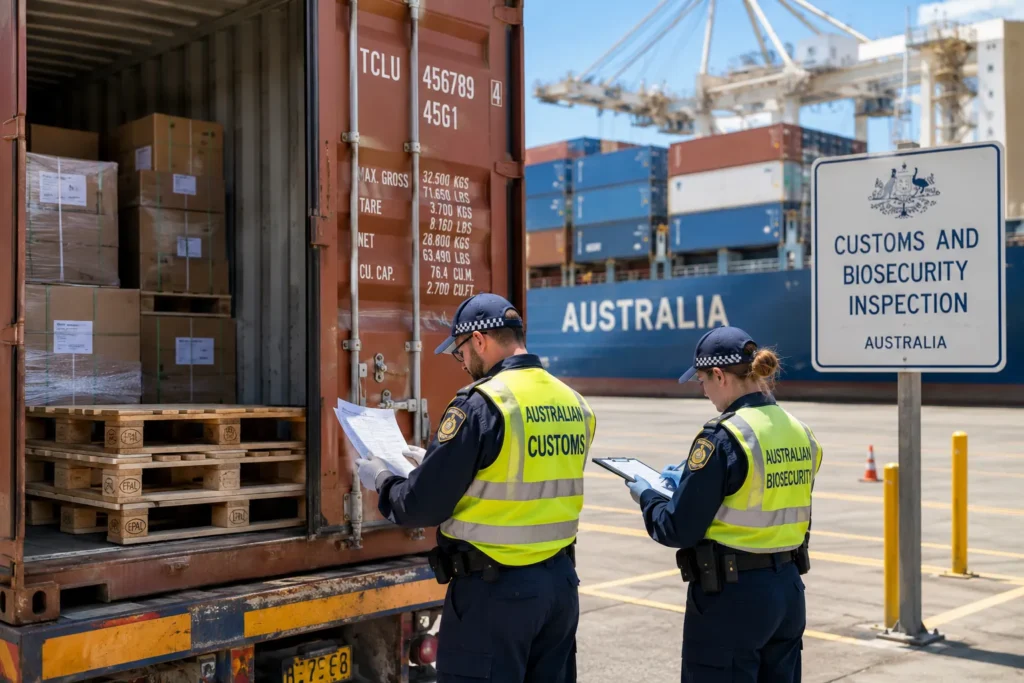
Before importing goods from China, check the relevant BICON conditions for the specific product.
Additional biosecurity requirements may apply to:
Timber, bamboo, and wooden products
Food and agricultural products
Plant materials and seeds
Animal products and biological materials
Used machinery or equipment contaminated with soil or plant material
Some products may be prohibited, while others can enter only when specific import conditions are satisfied.
Where an import permit is required, it must be granted before the goods arrive in Australia.
Containerised sea freight shipments generally require an appropriate packing declaration that identifies packaging materials and relevant container cleanliness information.
This applies to qualifying Full Container Load (FCL) and Less than Container Load (LCL) cargo.
Solid timber packaging, including wooden pallets, crates, and dunnage, must comply with applicable Australian biosecurity requirements.
Importers should verify that:
Timber packaging has received an accepted treatment where required
ISPM 15 markings are present when applicable
Packing declarations accurately identify timber packaging
Containers are clean and free from soil, insects, and plant or animal contamination
Fumigation is not automatically required for every shipment. The treatment requirement depends on the packaging, commodity, and relevant BICON conditions.
Australia may also conduct additional seasonal pest inspections. For the 2026–2027 brown marmorated stink bug (BMSB) season, certain shipments associated with China may be subject to heightened surveillance or random inspections, depending on the cargo and risk criteria.
Non-compliant goods may be held for examination, directed for treatment, exported, or destroyed at the importer’s expense.
The fundamental Australian customs requirements apply to commercial goods regardless of the transportation method.
However, sea freight, air freight, and express courier shipments involve different cargo handling procedures, documentation arrangements, and release schedules.
Sea freight from China to Australia is commonly used for machinery, furniture, construction materials, and large commercial shipments.
Customs declarations can be prepared before the vessel arrives, provided the required information is available.
The main considerations include:
FCL Shipments: Customs and biosecurity clearance must be completed before the container can be released for collection or onward transport
LCL Shipments: Cargo must also undergo deconsolidation at the designated facility before individual consignments become available
Container Documentation: Packing declarations, timber treatment evidence, and other biosecurity records must be supplied when applicable
Port Charges: Terminal handling, storage, inspections, and local transport may affect the final delivery cost
Even when the customs declaration has been accepted, physical cargo availability depends on terminal operations and any outstanding biosecurity requirements.
Air freight from China to Australia is generally used for urgent commercial goods, smaller shipments, and high-value cargo.
Air shipments require accurate commercial invoices, packing lists, and Air Waybills.
Express courier companies may coordinate customs declarations and clearance for eligible parcels, while larger commercial air freight shipments commonly involve a freight forwarder and licensed customs broker.
Important differences include:
Air cargo generally becomes physically available sooner than containerised sea freight
Express shipments may use courier-managed declaration procedures
Goods valued above AUD 1,000 generally require a Full Import Declaration
Regulated products remain subject to applicable customs and biosecurity requirements
Choosing a faster shipping method does not exempt goods from import duties, GST, or inspections.
Customs clearance in Australia typically takes 24–48 hours for routine shipments with complete documentation, accurate declarations, and no inspection requirements. However, some shipments may take 1–3 business days, depending on the shipping method, cargo type, and customs procedures.
Goods can often be cleared before arrival when declarations are submitted in advance. However, customs clearance does not always mean the cargo is immediately available for delivery.
| Shipment Type | Estimated Time | Key Considerations |
|---|---|---|
| Express Parcels (≤ AUD 1,000) | Within hours to 1 business day | Simplified clearance for eligible goods |
| Air Freight | 1–2 business days | Documentation, customs assessment, and cargo availability |
| Sea Freight (FCL) | 1–3 business days | Container release, customs checks, and biosecurity clearance |
| Sea Freight (LCL) | 3–7 business days | Includes container unloading, CFS deconsolidation, and cargo availability |
These are indicative logistics planning estimates, not guaranteed government processing times. LCL estimates include cargo handling after customs assessment.
For shipments valued above AUD 1,000, a Full Import Declaration is generally required. Eligible lower-value sea and air cargo may be processed through a Self-Assessed Clearance (SAC) declaration.
Australia’s strict biosecurity requirements can extend clearance times, particularly for timber packaging, food products, agricultural goods, and other regulated cargo.
Common causes of delays include:
DAFF inspections: Physical examinations or document reviews may add several business days
Fumigation or treatment: Goods requiring treatment may face additional handling and processing delays
Missing documents: Incorrect invoices, packing declarations, or import permits can prevent release
Seasonal pest controls: Selected goods from China may undergo additional inspections during the September–April Brown Marmorated Stink Bug (BMSB) risk season
To speed up customs clearance, importers should prepare accurate documents, check BICON requirements, and arrange customs declarations before cargo arrival.
Tip: For sea freight, coordinate customs and biosecurity documentation with your freight forwarder before the vessel reaches Australia. Early preparation can help reduce storage charges and delivery delay
Customs clearance delays in Australia often result from incorrect shipping documents, inaccurate declarations, or failure to meet biosecurity requirements. These issues can lead to cargo inspections, additional storage charges, and delayed delivery.
Understanding the most common problems helps importers prepare shipments correctly before they leave China.
Incorrect HS Codes: Wrong tariff classifications may result in incorrect customs duties, additional assessments, or penalties.
Missing Shipping Documents: Incomplete commercial invoices, packing lists, or origin documents can delay customs processing.
Biosecurity Non-Compliance: Untreated timber packaging, contaminated containers, or restricted products may trigger DAFF inspections.
Incorrect Customs Value: Inaccurate declared values can lead to reassessment of import duties and GST.
Missing Import Permits: Certain food, agricultural, animal, and plant products require approval before importation.
Importers can reduce clearance risks by taking a few practical steps before shipping:
Verify Product Classification: Confirm Australian HS codes and applicable customs duty rates.
Prepare Accurate Documents: Ensure invoices, packing lists, and transport documents contain consistent information.
Check Biosecurity Requirements: Use Australia’s BICON system to identify import conditions and required permits.
Confirm ChAFTA Eligibility: Obtain valid origin documentation when claiming preferential customs duty.
Arrange Pre-Arrival Clearance: Work with a licensed customs broker to prepare declarations before cargo arrives.
Tip: Coordinate with your freight forwarder and Australian customs broker before shipment departure. Early document checks can help prevent unnecessary inspections, storage charges, and delivery delays.
Working with an experienced freight forwarder and licensed customs broker can simplify customs clearance from China to Australia. They help coordinate shipping documents, import declarations, customs duties, biosecurity requirements, and final cargo delivery.
While a freight forwarder manages transportation and logistics, a customs broker handles customs declarations and compliance with Australian Border Force (ABF) requirements.
Both services play important roles in the import process:
Customs Broker: Prepares import declarations, verifies HS codes, calculates duties and GST, and assists with customs compliance
Freight Forwarder: Arranges sea or air freight, coordinates shipping documents, manages cargo handling, and organizes delivery
Biosecurity Coordination: Helps arrange required documentation, DAFF inspections, and cargo treatment when necessary
Import declarations must be lodged by the goods owner or an appropriately licensed customs broker. Importers should confirm who is responsible for clearance before shipping.
DDP shipping from China to Australia offers a coordinated solution for importers who prefer the seller to arrange transportation, import clearance, and payment of applicable duties and taxes.
However, DDP shipments must still comply with Australian customs and biosecurity regulations. The importer of record and clearance responsibilities should be confirmed in advance.
Tonlexing supports importers with:
Sea freight and air freight arrangements
Shipping documentation and customs brokerage coordination
FCL, LCL, and cargo consolidation services
DDP and door-to-door delivery arrangements
Need help with customs clearance from China to Australia? Contact Tonlexing for a tailored freight quotation and customs clearance support based on your cargo details, shipping method, and delivery destination.
Many ordinary products have general customs duty rates of 0% or 5%. Eligible Chinese-origin goods may qualify for 0% preferential duty under ChAFTA. Actual rates depend on the tariff classification and applicable measures.
Routine shipments often clear within 1–3 business days when documents are complete. Inspections, biosecurity checks, or missing documentation may extend the processing time.
Commercial consignments valued above AUD 1,000 generally require a Full Import Declaration. Most goods valued at AUD 1,000 or less have different clearance arrangements, with exceptions for certain products.
Yes. Most taxable imports into Australia are subject to 10% GST, calculated using the applicable taxable importation value.
A Certificate of Origin is commonly used to support ChAFTA preferential tariff claims. Other qualifying origin documentation may be accepted under specific conditions.
Useful freight, customs and importing resources related to this shipping guide.
Shipping from China to Australia includes reliable sea freight and fast air shipping. Compare delivery time, shipping costs, and logistics option...
Read guide →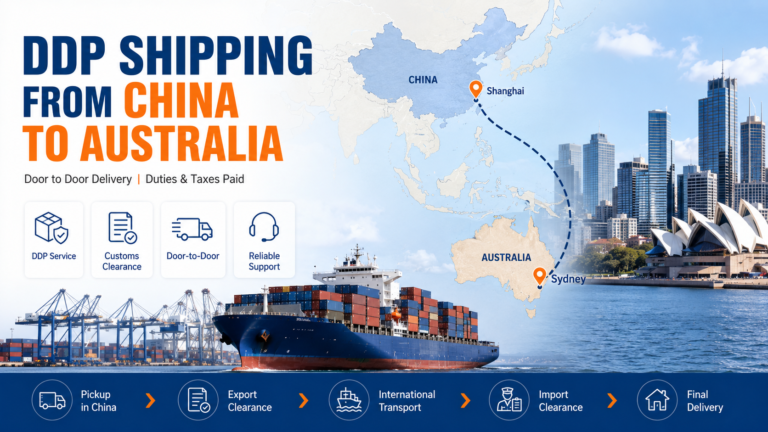
DDP Shipping from China to Australia Verified & Reviewed · Last updated June 2026 DDP shipping from China to Australia offers a simple door-to-do...
Read guide →
Freight Forwarder from China to Australia Verified & Reviewed · Last updated July 2026 Freight forwarding from China to Australia depends on your...
Read guide →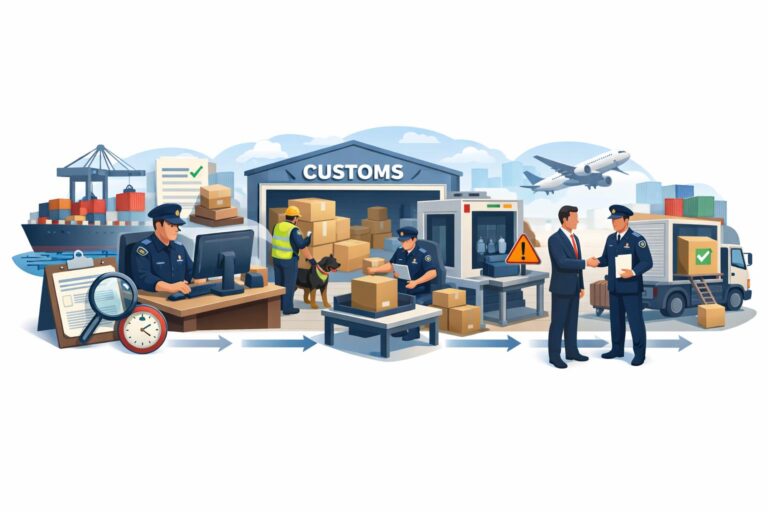
Customs Clearance Step by Step: The Complete Process Verified & Reviewed · Last updated February 2026 Customs clearance step by step helps intern...
Read guide →Introduction to Customs Clearance How to clear customs when importing from China is one of the most critical steps in international trade. Whethe...
Learn more → Useful Resource Documents Required to Import from China (2025 Guide)Importing goods from China can be highly profitable—but only when you understand the necessary documents and import requirements. Whether you’re...
Learn more →WhatsApp us