

FAS Incoterms Explained: Meaning, Costs and Responsibilities
- Verified & Reviewed · Last updated July 2026
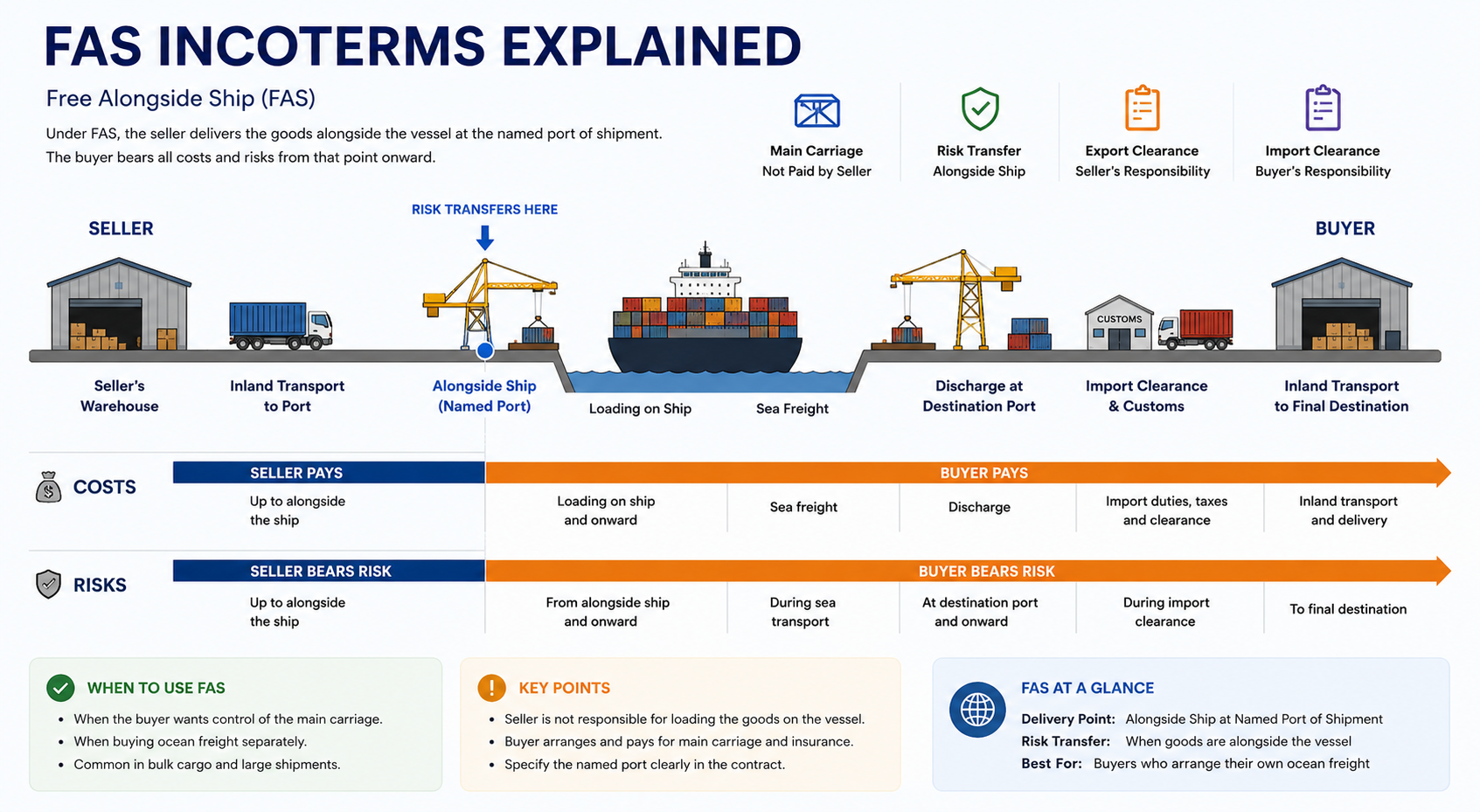
FAS stands for Free Alongside Ship. Under this Incoterm, the seller delivers the goods alongside the buyer’s nominated vessel at an agreed port of shipment.
This guide explains how FAS Incoterms work, including seller and buyer responsibilities, risk transfer, loading costs, suitable cargo types, and the differences between FAS, FOB and FCA.
Seller & Buyer Obligations
Risk Transfer & Costs
FAS vs FOB vs FCA
- Experienced China-based logistics specialists
Table of Contents
What Does FAS Mean in Shipping?
FAS (Free Alongside Ship) is one of the international trade terms published by the International Chamber of Commerce under the Incoterms rules. It is used only for sea or inland waterway transport and defines the point where delivery, costs and risks are divided between the seller and the buyer.
Under the FAS Incoterm, the seller must deliver the goods alongside the vessel nominated by the buyer at the agreed port of shipment. Delivery is completed once the cargo is placed beside the ship, such as on a quay, wharf or barge. The seller is not responsible for loading the goods onto the vessel.
From that delivery point, risk transfer occurs immediately. The buyer assumes the risk of loss or damage, pays the loading costs, arranges the main freight and completes import formalities at the destination.
FAS is designed for bulk cargo, breakbulk cargo and oversized project cargo that can be delivered directly alongside a ship. It is commonly used for products such as steel, timber, machinery, boats, tractors and wind turbine blades.
However, FAS is generally not suitable for containerized cargo. Most containers are handed over at a container terminal before the vessel arrives, making FCA (Free Carrier) the more appropriate Incoterm in those situations.
A complete FAS clause should always specify the exact port of shipment. For example:
FAS Port of Shanghai, China, Incoterms 2020
The sales contract should also identify the specific delivery location within the port, the agreed delivery date, and the vessel nominated by the buyer to avoid disputes over delivery, costs and responsibilities.
How Does FAS Work?
A typical FAS shipment involves coordination between the supplier, purchaser, freight forwarder, carrier and port operator.
The buyer nominates a vessel
The buyer selects the carrier and books a suitable ship. The seller should receive the vessel name, berth, cargo cut-off time and expected arrival schedule early enough to arrange transportation.
The vessel nominated must be capable of receiving the cargo. For heavy equipment or out-of-gauge goods, the purchaser should confirm crane capacity, deck space and securing requirements.
The seller prepares the cargo
The seller prepares the goods according to the sales contract. This normally includes export packing, marking, weighing and preparing the commercial invoice and packing list.
Special cargo may also require technical drawings, lifting points, centre-of-gravity markings or handling instructions.
The seller completes export clearance
The seller handles export customs clearance and obtains any permits required in the country of origin.
Product descriptions, quantities, values, weights and HS codes should match across the commercial invoice, packing list and customs documents. Inconsistent information can delay the shipment.
The seller delivers the goods alongside the ship
The seller arranges domestic transportation from the factory or warehouse to the port of shipment.
Merely entering the port area does not complete the seller’s obligations. The cargo must reach the specific port location stated in the contract and be positioned alongside the vessel nominated by the buyer.
The buyer takes over the shipment
Once the goods are alongside the ship, the buyer assumes the remaining costs and risks. These include lifting the cargo onto the vessel, ocean freight, insurance when purchased, destination charges and inland transport after arrival.
Seller’s Obligations Under FAS
The seller is responsible for bringing export-cleared cargo to the agreed location beside the ship.
The seller’s obligations normally include:
Supplying goods that meet the purchase agreement
Preparing the commercial invoice
Packing and marking the cargo
Paying transportation costs to the named port
Completing export customs clearance
Obtaining required export permits
Placing the goods alongside the vessel
Notifying the buyer that the cargo is ready
Providing proof of handover
Proof of handover may be a dock receipt, terminal receipt or another document confirming that the goods have reached the agreed location.
The seller pays all normal expenses required to deliver the goods to that point. However, the seller does not pay the main freight, destination port charges or import duties.
Buyer’s Obligations Under FAS
The buyer’s obligations begin before the goods arrive at the port because the buyer must nominate a suitable ship and provide accurate instructions.
The buyer is responsible for:
Booking the main carriage
Providing the vessel name and berth information
Accepting the goods at the agreed location
Paying loading costs
Arranging marine cargo insurance when needed
Paying ocean freight
Completing import formalities
Paying import duties and taxes
Managing transportation from the destination port
Arranging final delivery
The buyer bears the transportation risks after the contractual handover has occurred. For project cargo, the purchaser should also coordinate crane operations, lifting plans and cargo securing with the carrier.
If the buyer provides incorrect information or fails to nominate a ship on time, the seller may be unable to complete the agreed handover. The contract should explain who pays additional costs caused by delays, berth changes or missed vessel schedules.
When Does Risk Transfer Under FAS?
Risk transfer occurs when the goods are placed alongside the vessel at the agreed point within the named port.
At that moment, the risk of loss or damage transfers from the seller to the buyer. The cargo does not have to be on board for this change to occur. This is the central feature of FAS Free Alongside Ship.
For example, suppose a manufacturer delivers an industrial machine to the quay beside the buyer’s ship. The machine is then damaged while being lifted onto the vessel. The loss would normally fall on the buyer because the goods had already been delivered alongside the ship.
Risk transfer should not be confused with the transfer of legal ownership. Incoterms define costs, risks and transport responsibilities, but they do not determine:
When ownership changes
When payment must be made
Which law governs the transaction
How disputes are resolved
These matters should be covered separately in the sales contract.
What happens when the ship is delayed?
A delayed ship may lead to storage, repositioning and handling charges.
The agreement should explain what happens when:
The ship arrives later than scheduled
The berth changes
The carrier refuses to receive the goods
The purchaser submits late instructions
The cargo exceeds the port’s free storage period
If the buyer fails to provide the required vessel information, the buyer may have to bear certain additional costs and risks before the usual handover can take place.

Who Pays the Costs Under FAS?
The cost division is based on the point where the goods are placed beside the ship.
| Cost or activity | Seller | Buyer |
|---|---|---|
| Export packing and marking | Yes | No |
| Commercial invoice and export documents | Yes | No |
| Transport to the agreed port | Yes | No |
| Export customs clearance | Yes | No |
| Placement alongside the vessel | Yes | No |
| Loading the goods onto the vessel | No | Yes |
| Main ocean freight | No | Yes |
| Cargo insurance | Not required | Usually arranged |
| Destination port charges | No | Yes |
| Import customs clearance | No | Yes |
| Import duties and taxes | No | Yes |
| Inland transport after arrival | No | Yes |
FAS is not a carriage paid or insurance paid arrangement. Neither party is automatically required to purchase insurance under this shipping term.
However, because the buyer takes the risk before the cargo is on board, insurance should normally begin no later than the moment the goods are placed beside the ship.
Port invoices can sometimes combine several services into one charge. The parties should clarify responsibility for:
Quay handling
Temporary storage
Crane positioning
Lifting onto the vessel
Barge services
Lashing and securing
Clear cost allocation prevents both parties from being charged for the same service.
When Should You Use FAS?
The FAS term works best when cargo can be delivered directly to the ship and the buyer wants control over vessel selection, loading arrangements and international freight.
Bulk cargo
FAS is often used for commodities that are shipped without standard containers, including:
Grain
Coal
Ore
Fertilizer
Cement
Timber
Petroleum products
Steel materials
The seller brings the goods alongside the ship, while the buyer manages the transfer onto the vessel and the main carriage.
Breakbulk cargo
Breakbulk goods are handled as individual pieces rather than packed inside standard containers.
Examples include:
Industrial machinery
Generators
Steel coils
Pipes
Boats
Tractors
Structural components
FAS can be appropriate when these goods are moved to a berth and lifted by ship-mounted or shore-based cranes.
Oversized project cargo
FAS is particularly useful for project cargo requiring a chartered or heavy-lift ship.
Typical examples include:
Wind-turbine blades
Pressure vessels
Mining equipment
Modular structures
In these cases, the buyer may prefer to control the carrier, crane arrangements and lifting plan.
Why FAS Is Not Suitable for Containerized Cargo
FAS should generally not be used for containerized cargo.
A sealed container is usually handed to a terminal operator before the nominated ship arrives. It may remain inside the container terminal for several days before being moved to the quay and loaded.
The supplier therefore does not physically place the goods alongside the ship. Using FAS would create a gap between the contractual handover point and the actual logistics process.
For containers, FCA Free Carrier is normally more appropriate. Under FCA, the seller can complete its obligations when the container is handed to the carrier or terminal operator at the named location.
For example: FCA Yantian International Container Terminal, Shenzhen, China, Incoterms 2020
This makes the contractual handover correspond with the physical transfer of control. ICC guidance also identifies FCA as the more suitable choice when containerized goods are delivered to a terminal before being loaded on board.
FAS should also be avoided when:
Goods are shipped by air, rail or road
Several transport modes are combined
Cargo is delivered to an inland depot
The supplier cannot access the vessel-side area
The purchaser cannot manage the main carriage
FAS vs FOB vs FCA
FAS, FOB and FCA all allow the buyer to arrange the main international transport, but they use different handover points.
| Term | Permitted transport | Handover point | Who places cargo on board? | Common use |
|---|---|---|---|---|
| FAS | Sea and inland waterway | Alongside the vessel | Buyer | Bulk, breakbulk and project cargo |
| FOB | Sea and inland waterway | On board the vessel | Seller | Non-containerized maritime cargo |
| FCA | Any transport mode | Named carrier handover point | Depends on location | Containers and multimodal shipments |
FAS vs FOB
Under FAS, the seller places the cargo beside the ship. The buyer is responsible for loading the goods onto the vessel.
Under FOB terms, the seller must place the cargo on board before its responsibility ends. FAS transfers risk alongside the ship, while FOB transfers risk after the goods are on board.
FAS may be better when the buyer has chartered a ship or contracted a specialist lifting company. FOB may be more practical when the supplier already controls port handling.
FAS vs FCA
FAS applies only to sea and inland waterway transport. FCA can be used for road, rail, air, sea or multimodal freight.
FAS requires the cargo to be placed beside a ship. FCA permits handover at a factory, warehouse, freight terminal, inland depot or container terminal.
For containerized cargo, FCA normally provides a more accurate handover point.
FAS vs DDP
FAS is an origin-port term. The seller’s work ends before the goods are placed on board.
Delivered Duty Paid is a destination-based term. Under DDP, the supplier normally arranges transport to the named destination and handles import customs clearance and duties.
The level of responsibility placed on the supplier is therefore much higher under DDP.
Frequently Asked Questions
FAS means Free Alongside Ship. The seller delivers export-cleared goods alongside the buyer’s nominated ship at a named port of shipment.
The buyer pays the main ocean freight. The seller pays the costs required to bring the cargo to the agreed point beside the ship.
The buyer pays for loading the goods onto the vessel. This is the main difference between FAS and FOB.
The risk of loss transfers when the goods have been placed alongside the ship at the agreed location and within the agreed period.
No. Neither party is required to buy insurance. However, the buyer normally arranges coverage because the buyer takes the risk before the cargo is placed on board.
Related Incoterms & Shipping Guides
Get an FAS Shipping Quote from China
- Clear origin port cost breakdown
- Support for bulk and project cargo
- Experienced vessel-side coordination
Get tailored FAS shipping options, transparent pricing, and expert support from factory pickup to delivery alongside the vessel.