
How to Minimize Amazon Seller Fees and Boost Your Profit Margins
- Verified & Reviewed · Last updated July 2026
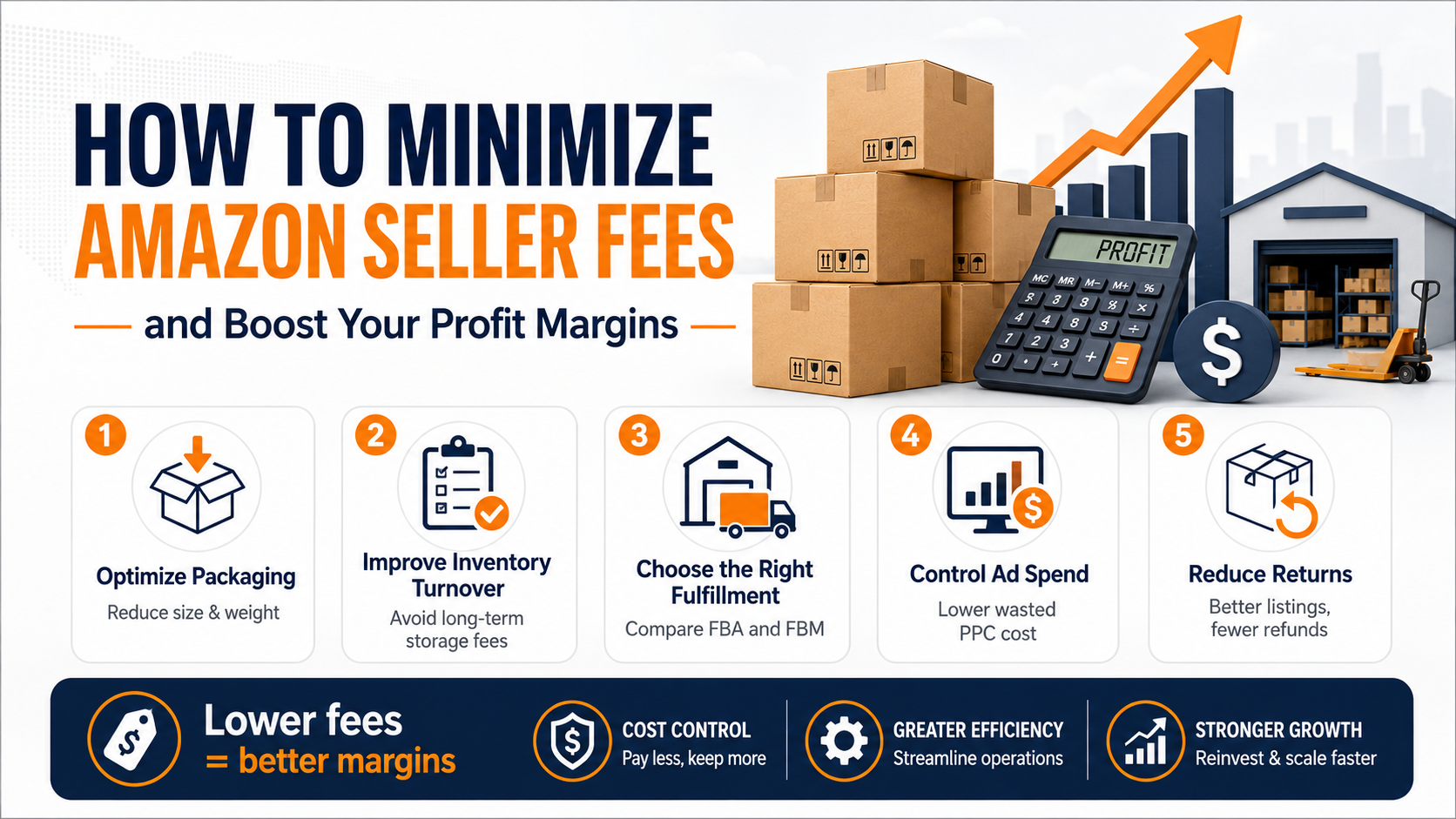
How to minimize Amazon seller fees and boost profit margins is one of the biggest challenges for Amazon sellers. Referral fees, FBA fulfillment charges, storage fees, advertising costs, returns, and inbound logistics can quickly reduce profitability if they are not carefully managed.
This guide explains how to lower Amazon selling costs, reduce FBA and storage fees, improve inventory turnover, compare FBA with FBM, control ad spend, and build healthier profit margins for each product.
Amazon Fees
Inventory & Storage
Profit Margin Strategies

- Experienced China-based logistics specialists
Table of Contents
How Can You Reduce Amazon Seller Fees?
The most effective strategy is to track profitability at SKU level instead of relying on total account revenue. Each product should be evaluated after Amazon fees, fulfillment costs, storage, advertising, returns, preparation, and inbound shipping have been deducted.
The highest-impact actions usually include:
Reducing packaged dimensions and weight
Improving inventory turnover
Keeping reserve stock outside Amazon
Checking product category classification
Comparing FBA, FBM, and third-party fulfillment
Auditing product measurements and settlement reports
Controlling unprofitable ad spend
Improving inbound carton utilization
Adjusting prices based on actual costs
Removing products that cannot achieve a sustainable margin
The right combination depends on the product category, package size, sales volume, average selling price, lead time, and fulfillment method.
A lightweight, fast-selling item may remain well suited to Amazon FBA. A bulky, seasonal, or slow-moving SKU may perform better through Fulfillment by Merchant or a hybrid model using a third-party warehouse.
Understand the Full Amazon Fee Structure
Amazon fees are not limited to a single commission. The final cost of selling depends on the marketplace, selling plan, product category, fulfillment model, package dimensions, inventory age, advertising activity, and optional services used.
Before trying to save money, divide the expenses into clear groups.
Referral Fees
Referral fees are generally calculated as a percentage of the amount paid by the customer. The applicable rate depends on the product category, and some categories may also have a minimum referral fee.
Incorrect classification can lead to unnecessary overcharging. A product placed in the wrong category may be subject to a different percentage or fee structure.
Review:
The category assigned to each ASIN
The referral percentage shown in Seller Central
Whether a minimum referral fee applies
Category-specific conditions
Recent fee changes
The classification of bundles and variations
Do not move a product into an inaccurate category simply to obtain lower referral fees. The classification should reflect the product’s actual purpose, specifications, and listing content.
Selling Plan and Category-Specific Charges
Amazon sellers can choose between different selling plans. The correct option depends on monthly order volume and the tools required by the business.
Individual seller fees may include a charge for each item sold, while a professional selling plan normally uses a recurring subscription. Some marketplaces and product categories may also apply closing fees or other category-specific charges.
Consider:
Expected monthly sales volume
Access to advertising tools
Bulk listing requirements
Reporting needs
Category eligibility
Subscription costs
Per-item charges
The cheapest plan is not always the most suitable. Sellers should compare the total cost and operational value of each option.
FBA Fulfillment Fees
FBA fulfillment fees cover services such as picking, packing, shipping, customer support, and other fulfillment activities.
The cost per unit is influenced by:
Packaged dimensions
Shipping weight
Product type
Size tier
Marketplace
Current Amazon fee rules
A product that crosses a size or weight threshold by a small amount may move into a more expensive fee tier. This is why packaging optimization can have such a significant effect on FBA costs.
Storage and Inventory-Related Fees
Amazon charges monthly storage fees for inventory held in its fulfillment network. Storage costs vary according to product size, season, marketplace, and the length of time units remain unsold.
Additional inventory-related charges may include:
Aged inventory fees
Storage overage fees
Low-inventory fees
Removal and disposal fees
Liquidation charges
Stranded inventory costs
Long-term storage fees and aged inventory charges can make weak products increasingly difficult to recover. Sellers should confirm current rates and thresholds in Seller Central before forecasting expenses.
Advertising, Returns, and Hidden Costs
Some of the most damaging expenses do not appear in a basic fulfillment estimate.
Common hidden costs include:
Sponsored advertising
Returns processing fees
Customer refunds
Damaged or unsellable inventory
Inbound placement charges
Labeling and preparation
Customs duties
International freight
Currency conversion
Software subscriptions
Third-party warehouse charges
A listing may appear profitable until these expenses are included.
Calculate True Profitability at SKU Level
Account-wide sales can hide underperforming products. A few strong listings may support several SKUs that generate revenue but little actual profit.
Use SKU-level profit tracking to monitor the true margin of individual products.
A practical formula is:
Net Profit per Unit = Revenue per Unit − Product Cost − Amazon Fees − Fulfillment Costs − Inbound Logistics − Advertising − Returns Allowance − Other Variable Costs
Then calculate:
Net Profit Margin = Net Profit per Unit ÷ Revenue per Unit × 100
Amazon seller fees can consume 30% to 45% of a product’s selling price, so tracking total costs at the SKU level matters.
Example SKU Profit Calculation
The following example is for illustration only, and it shows why revenue alone can be misleading unless you account for total costs.
| Cost Item | Amount per Unit |
|---|---|
| Customer payment | $40 |
| Product and packaging | $11 |
| Referral fee | $6 |
| Fulfillment | $7 |
| Freight and preparation | $3 |
| Advertising | $5 |
| Storage and returns allowance | $2 |
| Estimated net profit | $6 |
| Estimated net profit margin | 15% |
The product generates $40 in revenue, but only $6 remains after the main costs are deducted, which works out to a 15% margin and sits around the lower end of the commonly cited healthy 15% to 20% range. Looking only at sales would create a misleading picture of actual profitability.
Use Actual Costs Instead of Permanent Estimates
Pre-launch estimates are useful, but ongoing decisions should be based on real operating data.
Review:
Amazon settlement reports
Fee Preview estimates
Advertising reports
Supplier invoices
Freight invoices
Customs charges
Warehouse statements
Return records
Reimbursement data
Update the model whenever supplier pricing, packaging, freight rates, fulfillment terms, or Amazon policies change.
Add an Allowance for Irregular Expenses
Some expenses do not occur on every order, but they still affect true profit margins.
Examples include:
Lost inventory
Damaged units
Product recalls
Refunds without resale
Disposal fees
Removal orders
Chargebacks
Unexpected preparation work
Instead of ignoring these costs, calculate an average allowance using historical data.
When returns and damage cost $1,200 across 6,000 units, the seller can add an average allowance of $0.20 per unit to future calculations.
Optimize Packaging to Reduce FBA Fees
Packaging affects more than presentation. It influences FBA fulfillment fees, storage costs, inbound shipping, damage rates, and customer returns.
The goal is not to use the cheapest possible materials. The goal is to create the smallest and lightest package that still protects the product and meets Amazon requirements.
Reduce Unnecessary Dimensions
Supplier packaging is often designed around factory convenience rather than ecommerce fulfillment. Oversized inserts, thick materials, and empty space can increase both shipping and fulfillment costs.
Potential improvements include:
Removing unused internal space
Using fitted protective inserts
Folding flexible products more efficiently
Separating detachable components
Reducing excessive cardboard
Replacing bulky manuals with compact instructions
Designing packaging around relevant size thresholds
A small dimensional reduction may move the product into a lower fee tier, creating savings on every unit sold.
Reduce Weight Without Reducing Protection
Lighter materials may lower both inbound freight and fulfillment expenses.
Possible changes include:
Lighter inserts
Thinner but tested cartons
Reduced plastic components
Smaller printed materials
Better product arrangement
More efficient protective materials
Do not remove protection purely to reduce weight. Product damage, returns, and negative reviews may cost more than the expected saving.
Verify Amazon’s Recorded Measurements
Amazon may remeasure products after inventory arrives at an Amazon fulfillment center. Incorrect dimensions or weight can lead to repeated overcharging.
Compare:
Supplier specifications
Your own package measurements
Seller Central data
The assigned product size tier
Actual fulfillment deductions
When the recorded figures appear incorrect, request a remeasurement and keep supporting photos, technical specifications, and packaging records.
Improve Inventory Management and Lower Storage Fees
Poor inventory management creates more than storage fees. It ties up cash, increases aged inventory exposure, and leaves sellers with fewer options when demand slows.
The objective is to maintain enough stock to support sales without using Amazon fulfillment centers as long-term warehouses.
Monitor Sell-Through by SKU
Sell-through measures how efficiently stock moves compared with the amount available.
Review it at SKU level because strong products can hide stagnant inventory in account-wide reports.
Weak sell-through may result from:
Over-ordering
Seasonal demand
High prices
Poor conversion
Ineffective advertising
Too many variations
Weak differentiation
Inaccurate forecasts
Use recent sales velocity rather than optimistic projections when planning replenishment.
Maintain Healthy Inventory Turnover
Healthy inventory turnover reduces storage exposure and keeps working capital available for stronger products.
The correct turnover rate varies by product type, lead time, seasonality, and business model. For many products, maintaining an inventory turnover rate of 4-6 is a useful benchmark, though the ideal level still depends on lead time and seasonality. Sellers should focus on whether stock is moving fast enough to avoid excessive holding costs.
A product with slow turnover may require:
Smaller purchase orders
Reduced FBA replenishment
Better listing content
Price adjustments for slow sellers
Bundling
Alternative sales channels
Discontinuation
Keep Reserve Stock Outside Amazon
One practical approach is to hold bulk inventory with a supplier, local warehouse, or third-party logistics provider and send smaller replenishment batches into FBA, which reduces storage costs, especially when demand is uneven or replenishment batches are large.
This can:
Reduce monthly storage fees
Lower aged inventory risk
Improve cash flow
Support multiple sales channels
Reduce exposure during listing suspensions
Make seasonal inventory easier to manage
The replenishment plan should include production time, international transit, customs clearance, warehouse handling, and Amazon receiving delays.
Monitor the Inventory Performance Index
The Inventory Performance Index reflects several aspects of FBA inventory health.
Sellers should regularly review:
Excess inventory
Stranded listings
In-stock performance
Sell-through rate
Listing issues
Restock recommendations
Improving the IPI score may provide greater storage flexibility and reduce the risk of overage fees.
Stranded inventory should be corrected quickly. Units that cannot be purchased may continue generating storage costs without producing revenue.
Act Before Inventory Becomes Severely Aged
Do not wait until long-term storage fees make recovery difficult. Create an internal action plan based on inventory age, demand, and remaining margin.
| Inventory Status | Recommended Action |
|---|---|
| Selling as forecast | Continue normal replenishment |
| Slower than forecast | Reduce the next shipment and improve conversion |
| Low-velocity stock | Test pricing, advertising, or bundling changes |
| Aging inventory | Compare discounts, liquidation, removal, and other sales channels |
| Unprofitable stock | Stop replenishment and choose the lowest-loss exit option |
The correct decision should be based on expected recovery value, future storage costs, and the cost of moving stock elsewhere.

Choose the Right Fulfillment Model
Amazon FBA is convenient, but it is not automatically the most profitable solution for every product.
Compare fulfillment methods using total cost per order, product dimensions, delivery expectations, operational capacity, and inventory risk.
Fulfillment by Amazon
Amazon FBA is often suitable for products that are:
Small and lightweight
Fast-moving
Easy to standardize
Profitable after fulfillment charges
Dependent on fast delivery
Supported by predictable demand
It can reduce the operational burden for many sellers who do not want to handle individual customer shipments. For some products, FBA fees can consume 30-40% of revenue, which is why product-level comparison matters.
However, Amazon FBA fees may become difficult to control when products are oversized, seasonal, fragile, customized, or slow-moving.
Fulfillment by Merchant
FBM allows the seller or a logistics partner to manage storage, packing, shipping, and customer service.
Using Fulfillment by Merchant for oversized products can lower shipping costs in some situations, especially when the seller already has access to competitive warehousing and delivery services.
FBM may be more suitable for:
Large or heavy products
Low-volume listings
Customized items
Products requiring special handling
Inventory shared across several channels
Goods that are expensive to store with Amazon
FBM gives sellers greater control over their own storage and shipping, but it also requires reliable order handling and customer support, and it can be a practical fallback for slow sellers that are expensive to hold in FBA.
Seller Fulfilled Prime
Seller Fulfilled Prime may allow qualified sellers to maintain Prime eligibility while shipping from their own facilities.
The program requires strict performance standards, including reliable delivery, order accuracy, and account health. Availability and eligibility requirements should be confirmed directly with Amazon before building a fulfillment strategy around it.
Hybrid FBA and Third-Party Fulfillment
A hybrid model combines Amazon FBA with external storage.
The third-party warehouse holds reserve inventory and supports activities such as:
Receiving
Inspection
FNSKU labeling
Repacking
Bundling
Pallet preparation
FBA replenishment
Removal order processing
Multichannel fulfillment
Using third-party logistics can reduce reliance on Amazon storage, particularly when production quantities are larger than immediate demand.
External warehousing is not automatically cheaper. Compare receiving fees, storage rates, handling charges, transportation, and minimum monthly costs.
Reduce Inbound Shipping and Preparation Costs
Inbound logistics affects every unit before it becomes available for sale. International freight, domestic transportation, customs clearance, preparation, and Amazon delivery should all be included in the landed cost.
Consolidate Multiple Suppliers
When products come from several factories, sending each shipment separately can create duplicated pickup, documentation, and handling charges.
A consolidation warehouse can:
Receive goods from multiple suppliers
Check quantities
Inspect packaging
Verify labels
Repack cartons
Combine compatible cargo
Prepare final Amazon shipments
Consolidation is especially useful when individual orders are too small for economical international transportation.
Compare Shipment Split Options
Amazon may offer different placement or shipment split options.
Do not compare only the fee shown during shipment creation. Include:
Amazon placement charges
Freight to each destination
Carrier minimums
Pallet handling
Appointment delivery
Labels and documentation
Warehouse labor
Administrative time
Minimal Shipment Splits may simplify inbound operations, while other split options may lower certain Amazon charges. The lowest-cost choice depends on shipment size, destination, and transportation expenses.
Improve Carton and Pallet Utilization
Poor carton utilization increases dimensional weight, freight charges, and storage requirements.
Review:
Units per master carton
Carton dimensions
Gross weight
Pallet stacking
Container utilization
Product protection
Amazon receiving limits
For shipments from China, compare express delivery, air freight, LCL sea freight, and FCL shipping based on cargo volume, urgency, landed cost, and replenishment requirements.
Control Advertising Costs Without Sacrificing Growth
Advertising can improve visibility and sales, but uncontrolled ad spend can turn a healthy gross margin into a weak net margin.
The objective is not to eliminate advertising. It is to invest in traffic that generates profitable orders or supports measurable organic growth.
Calculate Break-Even Advertising Spend
Start by determining how much remains after all non-advertising expenses.
Break-Even Ad Spend per Order = Revenue per Order − All Non-Advertising Costs
When a product generates $35 and all other expenses total $28, only $7 remains for advertising and profit. Spending more than that to generate the order creates a loss.
This calculation should be completed for each SKU because product economics can vary significantly, and it helps control both ad spend and ad costs at the SKU level.
Use Different Targets for Different Products
A single advertising target does not work for every listing.
Consider:
Net margin before advertising
Conversion rate
Organic ranking
Repeat purchase potential
Return rate
Product lifecycle
Competitive intensity
Strategic importance
A new listing may temporarily accept lower profitability to build sales history. An established low-margin product may require much tighter campaign control.
Remove Waste at Search-Term Level
Campaign totals may hide individual search terms that consume budget without generating sales.
Review customer search-term data and:
Add negative keywords
Lower bids on weak terms
Move strong terms into focused campaigns
Separate branded and generic traffic
Remove irrelevant product targets
Review placement adjustments
Allocate more budget to profitable searches
Avoid making decisions from very small data samples. Campaigns need enough clicks and conversions to produce useful conclusions.
Improve Conversion Before Increasing Budget
Higher bids will not solve a weak listing.
Improve:
Main images
Product titles
Key benefits
A+ Content
Review quality
Price positioning
Variation structure
Delivery promise
Product differentiation
A stronger conversion rate allows the same advertising budget to produce more orders.
Audit Amazon Fees and Recover Incorrect Charges
Regular audits of seller fees can uncover incorrect dimensions, missing reimbursements, inventory discrepancies, and unexpected deductions.
High-volume products should receive priority because even a small overcharge per unit can create a significant loss over time.
Compare Fee Preview with Actual Deductions
The Fee Preview tool provides an estimate of referral and fulfillment charges.
Compare these figures with actual deductions, especially for:
High-volume products
Recently repackaged items
SKUs near size thresholds
Products with surprise fees
Listings with slim margins
Products with unusual fee increases
A small difference may have a meaningful effect when multiplied across thousands of units.
Review Amazon Settlement Reports
Amazon settlement reports can reveal:
Unexpected Amazon seller fees
Refund deductions
Advertising charges
Storage expenses
Reimbursements
Removal orders
Service fees
Inventory adjustments
A monthly review is easier than trying to investigate an entire year of transactions at once.
Track Lost, Damaged, and Returned Inventory
Compare:
Units shipped to Amazon
Units received
Inventory adjustments
Customer returns
Removal orders
Reimbursements
Unsellable stock
Returns should also be reviewed by reason. Repeated complaints about sizing, compatibility, missing parts, or packaging may indicate a listing or product problem.
Third-party tools can automate parts of the audit process and identify potential discrepancies. However, sellers should still verify claims and understand the underlying fee structures.
Improve Your Pricing Strategy and Product Mix
Lower costs alone may not create healthier margins. Some listings need a stronger price position, better differentiation, or a product-level decision.
Set Prices from Required Profit
Instead of copying the lowest competitor, calculate the price required to support the desired margin.
A simplified formula is:
Required Price = Total Cost per Unit ÷ (1 − Target Margin)
When the total cost per unit is $24 and the target margin is 20%:
$24 ÷ 0.80 = $30
This is only a starting point. The final price must also reflect demand, competition, conversion, reviews, and customer value.
Raising prices may improve profitability, but large changes can reduce conversion. Test smaller increases and adjust pricing based on fee changes, conversion, and net profit data rather than copying competitors blindly.
Avoid Competing Only on Price
Repeated discounting can increase unit sales while reducing actual profitability.
Build stronger value through:
Better materials
More useful accessories
Improved packaging
Clear instructions
Stronger product images
Reliable support
Longer warranties
Genuine product bundles
These improvements can support a stronger average selling price and reduce direct comparison with identical products.
Use Bundles Carefully
Bundles can reduce direct price competition and improve the value of each order. However, they must still fit an efficient fulfillment tier.
Before launching a bundle, recalculate:
Referral fees
FBA fulfillment fees
Packaged dimensions
Shipping weight
Advertising requirements
Return risk
Profit per order
The bundle should solve a clear customer need rather than combine unrelated items.
Remove Products That Cannot Become Profitable
Some products should not remain in the catalog simply because they generate sales.
Review whether each SKU:
Produces positive net profit
Has improving or declining margins
Can support a higher price
Can be repackaged
Can move to FBM
Creates repeat purchases
Supports more profitable products
Ties up excessive capital
Low-margin products that cannot achieve healthier margins may need to be repositioned, bundled, fulfilled differently, or discontinued to increase profitability by freeing cash and management attention for products with stronger margins. Too often, many sellers keep unprofitable SKUs too long because they focus on revenue instead of net profit.
30-Day Amazon Fee Reduction Plan
A structured plan helps sellers improve profitability without trying to change everything at once.
Week 1: Build a SKU-Level Cost Model
Collect:
Product cost
Packaging cost
Referral fees
Fulfillment fees
Storage costs
Advertising spend
Freight and preparation
Return allowance
Other variable costs
Rank products by net margin rather than revenue, using this SKU model as a core control system for your ecommerce business.
Week 2: Review Packaging and Fulfillment
Identify:
Products near a fee-tier threshold
Incorrect recorded dimensions
Oversized packaging
Bulky products that may suit FBM
Products that could use hybrid fulfillment
High-cost inbound shipment plans
Prioritize changes that affect many units.
Week 3: Improve Inventory Health
Review:
Sell-through rate
Days of supply
Excess inventory
Aged stock
Stranded listings
Replenishment quantities
Inventory Performance Index
Optimize inventory levels based on realistic demand and lead time.
Week 4: Audit Fees and Advertising
Check:
Fee Preview data
Amazon settlement reports
Lost and damaged inventory
Reimbursement records
Return transactions
Unprofitable search terms
Campaign spend by SKU
Most sellers review fees and campaigns too infrequently, which lets avoidable costs continue for months. At the end of the month, compare the new net margin with the original baseline.
Frequently Asked Questions
Common costs include referral charges, subscription or per-item selling fees, fulfillment, storage, returns, advertising, and inbound shipping. The total varies by marketplace, product category, package size, and the fulfillment method you use.
Start with packaging. Smaller dimensions and lower weight can move a product into a cheaper size tier. It is also important to check the measurements shown in Seller Central, improve sell-through, avoid holding excess stock, and replenish in smaller batches.
For bulky or slow-moving items, merchant fulfillment or a third-party warehouse may be more economical.
Yes. Once fulfillment, storage, advertising, returns, and logistics are included, the remaining margin can be much smaller than expected.
The impact is usually greater for oversized products, low-priced items, slow-moving stock, and listings that depend heavily on paid traffic. The best way to understand the real result is to calculate profit for each SKU.
It depends on the product. FBA is often a good fit for small, lightweight, fast-selling items. FBM may work better for bulky, seasonal, customized, or low-volume products that are expensive to store with Amazon. Compare the full cost of each option, including storage, packing, delivery, returns, and the time required to manage orders.
Many sellers use a net margin of around 15% to 20% as a practical benchmark, but the right target depends on the category, level of competition, return rate, and advertising needs. The most important point is that the product remains profitable after all operating costs are included, not just after the product cost and commission are deducted.
Related Amazon FBA Shipping & Cost Guides
- DDP to Amazon FBA USA
- Amazon FBA Fees in 2026: A Complete Breakdown of Seller Costs and Changes
- Shipping from China to Saudi Arabia Amazon FBA
- What is the Best Shipping Method for Amazon FBA USA
- Amazon FBA Warehouse Requirements for Outer Box Size and Pallet Standards
- What Is Amazon FBA? Meaning & Logistics Benefits in North America
Reduce Amazon FBA Costs with Smarter Logistics
- Supplier consolidation and FBA preparation
- Cost-effective shipping from China
- Flexible 3PL storage and replenishment
Get a tailored logistics plan to reduce landed costs, improve inventory flow, and keep your Amazon stock aligned with demand.