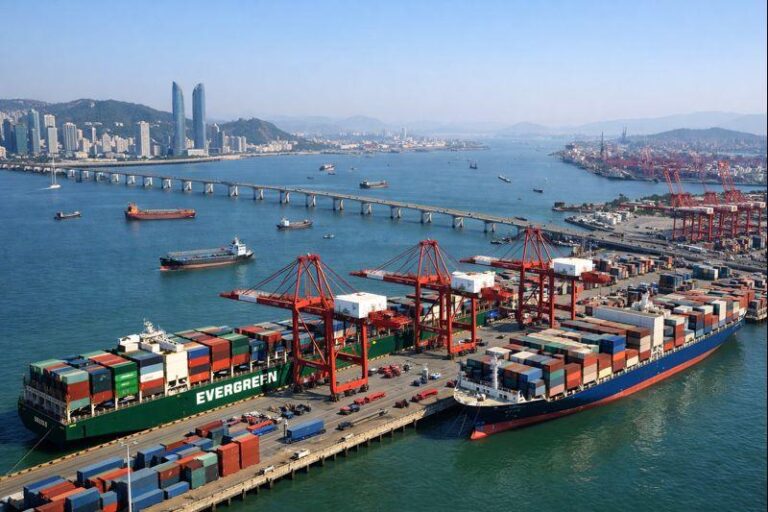


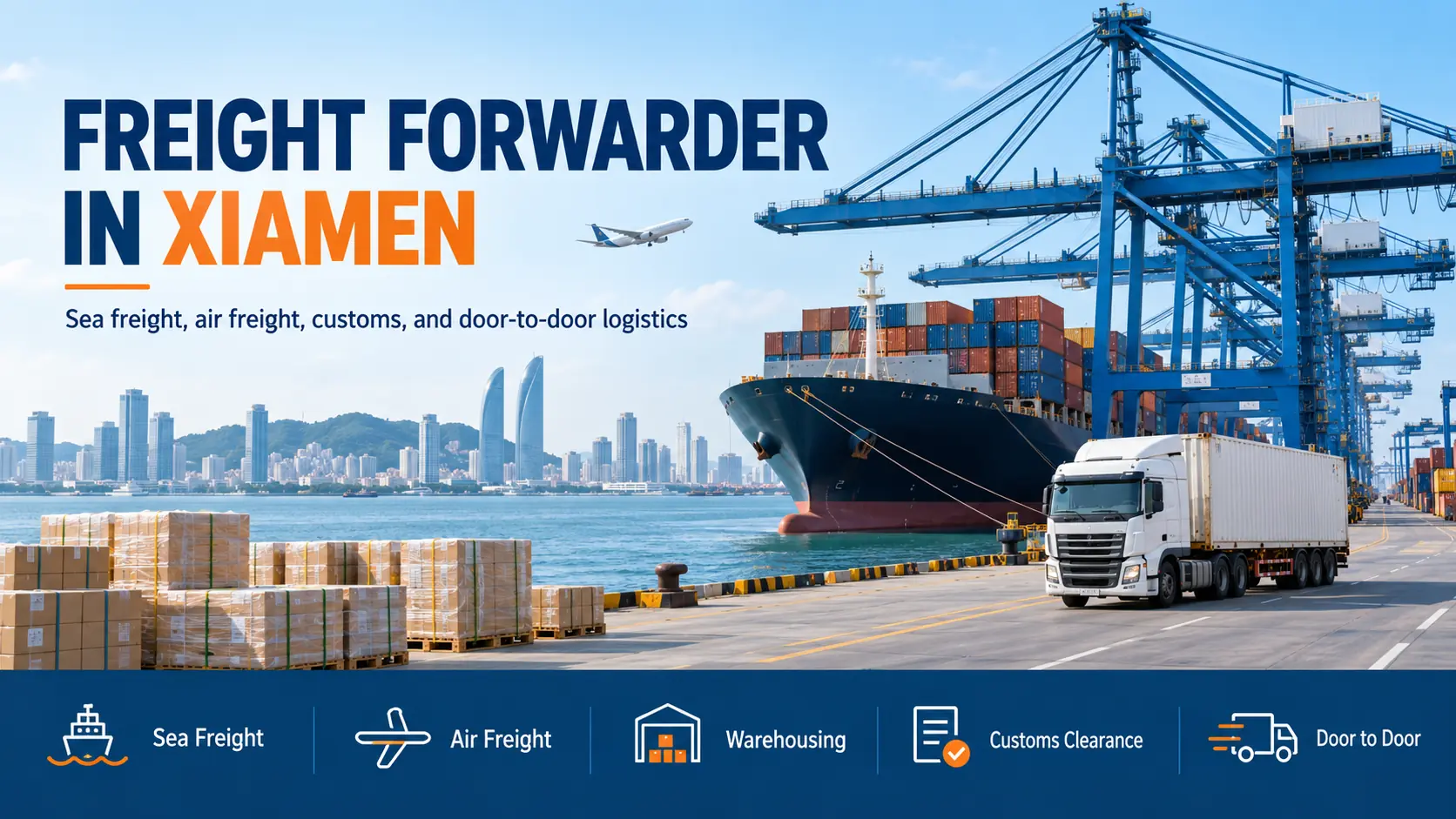
Freight Forwarder in Xiamen
- Verified & Reviewed · Last updated September 2026
Xiamen is a major logistics gateway in southeast China, connecting Fujian’s manufacturing centers with international ocean and air freight networks.
Tonlexing provides freight forwarding in Xiamen, including sea freight, air freight, warehousing, customs clearance, cargo consolidation, and door-to-door delivery.
Sea & Air Freight
Cargo Consolidation
Door to Door Shipping
- Experienced China-based logistics specialists
10,000+ international shipments handled Global sea, air & DDP shipping solutions 24/7 shipment tracking & customer support
Table of Contents
Why Xiamen Is an Important Freight Hub in Southeast China
Xiamen is one of the key logistics gateways in Fujian, China, connecting manufacturers across southeast China with international markets by sea and air. Its location on the Taiwan Strait, together with established port facilities and regional transport links, makes the city a practical export hub for cargo originating not only in Xiamen, but also in nearby manufacturing centers such as Quanzhou, Zhangzhou and Longyan.
For importers, this means suppliers located across Fujian can move goods to Xiamen for warehousing, consolidation and international shipping. When several factories are involved, cargo can be collected from different locations and combined before export, helping simplify the supply chain and reduce the number of separate shipments.
Xiamen also supports a broad range of international logistics activities, including container shipping, air cargo, customs handling, warehousing and distribution. These services allow businesses to choose different logistics solutions according to cargo volume, delivery time and destination.
Key advantages of shipping through Xiamen include:
Strong manufacturing access: convenient connections to industrial areas across Fujian
International shipping routes: ocean services connecting Xiamen with Asia, North America, Europe and other major markets
Flexible cargo handling: support for full-container, consolidated and time-sensitive shipments
Warehousing and consolidation: useful for importers purchasing from multiple suppliers
Integrated logistics services: factory pickup, customs coordination and international transportation can be managed within one shipping plan
Because of this combination of port access, regional manufacturing connections and logistics infrastructure, Xiamen, China works well as both an export gateway and a supply chain hub for businesses shipping commercial goods from southeast China.
Freight Forwarding Services in Xiamen
A freight forwarder coordinates the different stages between the supplier and the international destination. The required logistics services depend on the type of goods, shipment size, urgency, Incoterm and final delivery location.
For some shipments, the job may involve a straightforward factory pickup and container booking. For others, goods may need to be collected from several suppliers, consolidated in a warehouse, checked before loading and then shipped under one international transportation plan.
Sea Freight from Xiamen
Sea freight is the most common choice for heavy cargo, regular inventory and larger commercial shipments where transportation cost is more important than speed.
Businesses shipping from Xiamen can use a dedicated container for larger orders or consolidated ocean freight for smaller quantities. FCL (Full Container Load) is normally used when the shipper needs an entire container, while LCL (Less than Container Load) allows smaller cargo to share container space with other shipments.
Common container options include 20GP, 40GP and 40HQ equipment. The best choice depends on the total volume, cargo weight, packaging and loading method rather than simply choosing the largest available container.
A typical ocean shipment from Xiamen may involve:
Collection from the factory or supplier
Warehouse receiving and consolidation where required
Carrier booking and export documentation
Customs declaration and terminal handling
Container loading or consolidated cargo loading
Ocean transportation and destination coordination
For machinery, oversized equipment and other project cargo, the forwarder should check package dimensions, gross weight, center of gravity and loading requirements before booking. Some goods may require an open-top container, flat rack or another specialized transportation solution.
Air Freight from Xiamen
Air freight is more suitable when delivery time is critical. Importers commonly use it for urgent replenishment, electronic components, samples, spare parts, high-value products and other time-sensitive commercial goods.
At present, air cargo in Xiamen is handled through Xiamen Gaoqi International Airport. In 2025, Gaoqi International Airport processed approximately 377,000 metric tons of cargo and mail.
Air freight should not be evaluated only by the flight time. The complete logistics process also includes factory pickup, airline cargo cutoff, airport handling, export procedures, flight availability and destination clearance. A route with a slightly longer flight schedule may still produce a better overall result if capacity and connections are more reliable.
Pricing is generally based on chargeable weight, so carton dimensions are important. When requesting a quotation, provide both the gross weight and the dimensions of each package rather than only the total weight.
Xiamen’s air logistics infrastructure is also entering a transition period. Xiamen Xiang’an International Airport is scheduled to begin operations by the end of 2026 and take over passenger and cargo services from Gaoqi International Airport. Its southern cargo area is planned with an initial annual cargo and mail handling capacity of 750,000 metric tons.
For shipments arranged during this transition, the actual departure airport and cargo acceptance arrangement should be confirmed when the booking is made.
Warehousing and Cargo Consolidation
Warehousing in Xiamen is especially useful when an importer purchases from multiple factories. Instead of asking every supplier to arrange a separate international shipment, goods can be collected at one warehouse and prepared for combined export.
This creates a more manageable supply chain. The warehouse acts as a central point for receiving goods, checking outer packaging and preparing the cargo before it is loaded.
Depending on the shipment, warehouse solutions can include temporary storage, carton counting, palletizing, relabeling, repacking and multi-supplier consolidation. For example, products from three factories in Fujian can be collected separately, received at the same warehouse in Xiamen and then loaded into one international shipment.
Consolidation is not automatically cheaper in every situation, but it can reduce unnecessary separate shipments and simplify logistics management. The decision should be based on supplier locations, cargo volume, warehouse handling costs and the final transportation plan.
Xiamen Port, Airport and Logistics Infrastructure
Xiamen’s logistics network combines maritime transportation, air cargo, warehousing, customs services and inland distribution. This gives importers several ways to build a shipping plan depending on where their suppliers are located and how quickly the goods need to reach the destination.
The city should therefore be viewed as a logistics origin rather than only as a port. Cargo can arrive from other areas of Fujian, receive additional handling in Xiamen and then leave China by sea or air.
Xiamen Port
Xiamen Port is the main maritime gateway for cargo moving through the city. Its overall planning includes several port areas, including Dongdu, Haicang and Xiang’an on the Xiamen side of the wider port system.
The actual terminal used for a shipment depends on the carrier, route and booking. Importers should therefore avoid arranging delivery to the port before the freight forwarder or shipping line has confirmed the correct terminal and cutoff information.
For commercial shipments, Xiamen Port supports container shipping, consolidated cargo and various specialized transportation requirements. Its connection with inland road networks also allows suppliers outside Xiamen to use the port without locating production directly beside the terminal.
Xiamen Air Cargo
Xiamen Gaoqi International Airport gives shippers a faster alternative for goods that cannot wait for ocean transportation. Direct and connecting air services can be selected according to the destination, cargo characteristics and available airline capacity.
When comparing air logistics solutions, businesses should consider:
Flight frequency and available space
Airport cargo cutoff times
Direct versus connecting services
Customs and documentation requirements
Handling requirements for special goods
Destination delivery time after arrival
This is especially important for urgent commercial cargo. A lower air rate is not necessarily better if it involves a long connection or limited flight frequency.
Warehousing, Free Trade and Distribution Facilities
Xiamen also supports warehousing, free trade, cross-border e-commerce and international logistics activities. These facilities give companies additional options when goods need storage, consolidation or distribution before export.
They are particularly useful for businesses operating more complex supply chains, but not every shipment needs a bonded or free trade arrangement. Regular commercial cargo can often move through standard warehousing and export procedures.
The right warehouse solution should therefore depend on what the goods require, rather than simply choosing a free trade zone because the shipment originates in Xiamen.
Major Shipping Routes from Xiamen
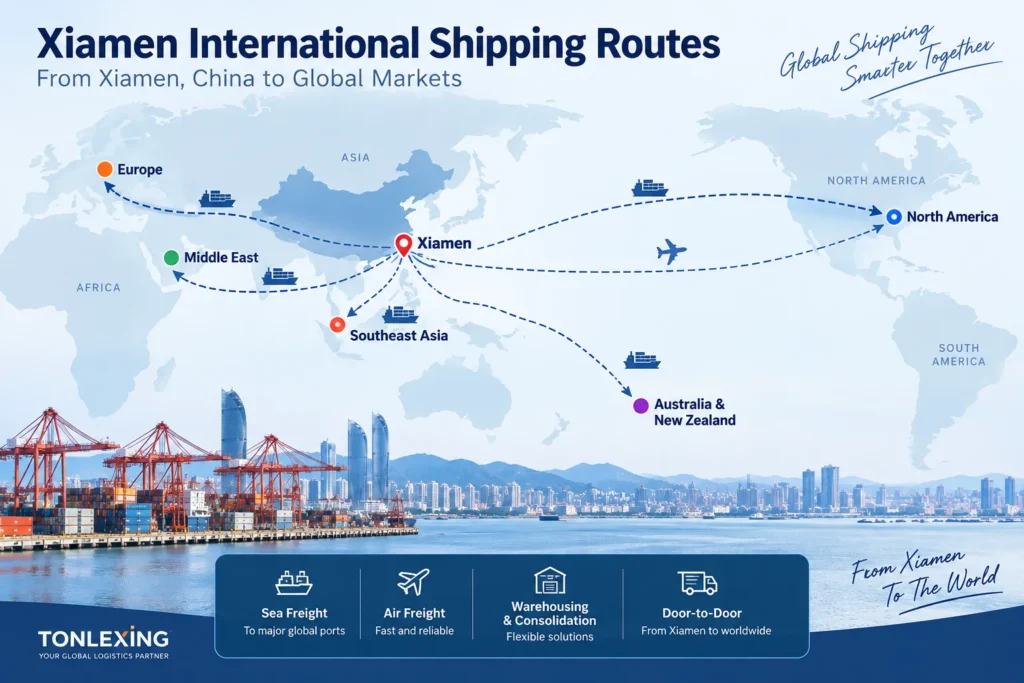
Xiamen has international shipping connections to markets throughout Asia and beyond. The most suitable route depends on the destination, carrier schedule, available capacity and cargo-ready date.
For regional trade, Xiamen is well positioned for shipments to Southeast Asia and Northeast Asia. Goods can move to markets such as Singapore, Malaysia, Vietnam, the Philippines, Japan and South Korea. Australia and New Zealand are also common destinations for products exported from southeast China.
For longer-distance trade, Xiamen supports transportation to North America, Europe and the Middle East.
| Region | Example Destinations | Common Shipping Options |
|---|---|---|
| Asia | Singapore, Malaysia, Vietnam, Philippines, Japan, South Korea | Ocean and Air |
| Australia & New Zealand | Sydney, Melbourne, Brisbane, Auckland | Ocean and Air |
| North America | USA, Canada | Ocean and Air |
| Europe | Major Northern and Western European markets | Ocean and Air |
| Middle East | UAE, Saudi Arabia and regional markets | Ocean and Air |
For shipments from Xiamen to the USA, the final destination should influence the port choice. A consignee in California may require a different routing strategy from one located in the Midwest or on the East Coast.
The same principle applies to Europe and other markets. A low ocean freight rate may involve an inconvenient arrival port, additional transshipment or higher inland transportation costs. The complete route should therefore be evaluated from the factory in China to the actual destination, not only from port to port.
How Much Does Freight Shipping from Xiamen Cost?
Freight shipping costs from Xiamen depend on the transport mode, cargo weight and volume, destination, container type, service scope, and current market conditions. Ocean freight is generally more economical for large or heavy shipments, while air freight is better suited to urgent, lightweight, or high-value cargo.
Xiamen Freight Cost Comparison
| Shipping Method | Typical Cost Range | Estimated Transit Time | Best Suited For |
|---|---|---|---|
| Ocean FCL – 40ft/40HC | USD 5,800–9,500+ / container | 14–35 days | Large and heavy commercial shipments |
| Ocean LCL | USD 40–130 / CBM | 20–45 days | Smaller shipments without a full container |
| Air Freight | USD 4.50–8.00 / kg | 3–10 days | Urgent, lightweight or high-value goods |
| Express Courier | USD 6.00–12.00 / kg | Varies by service | Samples and smaller parcels |
| Air/Sea DDP | Approx. USD 2.50–8.50+ / kg | Depends on route | E-commerce and door-to-door shipments |
These ranges are useful for initial budgeting, but the final rate can change according to the cargo-ready date, shipping route and service scope.
Costs That May Not Be Included in the Base Freight Rate
The ocean or air freight rate is only one part of the total logistics cost. Depending on the Incoterm and shipping arrangement, additional charges may apply before departure or after the cargo reaches the destination.
Common additional costs include:
Origin charges in China: supplier pickup, warehouse handling, export documentation, terminal handling, and loading fees
Customs clearance: export declaration in China and destination customs brokerage where required
Import duties and taxes: based on the HS code, customs value, product type, and destination-country rules
Destination charges: terminal handling, port or airport fees, local trucking, and delivery charges
Special cargo charges: additional handling for oversized, heavy, dangerous, or regulated goods
For this reason, two freight quotations with similar base rates can result in very different final costs.
To receive a more accurate quote for shipping from Xiamen, provide the cargo description, number of packages, gross weight, dimensions or total CBM, supplier location, destination city or ZIP code, and Incoterm such as EXW, FOB, or CIF.
How Shipping from Xiamen Works
A well-planned shipment begins before the goods arrive at the port or airport. Accurate cargo information helps the freight forwarder select the correct transportation method, arrange the right equipment and identify documentation requirements before delays occur.
The process usually follows six stages.
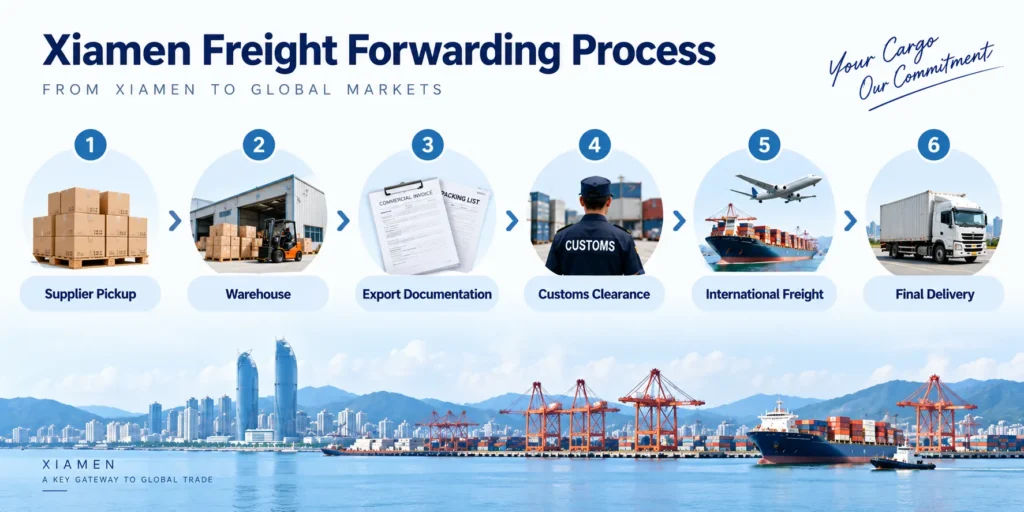
Confirm Cargo and Supplier Information
The importer provides the product description, quantity, packaging, gross weight, dimensions, supplier address and destination. Special cargo should be identified at this stage.
Select the Shipping Solution
The freight forwarder compares ocean, air, dedicated-container and consolidated options according to the shipment size, required transit time and overall shipping needs.
Arrange Pickup and Warehousing
Goods can be collected from factories in Xiamen or surrounding areas of Fujian and moved to a warehouse, port facility or airport cargo terminal. Multi-supplier shipments may be consolidated before export.
Prepare Export Documentation
Commercial invoices, packing lists, customs information and transportation documents are checked before the cargo enters the final export process.
Complete Export and International Transportation
After customs procedures and carrier acceptance are completed, the cargo is loaded onto the vessel or aircraft and begins international transportation.
Handle Arrival and Final Delivery
At destination, the shipment passes through import customs clearance before collection or inland delivery. Door-to-door logistics may include coordination of this final stage.
Clear communication during each step is important. The importer should know when the goods are collected, when the booking is confirmed and when the shipment departs.
Customs Clearance and Cargo Documents
Accurate customs documentation is essential when shipping goods from Xiamen, China. Even when the freight booking is confirmed, incomplete product descriptions, incorrect HS codes, or inconsistent invoice and packing information can delay export customs clearance and may lead to additional inspections or charges.
For most commercial shipments, the supplier and freight forwarder should review the cargo information before the goods reach the port, warehouse, or airport. The exact requirements depend on the product, destination, and shipping method.
Standard Shipping and Customs Documents
Most exports from Xiamen require a set of commercial, transport, and customs documents. The information should remain consistent across all paperwork, especially the product name, quantity, weight, value, and consignee details.
Common documents include:
Commercial Invoice: product description, quantity, unit price, total value, HS code, and Incoterm such as EXW or FOB
Packing List: carton or pallet quantity, gross and net weight, dimensions, and total volume
Bill of Lading (B/L): the main transport document for ocean freight
Air Waybill (AWB): used for air cargo shipments
Export Customs Declaration: contains the shipment information submitted for export clearance in China
Sales Contract or Customs Authorization: may be required depending on the transaction and declaration arrangement
Clear product descriptions are important. Generic terms such as “parts,” “accessories,” or “samples” should be avoided when a more accurate description can be provided.
Certificates for Special or Regulated Cargo
Some products require additional certificates before they can be exported or accepted by the carrier. These requirements usually depend on the commodity and destination country rather than Xiamen itself.
Examples may include:
Certificate of Origin: may be requested by the buyer or customs authority and can support preferential tariff treatment where applicable
Fumigation Certificate: may be required for certain wooden packaging materials
MSDS: commonly requested for chemicals, batteries, liquids, and other regulated products
UN38.3 documentation: often required for lithium batteries and battery-powered products
Product-specific certificates or permits: depending on the commodity and destination market
For batteries, chemicals, dangerous goods, or other regulated cargo, these documents should be checked before booking because carrier acceptance requirements can vary.
Avoiding Customs Delays in Xiamen
Many customs problems can be prevented before the cargo reaches the terminal. Importers and suppliers should confirm the HS code, declared value, packaging information, and destination requirements early in the shipping process.
Before export, check that:
The commercial invoice and packing list contain matching information
The HS code accurately reflects the product
Required certificates are available
Wooden packaging meets destination-country rules
Special cargo documents have been accepted by the carrier
A freight forwarder in Xiamen can coordinate export documentation and customs declaration, but the supplier and importer still need to provide accurate cargo information. Preparing the documents early helps reduce the risk of customs holds and last-minute shipment delays.
How to Choose a Freight Forwarder in Xiamen
Choosing a freight forwarder in Xiamen should involve more than comparing the lowest shipping rate. A reliable forwarding partner needs to understand the cargo, explain the service scope clearly, and coordinate the different stages between the supplier and final destination.
For businesses shipping from Xiamen or other parts of Fujian, the forwarder should be able to manage origin pickup, warehousing, export procedures, international transportation, and destination delivery as one connected logistics process.
Check the Forwarder’s Service Capability
The right forwarder should be able to match the shipping method to the actual cargo rather than offer the same solution for every shipment.
Depending on your order, you may need:
Ocean freight for larger or heavier shipments
Air freight for urgent or high-value cargo
Warehouse receiving and cargo consolidation
Export customs coordination
Door-to-door delivery
Support for machinery, oversized, or special cargo
For importers working with several factories, warehousing and consolidation are particularly important because goods from different suppliers may need to be combined before export.
Compare the Full Logistics Scope
A low freight rate does not always mean a lower total shipping cost. One quotation may include only international transportation, while another may also cover pickup, warehouse handling, customs clearance, destination charges, and final delivery.
Before confirming a forwarder, check what is actually included in the quotation and whether the service scope matches your Incoterm and delivery requirements.
A reliable freight forwarder should also ask for detailed cargo information before giving a final rate, including the product type, quantity, weight, dimensions, supplier location, and destination.
Why Tonlexing Is a Practical Choice for Xiamen Shipments
Tonlexing provides international freight forwarding and logistics services for businesses shipping from Xiamen, Fujian, and other major manufacturing areas in China.
We can coordinate the shipment from supplier pickup through international transportation and final delivery, allowing importers to manage more of the supply chain through one logistics partner.
Depending on the shipment, Tonlexing can arrange:
Sea and air freight from Xiamen
Supplier pickup and warehouse receiving
Multi-supplier cargo consolidation
Export customs coordination and shipping documents
Door-to-door shipping to selected destinations
Project and special cargo support
Our approach is based on the actual shipment rather than a fixed service package. For example, a small urgent order may be better suited to air freight, while regular commercial cargo may move more efficiently by ocean. If several suppliers are involved, the goods can first be consolidated before international shipping.
For businesses looking for a freight forwarder in Xiamen, Tonlexing can help compare the available logistics options and build a shipping plan around the cargo, destination, and required delivery time.
Send us your packing list, supplier location, and destination to receive a shipping recommendation and quotation from Xiamen.
Frequently Asked Questions
How much does a freight forwarder in Xiamen charge?
There is no standard fee for every shipment. Costs depend on the cargo weight and volume, transportation method, supplier location, destination and service scope. A port-to-port shipment will also have a different cost structure from a complete door-to-door service.
For an accurate quotation, provide a packing list together with the pickup and delivery locations.
What is the main shipping port in Xiamen?
Xiamen Port is the main international maritime gateway serving the city and surrounding manufacturing areas in Fujian. It includes multiple port areas and terminals, so the specific terminal depends on the carrier and shipping route.
The terminal should be confirmed after the booking rather than assumed in advance.
Can small shipments be shipped from Xiamen?
Yes. Smaller commercial shipments can move as consolidated ocean cargo or by air depending on their volume, weight, value and delivery requirements.
For very small but urgent goods, air transportation may be more practical. For heavier cargo that is not time-sensitive, consolidated ocean shipping is often worth comparing.
Can a freight forwarder combine goods from several suppliers?
Yes. Goods from several suppliers can be collected and delivered to a warehouse in Xiamen for consolidation before international shipping.
This is particularly useful for importers sourcing from multiple factories across Fujian or other regions of China because the goods can be prepared as one coordinated shipment.
How do I choose a reliable freight forwarder in Xiamen?
Look beyond the freight rate. Compare the forwarder’s experience with Xiamen shipments, transportation options, warehousing capability, customs support, quotation transparency and communication.
A reliable freight forwarder should review the cargo details before recommending a shipping solution and should clearly explain which services are included in the quotation.
Related Logistics Guides
Useful freight, customs and importing resources related to this shipping guide.
Related Guide
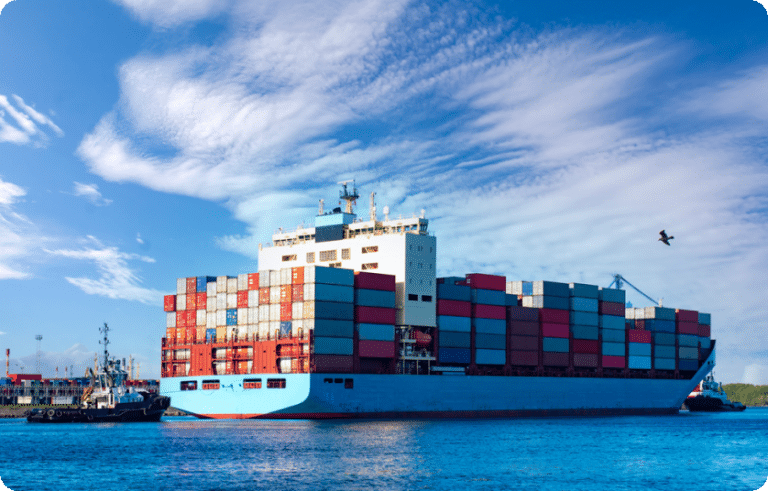
Sea Freight Shipping from China
Sea freight is the most cost effective shipping method for large volumes and container load cargo. It is ideal for businesses looking to reduce s...
Read guide →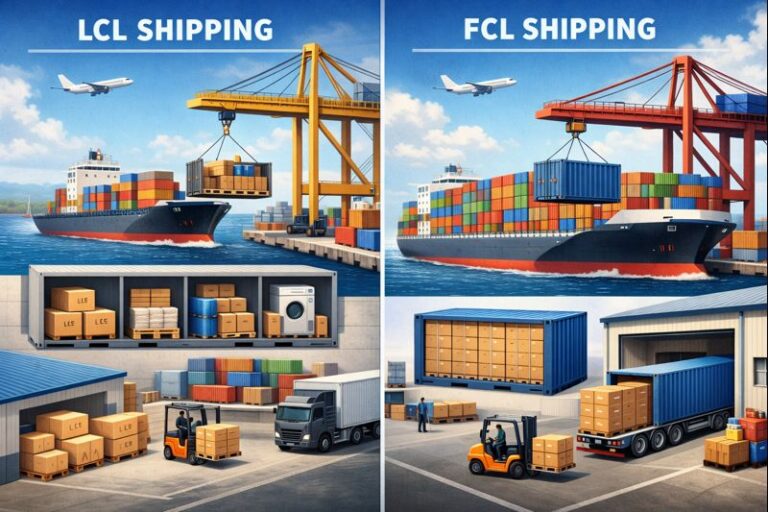
Related Guide
LCL vs FCL Shipping: What They Mean, Key Differences, and Which One to Choose
LCL vs FCL Shipping: What They Mean, Key Differences, and Which One to Choose Verified & Reviewed · Last updated January 2026 FCL vs LCL shipping...
Read guide →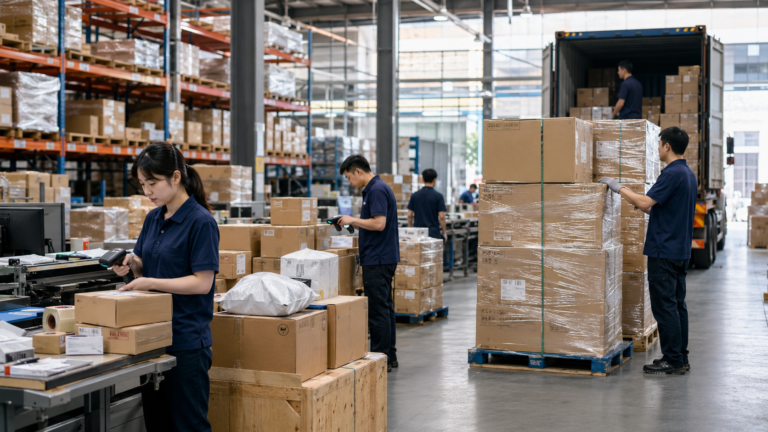
Related Guide
China Warehouse Consolidation Service
China Warehouse Consolidation Service Verified & Reviewed · Last updated May 2026 China warehouse consolidation service helps importers collect g...
Read guide →
Useful Resource
Door to Door Shipping from China
Door to door shipping from China by air, sea, rail or express. Compare DDP vs DAP, costs, transit times, customs clearance and final delivery.
Learn more → Useful Resource How to Choose the Best Freight Forwarder in ChinaIn the complex world of international trade, selecting a reliable freight forwarder is a crucial step in ensuring a smooth and cost-effective sup...
Learn more →