Related Guide
How to Import Machinery from China
How to Import Machinery from China Verified & Reviewed · Last updated August 2026 Importing machinery from China requires careful supplier verifi...
Read guide →

Importing woodworking machinery from China helps furniture manufacturers and wood-processing businesses source production equipment at competitive prices.
Learn how to verify suppliers, check machine specifications and safety standards, calculate total import costs, arrange shipping, and clear customs before delivery.
Supplier Verification
Import Costs
Shipping & Customs
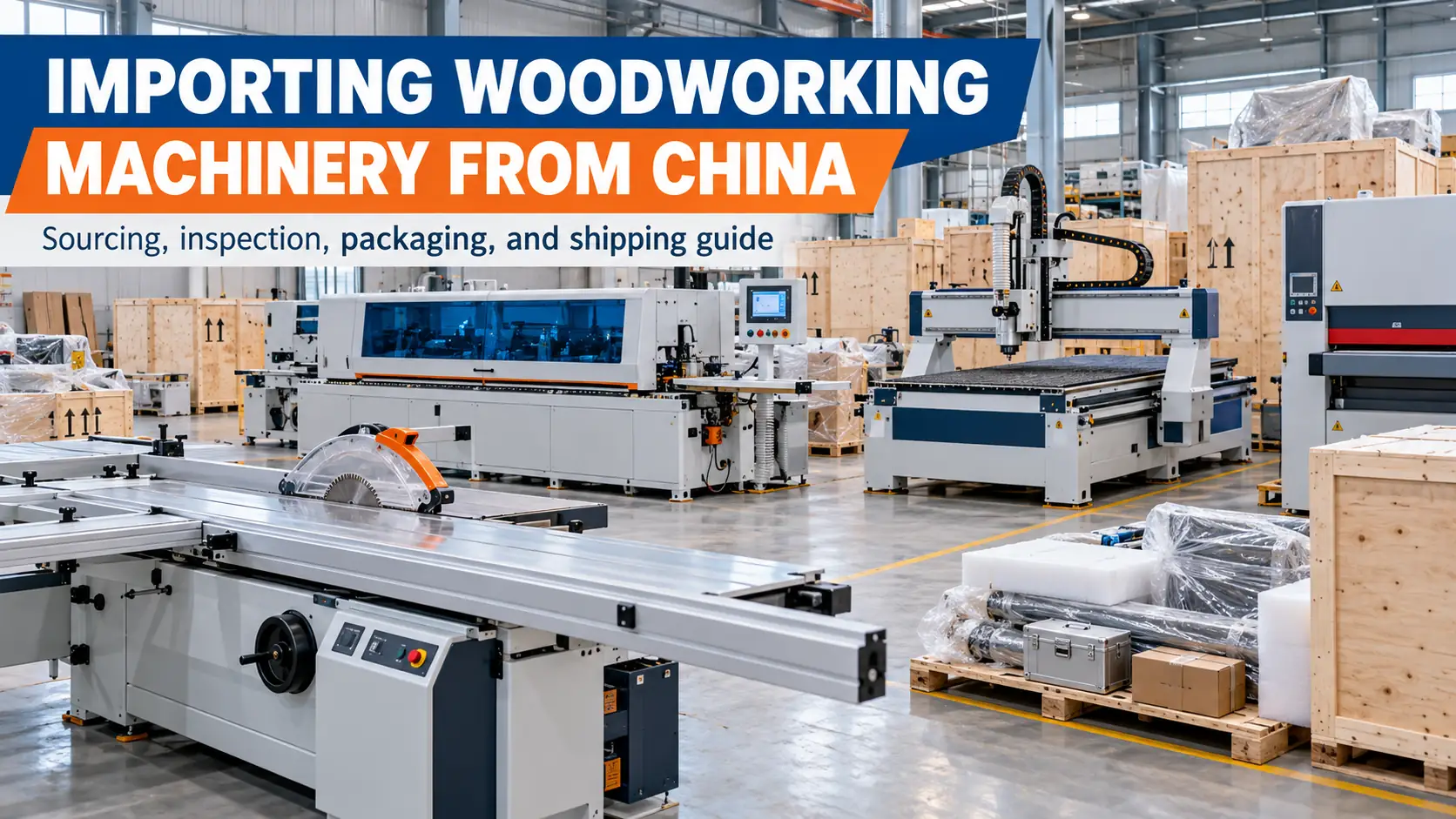
Chinese manufacturers supply machines for furniture production, cabinet making, solid wood processing, and panel manufacturing. The right machine depends on the materials being processed, production volume, required accuracy, and level of automation.
| Machine Type | Typical Application | Key Considerations |
|---|---|---|
| CNC routers | Cutting, engraving, and shaping panels | Working area, spindle power, and software compatibility |
| Panel saws | Cutting MDF, plywood, and laminated boards | Cutting capacity, accuracy, and feeding system |
| Edge banding machines | Applying edge materials to panels | Panel thickness, material compatibility, and speed |
| Planers and moulders | Sizing and shaping solid wood | Working width, cutting depth, and tooling |
| Sanding machines | Preparing surfaces for finishing | Sanding width, abrasives, and dust extraction |
| Woodworking presses | Veneering, laminating, and panel bonding | Pressing area, pressure, and heating system |
| Automated production lines | Integrated furniture manufacturing | Production capacity, layout, and system integration |
Woodworking presses include hot, cold, and vacuum models for different bonding and finishing applications. Buyers sourcing woodworking tools or hand tools alongside industrial machines should confirm whether all products can be packed and shipped together.
Before requesting quotations, define your materials, workpiece dimensions, expected output, and required operations. A cabinet manufacturer processing MDF may prioritize CNC nesting, panel cutting, and edge banding, while a solid wood factory may need planers, moulders, and sanding equipment.
Supplier capabilities vary in production capacity, quality control, customization, and after-sales support. Verifying these factors before placing an order helps reduce purchasing risks and avoid costly problems after delivery.
Before placing an order, take the following steps:
Check manufacturer credentials: Review business registration, factory capabilities, export experience, and product specifications.
Evaluate quality control: Ask about inspection procedures, machine testing, and ISO 9001 quality management certification, if available.
Confirm customization: Verify that the supplier can meet your production needs, electrical specifications, and software requirements.
Check warranty and spare parts: Confirm warranty coverage, replacement-part availability, and technical support.
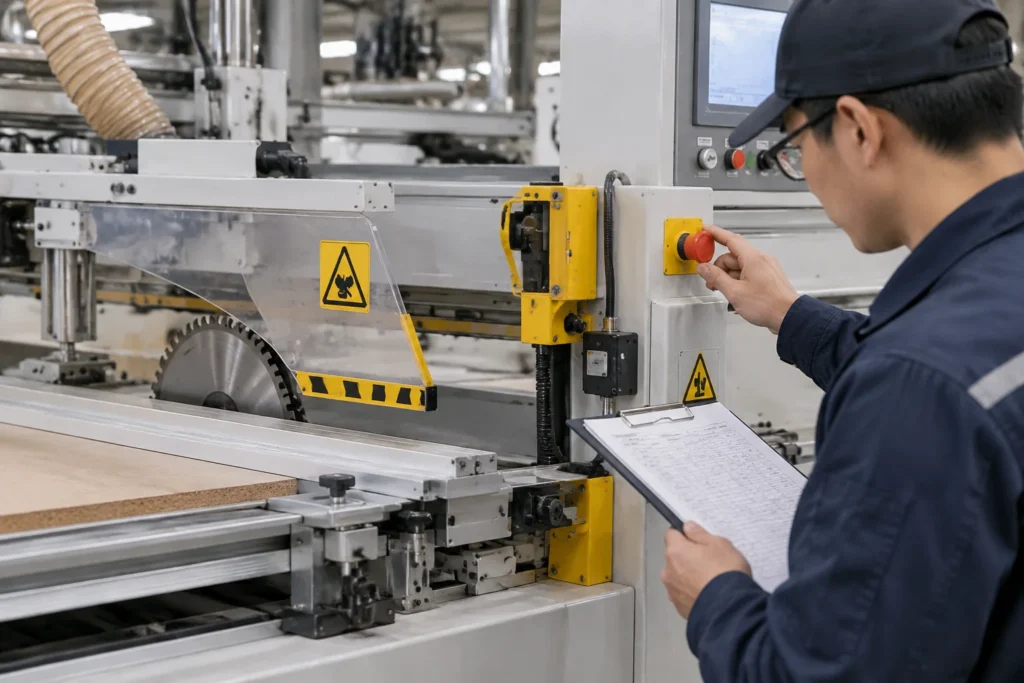
Arrange pre-shipment inspection: Test the machine against agreed specifications and check its safety features before dispatch.
Before paying a deposit, document the machine model, included accessories, delivery schedule, payment terms, and acceptance criteria in the purchase contract. Clear communication with the manufacturer can save time and expenses by resolving technical issues before production or shipping.
For additional guidance, see our guide to importing machinery from China.
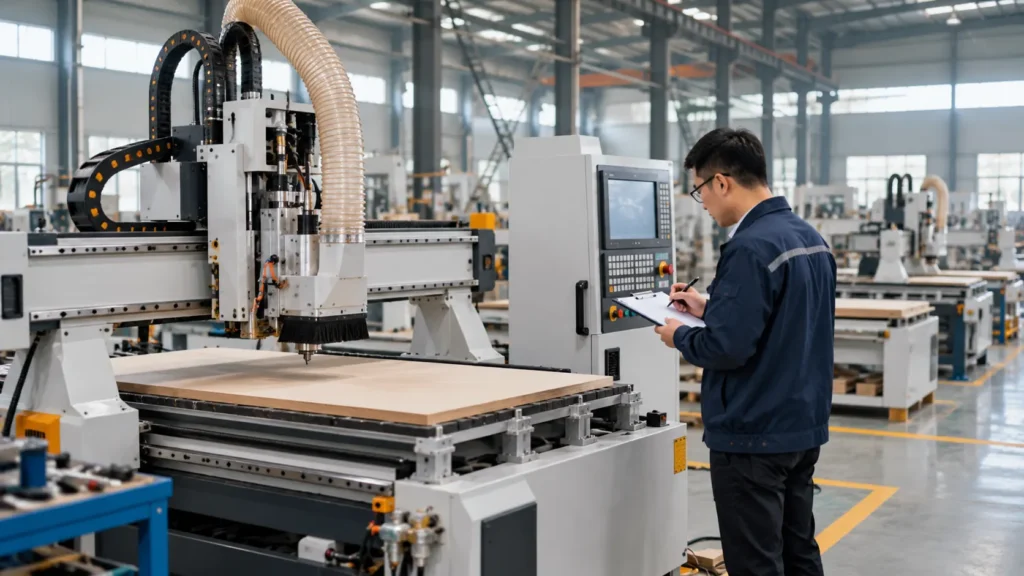
Before ordering, confirm that the machine suits your production needs and the applicable rules in the destination market. Checking these details before manufacturing helps avoid costly modifications and installation problems.
Request a detailed specification sheet covering:
Processing capacity: Working dimensions, cutting accuracy, production speed, and compatible materials
Electrical configuration: Voltage, frequency, phase, motor power, and connection requirements
Software compatibility: Control systems, licenses, file formats, and language options for CNC machines
Physical dimensions: Overall size, machine weight, floor space, and lifting requirements
Utility connections: Dust extraction, compressed air, and other facility connections
Some machines manufactured in China use 380V/50Hz configurations, but electrical specifications vary by model. Although 220V/60Hz supplies are used in some US and Latin American facilities, they are not universal. Confirm the actual requirements at your installation site and request any necessary motor adaptations during manufacturing.
Woodworking machines can expose operators to rotating blades, moving components, flying debris, electrical hazards, and wood dust. Check machine guarding, emergency-stop functions, operating instructions, and dust extraction provisions. Do not assume that lower-priced machines include every safety device or conformity document required by the destination market.
For applicable machine categories, consult the ISO 19085 woodworking machinery safety standards. US importers should also review OSHA machine-guarding requirements.
For the European Union, confirm the applicable machinery legislation, conformity assessment, technical documentation, and CE marking obligations. Additional ergonomic and operator-safety requirements may apply depending on the machine and its intended use.
Before shipment, ensure the delivered machine matches the agreed specifications and that all required documentation is available for import and installation.
The total landed cost of importing woodworking machinery from China includes the purchase price and all expenses required to transport, clear, and deliver the machine to your facility. Calculating these costs in advance helps you compare supplier quotations and plan your import budget.
Total Landed Cost = Machine Price + Origin Charges + International Freight + Insurance + Import Duties and Taxes + Customs Fees + Final Delivery + Installation
When calculating your costs, consider these key expenses:
Machine price and origin charges: Include the machine, accessories, export packaging, and applicable factory collection or handling fees.
International freight and insurance: Obtain a quotation based on the shipping route, packed dimensions, gross weight, and cargo value.
Import duties and taxes: Check the applicable tariff classification and destination-country tax rules. Rates vary by machine category and market.
Customs and port fees: Allow for customs broker services, terminal handling, documentation, and potential storage charges.
Final delivery and installation: Include inland trucking, unloading equipment, assembly, electrical adjustments, and commissioning where required.
Use the freight cost calculator from China to estimate transportation expenses. For a tailored quotation, provide the machine specifications, packed dimensions, gross weight, pickup location, destination, and agreed shipping terms.
The right Incoterm clarifies who arranges transportation, handles export or import formalities, and pays the associated charges. The best shipping method depends on cargo dimensions, weight, handling requirements, destination, and delivery schedule.
| Incoterm | Main Responsibility | Buyer Consideration |
|---|---|---|
| EXW | Goods available at seller's premises | Arrange collection and export logistics |
| FCA | Seller delivers to the agreed carrier | Confirm handover location |
| FOB | Seller delivers goods on board the vessel | Arrange ocean freight and destination charges |
| CIF | Seller pays freight and required insurance to the destination port | Check insurance coverage and destination fees |
| DAP | Seller delivers to the named destination | Handle import clearance and applicable duties |
| DDP | Seller arranges delivery, including import clearance and applicable duties under the agreed terms | Confirm the seller can fulfill import obligations |
For containerized cargo, FCA may be more suitable than FOB when goods are handed to a carrier before vessel loading. Specify the named place or port and the applicable Incoterms edition in your contract.
See our guide to FOB shipping from China for further details.
Sea freight is commonly used for industrial machines because many units are heavy or bulky.
LCL sea freight: Suitable for smaller consignments that can be safely consolidated with other cargo. A single machine weighing under two tonnes may be suitable, depending on its dimensions, packaging, and handling requirements.
FCL sea freight: Worth considering for large machines, multiple units, or cargo that benefits from dedicated container space. Shipping three or more units may justify comparing FCL costs, but the total volume and charges determine the best option.
Flat-rack or open-top containers: May be necessary when machinery exceeds standard container dimensions or requires specialized loading.
Air freight: Generally more suitable for urgent spare parts, electronic components, and small accessories than complete industrial machines.
Some market references cite USD 2,700–3,400 for a 40HQ container from China to the United States and USD 80–150 per CBM for LCL freight. These figures are indicative only, not verified current Tonlexing rates. Actual prices depend on the route, quotation date, surcharges, cargo specifications, and destination handling.
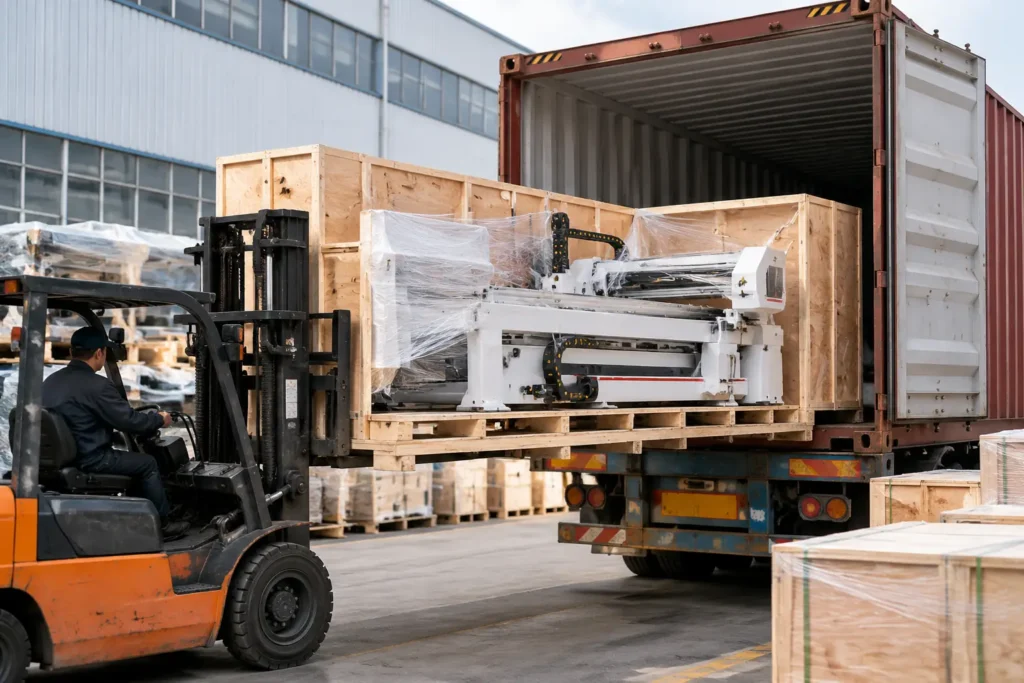
Accurate documentation and correct product classification help prevent customs delays and additional charges. Requirements vary by machine category and destination-country regulations.
Prepare the following documents before dispatch:
Commercial invoice: Identifies the machine, seller, buyer, and transaction value
Packing list: Specifies package quantities, dimensions, and gross and net weights
Bill of lading: Provides transport and shipment details
Purchase contract: Records the agreed specifications, price, and trade terms
Certificate of origin: Provides origin information when required
Compliance documents: Includes applicable conformity declarations, safety documentation, and technical records
Woodworking machines do not share a single HS code. Classification depends on the machine’s function, design, and applicable tariff rules. A CNC router, panel saw, and woodworking press may fall under different classifications.
Before shipping, confirm the correct code, applicable taxes, and any required permits, labels, or technical documentation. A customs broker can help verify the machine category and prepare the import declaration.
For further guidance, see our documents required to import from China and step-by-step customs clearance guide.
Proper packing protects machinery from moisture, vibration, corrosion, and damage during international transport. Before dispatch, confirm the packing method, final cargo dimensions, machine weight, and loading arrangements with the manufacturer and freight forwarder.
Protective crating: Use suitable wooden crates, moisture barriers, and protection for sensitive components.
Dimensions and weight: Confirm the final packed measurements and gross weight before selecting a container.
Loading and securing: Identify approved lifting points, check weight distribution, and secure the machine properly.
Wooden packaging compliance: Verify applicable ISPM 15 rules if solid wood packaging is used.
Use the CBM calculator for shipping from China to estimate cargo volume before requesting a quotation.
Prepare the installation site, electrical connections, floor space, and lifting equipment before delivery. Confirm whether the supplier provides assembly instructions, commissioning, software support, and operator training.
Machines may require replacement cutting tools, belts, sensors, and electronic control boards during normal operation. Check spare-parts availability, prices, delivery times, and warranty coverage before placing your order. Keeping essential replacement parts on hand can help reduce production downtime.
Avoiding common purchasing and logistics mistakes helps control costs and prevent production delays.
Choosing only by price: Compare specifications, quality control, accessories, and warranty coverage.
Ignoring electrical compatibility: Confirm voltage, frequency, phase, and motor specifications before production.
Skipping inspection: Check machine operation, safety devices, and included accessories before dispatch.
Underestimating freight expenses: Include origin charges, international transport, customs fees, and final delivery.
Using an incorrect tariff classification: Verify the code and applicable taxes with a qualified customs broker.
Overlooking after-sales support: Confirm spare-parts availability, warranty terms, and technical assistance.
Coordinate the supplier, freight forwarder, customs broker, and installation team before dispatch so that missing information can be resolved in advance.
The total depends on the machine price, packaging, freight, insurance, applicable taxes, customs clearance, delivery, and installation. Request a quotation using the actual machine specifications and destination.
Common documents include a commercial invoice, packing list, bill of lading, and supporting technical information. Additional permits or conformity records may be required depending on the machine and destination.
Provide the machine’s function, design, and technical specifications to a customs broker or customs authority for classification verification.
LCL may suit smaller consignments that can be consolidated safely, while FCL may be preferable for larger machines or cargo requiring dedicated container space. Compare total freight costs, dimensions, handling, and delivery schedules.
Confirm the machine specifications, electrical compatibility, safety features, inspection results, packed dimensions, and shipping documents. Also prepare for customs clearance, unloading, installation, and spare-parts support.
Useful freight, customs and importing resources related to this shipping guide.
How to Import Machinery from China Verified & Reviewed · Last updated August 2026 Importing machinery from China requires careful supplier verifi...
Read guide →
Shipping Factory Machines from China Verified & Reviewed · Last updated July 2026 Shipping factory machines from China requires careful planning...
Read guide →
Shipping CNC Machines Verified & Reviewed · Last updated April 2026 Shipping CNC Machines from China is a complex process that requires proper pl...
Read guide →
Packaging machines are vital for various industries, including food, beverages, pharmaceuticals, and consumer goods. As one of the world’s leadin...
Read guide →Pre-Shipment Inspection in China for Importers Verified & Reviewed · Last updated July 2026 A pre-shipment inspection helps importers identify de...
Learn more → Useful Resource Documents Required to Import from China (2025 Guide)Importing goods from China can be highly profitable—but only when you understand the necessary documents and import requirements. Whether you’re...
Learn more →WhatsApp us