Related Guide
Building Materials Shipping from China
Building Materials Shipping from China Verified & Reviewed · Last updated May 2026 Building materials shipping from China helps importers, contra...
Read guide →

Importing sanitary ware from China requires careful supplier selection, quality control, compliance, packaging and shipping planning. This guide covers the complete process, from sourcing and inspection to freight, customs clearance and landed costs.
Sanitary Ware Suppliers
Shipping Costs
FCL & LCL Shipping
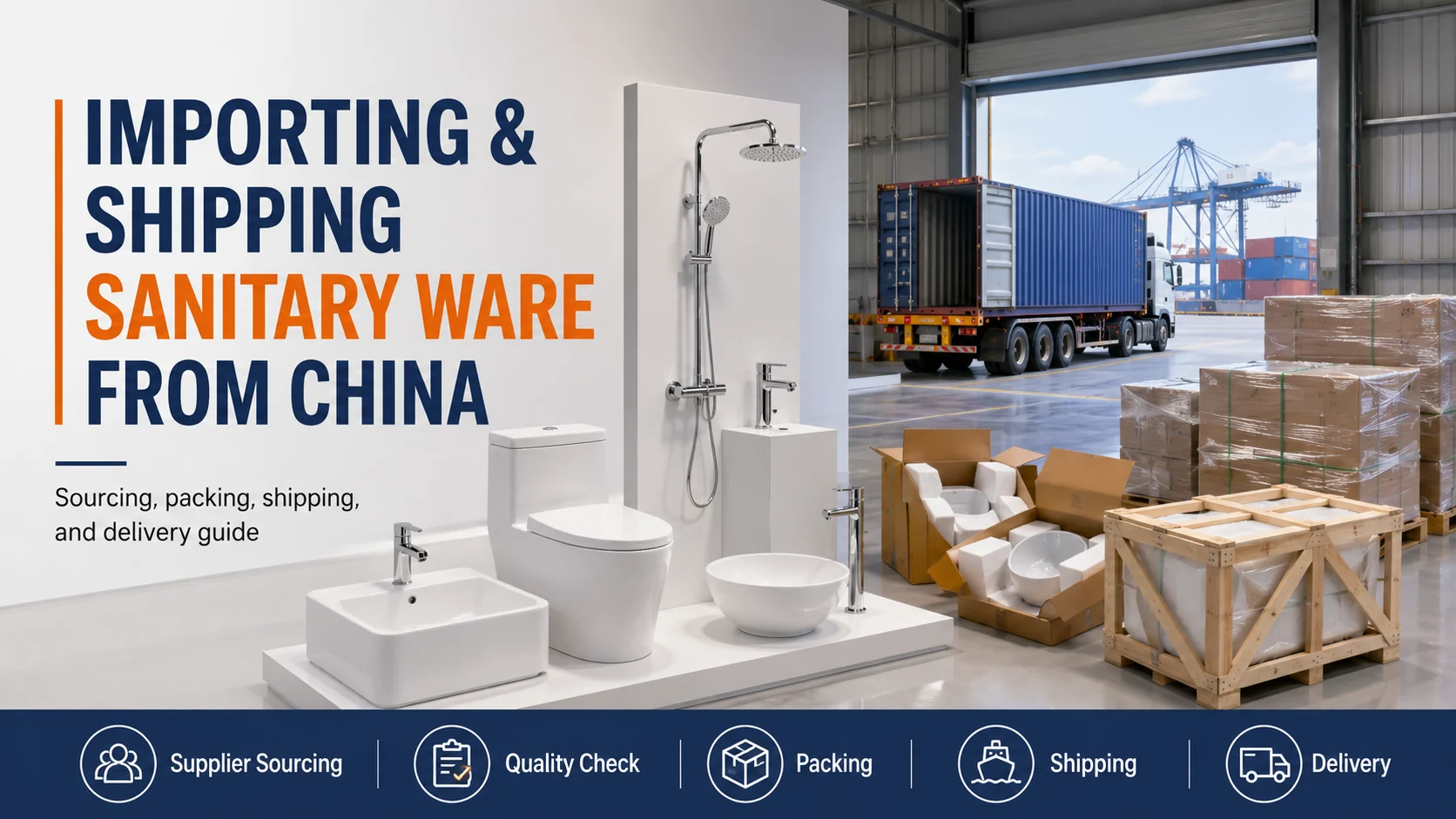
China produces a wide range of sanitary ware products for residential, commercial and hospitality markets. However, sanitary ware is not one uniform product category. Ceramic fixtures, faucets, shower products and bathroom furniture use different materials and production processes, so buyers should define the exact products they need before comparing suppliers.
This is especially important when several bathroom products will be combined in one order. The supplier, quality-control method, packaging and customs classification may be different for each category.
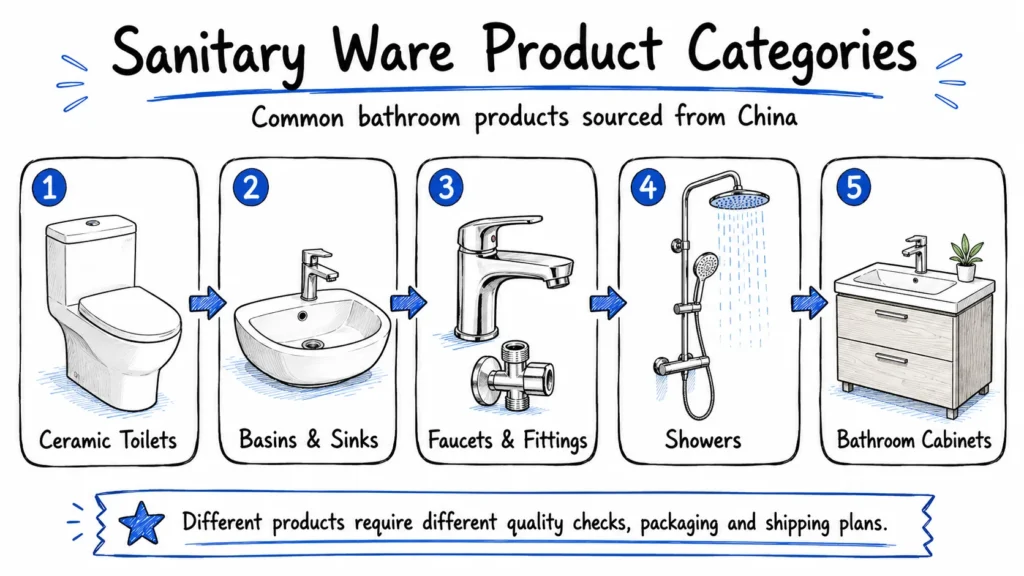
Ceramic sanitary ware is one of the main product groups imported from China. It includes toilets, toilet bowls, bathroom basins, pedestal basins, sinks, bidets, urinals and similar bathroom fixtures.
These products are widely manufactured in China, particularly in established ceramic production areas. From a logistics perspective, they also require careful handling because they combine significant weight with a risk of cracking, chipping or surface damage.
Common ceramic products include:
One-piece and two-piece toilets
Wall-hung toilets
Countertop and under-counter basins
Pedestal basins
Bidets and urinals
Packaging dimensions deserve attention at the purchasing stage. Two toilets may have similar factory prices but different landed costs if one model requires a much larger carton. For container shipments, better carton utilization can reduce the freight cost allocated to each unit.
China also has a large manufacturing base for bathroom faucets, shower mixers, shower heads, valves, floor drains, flexible hoses and other bathroom fittings.
With these products, appearance alone is not enough to judge quality. Similar-looking faucets can use different body materials, cartridges, plating processes and internal components.
Before production, importers should confirm points such as material specifications, surface treatment, cartridge type, connection standards and included fittings. For high-quality bathroom fittings, consistency of materials and functional performance are usually more important than appearance alone.
Other bathroom products commonly sourced in China include bathtubs, shower enclosures, bathroom cabinets, mirrors, shelves, towel racks, bathroom hardware and bathroom accessories.
These products may be made from acrylic, tempered glass, stainless steel, aluminum, engineered wood and other materials. Their packaging and transportation requirements can therefore differ significantly from ceramic sanitary ware.
For complete bathroom projects, it is common to source several product categories from specialized manufacturers and consolidate them before export.
Sanitary ware manufacturers in China are concentrated in several established production clusters. Different regions have different strengths, so understanding these areas can help buyers find more suitable suppliers and organize factory inspections, inland transportation and consolidation.
Guangdong Province is particularly important because several major bathroom and sanitary ware manufacturing centers are located within the wider South China supply chain.
| Region | Main Product Categories |
|---|---|
| Foshan | Sanitary ware, bathroom furniture and building materials |
| Chaozhou | Ceramic toilets, basins and related sanitary ware |
| Kaiping / Jiangmen | Faucets, plumbing fittings and bathroom hardware |
| Zhongshan | Shower products, enclosures and bathroom hardware |
| Nan'an / Fujian | Faucets, plumbing products and related fittings |
Foshan is one of China’s major sourcing centers for ceramics, sanitary ware and building materials. Importers can find ceramic bathroom products, bathroom furniture, shower products and related interior materials within the wider Foshan supply network.
Chaozhou is particularly associated with ceramic sanitary ware production. Manufacturers in the area produce toilets, bathroom basins and other ceramic fixtures for domestic and export markets.
For buyers sourcing ceramic products, supplier verification remains important. Factories in the same production region can differ in glazing quality, dimensions, production control, export packaging and overall quality.
Kaiping and the surrounding Jiangmen area have a strong manufacturing base for bathroom faucets, plumbing fittings and related hardware. Buyers sourcing these products should pay close attention to materials, cartridges, plating and connection specifications.
Zhongshan and other nearby South China cities also have manufacturers producing shower products, bathroom hardware and related building materials.
For importers buying from several suppliers in Guangdong, the relatively concentrated manufacturing network can make consolidation easier. Goods from several factories can be collected at one warehouse before international shipping.
Nan’an and other areas in Fujian also have established supplier networks for faucets, plumbing products and related sanitary materials.
The best sourcing location ultimately depends on the product. A specialized ceramic sanitary ware manufacturer, faucet producer and bathroom cabinet supplier do not need to be located in the same city. For mixed orders, choosing the right manufacturer for each category and consolidating the cargo later is often more practical.
Finding sanitary ware suppliers in China is relatively easy. Choosing a supplier that can consistently meet your specifications, quality requirements and delivery schedule requires more careful verification.
Price should be only one part of the decision. A slightly higher quotation can be more economical if the supplier provides more stable quality, stronger packaging and more reliable production.
Sanitary ware covers several different manufacturing categories, so not every supplier is equally strong in every product.
A factory producing ceramic toilets and bathroom basins uses a very different production process from a manufacturer specializing in faucets or bathroom cabinets. Buyers should therefore prioritize suppliers whose main product range matches what they intend to import.
For example, ceramic sanitary ware manufacturers should be able to explain their ceramic production and inspection process, while faucet suppliers should understand materials, cartridges, plating and connection specifications.
B2B platforms such as Alibaba and Made-in-China can help buyers identify potential suppliers, but an online profile should only be the starting point.
Before placing a commercial order, confirm whether the company is a manufacturer, trading company or a combination of both. A trading company is not necessarily a poor choice, especially when sourcing several bathroom categories, but the buyer should know who actually manufactures each item.
Important points to verify include:
Business and factory information
Main product specialization
Export experience
Production capacity
Quality-control procedures
Available certificates or test reports
Packaging standards
Warranty and customer support
For larger orders, a factory audit can provide a clearer view of the supplier’s equipment, production lines and internal management.
A good sample does not guarantee that a factory can complete a large commercial order on schedule.
Before confirming the purchase order, ask about normal lead time, peak-season capacity and whether important components are manufactured in-house or sourced from other factories.
For long-term importing, consistent quality, realistic lead times and clear communication are generally more valuable than choosing the lowest-priced supplier.
Samples are particularly important for sanitary ware because photographs cannot show every detail of product quality. Glaze consistency, exact dimensions, surface finish, fittings and installation compatibility are easier to evaluate with a physical sample.
Once approved, the sample can also be used as a reference during mass production and final inspection.
MOQ depends on the product and the level of customization required. A supplier may accept a relatively small quantity for an existing model but require a larger order for a custom mold, special color or private-label package.
Customization may involve:
Product dimensions
Color or surface finish
Logos and branding
Faucets or included fittings
Accessories
Printed cartons and packaging
Customized products normally require closer production control. Specifications should therefore be finalized before manufacturing begins, because late changes can affect cost, lead time and quality consistency.
Quality control should begin before production rather than at the final inspection. The purchase order should clearly define dimensions, materials, colors, fittings, accessories, labeling and packaging so that both buyer and manufacturer understand what is acceptable.
Approved samples, drawings and specification sheets can help make quality requirements more objective.
Ceramic sanitary ware can develop defects during forming, glazing, firing and handling. A visually good sample does not guarantee that the entire production batch will have the same quality.
Inspection may focus on:
Cracks and chips
Deformation
Pinholes and glazing defects
Color consistency
Incorrect dimensions
Surface damage
For faucets and bathroom fittings, the inspection criteria are different. Depending on the item, buyers may need to check materials, plating, cartridges, threads, included fittings and general operation.
The quality standard should always be based on agreed specifications rather than a vague requirement such as “high quality.”
A pre-shipment inspection normally takes place after the order is substantially completed but before the goods are released for export.
The aim is to confirm that the finished goods match the approved order and that the export packaging is suitable for transportation.
| Inspection Area | Typical Check |
|---|---|
| Product | Model, dimensions, color and quantity |
| Appearance | Cracks, scratches, glaze and finish |
| Function | Flushing, leakage or operation where relevant |
| Components | Fittings, valves and accessories |
| Packaging | Cartons, cushioning, labels and shipping marks |
Finding problems while the cargo is still at the factory gives the supplier an opportunity to correct them. After the shipment reaches the destination, replacement and rework become much more expensive.
Import requirements for sanitary ware depend on the product type and destination market. Toilets, faucets, shower fittings and bathroom furniture may follow different technical or regulatory requirements, so buyers should confirm compliance before production begins.
A supplier’s previous export experience does not automatically mean every product in its catalog is suitable for your market. Check whether relevant certificates or test reports apply to the exact model being purchased.
Depending on the destination, requirements may involve:
Plumbing or water-contact standards
Water-efficiency requirements
Product testing or certification
Labeling and import documentation
Chinese manufacturers may also reference domestic standards or quality-management systems such as ISO 9001. These can provide useful information about factory processes, but they do not replace the requirements of the destination market.
Sanitary ware products do not all use the same HS code.
Ceramic toilets, bathroom basins and similar ceramic sanitary fixtures are commonly associated with HS heading 6910, while faucets, valves, bathroom cabinets and other fittings may fall under different classifications.
The correct HS code affects customs duties, taxes and import documentation. For mixed shipments, each main product category should therefore be classified separately and confirmed before shipping.
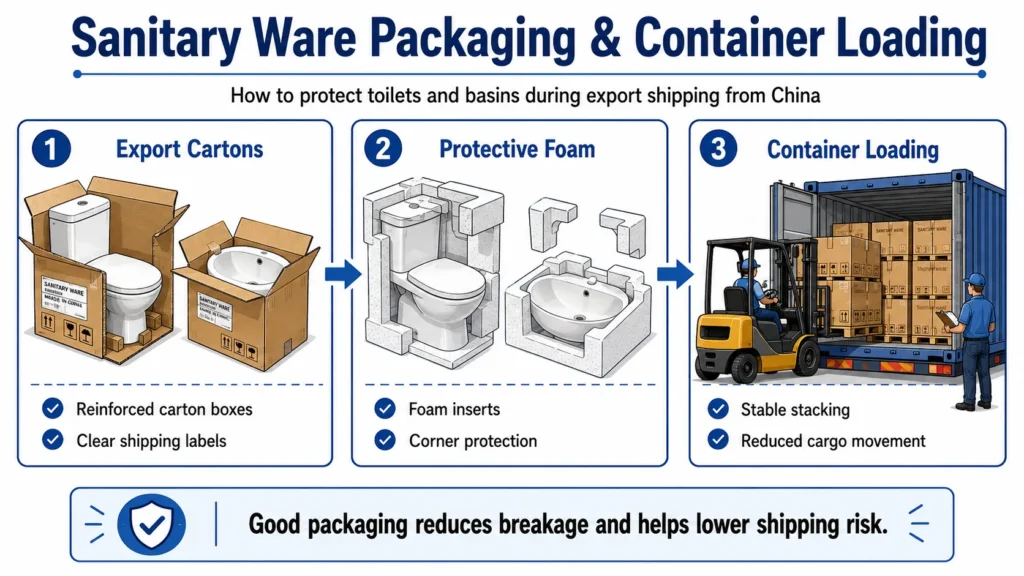
Sanitary ware requires careful export packaging because ceramic toilets, basins and other bathroom fixtures are heavy, fragile and vulnerable to impact during handling.
Good packaging should protect the cargo through factory pickup, warehouse handling, container loading, ocean transportation and final delivery.
For ceramic sanitary ware, manufacturers normally use reinforced export cartons with sufficient internal protection. Depending on the product, additional protection may include:
Molded foam or protective inserts
Reinforced cardboard and corner protection
Internal separators
Pallets or wooden reinforcement where appropriate
Clear product and handling labels
Faucets, bathroom fittings and accessories require different protection. Individual items should be wrapped to prevent scratches or plating damage, while small components should be packed and labeled carefully to avoid missing parts.
Packaging alone is not enough. Sanitary ware also needs to be loaded correctly inside the container.
Heavy ceramic cartons should be stacked according to their strength, with weight distributed evenly and excessive empty space reduced to limit movement during transportation.
Container utilization also affects cost. More efficient carton dimensions can increase the number of sanitary ware products loaded into one container and reduce the shipping cost per unit.
Because many sanitary ware products are heavy or bulky, sea freight is normally the first transportation method to evaluate for commercial imports.
The right shipping method depends on shipment volume, cargo characteristics, destination and required delivery time.
FCL, or Full Container Load, is usually suitable for larger sanitary ware shipments.
The main advantage for fragile ceramic cargo is greater control over loading. Toilets, basins and other products can be stacked and secured according to carton strength, weight and loading requirements without sharing container space with unrelated cargo.
FCL can be particularly suitable for:
Large quantities of ceramic sanitary ware
Fragile toilets and bathroom basins
Cargo consolidated from several suppliers
Orders requiring controlled container loading
Common container options include 20ft, 40ft and 40HQ containers. The most suitable option depends on both volume and gross weight.
For ceramic sanitary ware, weight can become a practical limitation because the cargo may become heavy before all available container space is used.
LCL, or Less than Container Load, is suitable when the order does not fill a complete container.
It can work well for trial orders, smaller wholesale shipments or mixed bathroom products. The main disadvantage is additional handling because LCL cargo normally passes through consolidation and deconsolidation warehouses.
Fragile ceramic sanitary ware therefore needs particularly strong packaging when shipped by LCL.
Importers should also compare total destination charges instead of choosing LCL only because the initial ocean freight appears inexpensive.
Air freight is generally not economical for bulk ceramic toilets, bathroom basins or bathtubs because of their weight and dimensions.
It is more practical for samples, faucets, replacement fittings and urgent bathroom hardware. Express courier services can also be useful when samples need to reach the buyer quickly before the main order is approved.
Rail freight may be considered for selected destinations in Europe or Central Asia, but availability depends on the specific route.
| Shipping Method | Best Use | Relative Cost | Main Consideration |
|---|---|---|---|
| FCL Sea Freight | Bulk sanitary ware | Low per unit | Better loading control |
| LCL Sea Freight | Smaller orders | Low–Medium | Additional handling |
| Rail Freight | Selected Eurasian routes | Medium | Route dependent |
| Air Freight | Urgent fittings and samples | High | Chargeable weight |
| Express | Small samples | High | Convenient for parcels |
There is no fixed cost for importing sanitary ware from China. The total depends on the product value, order quantity, packaging, shipping method, destination, customs duties and final delivery requirements.
For bulky or fragile sanitary ware, container utilization and handling can also have a noticeable impact on the final cost.
A practical landed-cost calculation is:
Product Cost + China Inland Transport + Inspection + Export Handling + International Freight + Insurance + Destination Charges + Duties & Taxes + Final Delivery = Total Landed Cost
The main cost factors include:
Product price and MOQ
Total CBM and gross weight
FCL or LCL shipping
Carton dimensions and container utilization
Origin and destination ports
Inspection costs
Port handling charges
Customs duties and taxes
Final delivery
For sanitary ware, the lowest factory price does not always result in the lowest landed cost. A supplier with more efficient packaging may allow more toilets or basins to fit inside a container, reducing the shipping cost per unit.
For an accurate freight estimate, provide the supplier location, carton quantity, dimensions, total CBM, gross weight and destination.
Accurate shipping documents are important for customs clearance because sanitary ware shipments may contain several product categories with different materials, values and HS classifications.
The required documents vary by destination, but common commercial shipping documents include:
Commercial Invoice
Packing List
Bill of Lading or Air Waybill
Certificate of Origin, where required
Product certificates or test reports, where applicable
Import permits or destination documents, if required
The Commercial Invoice should clearly describe the goods, quantity, unit value and total value, while the Packing List should show carton quantities, weights and package details.
For mixed shipments, avoid using a vague description such as “bathroom products” for everything. Ceramic toilets, faucets, bathroom cabinets and fittings may require different customs classifications.
Before departure, check that the invoice, packing list and transport documents are consistent. This can reduce customs queries and unnecessary clearance delays.
A clear import process helps coordinate suppliers, quality control, shipping and customs clearance. The most important point is to confirm product requirements and compliance before the cargo leaves China.
Confirm the sanitary ware category, material, dimensions, color, fittings, accessories and technical requirements. At this stage, you should also check the main destination-market standards that may apply to the products.

Compare sanitary ware manufacturers based on product specialization, factory capability, export experience and quality control. Order samples to verify appearance, dimensions, finish and functionality before mass production.

Agree on the unit price, MOQ, production lead time, payment terms, packaging and Incoterms. FOB is commonly used for sea freight, while EXW can be practical when cargo is collected from several factories.

Inspect the finished sanitary ware and export packaging before shipment. Confirm that the products match the approved samples, specifications and order quantities.

Provide the freight forwarder with the supplier locations, cargo-ready date, carton quantity, dimensions, total CBM, gross weight and destination.

Prepare the commercial invoice, packing list, transport document and any required compliance documents before arrival.

Most sanitary ware import problems are predictable, which means many can be reduced through better planning before production and shipping.
Breakage during transportation is one of the most obvious risks with ceramic sanitary ware. Strong export cartons, internal protection and controlled container loading help reduce damage.
Quality inconsistency can occur when the bulk order differs from the approved sample in glaze, dimensions, materials, fittings or finish. Clear specifications and pre-shipment inspection provide a more reliable basis for acceptance.
Incorrect specifications can also create expensive problems, especially when installation dimensions, connections or included accessories are wrong. Important requirements should be documented before production.
Other common issues include:
Certificates that do not apply to the actual model
Production delays
Missing fittings or accessories
Unexpected destination charges
Incorrect HS classification
These problems are much easier to manage when supplier selection, quality control and logistics are coordinated before the cargo leaves China.
Sanitary ware shipments often involve fragile ceramic products, bulky cartons and cargo collected from several suppliers. Choosing the right shipping plan therefore requires more than simply booking space with a carrier.
Tonlexing provides freight forwarding services for importers shipping sanitary ware, bathroom fittings and other building materials from China. We can coordinate cargo from major manufacturing regions such as Guangdong and Fujian and arrange transportation according to the actual volume, weight and destination.
Our services can include:
Supplier pickup and warehouse receiving
Multiple-supplier consolidation
FCL and LCL sea freight
Container loading coordination
Air freight for samples or urgent fittings
Export customs clearance and shipping documents
Cargo tracking and destination delivery
For ceramic sanitary ware, carton dimensions, cargo weight and loading arrangements are also important when selecting the shipping method. This helps importers choose a suitable container or LCL solution while reducing unnecessary handling and inefficient use of container space.
If you are sourcing toilets, basins, faucets, bathroom cabinets or mixed sanitary ware from several Chinese manufacturers, provide the supplier locations, carton quantity, total CBM, gross weight and destination. Tonlexing can then recommend a practical shipping solution based on the actual cargo.
Major manufacturing areas include Foshan, Chaozhou, Kaiping and Zhongshan in Guangdong Province, together with Nan’an and other production areas in Fujian. Different regions specialize in ceramic sanitary ware, faucets, bathroom fittings and related products.
Check the supplier’s main products, factory capability, export experience, production capacity, quality-control process and packaging standards. For larger commercial orders, factory audits and pre-shipment inspections can provide additional verification.
There is no universal certification for all sanitary ware. Requirements depend on the product category, material, intended use and destination market. Relevant standards and supporting documents should be confirmed before production.
FCL is generally more practical for larger or fragile ceramic shipments because container loading can be controlled and the cargo receives less shared-container handling. LCL can be suitable for smaller orders when strong export packaging is used.
Sea freight is usually the first option to evaluate for commercial toilet shipments because ceramic sanitary ware is relatively heavy and bulky. Larger orders commonly use FCL, while smaller commercial shipments may use LCL.
Useful freight, customs and importing resources related to this shipping guide.
Building Materials Shipping from China Verified & Reviewed · Last updated May 2026 Building materials shipping from China helps importers, contra...
Read guide →
China has established itself as a global hub for construction materials, offering a diverse range of high-quality products at competitive prices...
Read guide →
How to import daily use porcelain from China has become one of the most profitable opportunities for international buyers in today’s global trade...
Read guide →
Sea freight is the most cost effective shipping method for large volumes and container load cargo. It is ideal for businesses looking to reduce s...
Read guide →Pre-Shipment Inspection in China for Importers Verified & Reviewed · Last updated July 2026 A pre-shipment inspection helps importers identify de...
Learn more → Useful Resource Documents Required to Import from China (2025 Guide)Importing goods from China can be highly profitable—but only when you understand the necessary documents and import requirements. Whether you’re...
Learn more →WhatsApp us