
Related Guide
What Is Container Freight Station CFS in Shipping?
What Is Container Freight Station CFS in Shipping? Verified & Reviewed · Last updated April 2026 A Container Freight Station CFS is a logistics f...
Read guide →An added benefit for eligible new customers shipping with Tonlexing.
Check Eligibility & Get a Quote →Subject to cargo eligibility, insurer approval and policy terms.
Coverage and insured value depend on the cargo, route and written insurer confirmation before shipment. Policy exclusions, deductibles and claims terms apply. The US$500,000 figure is a maximum coverage limit, not a guaranteed claim payment. Insurance premiums are not represented as free unless expressly confirmed in your quote.


LCL shipping to the USA involves more than the ocean freight rate. Once cargo arrives, additional costs may include destination CFS handling, terminal fees, documentation, customs clearance, and storage.
Learn how LCL destination charges are calculated, what fees to expect at U.S. ports, and how to avoid unexpected costs.
Destination CFS Fees
LCL Cost Breakdown
Avoid Hidden Fees
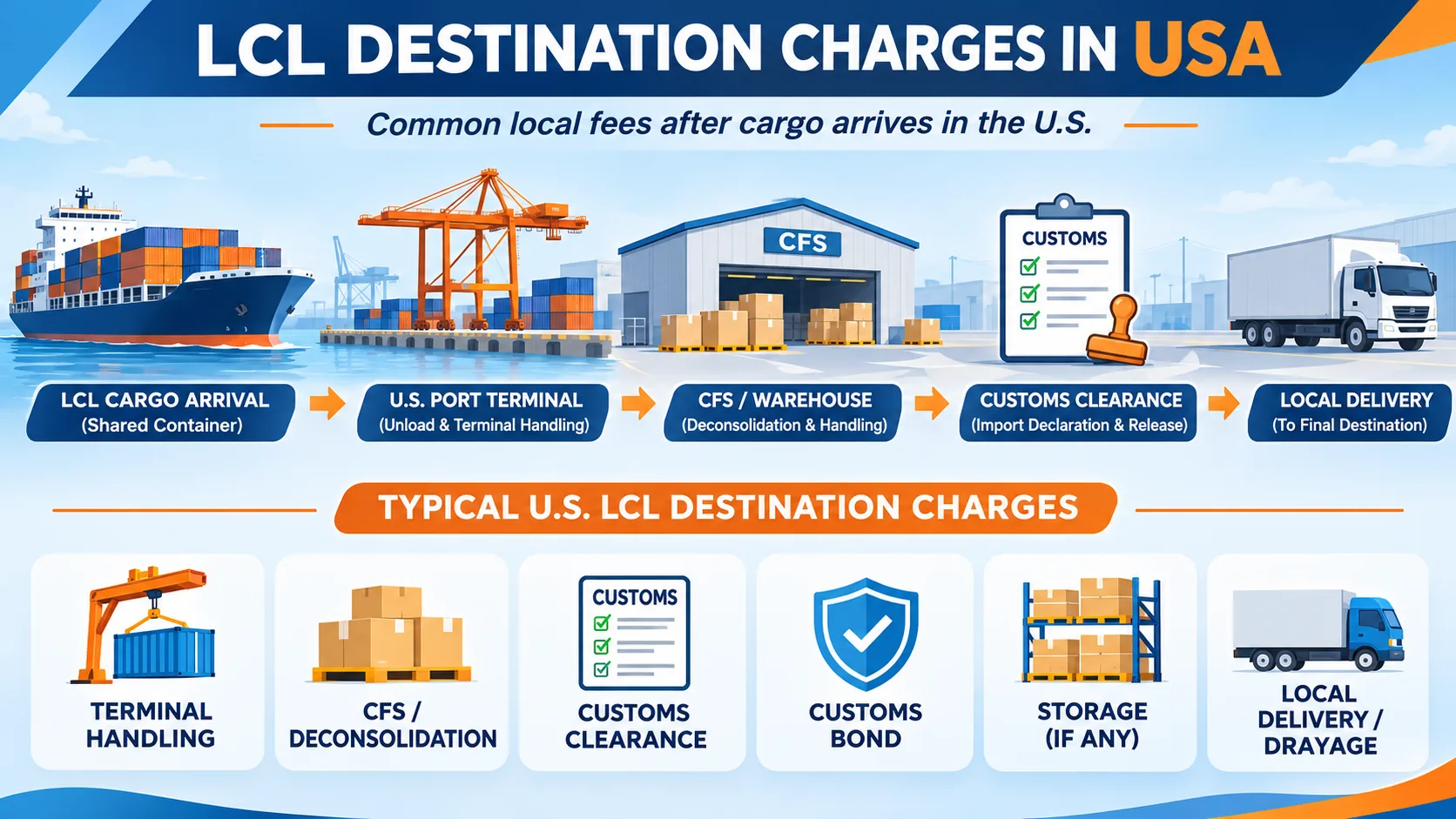
LCL destination charges are the local service fees incurred after a shared ocean freight container arrives in the United States. They cover the handling, deconsolidation, documentation, and release of individual shipments.
Unlike Full Container Load (FCL) shipping, where one importer books an entire container, LCL shipping involves multiple shipments belonging to different consignees. The consolidated container must be unloaded and separated before each importer can collect their goods.
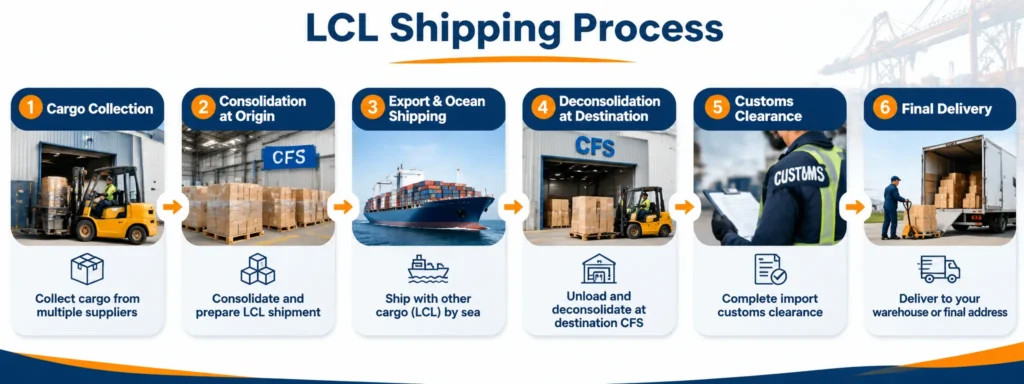
A typical LCL shipping process includes:
Vessel arrival: The consolidated container reaches the U.S. port.
Terminal handling: The container is unloaded and transferred from the marine terminal.
CFS deconsolidation: The container is transported to a CFS warehouse for unloading and sorting.
Customs clearance: The importer or appointed customs broker completes the required import procedures.
Cargo release: Documentation and outstanding service fees are settled.
Final delivery: The shipment is collected or transported to the consignee’s address.
LCL costs are generally divided into three categories:
| Cost Category | Main Services |
|---|---|
| Origin charges | Origin CFS receiving, cargo measurement, documentation, and consolidation |
| Ocean freight | Transportation of consolidated cargo by sea |
| Destination charges | Destination CFS handling, terminal services, documentation, and cargo release |
Origin CFS fees are incurred before the shipment leaves the exporting country. Destination CFS fees arise when the shared container is unloaded and individual shipments are prepared for collection.
The distinction matters because a low base ocean freight rate does not necessarily include all origin and destination services.
For more information about the shipping process, see our guide to consolidated shipping.
The fees charged for LCL shipments in the USA vary depending on the carrier, freight forwarder, destination CFS, and agreed shipping services. Common costs include CFS handling, terminal handling, documentation, and cargo release. Additional fees may apply for customs clearance, storage, inspections, and inland delivery.
| Fee Type | Description | Billing Method |
|---|---|---|
| CFS Deconsolidation Fee | Unloading the shared container and separating individual shipments | Per CBM or W/M |
| Destination Terminal Handling | Handling the container at the marine terminal | Per shipment or according to tariff |
| Documentation Fees | Processing arrival documents and issuing the Delivery Order | Per shipment or document |
| Customs Brokerage | Preparing import entries and handling customs clearance | Per entry or shipment |
| Storage Fees | Holding cargo beyond the free storage period | Per day, CBM, or pallet |
| Examination Fees | Additional handling required for customs inspections | Based on actual services |
| Inland Trucking | Transporting released cargo from the CFS to the final destination | Per shipment or route |
After the shared container arrives, the destination Container Freight Station (CFS) handles unloading, sorting, and separating individual shipments. These services prepare the cargo for customs release and collection.
CFS handling fees are commonly calculated per CBM or W/M, with minimum charges potentially applying. Check whether the quoted rate includes unloading, sorting, and warehouse handling.
For more information, see What Is a Container Freight Station (CFS) in Shipping?.

Destination Terminal Handling Charges (DTHC) cover the handling of containers at the marine terminal, including unloading and terminal operations. Depending on the carrier and freight agreement, these charges may be included in the ocean freight rate or billed separately. Confirm whether they are prepaid or payable at destination.
Documentation fees cover the processing of arrival paperwork and cargo release documents. Common charges include Delivery Order (D/O) issuance, bill of lading processing, and arrival notice administration. Outstanding documentation fees or incomplete paperwork may delay cargo release.
Customs brokerage fees cover the preparation and submission of import entries to U.S. Customs and Border Protection (CBP). These service fees are separate from government charges such as customs duties, Merchandise Processing Fee (MPF), and applicable Harbor Maintenance Fee (HMF).
Importers may also need a customs bond and should account for any examination expenses when estimating the total landed cost.
Learn more about Customs Bond for USA Imports.
If cargo remains at the destination CFS beyond the permitted free storage period, additional storage fees may apply. Delayed customs clearance, missing release documents, or late pickup arrangements can all increase warehouse costs.
CFS storage is different from port demurrage and container detention. Storage applies to cargo held at the warehouse, while demurrage and detention relate to container use and terminal or equipment time limits.
After customs clearance and cargo release, importers may arrange inland trucking from the destination CFS to their warehouse or final delivery address. The cost depends on the distance, cargo dimensions, gross weight, truck type, and delivery requirements.
Port-to-port LCL ocean freight does not automatically include final delivery. Confirm whether your freight quotation covers CFS pickup only or transportation to the final destination.
LCL pricing depends on the billing method applied to each service. Some fees are calculated by volume or weight, while others are fixed per shipment or document.
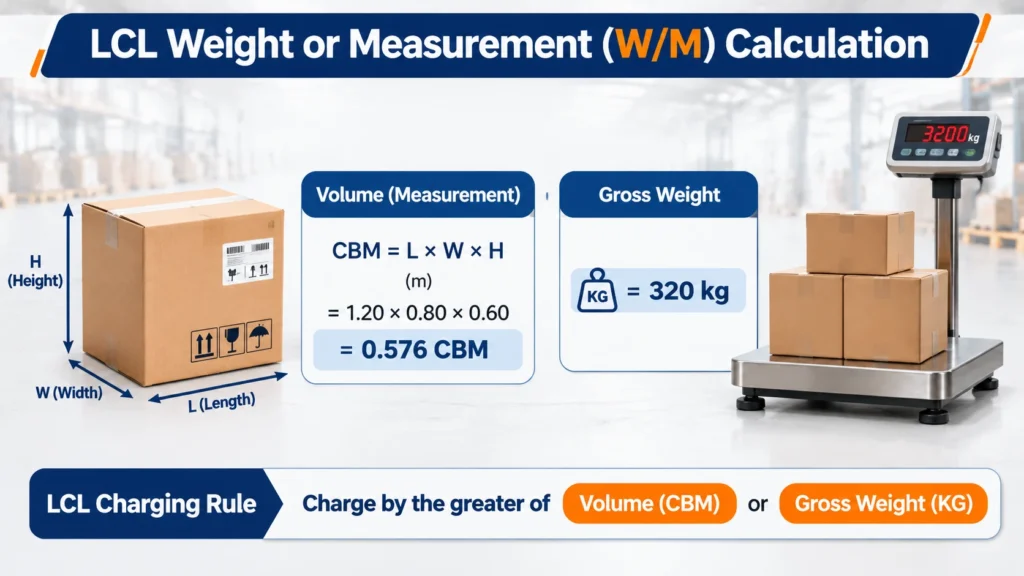
LCL ocean freight commonly uses the Weight or Measurement (W/M) principle to calculate the chargeable quantity.
Under a common ocean freight convention:
1 cubic meter (CBM) equals one measurement unit.
1 metric ton equals one weight unit.
The higher of the two measurements determines the chargeable quantity.
For example:
| Shipment | Cargo Volume | Gross Weight | Chargeable Quantity |
|---|---|---|---|
| A | 2.4 CBM | 1,100 kg | 2.4 W/M |
| B | 0.8 CBM | 1,200 kg | 1.2 W/M |
Shipment A is charged by volume because 2.4 CBM is greater than 1.1 metric tons.
Shipment B is charged by weight because 1.2 metric tons exceeds 0.8 CBM.
The same principle may apply to certain CFS handling services, but individual warehouses can use different billing rules, density ratios, and minimum quantities.
LCL charges generally fall into two billing categories.
This distinction is important for small shipments. Even when the cargo occupies less than one cubic meter, a minimum charge or fixed documentation fee may still apply.
Some freight forwarders and CFS warehouses establish a minimum billing quantity for small shipments.
The final invoice may also change if the destination warehouse measures a different shipment volume or weight from the original booking request.
To reduce discrepancies, provide accurate outer dimensions, gross weight, package quantities, and a complete packing list before shipping.
LCL destination charges vary by U.S. port, CFS warehouse, freight forwarder, and shipment volume. As a general reference, destination CFS handling may cost around $15–$40 per CBM, while broader CFS-related charges can reach $30–$80 per CBM, depending on the services included.
Other common charges may include:
Destination Terminal Handling: Approximately $100–$250 per shipment, depending on the carrier and terminal tariff.
Documentation and Delivery Order Fees: Around $50–$100 per shipment for arrival paperwork and cargo release processing.
CFS Storage: Approximately $5–$15 per CBM per day after the applicable free storage period.
Customs Brokerage: Charged separately according to the broker’s service scope and customs entry requirements.
Inland Trucking: Depends on the distance from the destination CFS to the final delivery address.
These figures are indicative pricing references rather than fixed U.S. tariffs. Some service providers combine multiple handling items into one charge, so importers should check what each quoted fee actually covers.
Consider an LCL shipment arriving at a U.S. port with the following details:
Cargo volume: 2.4 CBM
Gross weight: 1,100 kg (1.1 metric tons)
Destination CFS rate: $15–$40 per CBM
Since the cargo volume is greater than its weight in metric tons, the chargeable quantity is 2.4 W/M.
The estimated CFS handling fee is: 2.4 × $15–$40 = $36–$96
This calculation covers only the example CFS handling charge. Terminal handling, documentation, customs brokerage, storage, and inland delivery may increase the final invoice.
Several factors influence the overall freight cost beyond the basic ocean freight rate:
Shipment volume and weight: LCL pricing generally uses the higher of the cargo’s volume or weight for W/M billing.
Origin and destination CFS fees: Receiving, consolidation, unloading, and cargo sorting contribute to local handling costs.
Ocean freight rate: The base rate varies with the shipping route, carrier capacity, and market conditions.
Additional surcharges: Bunker Adjustment Factor (BAF), fuel surcharges, currency adjustments, and peak season surcharges may apply depending on the quotation.
Destination requirements: Customs clearance, cargo release, warehouse storage, and inland trucking can add to the total landed cost.
LCL is commonly considered for shipments below approximately 15–20 CBM, although the most economical option depends on the route and actual freight quotations. FCL is generally priced per container and may become more competitive as shipment volume increases.
When comparing LCL and FCL, consider both the freight cost and transit time. LCL shipments require additional consolidation and deconsolidation, while FCL generally involves fewer cargo handling stages.
To avoid unexpected expenses, request an itemized quotation that clearly separates the base ocean freight rate, origin charges, destination handling, and any services payable after arrival.
A low ocean freight rate does not always mean a low total shipping cost. The final LCL invoice may include additional charges that were not covered in the original quotation, such as destination handling, documentation, storage, or other local fees.
Some quotations cover only the base ocean freight rate, excluding origin charges, destination CFS handling, and documentation fees. These costs may be billed separately when the shipment arrives. Always confirm which services are included and which charges must be paid at the destination.
LCL pricing is based on the chargeable quantity calculated from cargo volume or gross weight. If the actual measurements differ from the original booking details, the final billing quantity and freight cost may increase.
Small shipments may be subject to minimum charges and fixed documentation fees. Additional services such as repacking, palletization, or special cargo handling can also increase the final invoice.
If cargo is not collected within the destination CFS’s free storage period, additional storage fees may apply. Delays in customs clearance or missing documents can also postpone cargo release and increase costs.
Incoterms determine how shipping costs and responsibilities are divided between the buyer and seller. Under CIF terms, for example, the seller pays for ocean freight and insurance to the named destination port, while the buyer is generally responsible for import clearance and duties. Other local charges depend on the agreed shipping arrangements.
To avoid unexpected LCL shipping costs, importers should confirm the full freight quotation and U.S. destination charges before the cargo leaves the origin port. Four practical steps can help prevent additional expenses.
Choose FOB Terms and Control Your Freight: Under FOB terms, you can appoint your own freight forwarder and compare ocean freight and destination fees. Under CIF, confirm which U.S. local charges are excluded from the seller’s quotation before agreeing on the price.
Request a Detailed Breakdown of Destination Fees: Ask your forwarder to list CFS deconsolidation, Destination Terminal Handling Charges (DTHC), Delivery Order (D/O), customs clearance, and inland trucking separately. Check the minimum charge and billing method to avoid unexpected costs on your final invoice.
Complete Customs Clearance Early: Submit ISF at least 24 hours before vessel loading and prepare your commercial invoice and packing list in advance. Also confirm the destination CFS’s free storage period and arrange cargo pickup promptly after release.
Prepare and Measure Cargo Properly: Palletize loose cartons when required and accurately measure the final CBM and gross weight to avoid extra handling and remeasurement fees.
They are local service fees incurred after a consolidated shipment arrives in the United States. They may include CFS handling, terminal services, documentation, and cargo release.
Not always. Some LCL ocean freight quotations include certain destination services, while others cover only the base transportation rate. Always request an itemized breakdown.
Some fees are calculated per CBM or W/M, while others are billed per shipment, bill of lading, or service. Minimum billing quantities may also apply.
Under CIF, the seller pays for carriage and insurance to the named destination port. The buyer is generally responsible for import clearance and duties. The treatment of other local charges depends on the carriage contract and agreed payment arrangements.
Customs duties and government fees are generally separate from freight forwarder and CFS service charges. Importers should account for applicable duties, MPF, HMF, and other government fees when calculating the total landed cost.
Useful freight, customs and importing resources related to this shipping guide.
What Is Container Freight Station CFS in Shipping? Verified & Reviewed · Last updated April 2026 A Container Freight Station CFS is a logistics f...
Read guide →
Origin Charges vs Destination Charges in International Shipping Verified & Reviewed · Last updated July 2026 Origin charges and destination charg...
Read guide →
Learn how LCL shipping and consolidated shipments help reduce shipping costs for smaller cargo from China.
Read guide →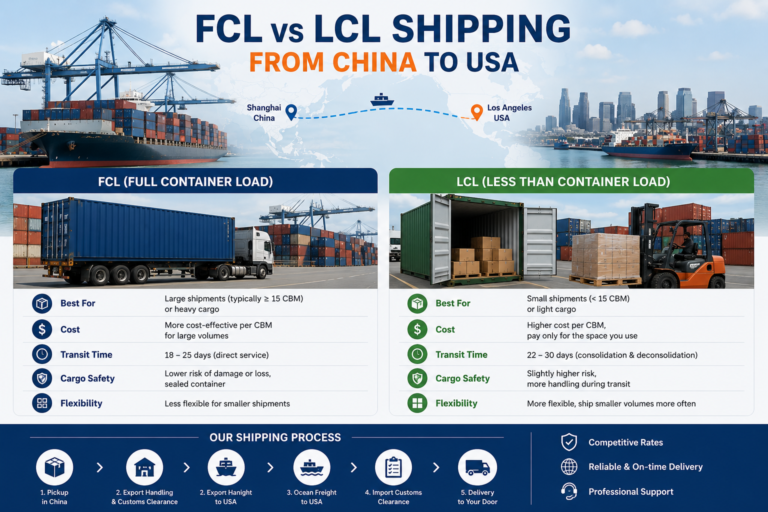
FCL vs LCL shipping from China to USA Verified & Reviewed · Last updated June 2026 FCL vs LCL shipping from China to USA depends on your cargo vo...
Read guide →When dealing with international shipping, one of the common costs importers and exporters encounter is Terminal Handling Charges (THC). These cha...
Learn more → Useful Resource Demurrage vs Detention vs StorageDemurrage vs Detention vs Storage Verified & Reviewed · Last updated January 2026 Demurrage vs detention vs storage is one of the most expensive...
Learn more →WhatsApp us