Related Guide
Shipping from China to Poland
Shipping from China to Poland – Rail, Sea & Door-to-Door in 2026 Fast, reliable shipping from China to Poland for B2B importers, eCommerce seller...
Read guide →

Rail freight from China to Poland provides a reliable transportation option between sea and air freight, offering competitive costs and stable delivery times for commercial shipments.
This guide covers rail freight costs, transit times, major China-Europe rail routes, customs clearance requirements, and FCL/LCL shipping options for importers shipping goods to Poland.
Rail Freight Costs
12–22 Days Transit
FCL & LCL Options
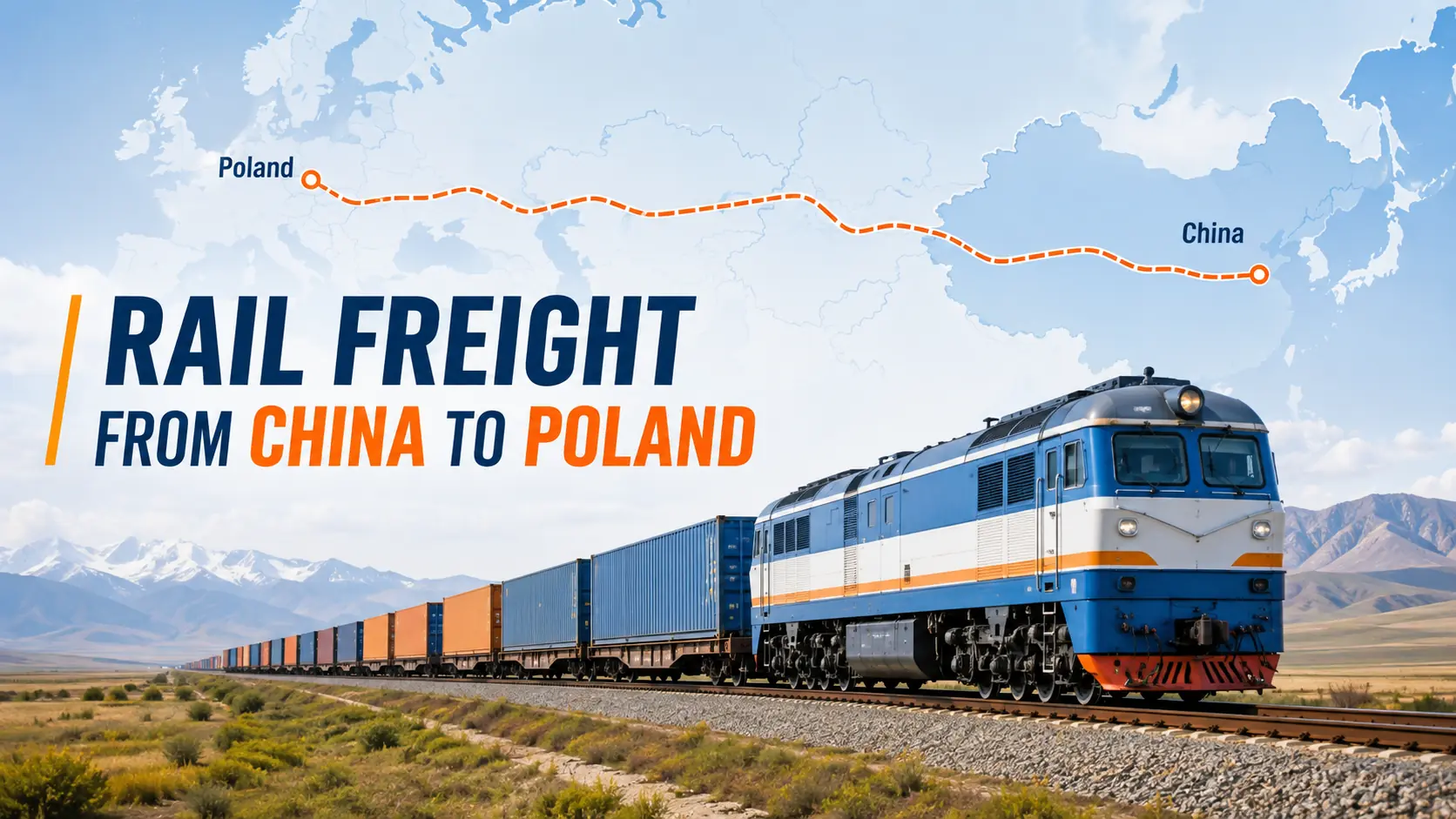
For importers planning rail freight from China to Poland, the following figures provide a simple reference before requesting a route-specific quotation.
USD 2,800–3,800
FCL Rail Freight
Suitable for medium-volume commercial cargo moving on a dedicated container basis.
USD 3,200–4,800
FCL Rail Freight
A practical option for larger or regular shipments that need more loading capacity.
USD 80–140/CBM
Shared Container Space
Best for smaller shipments that do not require a full container load.
12–22 days
China to Poland Rail
Transit time varies by departure city, rail route, border processing, and final delivery location.
Actual shipping costs and delivery times depend on cargo details, railway capacity, customs requirements, and whether pickup or final delivery is included.
The rail freight cost from China to Poland depends on the shipment type, cargo volume, departure location, destination city, and required service scope. Compared with air freight, rail transport provides a more affordable option for medium and large shipments, while offering shorter transit times than sea freight.
For standard commercial shipments, estimated rail shipping costs in 2026 are:
| Shipping Method | Estimated Cost | Suitable For |
|---|---|---|
| LCL Rail Freight | USD 80–140/CBM | Small and medium shipments |
| 20ft FCL Rail Freight | USD 2,800–3,800/container | Medium-volume cargo |
| 40ft HC FCL Rail Freight | USD 3,200–4,800/container | Large-volume shipments |
| Door-to-Door Rail Service | Around CNY 10–16/kg | Complete logistics solutions |
The final quotation may vary depending on the railway route, cargo details, customs requirements, and whether pickup and final delivery are included.
The actual shipping costs from China to Poland are influenced by several factors:
Departure city in China: Rail hubs such as Xi’an, Chengdu, Chongqing, Zhengzhou, and Yiwu may have different rates and schedules.
Cargo characteristics: Weight, volume, dimensions, and product category affect the final calculation.
Service scope: Station-to-station, station-to-door, and door-to-door services include different cost items.
Destination location: Delivery to major hubs such as Łódź or Warsaw may differ from delivery to other Polish cities.
Additional services: Customs clearance, insurance, storage, and special handling may affect the total transport costs.
When comparing rail freight quotations, importers should review the complete logistics cost rather than only the main railway rate.
The rail transit time from China to Poland usually takes around 12–22 days, depending on the departure city, selected railway route, border processing, and final delivery location.
Rail freight offers a middle solution between sea and air transport. It is significantly faster than ocean shipping while maintaining a lower cost compared with air freight, making it suitable for importers that need reliable delivery schedules for commercial cargo.
Typical delivery time:
| Shipping Stage | Estimated Time |
|---|---|
| Terminal-to-terminal rail transit | 12–18 days |
| Complete door-to-door delivery | 18–25 days |
For shipments to major Polish logistics hubs:
Łódź: Around 14–18 days for established rail services
Warsaw: Around 15–22 days depending on final delivery arrangements
Other Polish cities: Additional road transportation time may apply
The actual China to Poland rail transit time can vary due to several operational factors:
Departure location in China: Different rail hubs have different schedules and available connections. Major departure hubs include Xi’an, Chengdu, Chongqing, Zhengzhou, and Yiwu.
Rail route selection: Northern routes through Kazakhstan, Russia, Belarus, and Poland are commonly used, while alternative routes such as the Middle Corridor may have different schedules.
Border processing: Gauge changes, customs inspections, and terminal operations can affect the overall delivery time.
Cargo preparation: Warehouse receiving, consolidation, and export clearance may add additional days before departure.
Destination delivery: Final trucking from the Polish rail terminal to the consignee’s address depends on distance and local transport conditions.
Importers should confirm whether the quoted transit time starts from warehouse receiving, train departure, terminal arrival, or final delivery, as different service providers may use different time definitions.
To improve delivery reliability, importers should:
Prepare commercial documents before shipment departure
Provide accurate HS codes and product information
Choose suitable departure terminals
Book rail capacity in advance during peak seasons
Confirm customs requirements before arrival
With proper planning, rail freight from China to Poland can provide a stable and predictable transportation option for businesses requiring faster delivery than sea freight without the high cost of air transport.
The rail routes from China to Poland are mainly operated through the China-Europe Railway Express network, connecting major manufacturing regions in China with Poland’s railway and logistics hubs.
Poland is one of the most important entry points for China rail transport into the European Union. After arriving in Poland, cargo can be distributed to local warehouses, factories, and other European countries through the regional road and rail network.
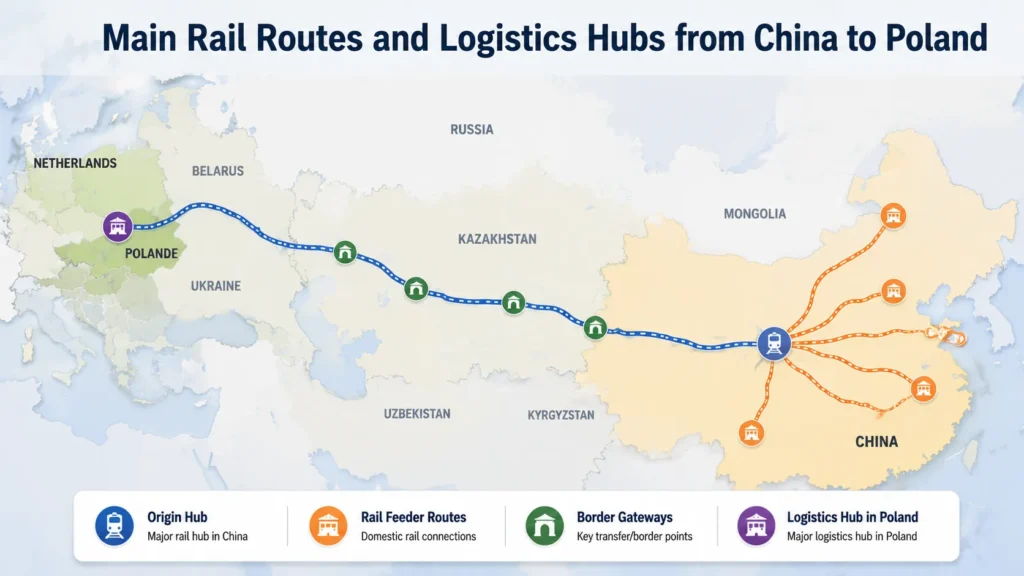
The Northern Corridor is one of the most commonly used routes for rail freight from China to Poland.
Typical routing:
China → Kazakhstan → Russia → Belarus → Poland
Many China-Europe rail services enter Poland through Małaszewicze, the main railway gateway near the Belarus–Poland border.
This route is widely used because of its established railway connections and relatively stable operating experience.
The Middle Corridor provides an alternative route connecting China with Europe through Central Asia and the Caspian region.
Typical routing:
China → Kazakhstan → Caspian Sea → Azerbaijan → Georgia → Türkiye → Europe
Compared with traditional northern routes, the Middle Corridor avoids some northern border crossings but requires additional multimodal transportation, including rail and ferry operations.
Potential advantages:
Alternative routing flexibility
Reduced dependence on northern routes
Growing connection with European markets
However, additional handling points may affect schedule stability. Transit time depends on ferry availability, border procedures, and operational conditions.
China has several important railway hubs connecting different manufacturing regions with Poland through the China-Europe Railway Express network.
NORTHWEST CHINA
One of the largest China-Europe rail hubs, connecting inland Chinese suppliers with regular rail services to Europe.
SOUTHWEST CHINA
An important China-Europe rail center serving manufacturers across southwest China and supporting international cargo connections.
WEST CHINA
A major departure hub for electronics, machinery, automotive parts, and industrial products from western China.
WEST CHINA
A major departure hub for electronics, machinery, automotive parts, and industrial products from western China.
EAST CHINA
Commonly used for consumer goods, small commodities, and e-commerce shipments from Zhejiang manufacturing areas.
YANGTZE RIVER DELTA
Serving exporters from Jiangsu, Shanghai, and surrounding manufacturing regions with access to China-Europe rail networks.
Poland plays a key role in China-Europe rail transport because it connects incoming rail freight with distribution networks across the European Union.
The main logistics hubs for rail freight from China include:
Małaszewicze is the main railway gateway for many China-Europe rail shipments entering the EU from the east. It handles border operations, container transshipment, and connections between Asian and European railway networks.
Łódź is one of Poland’s key inland logistics centers and an important destination for China rail shipments. Its central location supports distribution to warehouses, factories, and markets across Poland and Central Europe.
Warsaw is Poland’s largest business and distribution hub, serving as an important destination for imported goods. Rail cargo can be delivered from Polish terminals to warehouses, manufacturing facilities, and regional distribution centers.
When shipping goods from China to Poland by rail, importers usually choose between FCL (Full Container Load) and LCL (Less than Container Load). The better option depends mainly on the shipment volume, cargo type, and how quickly the goods need to be delivered.
FCL is normally used for larger shipments that can fill a container, while LCL is a practical choice for smaller shipments that do not require a full container.
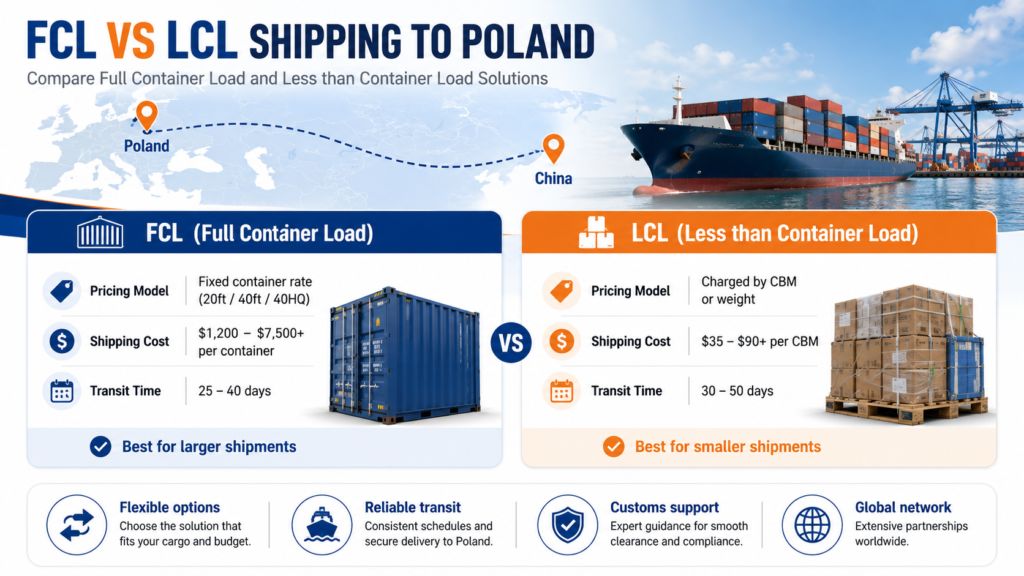
FCL rail freight means the cargo is loaded into a dedicated container for one shipper. It is commonly used by companies importing regular volumes from China, especially for machinery, industrial products, electronics, and automotive parts.
Common container options include:
20ft container: suitable for medium-volume shipments
40ft high cube container: suitable for larger shipments requiring more loading space
The main benefits of FCL rail shipping include:
Less handling during transportation
Better protection for the cargo
Easier loading arrangement at the supplier’s warehouse
More suitable for heavy or high-value goods
For businesses shipping larger quantities, FCL is often more cost-effective because the transportation cost is spread across a higher cargo volume.
LCL rail freight is designed for smaller shipments that do not require a full container. The cargo shares container space with other shipments and is consolidated before departure.
It is commonly used for:
Samples
Small commercial orders
Trial shipments
Goods from multiple suppliers
Before shipment, LCL cargo is usually delivered to a consolidation warehouse in China, where it is measured, checked, and loaded together with other shipments.
Compared with FCL, LCL may require additional handling at both origin and destination, which can slightly increase the delivery time.
A complete rail shipment involves several stages, from factory pickup in China to final delivery in Poland.
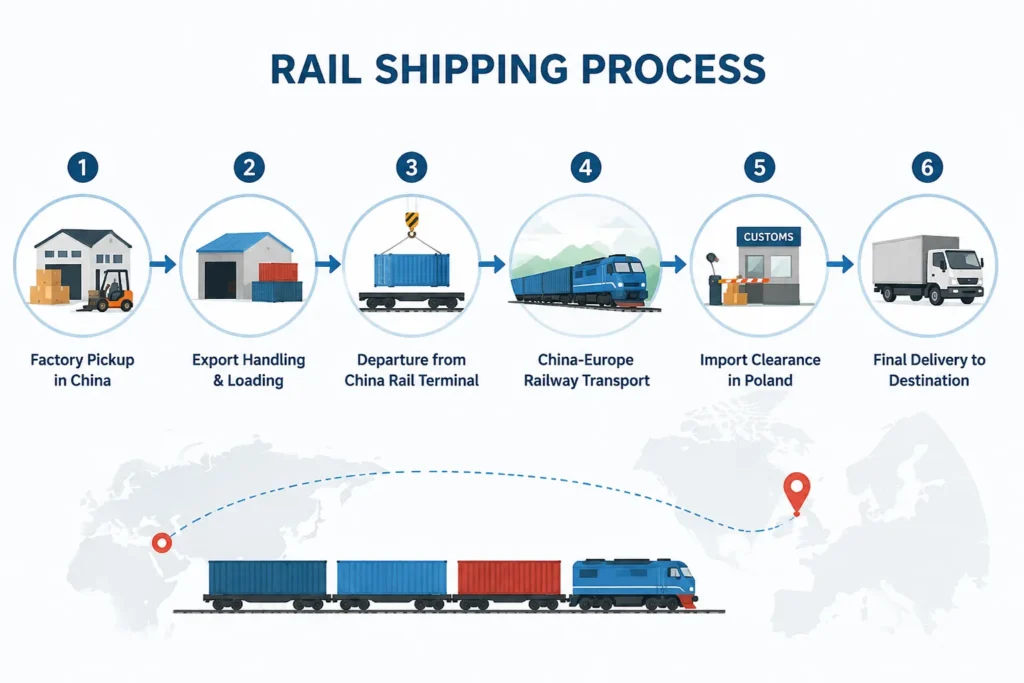
The process usually begins with collecting goods from the supplier.
The freight forwarder arranges:
Factory pickup
Warehouse receiving
Cargo measurement
Weight verification
Packaging inspection
Accurate cargo information is important because railway freight costs are calculated based on actual shipment data.
Before departure, exporters must complete Chinese export procedures.
Common documents include:
Commercial invoice
Packing list
Export declaration information
HS code
Transport documents
Incorrect product descriptions or missing documents can delay shipment preparation.
After export clearance, cargo is loaded for China-Europe rail transport.
The shipment moves through the selected railway corridor and passes multiple countries before reaching Poland.
The actual route depends on:
Departure terminal
Railway schedule
Border conditions
Current operational situation
Because China and Europe have different railway gauge systems, containers usually require transfer operations at certain border points.
These operations may include:
Container lifting
Railway wagon replacement
Customs coordination
Terminal handling
Border procedures are one of the main factors affecting overall delivery time.
When the shipment arrives in Poland, customs procedures must be completed before final delivery.
The importer or customs representative handles:
Import declaration
Duty calculation
VAT procedures
Product compliance checks
Proper preparation before arrival helps avoid unnecessary storage costs.
After customs release, cargo can be delivered by truck to:
Warehouses
Factories
Distribution centers
Retail locations
Door-to-door rail services combine all these steps into one logistics solution, making them easier for importers without local logistics resources.
Customs clearance is an important step when shipping goods from China to Poland by rail. Since Poland is part of the European Union, imported goods must complete EU import procedures before they can be released for delivery or distributed to other European countries.
The customs process mainly depends on the product type, HS code, declared value, origin of goods, and importer information. Preparing the correct documents before the shipment arrives can help avoid unnecessary delays and additional storage costs.
The required documents for rail imports into Poland are similar to other international shipments. Preparing accurate paperwork before arrival can help avoid customs delays.
Common documents include:
Commercial Invoice
Packing List
HS Code information
Rail transport document
Product certificates when required
The exact requirements depend on the product category, customs classification, and import regulations. For regulated products, additional documents such as compliance certificates or test reports may be required.
For rail freight from China to Poland, the customs process usually includes:
Document preparation
The commercial invoice, packing list, HS code, and importer information are checked before arrival.
Customs declaration
The customs broker or importer submits the import declaration based on the shipment details.
Customs review
Customs may check the declared value, product classification, origin, or required compliance documents.
Duty and VAT payment
Applicable customs duties and import VAT must be completed before cargo release.
Cargo release and delivery
After clearance, the shipment can be delivered from the railway terminal to the final destination.
Most customs delays are caused by incomplete or inconsistent shipment information.
Importers can reduce risks by:
Providing accurate product descriptions
Confirming HS codes before shipping
Ensuring invoice and packing list information matches
Preparing compliance documents in advance
Confirming importer details before arrival
For businesses without experience handling EU imports, working with a freight forwarder familiar with China–Poland rail freight can simplify customs coordination and reduce the risk of delays.
Choosing the right shipping method depends on delivery urgency, cargo volume, and budget.
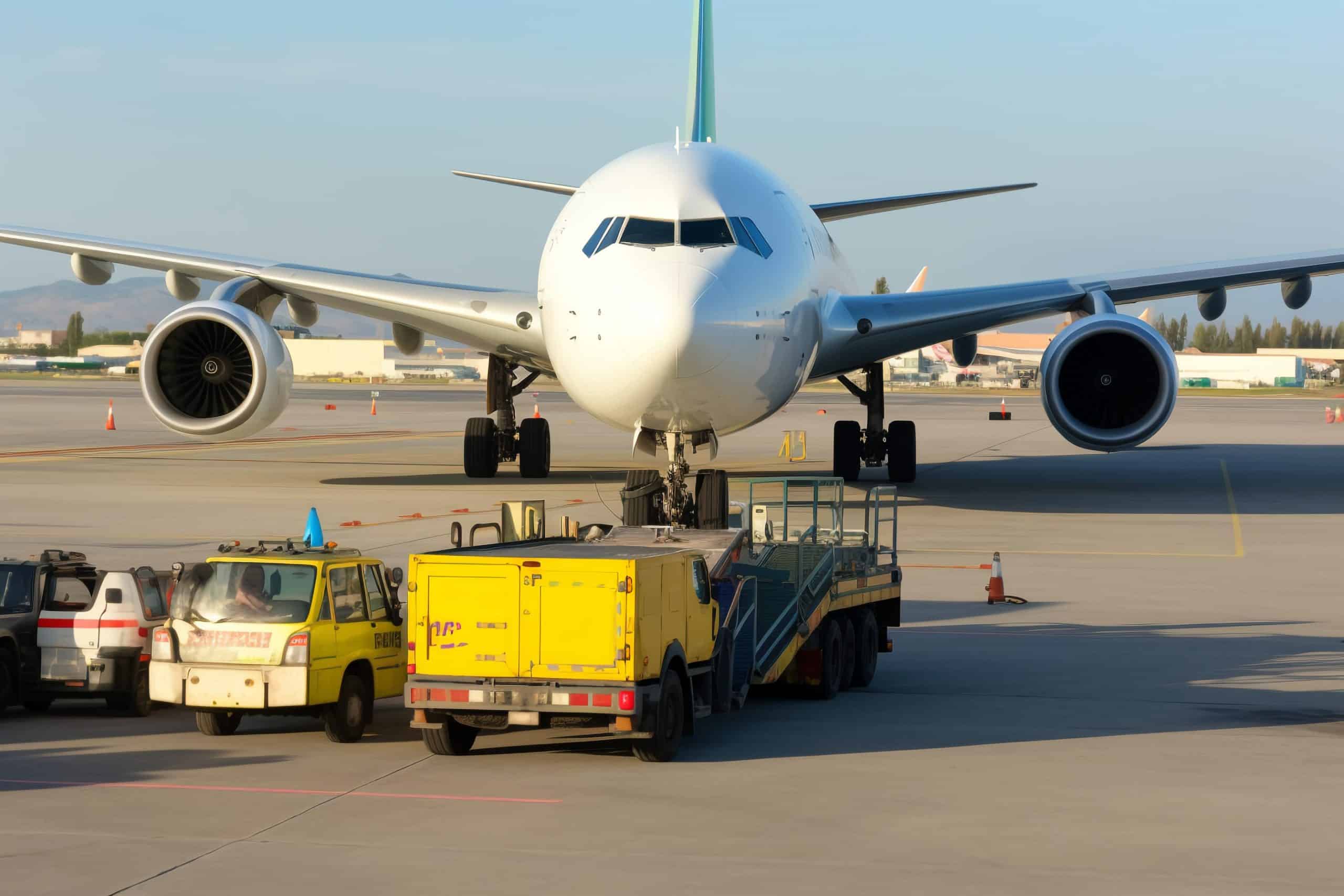
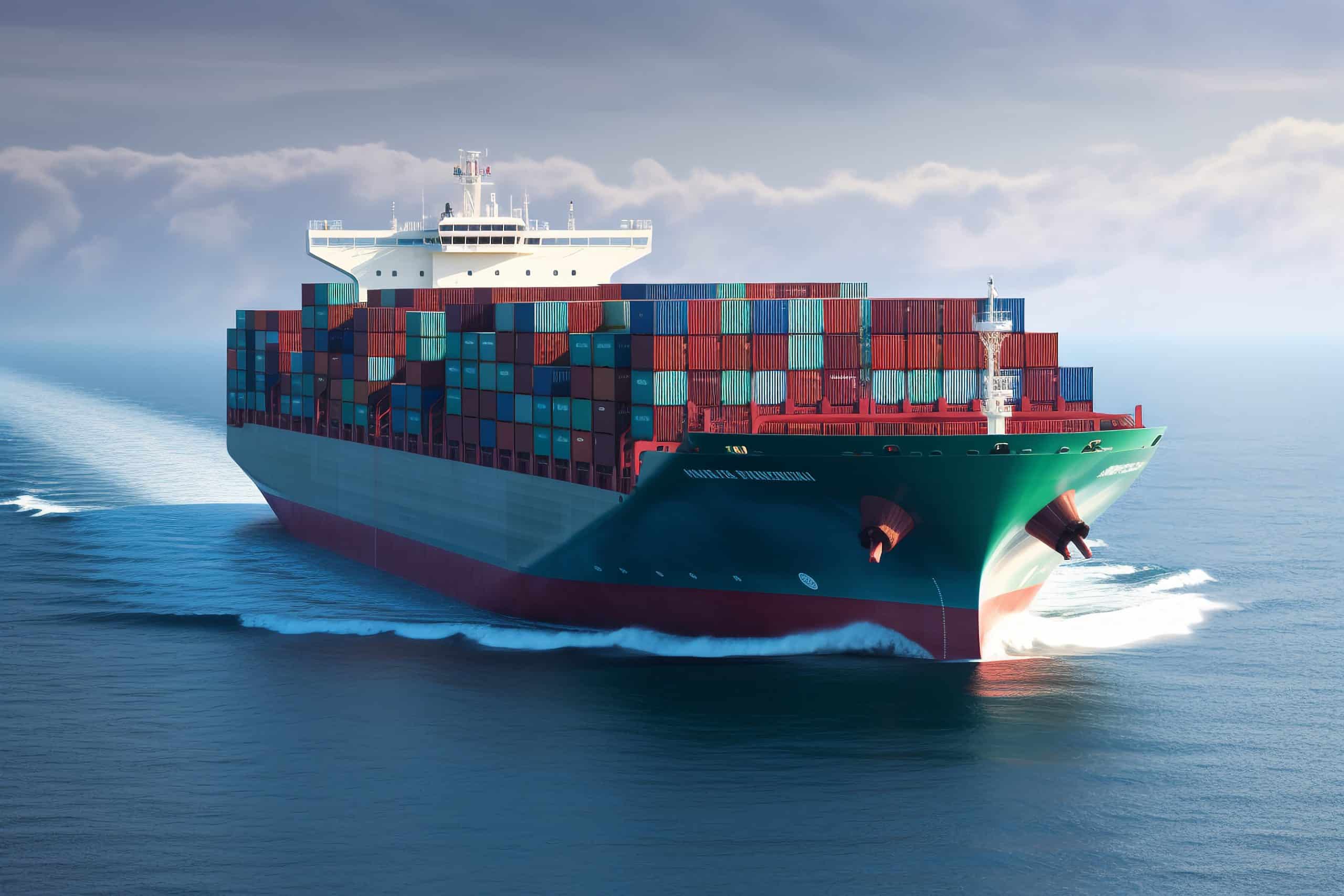
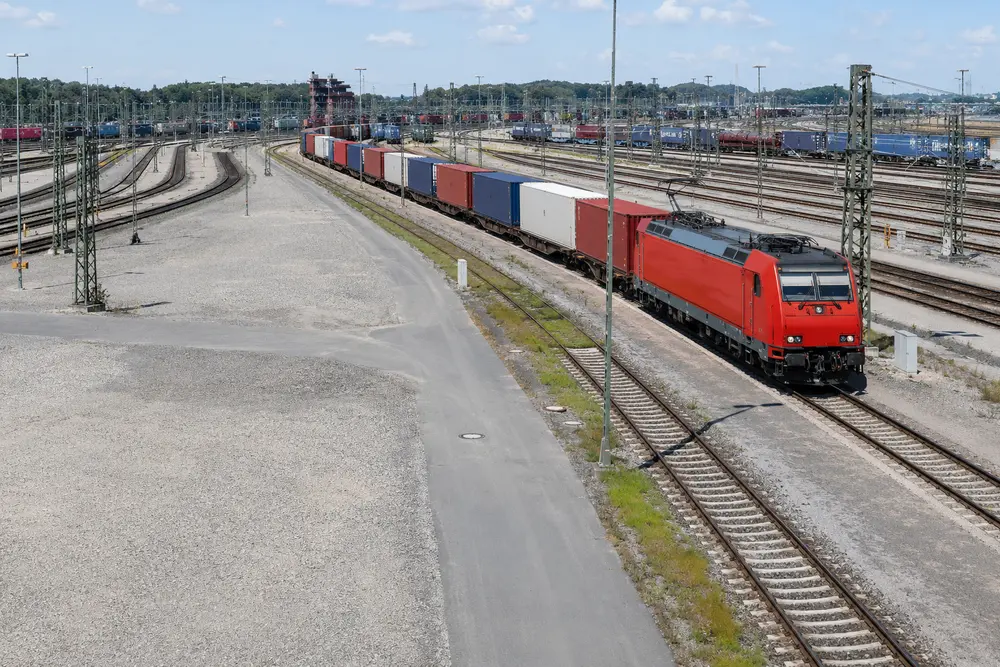
Many importers combine different shipping methods depending on inventory requirements.
For example:
Urgent products → air freight
Regular inventory → rail freight
Large-volume stock → sea freight
Rail freight from China to Poland is suitable for a wide range of commercial goods that require a balance between delivery speed and transportation costs. Compared with air freight, rail offers better cost efficiency for heavier shipments, while providing faster delivery than traditional sea freight.
Common products transported through China-Europe rail services include:
Electronics and consumer goods: Electronic components, consumer devices, communication equipment, and small appliances.
Machinery and industrial products: Manufacturing equipment, machine parts, industrial tools, and production components.
Automotive parts: Vehicle components, spare parts, and automotive accessories requiring stable supply chain transportation.
Consumer and retail goods: Textiles, household products, furniture components, and e-commerce inventory.
Rail shipping is especially suitable for importers that need shorter lead times than sea freight but want to avoid the high cost of air transport. Before choosing rail freight, businesses should consider cargo type, shipment volume, product requirements, and customs regulations.
Rail freight from China to Poland provides a middle option between sea and air transport. It offers shorter delivery times than ocean shipping while maintaining lower costs compared with air freight, making it suitable for businesses that need reliable transportation for commercial cargo.
Rail transport has become an important shipping option for importers because of its balance between speed, cost, and capacity.
Main advantages include:
Balanced cost and transit time: Rail freight is generally more affordable than air freight and faster than sea freight, making it suitable for medium-volume shipments.
Stable delivery schedules: Compared with ocean shipping, rail transport is less affected by port congestion and vessel schedule changes.
Suitable for larger cargo volumes: Rail provides more capacity than air transport and can handle machinery, industrial products, electronics, and other commercial goods.
Better European distribution: After arriving in Poland, cargo can be delivered efficiently to other European markets through road and rail networks.
Lower environmental impact: Rail transportation typically produces fewer emissions compared with air freight.
Although rail freight offers many benefits, importers should also consider several factors that may affect delivery performance.
Common challenges include:
Border operations: Railway gauge changes, customs procedures, and terminal handling may influence transit times.
Route availability: Schedules and costs can vary depending on the departure hub, railway capacity, and selected route.
Customs requirements: Incorrect HS codes, incomplete documents, or unclear product information may delay cargo release in Poland.
Additional handling points: Rail shipments may involve transfers and terminal operations during international transportation.
For businesses shipping from China to Poland, choosing the right route and preparing accurate shipment information in advance can help reduce delays and improve overall logistics efficiency.
Choosing the right freight forwarder can affect shipping reliability, customs efficiency, and overall transportation costs. A professional partner should understand both China export procedures and Poland import requirements.
A reliable freight forwarder should have experience with:
China-Europe Railway Express routes
FCL and LCL rail shipments
Factory pickup and warehouse handling
Border and terminal operations
Understanding different rail routes and departure hubs helps select a more suitable shipping solution based on cargo requirements.
Rail shipping involves more than international transportation. The freight forwarder should also be able to assist with:
Export documentation
Customs clearance coordination
HS code checking
Final delivery arrangements in Poland
Door-to-door support can simplify the process for importers that do not have local logistics resources.
When comparing quotations, check whether the price includes:
Pickup in China
Rail freight
Customs services
Destination handling
Final delivery
The lowest freight rate does not always mean the lowest total cost. A complete service scope helps avoid unexpected charges.
Tonlexing provides rail freight solutions from China to Poland, including FCL/LCL shipping, export coordination, customs support, and door-to-door delivery.
Rail freight from China to Poland usually takes around 12–22 days depending on the departure city, route, border processing, and destination location.
A complete door-to-door shipment may require additional time for pickup, customs clearance, and final delivery.
The estimated cost depends on the shipment type:
20ft FCL: USD 2,800–3,800/container
40ft HC FCL: USD 3,200–4,800/container
LCL rail freight: USD 80–140/CBM
Final pricing depends on cargo details, route availability, and service scope.
Yes. Rail freight is generally much cheaper than air freight for medium and large shipments.
It provides a balance between speed and cost, making it suitable when sea freight is too slow and air freight is too expensive.
Yes. LCL rail freight allows smaller shipments to share container space.
It is suitable for importers who do not have enough cargo volume for a full container but require faster delivery than sea freight.
Yes. Poland is one of the most important entry points for China rail transport into the European Union.
Rail hubs such as Małaszewicze and Łódź connect imported goods with distribution networks across Poland and other European countries.
Useful freight, customs and importing resources related to this shipping guide.
Shipping from China to Poland – Rail, Sea & Door-to-Door in 2026 Fast, reliable shipping from China to Poland for B2B importers, eCommerce seller...
Read guide → Shipping Cost from China to Poland (2026 Guide) Verified & Reviewed · Last updated May 2026 Shipping cost from China to Poland in 2026 typically...
Read guide →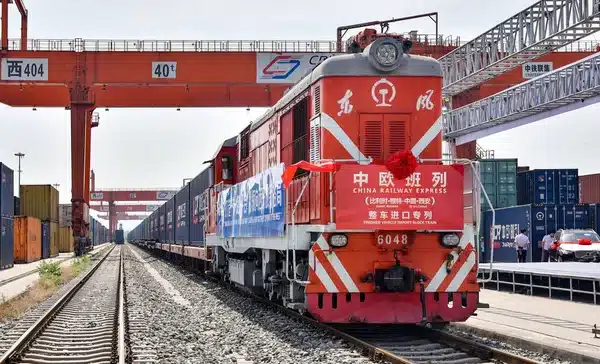
Railway freight has become an increasingly popular shipping solution for businesses looking to transport goods from China to Europe. The rise of...
Read guide →
Shipping from China / Rail Freight from China International Rail Freight Services · China to Europe & Eurasia Rail Freight from China Move cargo...
Read guide →China and Russia share one of the most vital trade corridors in Eurasia, supporting a growing volume of exports across industries such as machine...
Learn more → Useful Resource Sea Freight from China to PolandSea Freight from China to Poland Verified & Reviewed · Last updated August 2026 Shipping goods from China to Poland by sea is a cost-effective so...
Learn more →WhatsApp us