
Related Guide
Road Freight from China to Kazakhstan
As Central Asia rises in strategic importance, road freight from China to Kazakhstan has become one of the most efficient and flexible logistics...
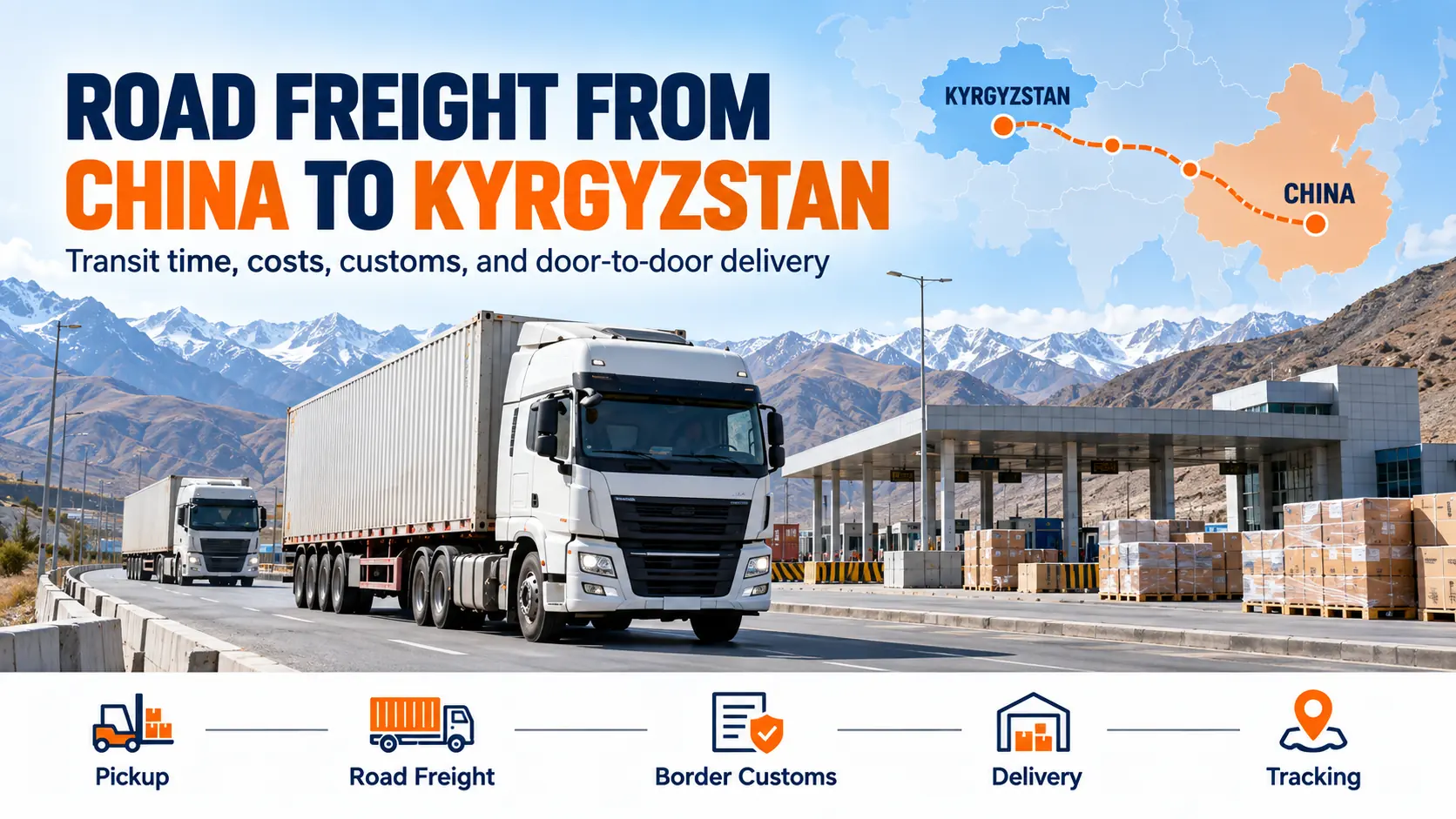
Read guide →Road freight from China to Kyrgyzstan typically takes around 10–18 days, with delivery available to Bishkek, Osh, Naryn, Jalal-Abad and other destinations. Importers can choose LTL for smaller shipments or FTL for larger dedicated loads.

Learn about road freight costs, transit times, Irkeshtam and Torugart border routes, customs clearance, and door-to-door delivery options from China to Kyrgyzstan.
Road Freight Cost
Transit Time
LTL & FTL
Road transportation offers a practical balance between cost, speed and inland delivery flexibility.
$3,000–$5,200
Per Truck
Dedicated truck service for larger commercial shipments, machinery and equipment.
$0.40–$0.60/KG
Shared Truck Space
Suitable for smaller shipments that do not require a full truck.
10–18 DAYS
China to Kyrgyzstan
FTL can be faster, while LTL requires additional consolidation time.
12% VAT
Kyrgyzstan Customs
Import duty is generally based on the HS code and EAEU tariff classification.
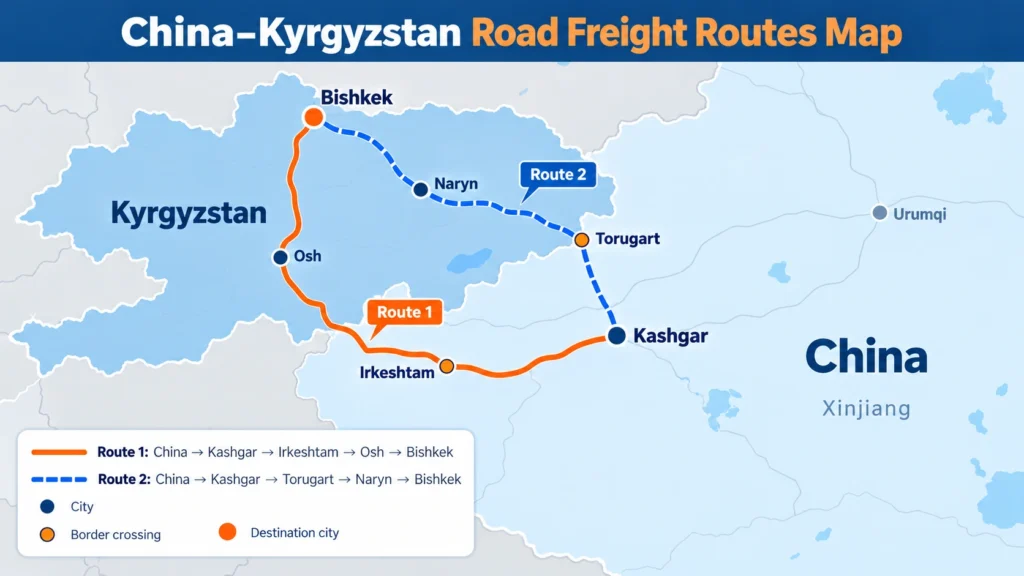
Most road freight enters Kyrgyzstan through Irkeshtam or Torugart, with onward delivery available to Bishkek, Osh and other destinations.
Most road freight first moves toward Xinjiang before crossing the China–Kyrgyzstan border.
For cargo originating in eastern or southern China, transportation usually consists of two stages: domestic trucking toward western China and cross-border road freight into Kyrgyzstan.
The two main established crossings are Irkeshtam and Torugart.
A common southern route is:
China factory → Urumqi / Kashgar → Irkeshtam → Osh → Final destination
Irkeshtam connects Xinjiang with southern Kyrgyzstan and is particularly suitable for cargo destined for:
Osh
Jalal-Abad
Southern Kyrgyzstan
Bishkek via onward trucking
Transit routes toward Uzbekistan
For shipments destined for Osh, Irkeshtam is often a practical option because cargo enters Kyrgyzstan from the south.
Another established route is:
Kashgar → Torugart → Naryn → Bishkek
Torugart connects western China with the Naryn region and provides access toward central and northern Kyrgyzstan.
Because the route passes through mountainous terrain, winter weather, snow and temporary road restrictions can affect transportation schedules.
Bedel is developing as another connection between China and Kyrgyzstan.
As of 2026, however, it should not yet be treated in the same way as Irkeshtam and Torugart for routine commercial trucking. Shippers should confirm current customs facilities, operating conditions and vehicle eligibility before selecting this route.
For most regular shipments, Irkeshtam and Torugart remain the primary road freight options.
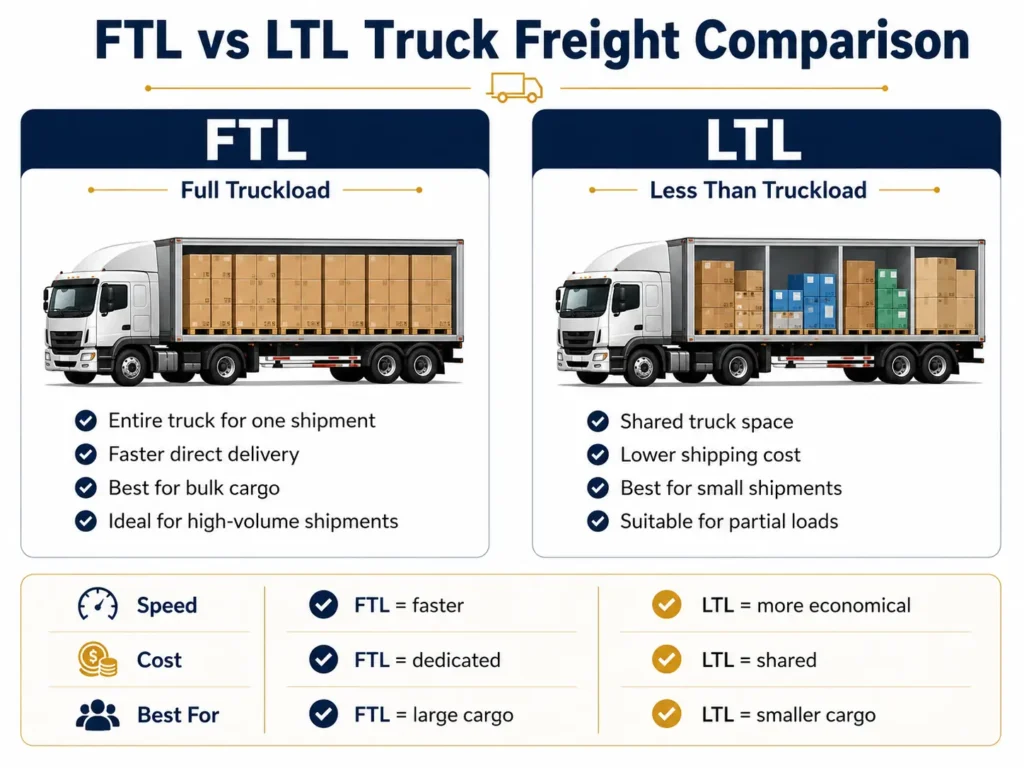
The choice between LTL and FTL affects cost, handling and delivery time.
LTL, or Less than Truck Load, allows several customers to share the same truck.
It is suitable for:
Small and medium commercial shipments
Consumer goods
Textiles and footwear
Auto parts
E-commerce inventory
Multiple supplier orders
Cargo is normally collected at a consolidation warehouse before departure.
LTL rates are usually calculated by weight or CBM, depending on cargo density. Transit time is generally around 12–18 days because additional consolidation may be required.
FTL, or Full Truck Load, provides dedicated vehicle capacity for one shipment.
It is more suitable for:
Large commercial orders
Machinery
Industrial equipment
Building materials
Project cargo
High-value shipments
FTL normally involves less cargo handling and more predictable departure planning.
Typical FTL transit time is around 8–12 days, depending on the origin, border crossing and final delivery location.
| Shipment Profile | Recommended Option | Why |
|---|---|---|
| Small commercial shipment | LTL | Lower cost through shared capacity |
| Multiple supplier orders | LTL | Goods can be consolidated before departure |
| Large-volume order | FTL | Dedicated truck capacity |
| Heavy machinery | FTL | Less handling |
| Bulky lightweight cargo | Depends on CBM | Volume may be the main cost factor |
| Urgent large shipment | FTL | Faster departure |
Both total weight and total CBM should be provided before deciding between LTL and FTL.
Road freight cost depends mainly on the pickup location, shipment size, truck type, border route and final delivery address.
The following prices are general market reference ranges. Actual quotations may change according to cargo type, season, vehicle availability and customs requirements.
FTL is normally quoted per truck and is suitable for larger shipments or cargo requiring dedicated vehicle capacity.
| Truck Type | Reference Cost | Typical Use |
|---|---|---|
| 9.6 m enclosed truck | USD 3,000–4,000 / truck | Medium-volume commercial cargo |
| 13–13.7 m semi-trailer | USD 4,000–5,200 / truck | Large machinery and high-volume cargo |
| Xinjiang-origin FTL | USD 1,000–2,200 / truck | Cargo already positioned near Xinjiang gateways |
Xinjiang-origin rates are lower because they exclude much of the domestic transport distance from China’s coastal manufacturing regions.
LTL is normally charged according to shipment weight or volume.
| Charging Method | Reference Rate |
|---|---|
| By weight | USD 0.40–0.60 / kg |
| By volume | USD 90–130 / CBM |
Dense cargo is more likely to be charged by weight, while lightweight but bulky shipments may be calculated by CBM.
DDP can combine transportation, customs clearance, duties or taxes and final delivery, depending on the quotation scope.
A typical reference range is: USD 5–11 / kg
DDP rates vary significantly according to the product and customs requirements, so importers should confirm exactly what is included before comparing quotations.
Road freight rates mainly depend on:
Pickup location – Longer domestic transport increases the total cost
Shipment size – Weight and CBM affect LTL pricing
Truck type – Larger or specialized vehicles cost more
Cargo type – Special cargo may require extra handling
Final destination – Remote delivery can increase the rate
Season and road conditions – Peak periods and winter weather can affect pricing
For an accurate quotation, provide the pickup city, destination, cargo name, total weight, CBM, package dimensions and cargo-ready date.
Road freight from China to Kyrgyzstan typically takes around 10–18 days overall. The actual transit time mainly depends on the selected service, pickup location in China and border conditions.
| Transport Mode | Typical Transit Time | Best For |
|---|---|---|
| FTL / Direct Trucking | 8–12 days | Large and time-sensitive shipments |
| LTL / Consolidated Freight | 12–18 days | Small and medium shipments |
| Door-to-Door Road Freight | 10–18 days | Complete pickup-to-delivery service |
FTL is usually faster because the truck does not need to wait for other customers’ cargo. LTL takes longer because goods must first be collected, consolidated and scheduled for departure.
Cargo collected from Guangzhou, Shenzhen, Yiwu or Shanghai may also require more domestic transportation time than shipments already located in Xinjiang.
Transit times are estimates rather than guaranteed arrival dates. Common causes of delay include:
Border congestion
Customs inspections
Winter weather
Incomplete documents
Public holidays
Remote final delivery locations
Torugart and Irkeshtam both pass through mountainous regions, so winter road conditions can have a greater impact on transit schedules.
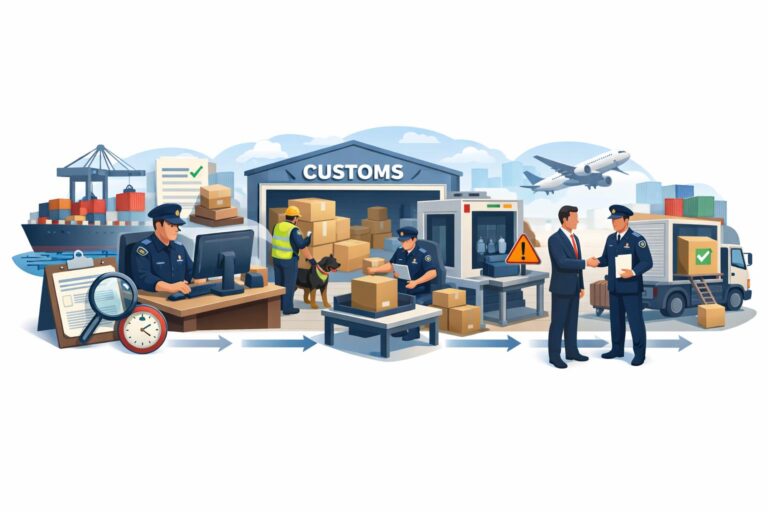
Customs clearance is an important part of road freight from China to Kyrgyzstan. Kyrgyzstan is a member of the Eurasian Economic Union (EAEU), so imported goods are handled under the EAEU customs framework.
Importers should confirm the HS code, customs value, product description and compliance requirements before cargo leaves China.
A typical commercial shipment may require:
Commercial Invoice
Packing List
Sales Contract
Road transport documents
Customs declaration information
Product certificates or permits when required
TIR documents when applicable
Certificates of Origin may also be required for certain products or customs purposes.
Preparing the documents before shipment can reduce delays caused by inconsistent product descriptions, values or supporting certificates.
Import taxes depend on the HS code, customs value and product category.
Import Duty: Most rates are generally around 0%–10%, although some products may be higher
VAT: Imported goods are generally subject to 12% VAT
Customs Processing Fee: Current trade guidance lists approximately 0.2% of customs value, subject to a minimum fee
Certain goods may also require excise taxes, licenses or additional compliance documents.
A door-to-door road freight service can coordinate the shipment from a Chinese supplier to the final delivery address in Kyrgyzstan.
Provide the cargo details, pickup location, destination, total weight, CBM and cargo-ready date.
The shipment size and delivery requirements determine whether consolidated or dedicated trucking is more suitable.
Goods can be collected directly from the supplier. Cargo from several suppliers can also be combined at a warehouse.
Packaging and commercial documents are checked before the goods enter the international transport stage.
Shipments from China's major manufacturing regions move west toward Urumqi, Kashgar or another logistics point.
Cargo normally enters Kyrgyzstan through Irkeshtam or Torugart.
After customs procedures are completed, the cargo continues to Bishkek, Osh, Naryn, Jalal-Abad or another agreed delivery address.
Road freight can handle a wide range of commercial cargo.
Typical shipments include:
Consumer goods
Machinery and industrial equipment
Auto parts
Textiles and footwear
E-commerce and project cargo
Special cargo requires additional planning.
Batteries and dangerous goods may require approved packaging and documentation, while oversized machinery may require special trucks or loading arrangements.
Fragile and high-value cargo may also require stronger packaging, insurance or additional security measures.
Road freight is not the only way to move cargo between China and Kyrgyzstan.
Transit Time: Around 10–18 days
General commercial cargo, LTL and FTL
Transit Time: Around 3–7 days
Urgent and lightweight cargo
Transit Time: Route-dependent
Selected multimodal shipments
Road freight is often the most practical option for shipping from China to Kyrgyzstan because it offers a balance between cost, transit time and inland delivery flexibility. Air freight is faster but more expensive, while rail options remain limited and often require additional transfers.
Kyrgyzstan’s railway network is still relatively limited, and the China–Kyrgyzstan–Uzbekistan railway remains under construction in 2026. For many importers, direct road transport remains easier to arrange because trucks can cross the border and continue directly to inland destinations such as Bishkek and Osh.
Typical road freight takes around 10–18 days. FTL usually takes around 8–12 days, while LTL normally takes 12–18 days.
LTL typically costs around USD 0.40–0.60/kg or USD 90–130/CBM. FTL commonly starts from around USD 3,000 per truck, depending on truck type, origin and destination.
The main established crossings are Irkeshtam and Torugart.
Yes. Commercial trucks can move between China and Kyrgyzstan through approved international land crossings.
LTL is more suitable for smaller shipments, while FTL is better for large loads requiring dedicated capacity and faster departure.
Useful freight, customs and importing resources related to this shipping guide.
As Central Asia rises in strategic importance, road freight from China to Kazakhstan has become one of the most efficient and flexible logistics...
Read guide →
Door to door shipping from China by air, sea, rail or express. Compare DDP vs DAP, costs, transit times, customs clearance and final delivery.
Read guide →
Air freight from China is the best option for time sensitive and high value shipments. It offers fast delivery, reliable transit times, and effic...
Read guide →
Customs Clearance Step by Step: The Complete Process Verified & Reviewed · Last updated February 2026 Customs clearance step by step helps intern...
Read guide →In the complex world of international trade, selecting a reliable freight forwarder is a crucial step in ensuring a smooth and cost-effective sup...
Learn more → Useful Resource What Is Cargo Insurance and How Does It Work?What Is Cargo Insurance and How Does It Work? Verified & Reviewed · Last updated April 2026 Cargo insurance protects goods against physical loss...
Learn more →WhatsApp us