Related Guide
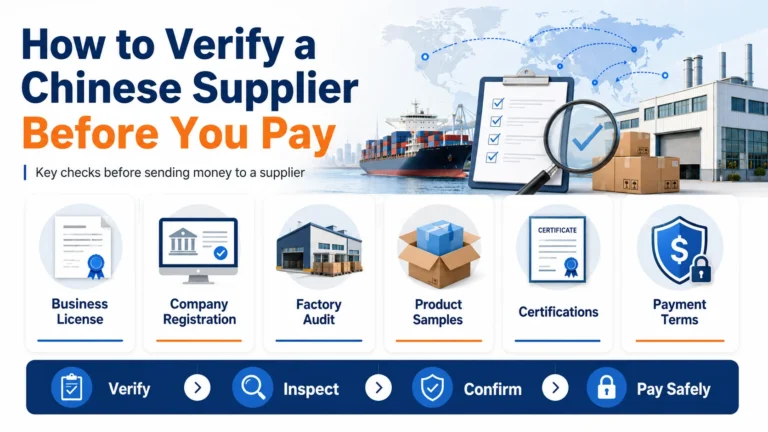
How to Verify a Chinese Supplier Before You Pay
How to Verify a Chinese Supplier Before You Pay Verified & Reviewed · Last updated July 2026 Before you pay a Chinese supplier, do not rely only...
Read guide →

China is a major sourcing base for mobile phone accessories, including phone cases, chargers, USB cables, screen protectors, headphones, wireless accessories and power banks.
This guide explains how to bulk import mobile phone accessories from China, covering supplier verification, MOQ, quality control, compliance, shipping, customs clearance and landed costs.
Supplier Verification
Quality & Compliance
Shipping & Landed Cost
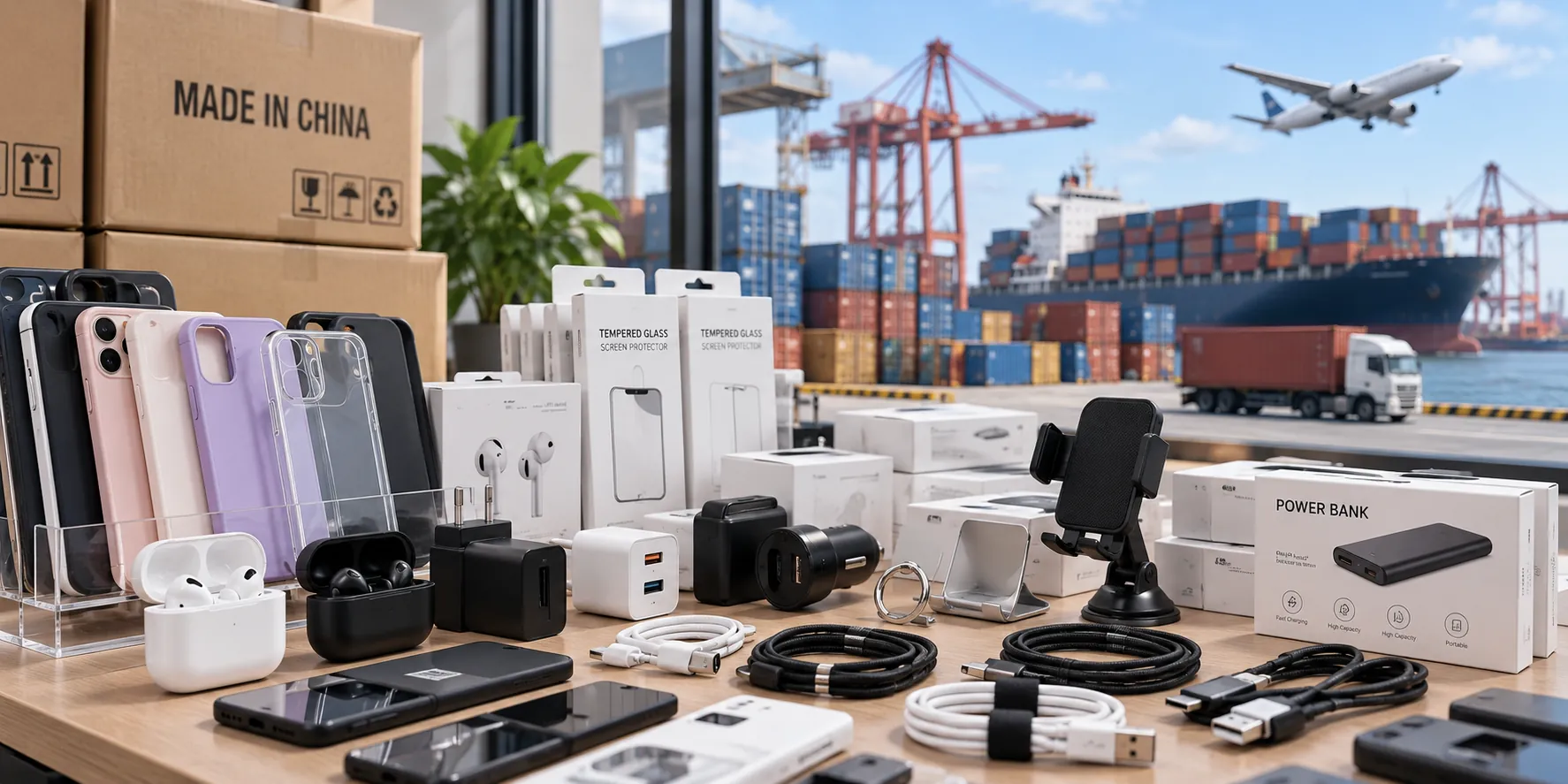
China has a mature manufacturing ecosystem for mobile accessories, consumer electronics and products used with smartphones and mobile phones.
Major advantages include:
A large range of mobile and cell phone accessories
Competitive factory and wholesale prices
Flexible order quantities for many stock items
OEM and ODM production
Private-label and custom packaging options
Large electronics manufacturing clusters
Access to factories, wholesalers and trading companies
Chinese manufacturers can supply both standard products and customized accessories for different markets.
For wholesalers and retailers, this makes it possible to source several product categories from China rather than relying on separate supply chains in different countries.
However, the lowest price is not always the best deal. Buyers should compare quality, production capability, delivery time, compliance support and supplier experience.
Product selection should also reflect demand in the destination market. Smartphone models, plug types, charging standards and customer preferences can differ significantly between countries.
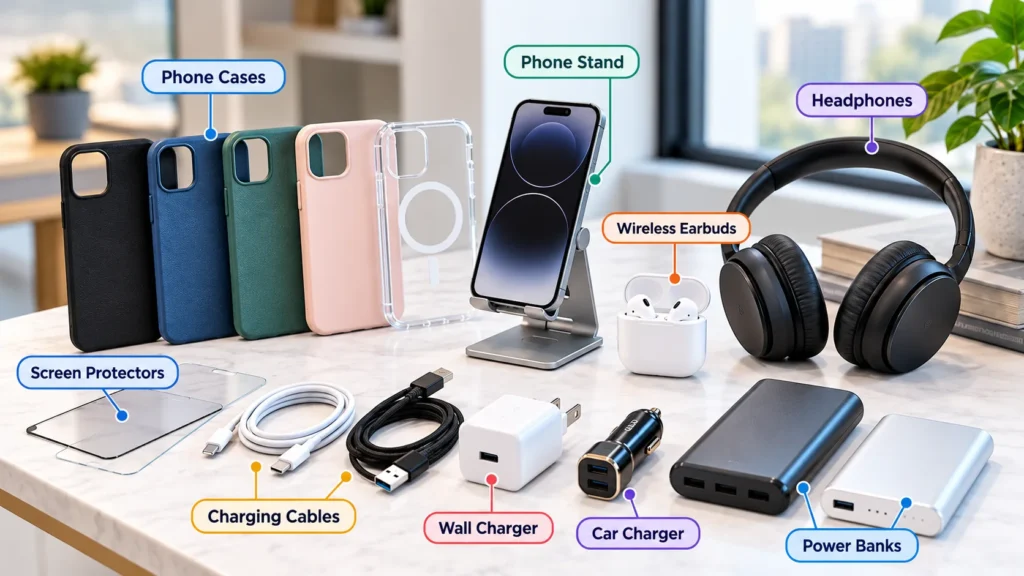
China supplies a wide range of mobile phone accessories for retail, e-commerce, wholesale, and private-label businesses. Buyers can source both low-cost everyday accessories and higher-value electronic products from manufacturers and trading companies.
Common product categories include:
Phone cases and covers – silicone, TPU, leather, magnetic, rugged, and custom-printed cases
Screen protectors – tempered glass, privacy glass, anti-glare, and camera lens protectors
Charging accessories – USB cables, wall chargers, car chargers, wireless chargers, and charging docks
Power banks – standard, fast-charging, magnetic, and high-capacity models
Earphones and headsets – wired earphones, Bluetooth earbuds, and gaming headsets
Phone holders and stands – desktop stands, car mounts, magnetic holders, and selfie sticks
Adapters and connectors – USB-C adapters, Lightning adapters, OTG connectors, and multi-port hubs
Replacement and repair accessories – batteries, screens, charging ports, tools, and small replacement parts
Smart accessories – Bluetooth trackers, wireless microphones, smart rings, and other compatible devices
When selecting products, buyers should check more than appearance and price. Accessories containing lithium batteries, Bluetooth modules, magnets, or other electronic components may require additional certificates, test reports, or shipping documents.
For bulk orders, it is also important to confirm compatibility, packaging, branding requirements, and the supplier’s MOQ before production begins.
Finding the right supplier is one of the most important steps when importing mobile phone accessories from China. Buyers can source products through major electronics manufacturing hubs, wholesale markets and online B2B platforms, but the best channel depends on the type of accessories, order quantity and level of customization required.
Shenzhen is one of China’s largest electronics manufacturing centers and a major sourcing hub for chargers, USB cables, wireless chargers, headphones, battery-powered accessories and other electronic phone accessories.
The Huaqiangbei area is especially well known for its wide range of mobile electronics and fast product turnover. It can be useful for wholesalers and distributors looking for new models, multiple price levels or suppliers with experience in electronics production.
Guangzhou has a large network of wholesalers and trading companies supplying cell phone accessories such as cases, cables, holders and charging products.
Yiwu is more suitable for buyers purchasing a broad mix of lower-value accessories, especially when smaller order quantities are required. Importers can source from several suppliers and later combine the goods through a consolidation warehouse before international shipping.
Alibaba, Made-in-China and Global Sources are also common places to search for Chinese suppliers and manufacturers.
However, finding a supplier online is only the first step. Before placing a bulk order, buyers should verify:
Business registration and company history
Whether the supplier is a factory or trading company
Main product categories and manufacturing capability
Export experience in your target market
Production lead time
Sample quality
Available test reports and certification
Payment terms
Quality control procedures
Warranty and defect-handling policies
A manufacturer may offer better control over production and customization for a specific product, while a trading company may be more convenient when sourcing several types of mobile accessories from different factories.
Before placing a large order, request physical samples and compare at least several suppliers based on quality, price, communication, lead time and compliance support, rather than choosing only the lowest quotation.
Order quantity and pricing for mobile phone accessories from China depend on the product type, supplier and level of customization. Standard stock products usually have the lowest MOQ, while private-label and fully customized products require larger orders.
In general:
Standard stock: existing products with little or no customization and the lowest order requirement.
Private Label / ODM: existing products customized with a logo, color, packaging or barcode. The MOQ is usually higher because printing and packaging suppliers often have their own minimum quantities.
Full OEM: new molds, structures, electronics or exclusive designs. This usually requires the highest investment, longer development time and larger production quantities.
Most Chinese suppliers also use tiered pricing, so the unit price generally decreases as the order quantity increases. However, buyers should compare more than price. Product specifications, materials, packaging, tooling fees, quality standards and production lead time can all affect the final cost.
For many new brands, private label or ODM is the easier starting point because it allows buyers to customize an existing product without paying for full product development. Full OEM is more suitable when a business needs a unique design or technical feature.
If new molds are required, the purchase agreement should clearly state who owns the tooling.
For first-time importers, starting with samples or a small pilot order is often safer than committing immediately to a large bulk order. Once the product quality, supplier reliability and market demand are confirmed, buyers can increase the quantity and negotiate better pricing.
Before production begins, buyers should confirm the main commercial terms with the supplier in a purchase order, proforma invoice or sales agreement. Clear written terms help reduce misunderstandings over product specifications, pricing and delivery.
The agreement should normally confirm:
Product specifications and quantity
Unit price and total order value
Packaging and labeling requirements
Incoterm, such as EXW or FOB
Production lead time
Quality inspection requirements
Payment terms
Delivery schedule
For customized mobile phone accessories, buyers should also confirm logo artwork, packaging design, colors and other OEM or private-label requirements before production.
Payment arrangements vary between suppliers. Many Chinese factories request a deposit before production, with the remaining balance paid before shipment or according to an agreed schedule.
Buyers should confirm the exact payment terms before making any payment and avoid assuming that all suppliers use the same structure.
Lead time depends on the product and level of customization. Standard stock mobile accessories may be available relatively quickly, while custom packaging, logo printing, molds or OEM production can require several weeks.
Importers should plan both production and shipping time. Air freight offers faster transit, while sea freight usually requires a longer delivery schedule.
For bulk orders, it is also wise to allow extra time for quality inspection, consolidation and customs clearance.
Quality control is essential when importing mobile phone accessories from China, especially for chargers, cables, wireless devices and other electronic products. Buyers should confirm product specifications before production and inspect the finished goods before shipment.
Always request samples before placing a bulk order. The approved sample can then be used as a reference for mass production.
A pre-shipment inspection may check:
Product quantity and appearance
Dimensions, colors and materials
Packaging and labeling
Functional performance
Defects and workmanship
For phone cases, buyers should check model compatibility, camera openings, buttons and surface finish. For chargers and USB cables, testing may include connectors, output, charging performance and overheating.
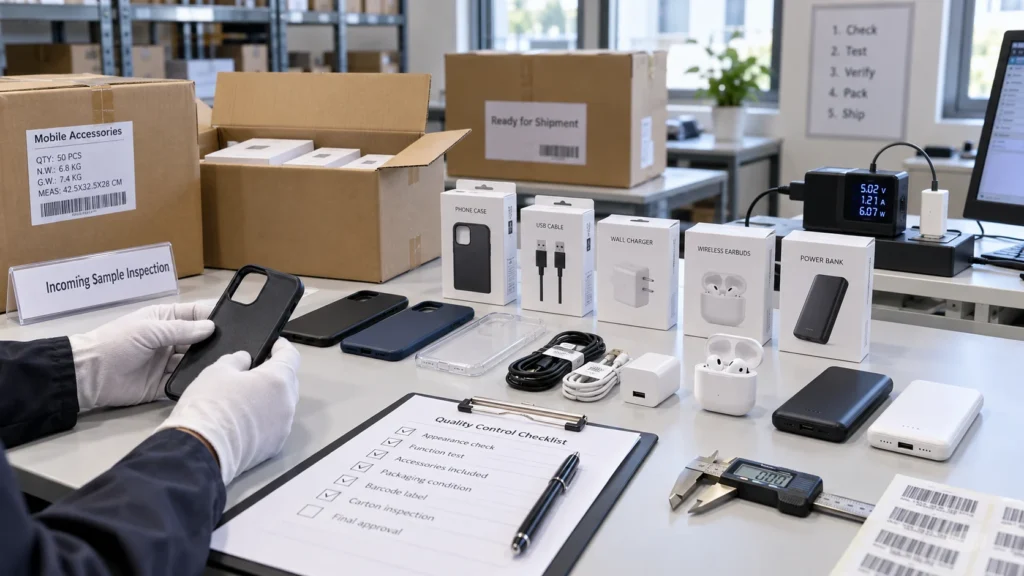
Battery-powered phone accessories, including power banks and some wireless products, require additional attention. Buyers should verify battery capacity, charging performance, labeling, packaging and relevant transport documents.
Poor battery quality can create both product and shipping problems, so these items should be checked carefully before export.
Compliance requirements depend on the product and destination country. Depending on the accessory, applicable requirements may involve CE, RoHS, FCC or other electrical, radio, environmental or safety standards.
Not all mobile accessories require the same certification. A silicone case, wall charger and wireless headset may be subject to very different rules.
For lithium battery products, transport documents such as a UN38.3 test report may also be required.
Importers should confirm applicable product and labeling requirements before production rather than waiting until the goods reach customs.
Choosing the right Incoterm helps clarify who is responsible for pickup, export procedures, international shipping, customs clearance and final delivery when importing mobile phone accessories from China.
Under EXW, the supplier makes the goods available at its factory or warehouse, while the buyer arranges pickup and most of the transportation process.
EXW can be useful when purchasing from several suppliers because one freight forwarder can collect and consolidate the goods in China before export.
Under FOB, the supplier generally handles export clearance and delivers the cargo to the agreed port of loading. The buyer then arranges the main international freight and destination-side logistics.
FOB is commonly used for sea freight and gives experienced importers more control over shipping arrangements and costs.
DDP shipping provides a more integrated door-to-door solution. Depending on the agreed service, transportation, customs clearance, duties and final delivery can be handled within one logistics arrangement.
This option is often convenient for buyers who want a simpler import process and do not want to coordinate multiple logistics providers.
The best Incoterm depends on your sourcing arrangement, shipping experience, destination and cargo type.
EXW: useful for multi-supplier consolidation
FOB: suitable for buyers who want more control over international freight
DDP: convenient for simplified door-to-door delivery
Whichever option you choose, confirm the Incoterm and named place clearly in the quotation or sales agreement before production begins.
The best shipping method for mobile phone accessories from China depends on cargo volume, weight, delivery time, destination and whether the goods contain lithium batteries.
| Shipping Method | Best For | Speed | Cost Level |
|---|---|---|---|
| Express | Samples and small orders | Very fast | High |
| Air Freight | Urgent small and medium shipments | Fast | Medium to high |
| Sea LCL | Smaller bulk shipments | Slower | Lower |
| Sea FCL | Large-volume cargo | Slower | Lower per unit |
| DDP | Buyers seeking door-to-door service | Varies | Depends on route |
Express courier services are suitable for samples and small quantities of phone accessories. For larger urgent shipments, air freight offers faster delivery than sea freight and is commonly used for compact, higher-value goods such as chargers, cables and electronic accessories.
Air freight costs are usually based on actual or chargeable weight, so carton size and packing efficiency can significantly affect the final shipping cost.
Sea freight is generally more economical for larger bulk orders.
LCL shipping is suitable when the cargo does not fill an entire container, while FCL shipping is often more cost-effective for large-volume shipments.
Buyers should compare total freight costs, destination charges and cargo volume before choosing between LCL and FCL.
DDP shipping can simplify the import process by combining international transportation, customs clearance and final delivery under one logistics arrangement.
It is particularly useful for buyers who prefer not to coordinate several shipping companies separately. The exact service scope, customs duties and delivery terms should be confirmed before booking.
Some mobile accessories, including power banks, wireless earbuds and other battery-powered products, may be subject to lithium battery shipping requirements.
Depending on the product and route, carriers may request:
Battery specifications
Suitable packaging
Required labels
Carrier approval
Importers should identify all battery-containing goods before requesting a shipping quotation, as they may require different transportation arrangements from ordinary cases, holders or USB cables.
When importing mobile phone accessories from China, buyers often work with several suppliers at the same time. One factory may supply cases, another may produce chargers, while other suppliers handle cables, screen protectors or retail packaging.
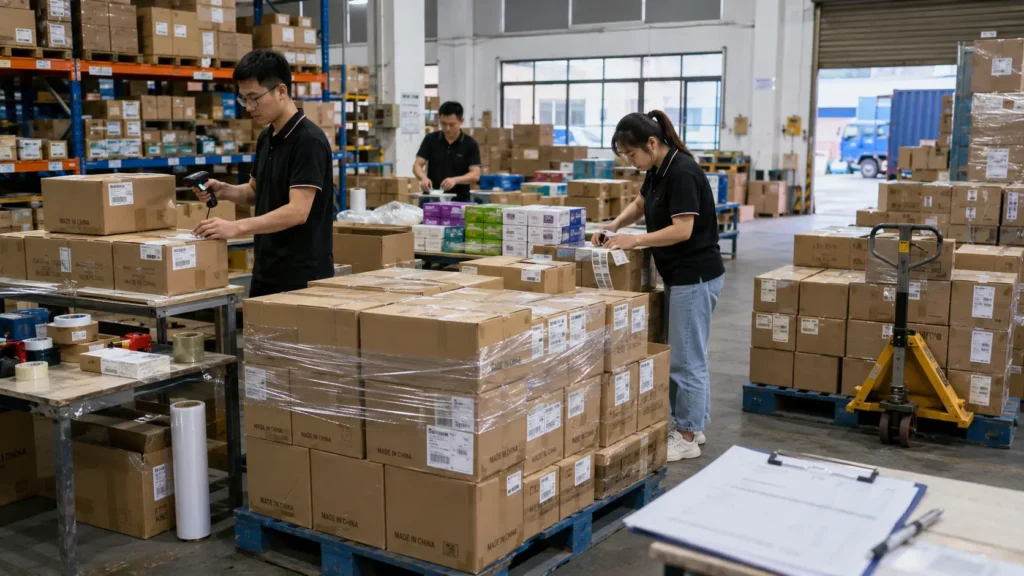
If each supplier ships separately, logistics costs and coordination can quickly become complicated. Consolidation allows these orders to be collected at one warehouse in China before export.
A typical process is:
Supplier Pickup → Warehouse Receiving → Quantity Check → Consolidation → Repacking → Export Shipping
At the warehouse, goods from different suppliers can be received, counted and organized before being combined into one shipment. Cartons can also be repacked when necessary to improve space utilization or reduce unnecessary volume.
Consolidating orders can help importers:
Reduce repeated domestic pickup and export charges
Manage several suppliers through one logistics process
Check quantities before international shipping
Combine cartons and optimize cargo space
Simplify shipping documents and cargo handling
Arrange one air or sea shipment instead of several separate shipments
This approach is especially useful for wholesalers sourcing a wide range of mobile accessories from China from different factories.
By using a consolidation warehouse, buyers can make multi-supplier orders easier to manage while reducing duplicated logistics costs and preparing the cargo for more efficient international shipping.
Customs clearance is an important part of importing mobile phone accessories from China. Requirements vary by destination country and product type, so buyers should confirm the correct tariff classification and required documents before shipment.
Common documents may include:
Commercial invoice
Packing list
Bill of lading or air waybill
Customs declaration
Certificate of origin where required
Product compliance documents
Battery documents for applicable goods
There is no single HS code for all phone accessories. Chargers, cables, headphones, cases and battery-powered products may fall under different tariff classifications, which can affect customs duties, taxes and regulatory requirements.
Importers should also check whether local importer registration, tax identification or additional permits are required in the destination market.
The real cost of importing includes much more than the supplier’s unit price.
A practical calculation is:
Total Landed Cost = Product Cost + China Pickup + Inspection + Packaging + Export Charges + International Freight + Insurance + Customs Duties and Taxes + Customs Clearance + Final Delivery
Other costs may also include customs brokerage, storage or processing fees depending on the destination and shipment.
Calculating the landed cost before placing a bulk order helps buyers compare suppliers and shipping methods more accurately. A lower factory price does not always mean a lower final cost once freight, duties and local charges are included.
For businesses importing multiple types of mobile accessories from China, confirming HS codes and destination charges in advance can also reduce the risk of unexpected customs costs or clearance delays.
The following ten steps provide a practical workflow:
Research your market. Identify popular smartphones, customer demand, retail prices and competing products.
Choose your accessories. Decide which products and models you want to import.
Prepare specifications. Define materials, functions, colors, packaging and branding.
Find suppliers. Compare manufacturers, factories, wholesalers and trading companies.
Request quotations and samples. Compare prices, quality, production times and commercial terms.
Confirm compliance. Identify applicable certification, labeling and battery requirements.
Sign off on commercial terms. Confirm the purchase order or sales agreement, Incoterm and payment schedule.
Arrange production and inspection. Check the finished goods before export.
Choose shipping and consolidate cargo. Compare express, air freight, LCL, FCL and DDP.
Complete customs clearance and delivery. Submit documents, pay applicable duties and arrange final transportation.
Following these steps helps reduce sourcing, production, shipping and customs problems before they become expensive.
Importing mobile phone accessories from China often involves several suppliers, different production schedules and multiple product categories. Tonlexing Logistics helps simplify this process by coordinating cargo collection, consolidation and international transportation from China to the final destination.
Tonlexing can arrange pickup from different factories and deliver the goods to a consolidation warehouse in China. Orders can then be checked, combined and prepared for export as one shipment, helping importers reduce repeated logistics costs and improve cargo management.
Depending on cargo volume, delivery time and destination, Tonlexing can provide:
Air freight
Sea freight
LCL and FCL shipping
DDP shipping
Door-to-door delivery
Warehousing and cargo consolidation
For power banks and other battery-powered accessories, Tonlexing can also coordinate suitable shipping solutions based on cargo type and carrier requirements.
Tonlexing can assist with export documentation, customs clearance and final delivery, helping buyers manage the shipping process more efficiently.
Whether you are importing phone cases, chargers, cables, headphones or mixed mobile accessories from China, Tonlexing can build a shipping solution based on your cargo details.
Send us your supplier locations, product list, carton dimensions, total weight, cargo volume and destination to receive a customized freight quote.
Shenzhen, Guangzhou and Yiwu are major sourcing locations for cell phone accessories. Buyers can also find manufacturers and wholesalers through Alibaba, Made-in-China and Global Sources. The best sourcing location depends on product type, quantity, customization and target market.
Start by researching your market, defining the products and specifications, finding suppliers and requesting samples. Confirm compliance, payment terms and the Incoterm before production. Inspect the goods before shipping and choose air freight, sea freight or another suitable transport method.
There is no universal MOQ. Stock goods often allow smaller quantities, while custom logos, colors, packaging or molds usually require larger orders. Minimum quantities should be confirmed with each supplier.
Private-label accessories can carry a company’s logo, packaging and visual identity. Frequently used promotional accessories such as cables, chargers, holders and cases can provide repeated brand exposure while helping retailers build a consistent product range.
Certification depends on the product and destination. Chargers, wireless devices and battery-powered accessories may face different electrical, radio, environmental and safety requirements. Verify the applicable rules before production.
Useful freight, customs and importing resources related to this shipping guide.
How to Verify a Chinese Supplier Before You Pay Verified & Reviewed · Last updated July 2026 Before you pay a Chinese supplier, do not rely only...
Read guide →
Factory Audit vs Product Inspection vs Container Loading Inspection Verified & Reviewed · Last updated July 2026 Factory audit, product inspectio...
Read guide →
Importing and shipping lithium batteries from China requires more preparation than moving ordinary cargo. Lithium batteries are regulated as dang...
Read guide →
Warehouse Consolidation in China — Faster, Smarter Global Shipping A consolidation warehouse combines cargo from multiple suppliers into one ship...
Read guide →Air freight from China is the best option for time sensitive and high value shipments. It offers fast delivery, reliable transit times, and effic...
Learn more → Useful Resource Sea Freight Shipping from ChinaSea freight is the most cost effective shipping method for large volumes and container load cargo. It is ideal for businesses looking to reduce s...
Learn more →WhatsApp us