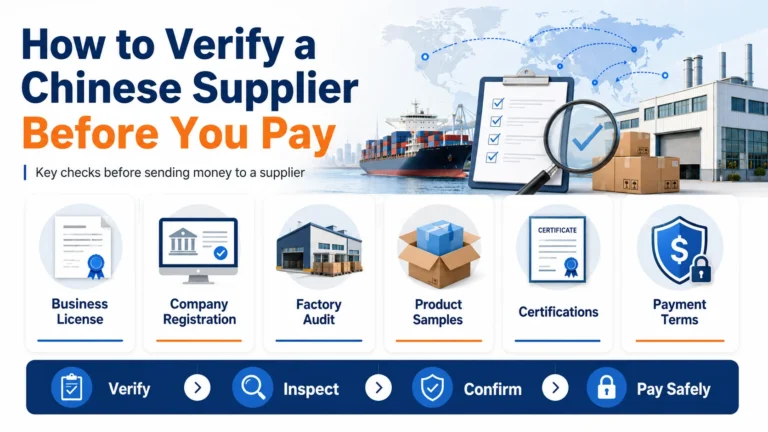
Related Guide
How to Verify a Chinese Supplier Before You Pay
How to Verify a Chinese Supplier Before You Pay Verified & Reviewed · Last updated July 2026 Before you pay a Chinese supplier, do not rely only...
Read guide →

Choosing between a China manufacturer and a trading company can affect product cost, MOQ, quality control, customization, communication, and supply chain transparency.
This guide explains the key differences between manufacturers and trading companies in China, how to verify a supplier’s business license and production capability, and when each option makes more sense for your sourcing needs.
Manufacturer vs Trading Company
Supplier Verification
China Sourcing Guide
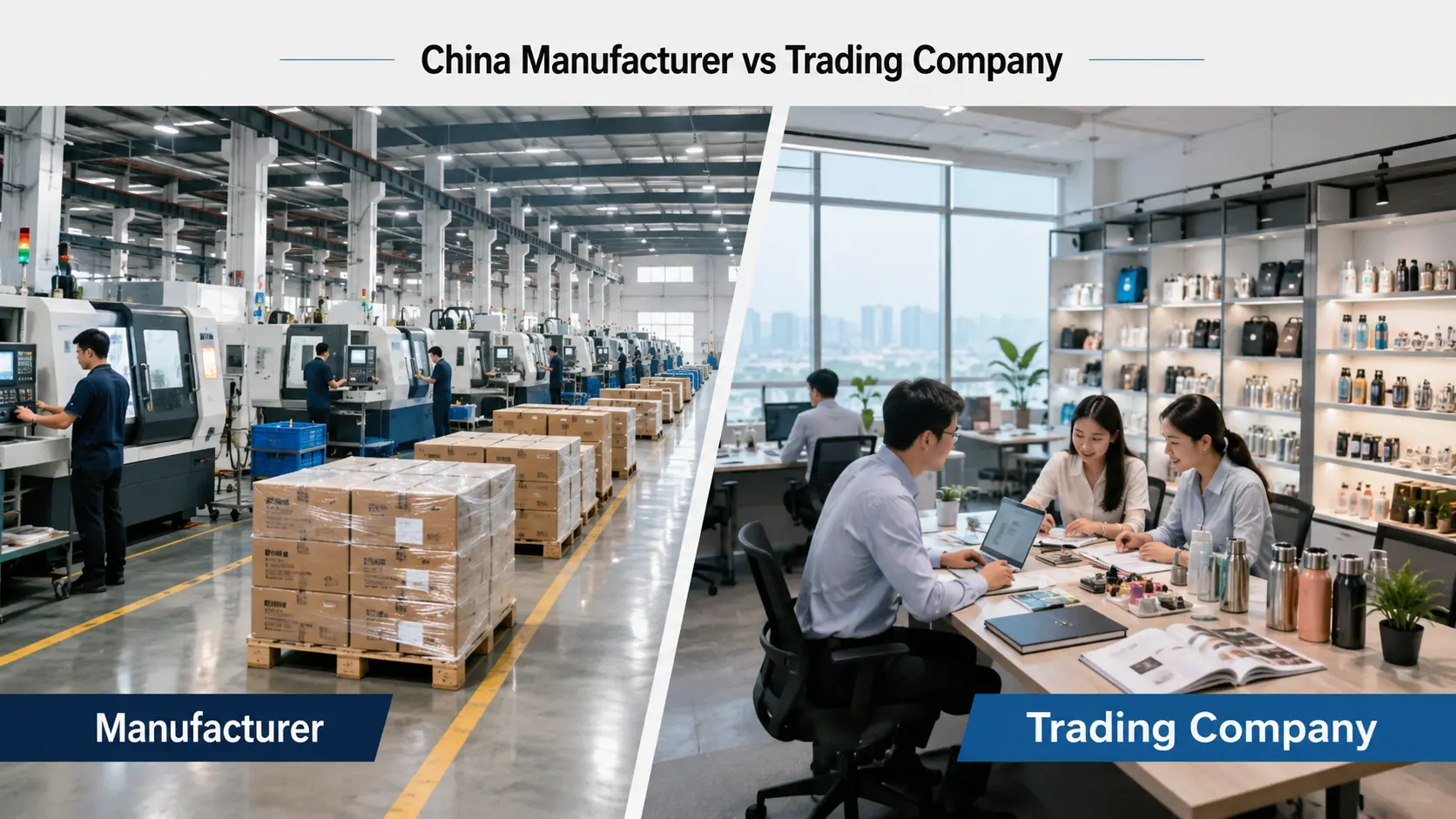
The main difference between a China manufacturer and a trading company is production control. A manufacturer owns or operates a production facility and manages the manufacturing process directly. A trading company usually does not produce goods itself. Instead, it sources products from one factory or multiple factories and sells them to international buyers.
For buyers, the better choice depends on order volume, product complexity, customization needs, budget, quality control requirements, and supply chain transparency. A manufacturer is often better for large-volume orders, custom products, and factory direct pricing. A good trading company can be more practical for small orders, mixed product categories, and buyers who need sourcing support.
In simple terms:
Choose a manufacturer when you need direct production control, lower unit cost, and deeper customization.
Choose a trading company when you need flexible minimum order quantities, multiple product categories, and easier communication.
Verify the supplier’s Chinese business license, business scope, factory photos, production facility, and actual supply chain before payment.
The main difference between a China manufacturer and a trading company is production control.
A manufacturer produces goods directly, manages the manufacturing process, and controls factors such as raw materials, equipment, workers, and quality inspection. A trading company sources products from factories and helps buyers manage supplier communication, orders, and export processes.
The key differences include:
| Factor | China Manufacturer | Trading Company |
|---|---|---|
| Production control | Directly manages production | Works with factory suppliers |
| Pricing | Usually lower for large orders | May include service margin |
| MOQ | Often higher | More flexible for small orders |
| Product range | Focuses on specific categories | Offers products from multiple factories |
| Customization | Better for OEM, ODM, and private label | Depends on factory partners |
| Quality control | Direct access to production process | Depends on supplier management |
| Communication | More focused on technical details | Usually easier for international buyers |
| Export support | May vary by factory | Often stronger in export coordination |
A manufacturer is usually better for buyers who need custom products, stable production, and long-term factory relationships. A trading company can be more suitable for buyers who need flexible quantities, multiple product categories, or sourcing assistance.
A manufacturer in China is a supplier that produces goods directly instead of sourcing them from other companies. It usually operates a production facility with manufacturing equipment, workers, raw material management, quality inspection processes, and production systems.
Most Chinese manufacturers specialize in specific product categories because production requires dedicated equipment, technical knowledge, and experience. For example, a furniture manufacturer may focus on desks, cabinets, and office chairs, while a packaging manufacturer may produce cartons, printed boxes, and labels.
Working directly with a manufacturer gives buyers greater visibility into the production process. This is especially valuable for products that require customization, such as special materials, custom molds, private label packaging, technical specifications, or strict quality requirements.
Chinese manufacturers are often a strong choice when buyers need direct production control. Because they manage the production floor, they can usually explain technical specifications, production limits, raw material options, and quality inspection steps more clearly.
Their main strengths include:
Better factory direct pricing for large orders
Stronger control over raw material and production process
Deeper customization for OEM, ODM, and own label products
Direct factory relationships for long-term supply chain planning
Better visibility into manufacturing equipment and production capacity
Easier quality improvement over repeated orders
For wholesalers, importers, and brands with stable demand, working with a reliable manufacturer can reduce unit cost and improve long-term product consistency.
Working directly with a factory is not always simple. Many Chinese factories are strong in production but weaker in international sales, English communication, export documentation, and overseas customer service.
Some factories mainly serve China’s domestic market, so they may not fully understand export requirements, packaging standards, destination customs rules, or international shipping documents.
Common limitations include:
Higher minimum order quantities
Slower communication with overseas buyers
Limited product range
Less flexibility for small trial orders
Weak export experience in some cases
Need for extra support with export documentation or logistics
This is why direct factory sourcing can reduce production cost, but it also requires stronger due diligence and better order management.
A trading company in China is a supplier that helps buyers source products from manufacturers. Unlike a factory, it usually does not produce goods directly or manage the production floor. Instead, it builds factory relationships and provides services such as supplier selection, communication, order coordination, quality follow-up, and export support.
Some trading companies work with a single product category, while others source products from multiple factories. For international buyers, this model can simplify China sourcing by providing one point of contact instead of managing several suppliers directly.
A good trading company does more than simply add a margin. It helps buyers reduce sourcing complexity, especially when the buyer is new to China, testing several products, or buying from multiple factories.
A reputable trading company can help with:
Finding suitable factory suppliers
Comparing prices, samples, and product quality
Negotiating lower MOQ options
Managing communication with different factories
Consolidating goods from multiple suppliers
Coordinating packaging, labeling, and carton marks
Preparing export documentation
Supporting international shipping arrangements
For startups, Amazon sellers, Shopify sellers, retail stores, and small importers, this type of support can save time and reduce sourcing mistakes.
The main concern when working with a trading company is supply chain transparency. Since the company may not own the production facility, buyers should understand who actually manufactures the products and how quality control is managed.
Some trading companies have strong factory relationships and clear quality processes. Others may hide the actual manufacturer, change factories without notice, or focus only on short-term sales. This can create risks for product consistency and long-term cooperation.
Trading companies typically add a service margin to factory prices. The markup may vary depending on the product category, order volume, and services provided. A higher price is not always a problem if the company provides valuable sourcing support and reduces operational challenges.
Common risks include:
A trading company is not automatically unreliable. The key factors are transparency, supplier management ability, quality control practices, and experience with international buyers.
The best choice depends on your business situation rather than simply choosing the lowest price. A supplier that matches your current needs can help reduce risks and improve long-term sourcing results.
| Your Situation | Better Option | Reason |
|---|---|---|
| Small trial order | Trading company | More flexible MOQ and easier sourcing |
| Multiple product categories | Trading company | Can coordinate different factory suppliers |
| Custom product development | Manufacturer | Direct technical communication |
| Large repeat orders | Manufacturer | Better production control and cost efficiency |
| Need strong IP protection | Manufacturer | More direct control over product development |
| Limited China sourcing experience | Good trading company | More support with communication and coordination |
Your choice can also change over time. Many businesses start with a trading company when testing products, then develop direct factory relationships after demand becomes stable.
When comparing a China manufacturer vs trading company, price, minimum order quantity, and product range are three factors that directly affect sourcing decisions.
Manufacturers usually have advantages in production cost and customization because they control the manufacturing process. Trading companies may offer more flexibility because they work with multiple factories and can support buyers with different sourcing needs.
Manufacturers often provide lower unit prices for large orders because buyers purchase directly from the production source. However, the final cost should also consider quality control, communication efficiency, export support, and potential production risks.
Trading companies usually include a service margin in their pricing, but they may provide additional value through supplier management, product comparison, and order coordination.
Manufacturers are usually better for:
Large-volume orders
Long-term purchasing
Products requiring strict cost control
Trading companies can be useful when buyers need:
Sourcing support
Easier supplier communication
Help managing multiple suppliers
Minimum order quantity is another major difference. Manufacturers often require higher MOQs because they need to cover raw material purchases, machine setup, and production planning.
Trading companies can often provide lower MOQ options because they work with different factory suppliers and may combine orders or source existing products.
Minimum order quantity is another major difference. Manufacturers often require higher MOQs because they need to cover raw material purchases, machine setup, and production planning.
Trading companies can often provide lower MOQ options because they work with different factory suppliers and may combine orders or source existing products.
| Factor | China Manufacturer | Trading Company |
|---|---|---|
| Price | Better for large orders | Includes sourcing service cost |
| MOQ | Usually higher | More flexible |
| Product range | Specialized categories | Multiple product categories |
| Best for | Bulk and custom production | Flexible sourcing |
The best choice depends on your order size, product requirements, and sourcing goals. A manufacturer may be the better option for production control, while a trading company may provide more convenience and flexibility.

It is not always easy to identify whether a supplier is a real manufacturer or a trading company. Many suppliers on Alibaba and other platforms describe themselves as manufacturers, but some are trading companies. Some are also hybrid suppliers that own one factory but source other products from different factories.
Buyers should not rely purely on the supplier’s introduction. The safest approach is to compare multiple signals, including the supplier’s Chinese business license, business scope, company address, product range, factory photos, communication behavior, and production evidence.
The Chinese business license is one of the first documents buyers should review when verifying a supplier. It shows key company details, including the registered name, business scope, address, and Unified Social Credit Code.
The business scope (经营范围) can provide useful clues. Manufacturers may include terms related to production, processing, or manufacturing, while trading companies may focus more on sales, wholesale, import and export, or trade services.
However, do not judge only by one keyword. Some manufacturers also register export activities, and some trading companies work closely with factories.
Before placing an order, check:
Company name matches payment and quotation details
Business scope relates to the products you need
Unified Social Credit Code can be verified
Buyers can also use China’s official National Enterprise Credit Information Publicity System (GSXT) to confirm the registered company information.
The business scope can show whether a company is mainly involved in manufacturing, trading, import and export, or general sales. However, buyers should not judge by one phrase alone. Some real factories also register import-export activities, while some trading companies may have affiliated factories.
The company address can also provide useful clues. Factories usually operate in industrial zones, manufacturing parks, or factory areas. Trading companies are more likely to be located in office buildings, commercial centers, or city business districts.
If the supplier claims to be a manufacturer but only provides an office building address, ask for the production facility address. Some manufacturers have both an office and a factory, which is normal, but the supplier should be able to explain both locations clearly.
Factory photos can help, but they are not enough by themselves. Some suppliers use old photos, shared images, or photos from another production facility. Buyers should ask for recent photos and videos that show real production activity.
A useful factory video should show the production floor, manufacturing equipment, workers, raw material storage, finished goods area, packaging area, and quality inspection area. It should also show products related to your order, not only a general factory environment.
A live video call is stronger than static photos because it is harder to fake. During the call, ask the supplier to show:
Production lines
Manufacturing equipment
Raw material storage
Packaging area
Quality inspection area
Finished goods warehouse
Product samples related to your order
If the supplier refuses any video calls or cannot show the production facility, you should verify more carefully before payment.
For high-value orders, customized products, or long-term cooperation, additional verification can reduce risk. A factory visit or third-party audit can help confirm production capacity, quality systems, equipment, and compliance requirements.
These checks are especially useful for products involving:
Custom molds
Electrical components
Children’s products
Safety requirements
Brand packaging
IP-sensitive designs
A proper supplier review helps buyers make decisions based on real production capability rather than only online information.
A supplier’s business license helps you understand its legal identity, but it does not tell the whole story. Some genuine manufacturers can produce goods but do not handle exports directly. They may mainly serve China’s domestic market and rely on export agents or trading companies to handle international trade.
On the other hand, some trading companies have stronger export documentation experience than small factories. They may understand commercial invoices, packing lists, export declarations, certificates, shipping documents, and destination requirements better than a production-focused factory.
This is why buyers should evaluate both production capability and export ability. A supplier may be good at making products but weak at handling exports. Another supplier may not produce directly but may be strong in communication, documentation, and order coordination.
Choosing the wrong supplier type can create problems across the entire supply chain. If you choose a trading company when you need deep customization, you may lose leverage because every technical detail must pass through a middleman. This can increase the risk of communication breakdowns, wrong materials, delayed production, and quality inconsistencies.
If you choose a manufacturer when your order is small and mixed, you may face higher MOQs, limited product range, slower response, and weaker export service. This is why sourcing strategies should align with your business goals instead of only chasing the lowest price.
Common risks include:
Hidden markup or unclear pricing
Weak quality control
Factory switching without notice
Poor IP protection
Wrong technical specifications
Inconsistent product quality
Delayed lead time
Incorrect export documentation
IP protection deserves special attention. If you are developing a new product, custom mold, private label design, or own label packaging, you should be careful about who receives your drawings, samples, files, and technical details.
Direct manufacturer cooperation may offer better control, but only when the factory is trustworthy and contract terms are clear.
Different buyers need different supplier types. A new Amazon seller may start with a trading company because small trial orders and mixed SKUs are easier to manage. Once a product sells well and order volume becomes stable, the buyer may move to a manufacturer for better pricing and customization.
A wholesaler buying one product in large quantities may benefit more from direct factory relationships. A retailer buying many different products may prefer a trading company because consolidation and communication are easier. A brand developing custom products usually needs a manufacturer because technical control and IP protection are more important.
| Buyer Type | Better Supplier Type |
|---|---|
| Startup testing products | Trading company |
| Amazon seller testing SKUs | Trading company |
| Established Amazon seller | Manufacturer or hybrid supplier |
| Wholesaler buying bulk goods | Manufacturer |
| Retailer buying mixed categories | Trading company |
| Brand developing custom products | Manufacturer |
| Buyer needing strong IP protection | Verified manufacturer |
| Buyer with limited China sourcing experience | Good trading company |
The supplier choice can also change over time. Many buyers start with a good trading company, then build direct factory relationships after their order volume becomes stable.
Supplier selection and shipping planning are closely connected. Even when buyers choose the right manufacturer or trading company, poor logistics management can still lead to delays, damaged cargo, customs problems, and unexpected costs.
A freight forwarder helps international buyers manage the movement of goods after production. This may include supplier pickup, warehouse receiving, shipment consolidation, export customs procedures, international transportation, customs clearance, and final delivery.
This support is especially valuable when buyers purchase from multiple Chinese suppliers or need to combine goods before shipment. Instead of coordinating with different factories, carriers, and customs requirements separately, buyers can work with one logistics partner to simplify the process.
A freight forwarder can also help identify shipping risks before cargo leaves China, including:
Weak export packaging
Incorrect carton marks or shipping information
Missing documents
Oversized or incorrectly measured cargo
Restricted items such as batteries
Customs declaration issues
For buyers sourcing from China, the supply chain involves more than just finding a supplier. The manufacturer or trading company is responsible for producing or sourcing the goods, while the freight forwarder helps move those goods efficiently to the destination market.
Tonlexing supports international buyers with sea freight, air freight, rail freight, truck transport, DDP, DDU, and door-to-door shipping solutions. This is especially useful for businesses working with multiple Chinese suppliers or requiring consolidated shipments.
A China manufacturer produces goods directly and controls the manufacturing process. A trading company sources goods from one or more factories and sells them to buyers. Manufacturers usually provide better production control, while trading companies provide easier communication and sourcing support.
It is often cheaper for large repeat orders because manufacturers do not add a middleman margin. However, for small orders, a trading company may still be cost-effective because it can offer lower MOQs, mixed products, and sourcing support.
Trading companies usually add a service margin. In many cases, this margin may range from 5% to 30%, depending on the product and service level. The extra cost can be acceptable if the trading company saves time, reduces mistakes, and manages sourcing more efficiently.
Ask for the supplier’s Chinese business license and check the company name, registered address, registered capital, business scope, and Unified Social Credit Code. The business scope can help you understand whether the company is mainly involved in manufacturing, trading, import and export, or other services.
You can check the business license, production facility address, factory photos, manufacturing equipment, product range, technical knowledge, and production videos. A live video call or third-party factory audit can provide stronger verification.
Useful freight, customs and importing resources related to this shipping guide.
How to Verify a Chinese Supplier Before You Pay Verified & Reviewed · Last updated July 2026 Before you pay a Chinese supplier, do not rely only...
Read guide →
China Sourcing Trip Guide Verified & Reviewed · Last updated June 2026 China Sourcing Trip Guide for importers: A sourcing trip to China can be o...
Read guide →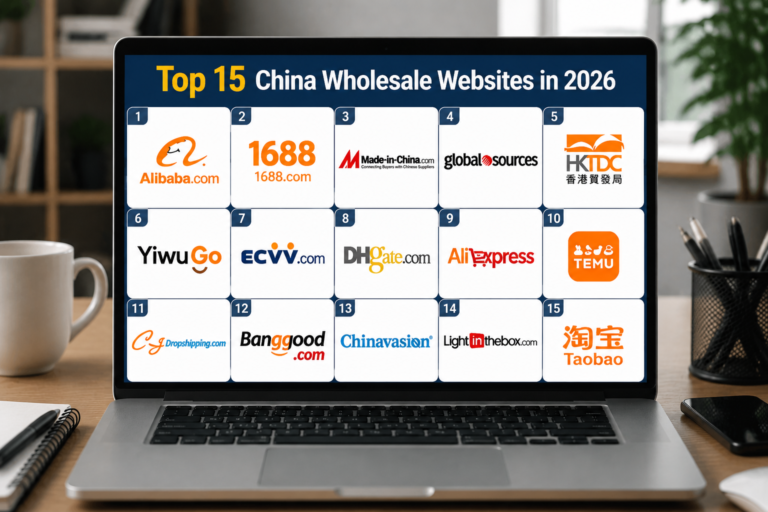
Top 15 China Wholesale Websites in 2026 Verified & Reviewed · Last updated May 2026 Sourcing products from China has become a key strategy for gl...
Read guide →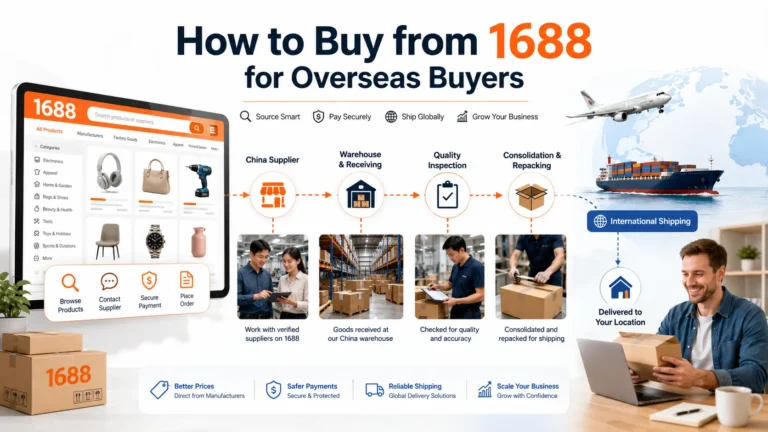
Why Overseas Buyers Are Turning to 1688 1688.com is a major Chinese wholesale marketplace used by manufacturers, wholesalers and domestic buyers...
Read guide →Top 20 Trusted China Wholesale Websites for Global Buyers in 2026 Verified & Reviewed · Last updated July 2026 Finding the right China wholesale...
Learn more → Useful Resource Alibaba Freight Forwarder from ChinaAlibaba Freight Forwarder from China Verified & Reviewed · Last updated July 2026 Finding a reliable Alibaba freight forwarder from China can mak...
Learn more →WhatsApp us