Related Guide
How to Verify a Chinese Supplier Before You Pay
How to Verify a Chinese Supplier Before You Pay Verified & Reviewed · Last updated July 2026 Before you pay a Chinese supplier, do not rely only...
Read guide →

When sourcing custom or private-label products from China, unclear requirements can lead to mistakes in materials, dimensions, packaging, or quality during production.
This guide explains how to create a clear product specification sheet for Chinese suppliers, covering product details, tolerances, samples, quality checks, packaging, and final approval before mass production.
Product Specifications
Quality & Testing
Sample Approval
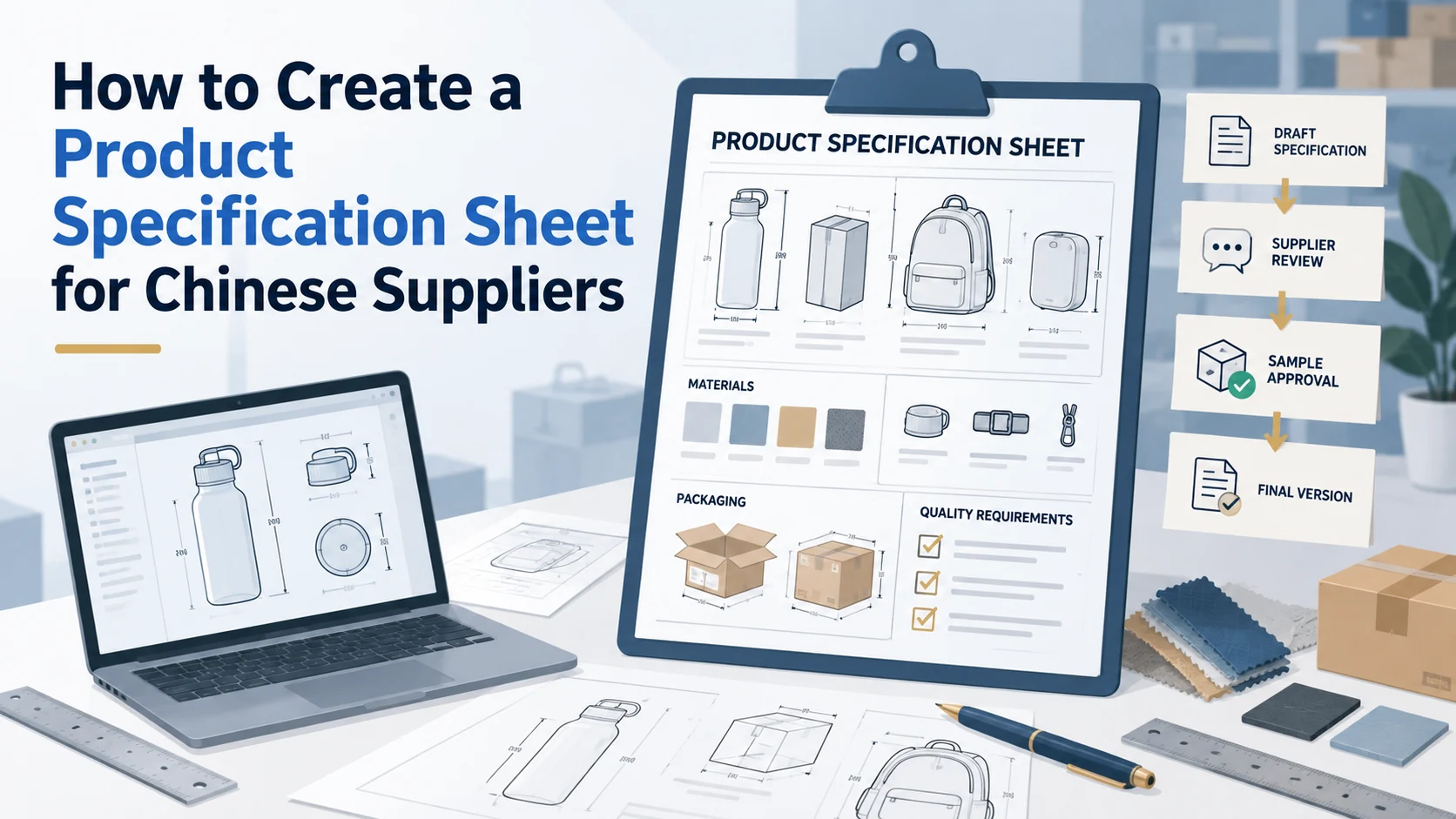
A product specification sheet should define what the manufacturer is expected to make and how the finished product will be judged. The exact contents depend on the product, but most documents cover identification, materials, dimensions, appearance, performance, branding, packaging, quality, and revision control.
Typical information includes:
Product name, model, SKU, and version
Materials and key components
Dimensions and tolerances
Color, finish, and appearance
Functional performance
Logo, labels, and markings
Unit and export packaging
Quality and testing criteria
Compliance information
Revision number and supplier confirmation
The most important rule is to avoid vague descriptions. Terms such as “high quality,” “strong,” “premium,” or “good packaging” leave too much room for interpretation. Whenever possible, use measurable values, drawings, approved samples, recognized color references, and clear pass/fail criteria instead.
A product specification sheet, often shortened to spec sheet, is a controlled document that explains how a product should be made and what standards it must meet.
It is different from a purchase order. A purchase order usually covers commercial information such as quantity, price, payment terms, Incoterms, and delivery timing. The specification document focuses on the product itself.
For example, a purchase order may confirm 5,000 units at a certain price, while the technical document defines:
Material and thickness
Product dimensions
Color and surface finish
Logo size and position
Functional requirements
Packaging configuration
Quality acceptance criteria
For customized products, both documents should normally be used together.
The purpose of a detailed spec sheet is not simply to create more paperwork. It reduces the number of decisions the factory needs to interpret during production.
An instruction such as “use premium stainless steel” may sound clear to the buyer, but it does not tell the purchasing team which grade, thickness, or finish to use. A requirement such as SUS 304 stainless steel, 0.8 mm thickness is much easier to source, produce, and inspect.
This is especially useful when the manufacturer has separate sales, purchasing, production, and quality-control teams. A clear document gives each team the same reference and reduces the risk of information being changed as it passes from one department to another.
It also helps buyers:
Compare quotations based on the same product specifications
Keep approved samples consistent with the production run
Reduce unapproved material or component substitutions
Create a clear basis for final inspection
Track approved changes through revision control
A practical workflow is:
Initial Specification → Sample → Sample Review → Revision → Final Approval → Mass Production → Inspection
A clear specification helps control the product, but buyers should also verify a Chinese supplier before you pay to confirm the company, factory capabilities, and payment details.
The exact contents will vary by product. A simple promotional item may only need a few key details, while electronics, machinery, or multi-component products usually require more technical information.
The aim is not to create the longest possible document. It is to define the points that could materially affect how the product is made, how it performs, how it looks, and whether the finished goods can be accepted.
Start with enough information to identify the product, the product version, and the current document revision. This is especially important when several samples, artwork files, or updated specifications are being discussed at the same time.
Include the basics:
Product name and model
SKU or item number
Supplier name
Target market
Revision number
Revision date
A simple system such as Rev. 01, Rev. 02, Rev. 03 is usually sufficient. Once a new version is approved, the previous one should no longer be used for production.
Important materials should be described precisely enough for the supplier to source the correct option. General terms such as “good plastic,” “strong fabric,” or “quality metal” provide very little control.
Depending on the product, define:
Material type and grade
Composition
Thickness or density
Fabric weight
Coating or surface treatment
Critical component model
Approved alternatives
For example, “metal body” is much less useful than “SUS 304 stainless steel, 0.8 mm thickness.”
If a material or component must not be substituted without approval, state this clearly.
Dimensions should use consistent units and identify the measurements that matter for fit, function, appearance, or assembly.
Typical measurements may include length, width, height, diameter, thickness, weight, spacing, or component position. Critical dimensions may also need a realistic tolerance.
For example:
Overall length: 100 ± 0.5 mm
Wall thickness: 2.0 ± 0.1 mm
Logo position: center alignment ± 2 mm
Tolerances should reflect the actual manufacturing process. Making them unnecessarily tight can increase cost without improving the finished product.
For complex parts, technical drawings are often the clearest way to show where each measurement applies.
Appearance details should use clear references rather than subjective descriptions. Terms such as “dark blue,” “smooth,” or “premium finish” can be interpreted differently by different people.
Useful references may include:
Pantone or other color standards
Approved physical samples
Gloss or matte finish
Surface texture
Printing or coating method
Annotated product photos
Reference images are helpful for showing appearance and placement, but they should support written specifications rather than replace them.
If the product has a specific function, define what needs to work and how it will be checked. The same principle applies to workmanship and cosmetic quality.
Depending on the product, this may include:
Power or voltage
Battery capacity
Load or durability
Operating time
Assembly quality
Surface defects
Printing quality
Avoid instructions such as “the product must be strong” or “the logo should look good.” A useful requirement should make it possible to determine whether the finished product passes or fails.
Branding and packaging should be confirmed before production, especially for private-label products. Logo placement, artwork, unit packaging, and carton configuration can all affect the final result.
Typical details include:
Logo dimensions and position
Printing, engraving, or embroidery method
Artwork file reference
Product labels and barcodes
Unit packaging
Accessories and manuals
Units per carton
Carton dimensions and weight
Shipping marks
Pallet requirements
Avoid relying only on terms such as “standard export packaging.” If packaging quality or presentation matters, describe what the supplier is expected to use.
One of the easiest ways to improve a spec sheet is to ask whether the supplier can manufacture each point consistently and whether an inspector can later verify it objectively.
If the answer is no, the instruction probably needs more detail.
| Vague Requirement | Clearer Specification |
|---|---|
| High-quality material | Define material type, grade, and thickness |
| Dark blue | Use a Pantone code or approved color sample |
| Large logo | Define width, height, and position |
| Strong carton | Define construction and protective materials |
| Good workmanship | Define unacceptable defects |
| Same as sample | Identify the approved sample and revision |
| Works well | Define the test method and pass criteria |
Not every detail needs laboratory-level precision. The amount of information should match the product risk, complexity, and importance of the feature being controlled.
A practical template can help organize product details, materials, dimensions, quality standards, packaging, and revision control in one place. Use the example below as a reference and adapt the fields to your product.
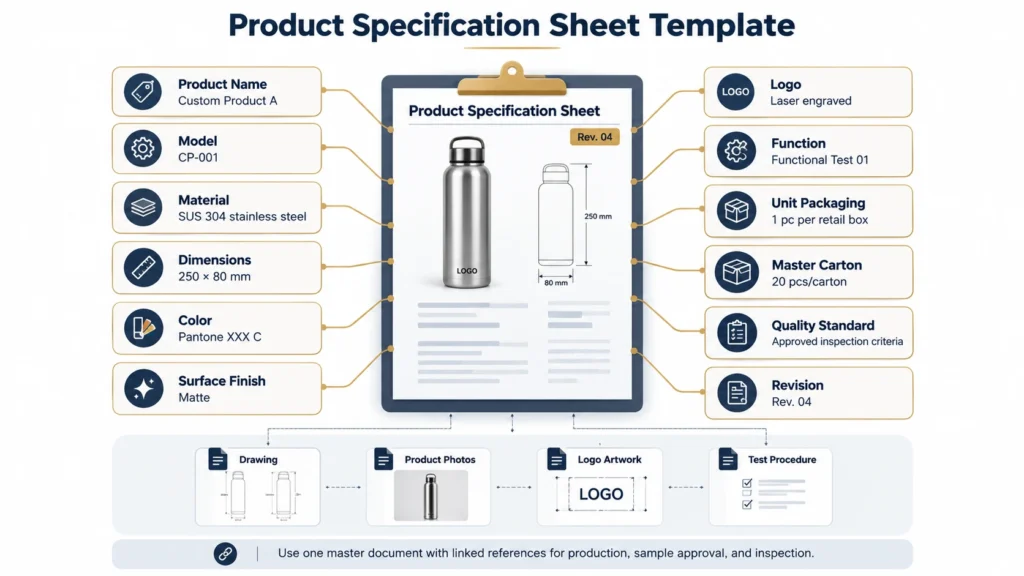
Download the Product Specification Sheet Template (Excel)
For more complex products, the template can be used as a master reference together with CAD drawings, packaging files, component lists, artwork, and test procedures.
A product specification should develop alongside the product rather than being written only after the sample has already been approved. Starting early helps keep the buyer, supplier, and quality team aligned.
Start by clarifying what the product is, how it will be used, and where it will be sold. These factors can affect materials, labeling, packaging, testing, and compliance.
Confirm the main basics:
Intended use
Target customer
Destination market
Key functions
Critical product features
The target market should be identified early because different destinations may have different product, labeling, or safety requirements.
Next, convert the product idea into details that the supplier can follow and the buyer can later verify.
Focus on areas that directly affect production and quality:
Materials and components
Dimensions and tolerances
Color and finish
Functional performance
Branding
Packaging
Quality standards
Avoid descriptions such as “high quality” or “strong.” Important product requirements should be measurable whenever possible.
Drawings and images are especially useful for customized products or products with multiple parts.
They can help show:
Dimensions
Component positions
Assembly details
Logo placement
Packaging configuration
Annotated photos, technical drawings, and artwork files should support the written instructions rather than replace them.
The document should explain how important product characteristics will be checked.
Depending on the product, inspection may cover dimensions, materials, workmanship, function, color, printing, assembly, or packaging.
Instead of saying a product or logo should “look good,” define what would make it unacceptable. If AQL inspection will be used, agree on the inspection level and acceptance criteria before production is completed.
When the supplier provides a sample, compare it with the latest document rather than approving it only by appearance.
Check the key points, including:
Materials and dimensions
Color and finish
Branding
Function
Workmanship
Packaging
If a change is approved during sample development, update the document at the same time so the written version matches the physical sample.
Sample development often involves several changes, so each important update should be traceable.
| Revision | Main Change | Status |
|---|---|---|
| Rev. 01 | Initial version | Superseded |
| Rev. 02 | Material updated | Superseded |
| Rev. 03 | Logo position adjusted | Superseded |
| Rev. 04 | Final sample approved | Current |
Once a new revision is approved, older versions should no longer be used for the production run.
After the final sample is approved, issue the final document and clearly identify it as the current production version.
Before production begins, confirm that:
The document matches the approved sample
Drawings and artwork are current
Packaging is finalized
Quality criteria are agreed
The supplier has confirmed the latest revision
Keeping the editable source file internally and sending the factory a fixed PDF version can also help reduce accidental changes.
Before paying a production deposit or balance, buyers can also review our guide on how to pay Chinese suppliers safely.
This real shipment involved a carton flow rack manufactured in China for warehouse storage. The original supplier document included both shipping information and product details, but the customer and consignee information has been removed for privacy.
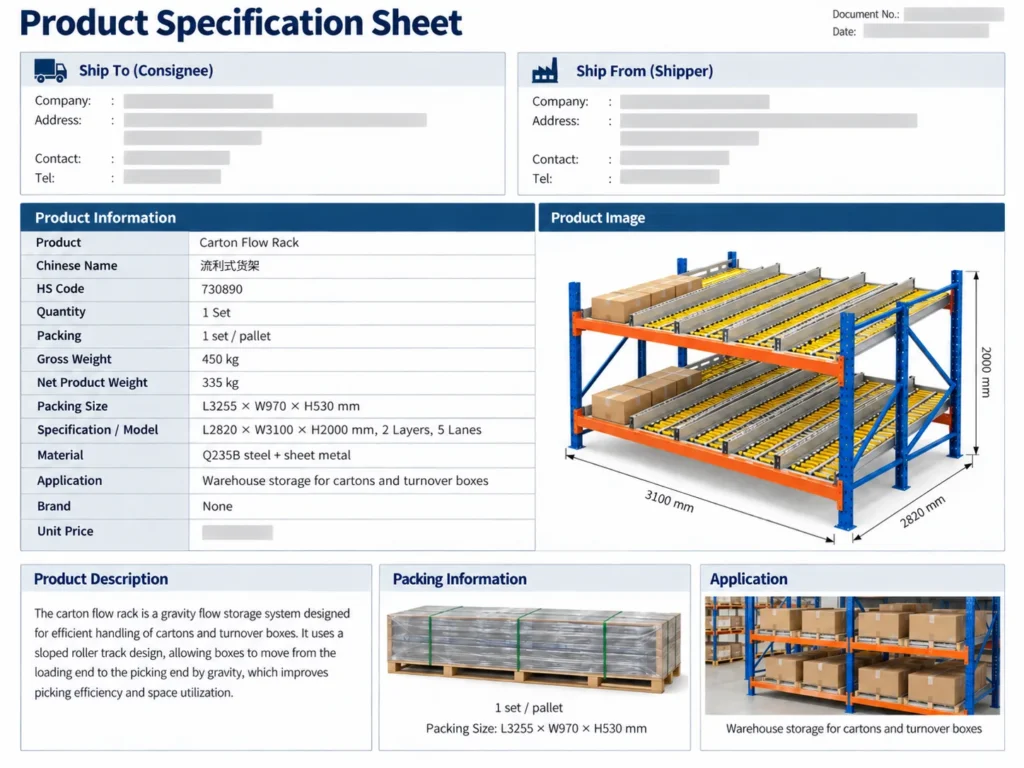
This type of information gives the buyer and logistics team a clear reference for the product configuration, dimensions, material, weight, and packing arrangement. For customized industrial products, these details are especially useful when confirming the order, arranging transportation, and checking whether the finished goods match the agreed specifications.
For repeated production or more complex orders, the supplier document can be further supported with technical drawings, load capacity, dimensional tolerances, surface treatment, component details, inspection criteria, and final packaging requirements.
The document should remain active throughout the purchasing process instead of being created once and then forgotten.
During quotation, sending the same product specifications to different suppliers helps ensure they are pricing comparable materials, construction, components, and packaging. A lower price is less meaningful if it is based on a thinner material or cheaper component.
During sample development, the document becomes the review checklist. After the final sample is approved, the current revision should become the reference for mass production.
It can also support:
Purchase order confirmation
Sample approval
Production control
Pre-shipment inspection
Quality dispute resolution
Buyers still evaluating potential suppliers may also want to understand the difference between a China manufacturer and a trading company.
Once production is complete, the approved product specifications and final sample can also be used as references during a pre-shipment inspection in China.
Quality criteria should clearly explain what counts as acceptable and what does not. General phrases such as “good workmanship” are difficult to apply consistently during inspection.
Depending on the product, quality checks may cover:
Scratches or dents
Loose threads or open seams
Printing defects
Assembly errors
Missing components
Functional failures
Packaging damage
Compliance requirements should also be based on the actual product and target market. Depending on the goods, relevant rules may involve electrical safety, chemical restrictions, batteries, food-contact materials, labeling, CE-related requirements, RoHS, FCC, FDA requirements, or other standards.
Do not add a certification simply because another supplier lists it. Confirm what actually applies to the product and destination before mass production begins.
Depending on the order stage and risk level, buyers may also need to choose between a factory audit, product inspection, or container loading inspection.
Many problems are caused by unclear instructions or poor document control rather than missing pages.
One common mistake is using subjective descriptions that cannot be inspected consistently. Another is relying too heavily on reference photos without documenting the materials, dimensions, or performance details behind them.
Other common problems include:
Approving sample changes without updating the current version
Using several revisions at the same time
Leaving packaging decisions until the end of production
Failing to define quality acceptance criteria
Keeping important instructions only in email or chat history
Supporting files are useful, but the final production reference should clearly identify which drawings, artwork files, samples, and revisions are approved.
It is a document that defines how a product should be made, including its materials, dimensions, components, appearance, packaging, and quality standards.
It should normally cover product identification, materials, dimensions, tolerances, appearance, performance, branding, packaging, quality criteria, and revision details.
It should be detailed enough for the supplier to manufacture the product without guessing, but it does not need unnecessary technical information.
Yes. For customized products, a preliminary version helps suppliers quote according to the same materials, construction, and packaging.
Yes. They are useful for dimensions, assembly details, logo placement, and appearance, but they should support written specifications rather than replace them.
Useful freight, customs and importing resources related to this shipping guide.
How to Verify a Chinese Supplier Before You Pay Verified & Reviewed · Last updated July 2026 Before you pay a Chinese supplier, do not rely only...
Read guide →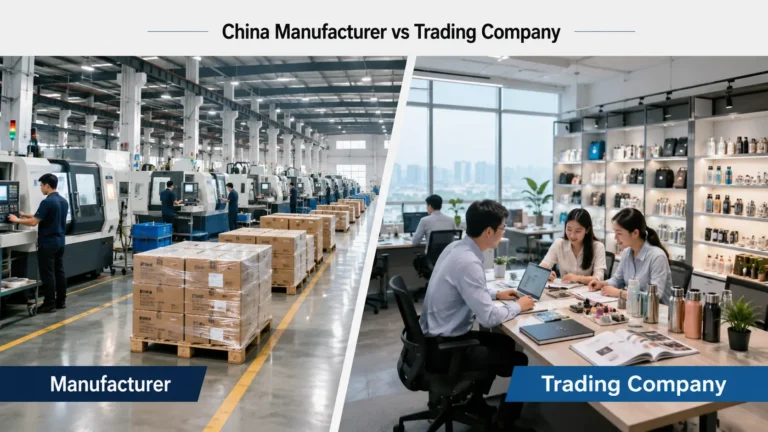
China Manufacturer vs Trading Company Verified & Reviewed · Last updated July 2026 Choosing between a China manufacturer and a trading company ca...
Read guide →
Factory Audit vs Product Inspection vs Container Loading Inspection Verified & Reviewed · Last updated July 2026 Factory audit, product inspectio...
Read guide →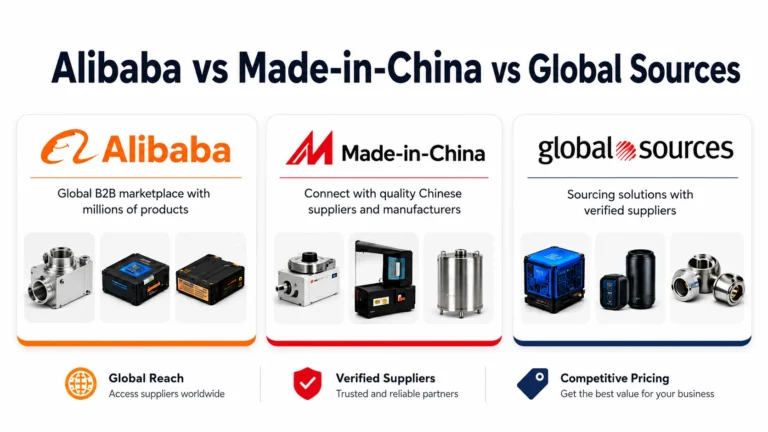
Alibaba vs Made-in-China vs Global Sources: Which Platform Is Best? Verified & Reviewed · Last updated July 2026 Alibaba, Made-in-China, and Glob...
Read guide →How to Pay Chinese Suppliers Safely Verified & Reviewed · Last updated July 2026 Paying Chinese suppliers safely is one of the most important ste...
Learn more → Useful Resource Top 10 Wholesale Websites for Finding Chinese SuppliersChina is the world’s leading hub for wholesale suppliers, offering a vast array of products at unbeatable prices. Whether you’re a retailer, a di...
Learn more →WhatsApp us