Shipping 5–20 Pallets from China to the USA

Shipping 5–20 pallets from China to the USA can be arranged through LCL, FCL, or air freight, depending on cargo volume, weight, and delivery urgency. Smaller shipments may suit LCL, while larger loads may benefit from a full container.

This guide covers shipping costs, transit times, container capacity, and U.S. customs requirements to help you choose the right option. See our guide to shipping 1–5 pallets from China to the USA for smaller shipments.

Shipping Costs

Transit Time

LCL vs FCL

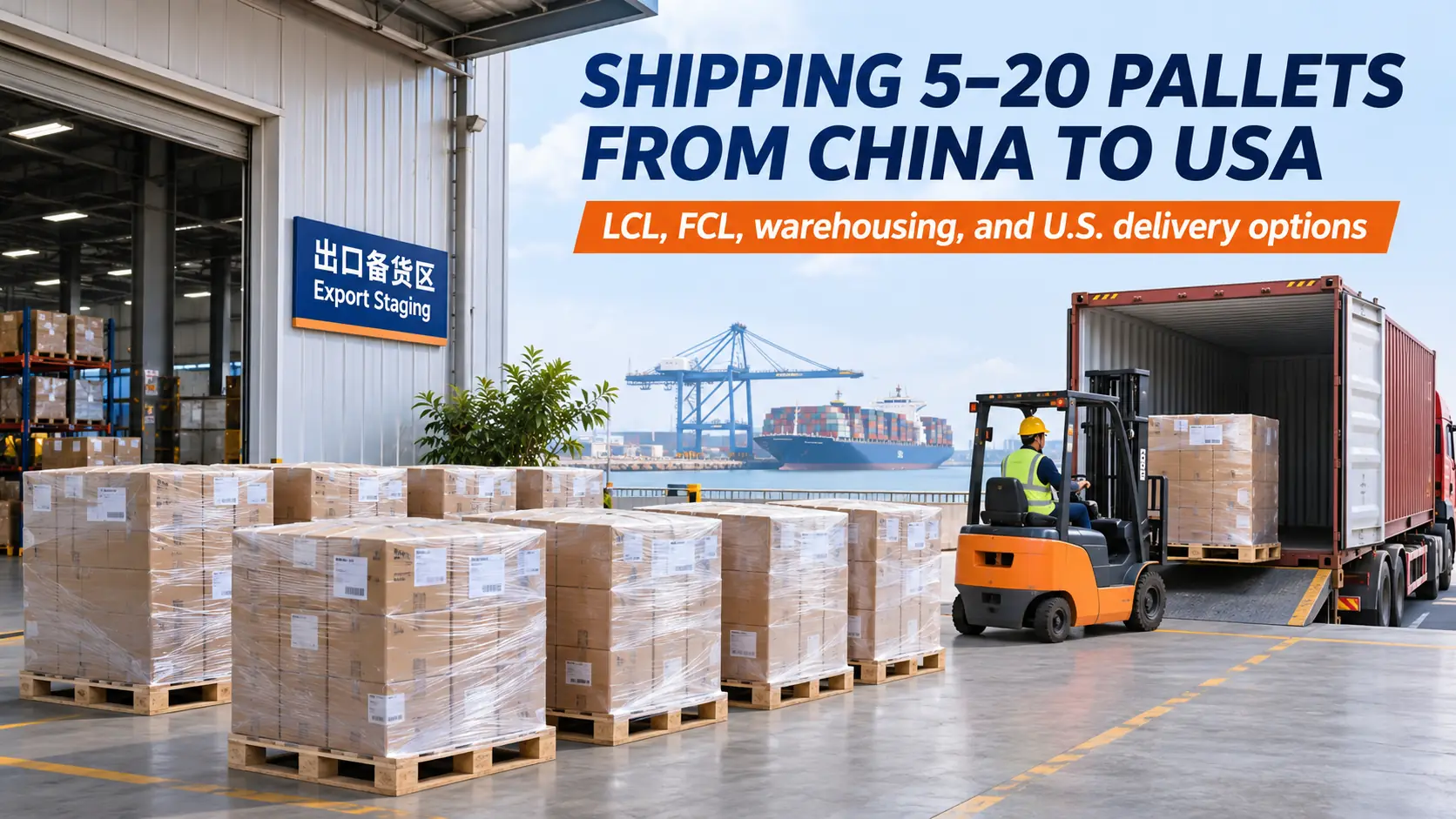
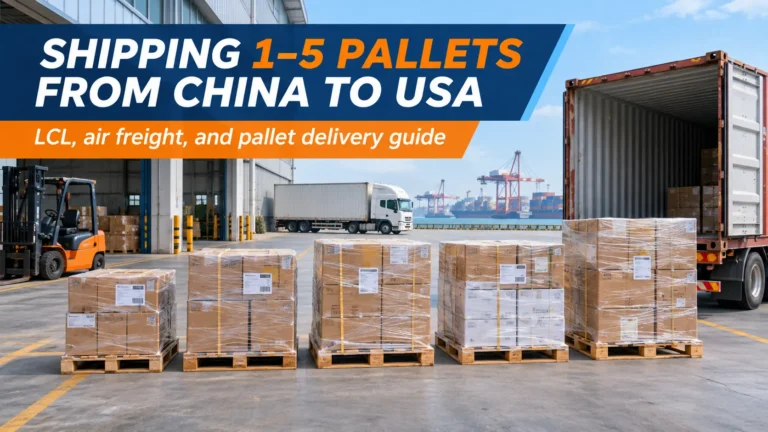
Shipping 5–20 pallets from China to the USA with warehouse cargo and forklift loading.
10,000+ international shipments handled    Global sea, air & DDP shipping solutions    24/7 shipment tracking & customer support

Table of Contents

What Are the Best Shipping Options for 5–20 Pallets from China to the USA?

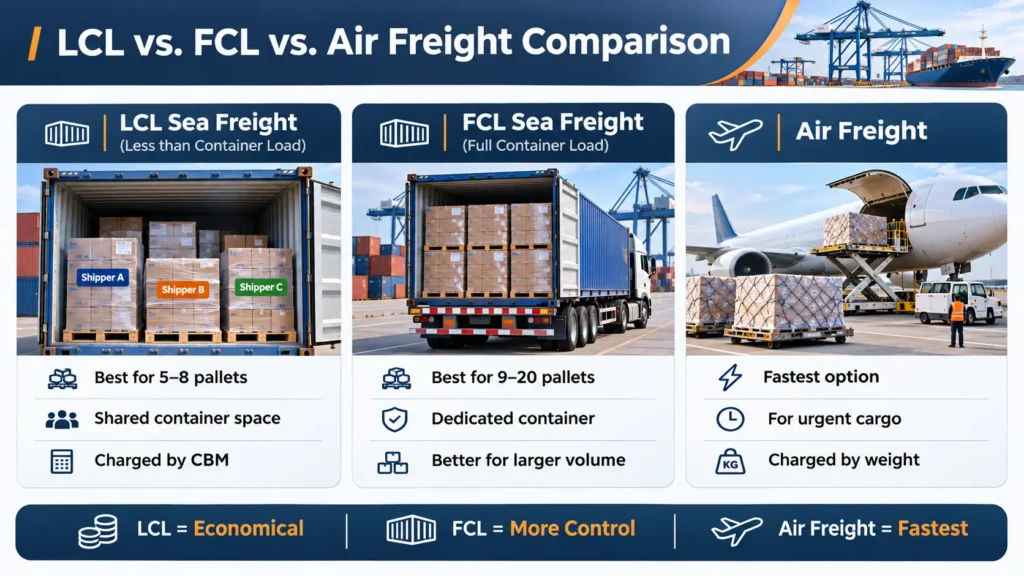
The best shipping method for 5–20 pallets depends on the total cargo volume, weight, delivery urgency, and destination. LCL is suitable for smaller shipments, while FCL becomes worth considering as cargo volume increases. Air freight is an alternative for urgent or high-value goods.

Shipping MethodSuitable Shipment SizeMain Advantage
LCL Sea FreightAround 5–8 palletsPay for the space used
20ft FCLAround 9–10 standard palletsDedicated container space
40ft FCLLarger shipments approaching 20 palletsMore loading capacity
Air FreightUrgent or high-value cargoFaster transportation

LCL Sea Freight for 5–8 Pallets

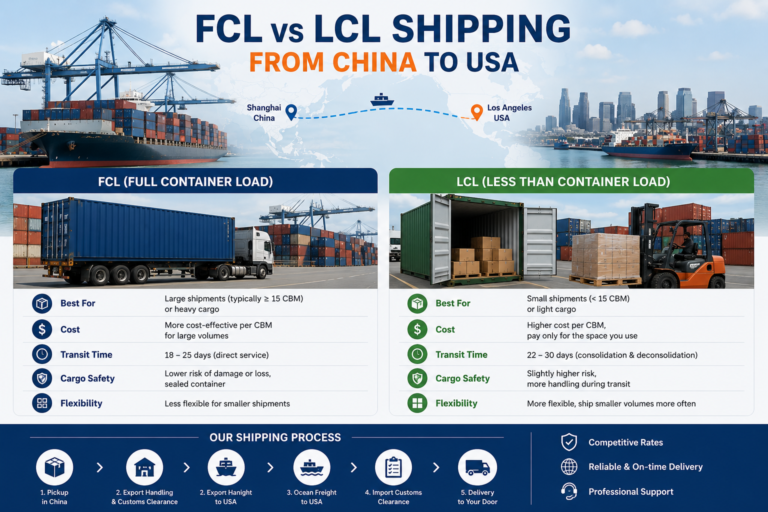
LCL (Less than Container Load) allows your cargo to share container space with shipments from other importers. It is a practical option when 5–8 pallets do not occupy enough space to justify booking a full container.

You pay according to the chargeable volume or weight rather than the cost of an entire container. However, additional handling is required when cargo is consolidated at origin and separated at the destination.

Before choosing LCL, check the total CBM and destination handling charges, as these can affect the overall cost.

FCL Shipping for 9–20 Pallets

FCL (Full Container Load) provides dedicated container space for your shipment. It is worth comparing with LCL when your cargo occupies a substantial portion of a container or exceeds approximately 15 CBM.

  • 20ft FCL: Generally suitable for around 9–10 standard pallets, depending on dimensions and loading arrangements.

  • 40ft FCL: Can accommodate approximately 20–21 standard pallets under suitable loading conditions.

FCL can reduce cargo handling and simplify loading arrangements. It is particularly useful when shipping larger quantities or combining goods from multiple suppliers into one container.

Air Freight for Urgent Pallet Shipments

Air freight is suitable for high-value products, urgent orders, and inventory that needs replenishment quickly. Unlike sea freight, charges are calculated using chargeable weight, which takes both actual weight and volumetric weight into account.

Although air freight costs more than ocean transportation, it can help importers meet tight delivery schedules and avoid extended inventory shortages.

Express courier services such as DHL, FedEx, and UPS are generally better suited to samples and smaller packages than multiple commercial pallets. For larger shipments, compare standard air freight with other available services.

LCL vs. FCL vs. air freight comparison for shipping pallets from China to the USA.

How Much Does It Cost to Ship 5–20 Pallets from China to the USA?

The cost of shipping 5–20 pallets from China to the USA varies depending on cargo volume, weight, shipping method, and destination. LCL is generally suitable for smaller shipments, while FCL may offer better value when the cargo occupies a larger portion of a container. Air freight costs more but provides faster transportation.

The following rates are general estimates for budgeting purposes:

Shipping MethodEstimated CostCharging Basis
LCL Sea Freight$80–$150Per CBM
40ft FCL$2,500–$4,500Per container
Air Freight$4–$10Per chargeable kg

As a broad planning reference, shipping 5–20 pallets may cost approximately $1,500–$6,000, depending on the shipment size, route, and service scope. These figures are not fixed quotations and may change with market conditions.

What Affects the Shipping Cost?

Several factors determine the final freight rate:

  • Cargo volume: LCL charges are generally based on CBM or chargeable weight. Larger shipments may justify booking a full container.

  • Cargo weight: Air freight is calculated using chargeable weight, which compares actual weight with volumetric weight.

  • Shipping route: The departure port in China and the U.S. destination affect ocean freight rates and inland transportation expenses.

  • Cargo characteristics: Oversized, fragile, or special-handling goods may incur additional charges.

  • Delivery requirements: Residential delivery, warehouse appointments, liftgate service, and remote locations can increase transportation costs.

For shipments exceeding approximately 15 CBM, compare an LCL quotation with a 20ft or 40ft FCL rate before booking.

What Additional Charges Should You Consider?

The quoted freight rate may not cover all expenses involved in importing palletized cargo. Include the following charges when calculating your total shipping budget:

  • Origin charges: Cargo receiving, warehouse handling, export documentation, and consolidation.

  • Destination charges: Terminal handling, deconsolidation, documentation, and warehouse fees.

  • Customs clearance: Customs broker fees and applicable entry charges.

  • Import duties and taxes: Based on the product’s HTS classification, customs value, and applicable tariffs.

  • Inland trucking: Transportation from the U.S. port or warehouse to the delivery address.

  • Cargo insurance: Optional coverage for eligible loss or damage.

  • Other fees: Fuel surcharges, storage costs, and additional handling expenses.

When requesting a quotation, ask your freight forwarder to separate origin charges, international freight, destination charges, customs clearance, and inland delivery. This makes it easier to compare offers and identify hidden fees before shipping.

How Many Pallets Fit in a 20ft or 40ft Shipping Container?

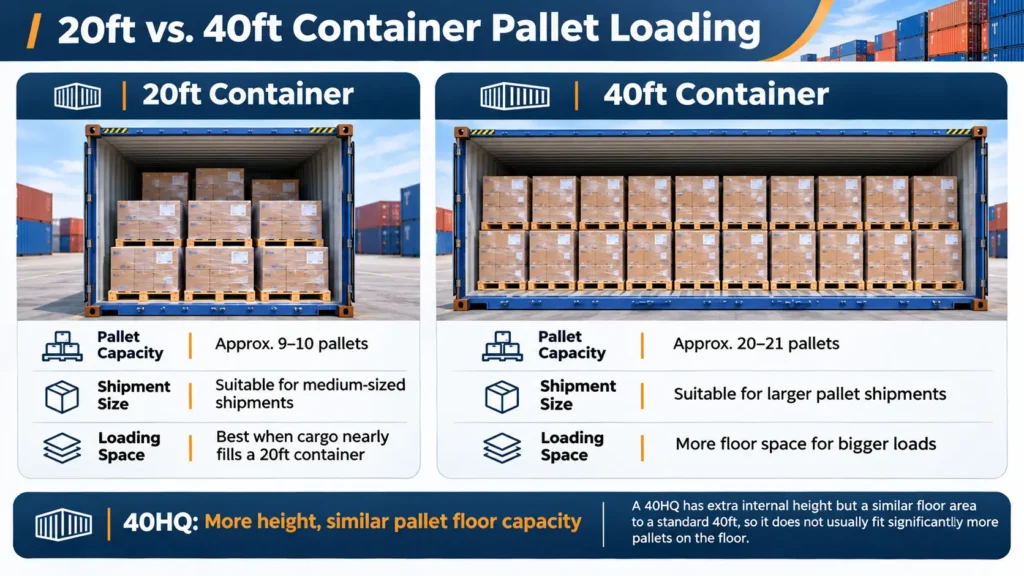
The number of pallets a shipping container can hold depends on pallet dimensions, cargo height, weight, and loading arrangement. As a general reference, a 20ft container holds around 9–10 standard pallets, while a 40ft container can accommodate approximately 20–21.

Container TypeApproximate Pallet CapacityMain Feature
20ft Standard9–10 palletsSuitable for smaller loads
40ft Standard20–21 palletsMore floor space
40HQ20–21 palletsAdditional internal height

A 40HQ container provides more vertical space than a standard 40ft container, but its floor area is similar. Therefore, it does not necessarily accommodate more pallets.

Before booking, confirm the following details with your freight forwarder:

  • Pallet dimensions: Measure the length, width, and height of each loaded pallet.

  • Total cargo weight: Ensure the shipment stays within the container’s payload limit.

  • Stacking requirements: Confirm whether pallets can be safely stacked.

  • Loading arrangement: Check pallet orientation, available floor space, and cargo clearance.

For shipments of 5–20 pallets, providing accurate dimensions and gross weight helps determine whether a 20ft or 40ft container is the better choice.

How Long Does It Take to Ship 5–20 Pallets from China to the USA?

The transit time for shipping 5–20 pallets from China to the USA depends on the shipping method, route, carrier schedule, and customs processing. Ocean freight is suitable for shipments with flexible delivery schedules, while air freight is faster for urgent cargo.

Shipping MethodEstimated Transit TimeMain Consideration
LCL Sea Freight25–40 daysConsolidation and deconsolidation required
FCL Sea Freight25–40 daysFewer cargo-handling stages
Air Freight2–15 daysFaster transportation
Express Shipping3–7 daysSuitable for smaller urgent shipments

Ocean Freight

Sea freight generally takes around 25–40 days from China to the USA. LCL shipments may take longer because cargo needs to be consolidated before departure and separated at the destination. FCL shipments usually involve fewer handling stages, although vessel schedules and port congestion can affect arrival times.

Routes to the East Coast may take longer than direct services to the West Coast. For example, an FCL shipment from Shanghai to Savannah may take approximately 35–55 days, depending on the carrier and routing.

Air Freight

Air freight typically takes 2–15 days, depending on flight availability, service level, and customs clearance. It is suitable for urgent inventory replenishment and high-value products that cannot wait for ocean transportation.

Express Shipping

Express services generally take around 3–7 days for eligible shipments. They are more suitable for samples, small packages, and urgent orders than multiple commercial pallets.

What Can Affect Shipping Transit Time?

Several factors can influence the overall delivery schedule:

  • Origin handling: Cargo inspection, warehouse processing, and export documentation can affect departure time.

  • Shipping route: Direct services and transshipment routes have different schedules.

  • Port congestion: Vessel delays and terminal backlogs can extend ocean transit time.

  • Customs clearance: Incomplete documents or additional inspections may delay cargo release.

  • Inland trucking: Transportation from the U.S. port to the warehouse adds time after arrival.

When planning inventory, distinguish between port-to-port transit time and total door-to-door delivery time. Allow additional time for customs clearance, port handling, and inland transportation.

U.S. Ports and Inland Delivery for Pallet Shipments

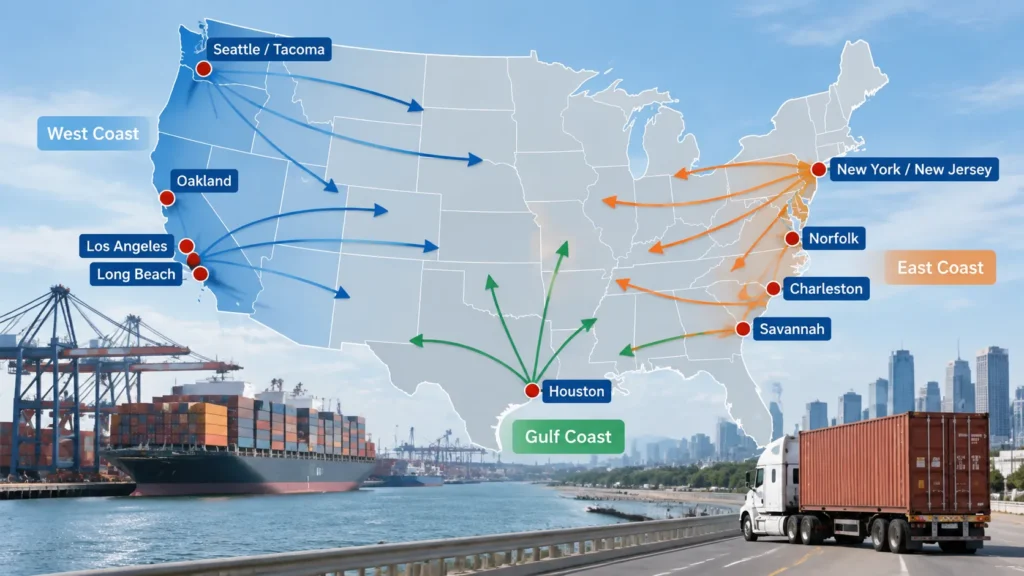
The choice of U.S. arrival port depends on the final delivery address, ocean freight rates, and inland transportation costs. After customs clearance, pallet shipments may require drayage, LTL, or FTL trucking to reach the receiving warehouse.

Map of major U.S. ports and inland routes for port-to-door container delivery

West Coast Ports

Los Angeles, Long Beach, and Oakland are common entry points for cargo arriving from China. They are suitable for shipments destined for California and other western states. See our guide to West Coast shipping ports in the USA for more information.

East Coast Ports

Savannah and New York/New Jersey are important gateways for shipments serving the southeastern and northeastern United States. Depending on the warehouse location, an East Coast route may help reduce inland transportation distances. Explore our overview of East Coast ports in the USA.

LTL vs. FTL Trucking for Inland Delivery

Once customs clearance is completed and the cargo is released, the pallets can be transported to the receiving address using LTL or FTL trucking.

  • LTL (Less Than Truckload): Suitable for smaller shipments that do not require an entire truck. Your pallets share truck space with other customers’ freight, with charges generally based on weight, dimensions, freight class, and delivery distance.

  • FTL (Full Truckload): Suitable for larger shipments or cargo requiring dedicated transportation. It offers more direct delivery and fewer handling points.

For shipments of 5–20 pallets, compare both options based on cargo volume, total weight, delivery distance, and unloading requirements. If your goods are going to a commercial warehouse or distribution center, confirm whether an appointment, liftgate, or special unloading equipment is required.

For shipments requiring transportation beyond the port, see our port-to-door container delivery service in the USA.

U.S. Customs Clearance and Documents for Pallet Shipments

All commercial pallet shipments entering the United States must comply with applicable import regulations. Before shipping, importers should prepare the required documents, verify product classifications, and confirm customs filing responsibilities to avoid clearance delays.

Documents Required for U.S. Customs Clearance

The main customs paperwork generally includes:

  • Commercial Invoice: Shows the seller, buyer, product descriptions, quantities, declared values, and transaction details.

  • Packing List: Provides the number of pallets, package details, dimensions, and gross and net weights.

  • Bill of Lading (B/L): Documents the shipment and transportation arrangements for ocean freight.

  • Air Waybill (AWB): Used as the transportation document for air freight.

  • HTS Classification: Determines the applicable import duty rates and helps identify product-specific requirements.

The commercial invoice and packing list should contain consistent cargo descriptions, quantities, and shipment information. Incorrect or incomplete import documents can delay customs clearance.

You can use our commercial invoice template for importing from China to the USA to understand the information required for an import transaction.

Import Duties, Customs Bond and ISF Filing

Import duties are determined by the product’s HTS classification, customs value, country of origin, and applicable trade measures. Certain Chinese products may also be subject to additional Section 301 duties.

Before shipping, verify the applicable tariff rates and calculate the expected import expenses. Our guide to estimating duties and taxes for shipping from China to the USA explains the main factors affecting import costs.

A customs bond may be required for formal entries to guarantee payment of applicable duties, taxes, and fees. Importers generally have two options:

  • Single-Entry Bond: Covers an individual import transaction.

  • Continuous Bond: Covers multiple shipments during a 12-month period.

For more information, see our customs bond guide for USA imports.

For ocean freight, the Importer Security Filing (ISF 10+2) must generally be submitted at least 24 hours before the cargo is loaded onto the vessel destined for the United States. Importers should coordinate with their customs broker or freight forwarder to ensure the filing is accurate and submitted on time.

If you choose DDP shipping, confirm who will act as the Importer of Record and who is responsible for customs declarations, duties, taxes, and customs clearance.

ISPM 15 Requirements for Wooden Pallets

Wooden pallets used for international shipments entering the United States must comply with ISPM 15 requirements when they contain regulated solid wood packaging material.

The wood must be debarked and treated using an approved method, such as heat treatment or methyl bromide fumigation, and carry a valid ISPM 15 mark.

Before cargo collection in China, check that:

  • Each applicable wooden pallet displays a legible ISPM 15 mark.

  • The wood packaging shows no signs of pest infestation.

  • Pallets are structurally sound and suitable for the cargo weight.

  • Packaging is properly secured for international transportation.

Non-compliant wood packaging may result in inspection, treatment, destruction, or re-exportation. Confirming pallet compliance before shipment helps reduce the risk of delays at the U.S. border.

How to Prepare 5–20 Pallets for International Shipping

Proper cargo preparation helps reduce damage, improve container utilization, and simplify customs inspections.

Before arranging shipping from China, check the following:

  1. Confirm pallet dimensions: Measure the length, width, and height of each loaded pallet. Record the gross weight accurately.

  2. Secure the cargo: Use stretch film, strapping, corner protectors, and suitable packaging to prevent movement during transportation.

  3. Check stacking requirements: Clearly identify whether pallets can be stacked. Do not stack fragile or unstable cargo without proper protection.

  4. Apply cargo labels: Include product identification, shipping marks, handling instructions, and other necessary information.

  5. Verify wooden pallet compliance: Ensure solid wood pallets meet ISPM 15 requirements for U.S. imports.

  6. Prepare shipping documents: Confirm that the commercial invoice and packing list match the actual cargo details.

If you are purchasing goods from multiple suppliers in China, consider consolidating them at one warehouse before export. A China warehousing and consolidation service can help receive goods from different suppliers, check cargo details, and arrange combined shipments when the loading plan allows.

Consolidation can simplify shipment coordination and reduce the need to arrange separate international shipments.

How to Choose a Freight Forwarder for Shipping 5–20 Pallets

Choosing a reliable freight forwarder is important when shipping 5–20 pallets from China to the USA. The right partner should be able to compare transportation options, coordinate cargo handling, and arrange customs clearance and inland delivery.

Before making a decision, consider these factors:

  • Shipping options: Check whether the forwarder can arrange LCL, FCL, and air freight based on your cargo volume and delivery schedule.

  • Transparent quotations: Request a breakdown of origin charges, international freight, destination fees, customs brokerage, and inland trucking. Confirm whether additional handling or storage fees may apply.

  • Cargo consolidation: If you purchase goods from multiple suppliers, check whether the forwarder can receive, inspect, and consolidate shipments at a warehouse in China. A China warehousing and consolidation service can help coordinate goods before export.

  • Customs support: Confirm who handles import documents, ISF filing, customs entry, and communication with the U.S. customs broker.

  • U.S. delivery arrangements: Check whether the forwarder can coordinate LTL or FTL trucking and meet the receiving requirements of your warehouse or distribution center.

  • Shipment updates: Ask how you will receive updates on cargo collection, departure, arrival, customs clearance, and delivery.

Tonlexing provides shipping coordination from China, including cargo consolidation, ocean and air freight arrangements, customs clearance coordination, and U.S. inland delivery. By reviewing your pallet dimensions, total volume, cargo weight, and destination, Tonlexing can help compare suitable shipping methods and provide a quotation based on your shipment requirements.

Frequently Asked Questions