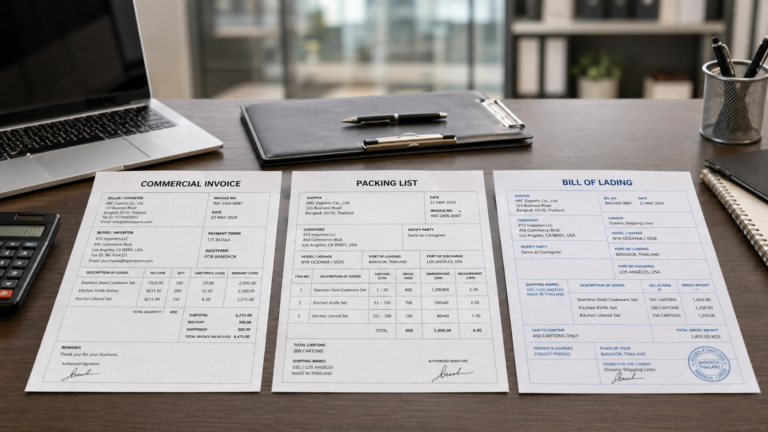
Related Guide
Commercial Invoice vs Packing List vs Bill of Lading
Learn the difference between a commercial invoice, packing list, and bill of lading in international shipping. Understand customs clearance, carg...
Read guide →

A commercial invoice template for importing from China to the USA helps importers prepare the key customs document required for international shipping, customs clearance, and duty calculation.
This guide explains what a commercial invoice should include, how to fill out each required field, the difference between a commercial invoice, pro forma invoice, and packing list, and how to avoid customs delays when shipping goods from China to the United States.
Commercial invoice form
HTS code & customs clearance
China to USA imports
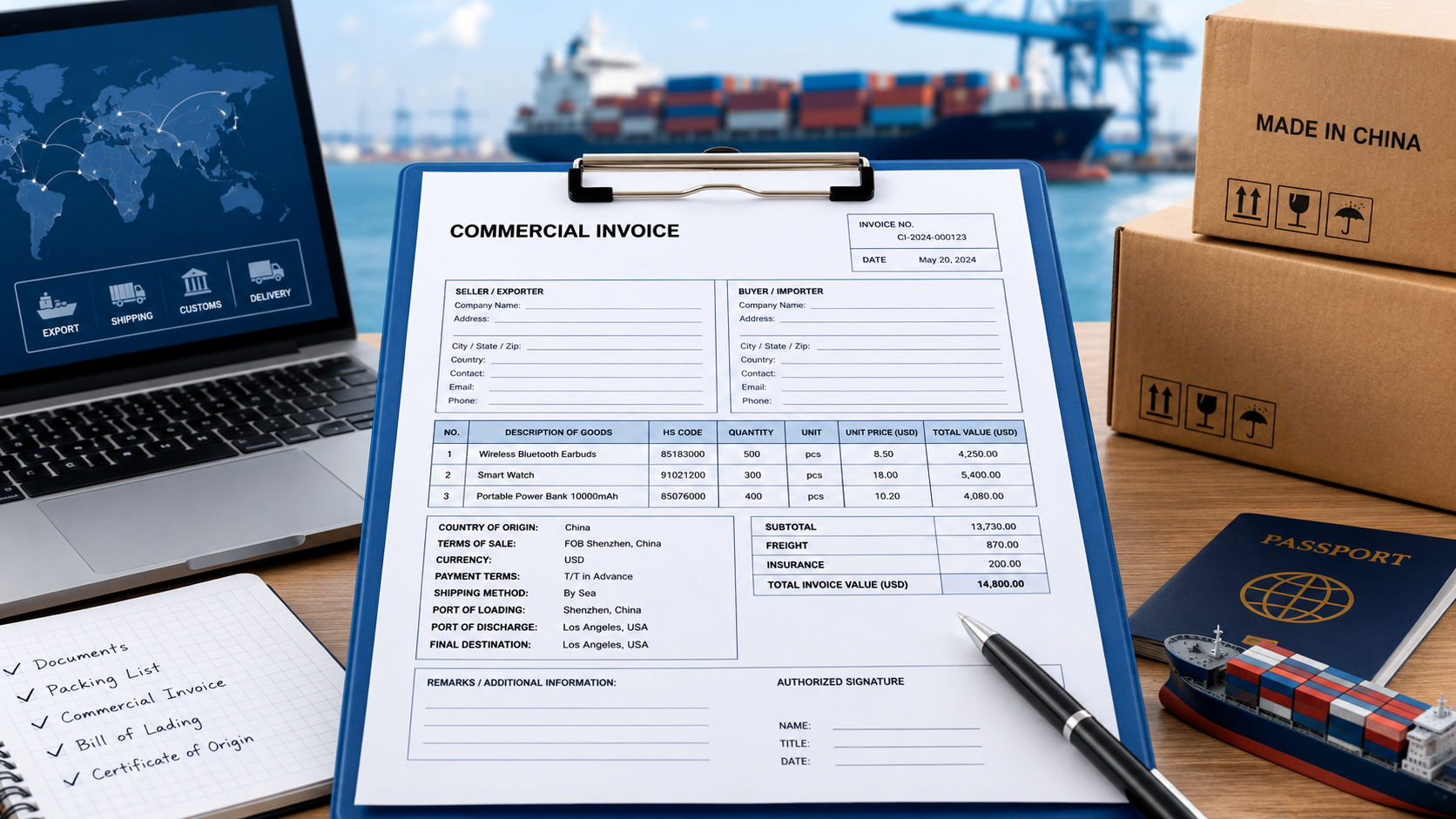
A commercial invoice is a legal customs document issued by the seller (exporter) to the buyer (importer) during an international transaction. It acts as the official bill of sale and is primarily used by customs authorities to calculate import duties, taxes, and clearance fees.
A commercial invoice is a mandatory document for most international shipments with commercial value. When goods enter the United States, customs authorities need to understand what the shipment contains, where it comes from, how much it is worth, and whether the correct duties and taxes have been declared.
A good invoice helps with:
Customs clearance
Import duties calculation
HTS code verification
Country of origin confirmation
International shipping records
Payment process documentation
Export documentation from China
Import compliance in the United States
For example, if you are importing furniture, electronics, clothing, machinery parts, auto parts, or consumer goods from China, the commercial invoice gives customs officials the key pieces of information needed to review the shipment.
Importers often confuse a commercial invoice, pro forma invoice, proforma invoice, customs invoice, and packing list. They are related, but they are not the same.
| Document | Main Purpose | When It Is Used |
|---|---|---|
| Commercial Invoice | Final invoice showing sale, value, buyer, seller, product details, and customs information | Used for customs clearance and import declaration |
| Pro Forma Invoice | Preliminary bill or quotation before the final sale | Used before payment, production, or shipment |
| Packing List | Shows package details, carton count, weight, volume, and packing method | Used by customs, warehouses, and freight forwarders |
| Customs Invoice | A customs-focused invoice required in some countries or shipping cases | Used for customs review in various countries |
A pro forma invoice may help the buyer confirm price and payment terms before production. However, the final invoice used for customs clearance should be the commercial invoice. In many cases, customs authorities require the final invoice because it reflects the actual transaction value.
A commercial invoice form for importing from China to the USA should include complete and relevant details. The format can vary, but the information must be easy to read and accurate.
The seller is usually the Chinese supplier, factory, manufacturer, or trading company.
Include:
Full company name
Business address in China
Contact person
Phone number
Email address
Tax ID or business registration number if available
The seller name should match the export documentation and sales contract.
The buyer is the company or person purchasing the goods. In many China to US shipments, the buyer may also be the Importer of Record.
Include:
U.S. company name
Full address
Contact person
Phone number
Email address
EIN or tax ID if required
Importer of Record information if different from the buyer
Both the buyer and seller information should be consistent across all shipping documents.
The consignee is the receiver of the goods. This may be the buyer, a warehouse, a 3PL provider, or an Amazon FBA fulfillment center.
Include:
Consignee name
Delivery address
Contact person
Phone number
Final destination country
Final destination address
If the delivery address is different from the buyer’s address, list it clearly.
Every commercial invoice should have a unique invoice number. You can also include a reference number, purchase order number, sales contract number, or shipment reference.
Include:
Invoice number
Invoice date
PO number
Reference number
Sales contract number if available
A clear invoice number helps the buyer, seller, freight forwarder, and customs broker track the shipment.
Shipment details connect the commercial invoice with the actual international shipping movement.
Include:
Shipping method
Port of loading in China
Port of entry in the USA
Final destination
Carrier name
Vessel name or flight number if available
Bill of lading number
Air waybill number
Container number if available
Tracking number for express shipping
For sea freight, common China ports include Shenzhen, Shanghai, Ningbo, Qingdao, Xiamen, and Guangzhou. For U.S. imports, common destination ports include Los Angeles, Long Beach, New York, Savannah, Houston, and Seattle.
The product description is one of the most important fields on a commercial invoice. Vague descriptions can cause customs delays.
Avoid descriptions such as:
Goods
Parts
Accessories
Samples
Plastic products
Electronics
Clothing
Use a complete description that explains what the product is, what it is made of, and how it will be used.
Better examples:
Stainless steel kitchen sink for residential use
Cotton knitted T-shirts for men
Aluminum LED ceiling light for indoor lighting
Plastic storage box for household use
Wooden hotel bedroom furniture
Auto brake pads for passenger vehicles
A complete description helps customs officials classify the product and review the declared value.
The product description is one of the most important fields on a commercial invoice. Vague descriptions can cause customs delays.
Avoid descriptions such as:
Goods
Parts
Accessories
Samples
Plastic products
Electronics
Clothing
Use a complete description that explains what the product is, what it is made of, and how it will be used.
Better examples:
Stainless steel kitchen sink for residential use
Cotton knitted T-shirts for men
Aluminum LED ceiling light for indoor lighting
Plastic storage box for household use
Wooden hotel bedroom furniture
Auto brake pads for passenger vehicles
A complete description helps customs officials classify the product and review the declared value.
The HS code is an international classification code used in global trade. The HTS code is the U.S. version under the Harmonized Tariff Schedule.
For China to USA imports, the supplier may provide a 6-digit HS code, but the U.S. customs broker usually needs the correct HTS code for import declaration.
Your commercial invoice should include:
HS code or HTS code
Product description
Material
Use
Quantity
Unit value
Total value
Country of origin
The correct HTS code helps determine import duties, taxes, and possible additional tariffs.
Each product line should show the total quantity, unit price, unit value, and total value.
Include:
Quantity
Unit of measure
Unit price
Total value
Specific currency
Total invoice amount
For China to USA shipments, USD is commonly used. If another currency is used, state the specific currency clearly.
The commercial value should match the actual amount paid or payable by the buyer. Do not reduce the invoice value only to lower taxes, because this may create customs compliance problems.
The country of origin shows where the product was manufactured. For most products made in China, the invoice should clearly state China or People’s Republic of China.
Do not confuse country of origin with the shipping country. If goods are shipped from China but manufactured in another country, the correct origin should be listed.
Country of origin is important for:
Import duties
Tariff treatment
Marking requirements
Customs declaration
Trade compliance
Terms of sale explain the responsibility between the buyer and seller. They affect freight charges, risk transfer, insurance, and delivery responsibility.
Common terms of sale for importing from China include:
For example, FOB Shenzhen means the seller handles delivery to Shenzhen port and China export clearance. The buyer usually handles international shipping, U.S. customs clearance, import duties, and final delivery.
DDP means the seller or logistics provider may handle more of the shipping process, including customs clearance and delivery. Even in such cases, the commercial invoice must still show accurate product details and value.
Payment terms show how the buyer pays the seller.
Common payment terms include:
T/T payment
30% deposit and 70% balance before shipment
Net 30
Letter of credit
PayPal
Alibaba Trade Assurance
Payment terms help support the transaction record and payment process.
You can use the commercial invoice template below as a practical reference for China to USA shipments. It should clearly show the invoice number, seller and buyer details, consignee, country of origin, destination country, shipment details, payment terms, terms of sale, product value, and authorized signature.
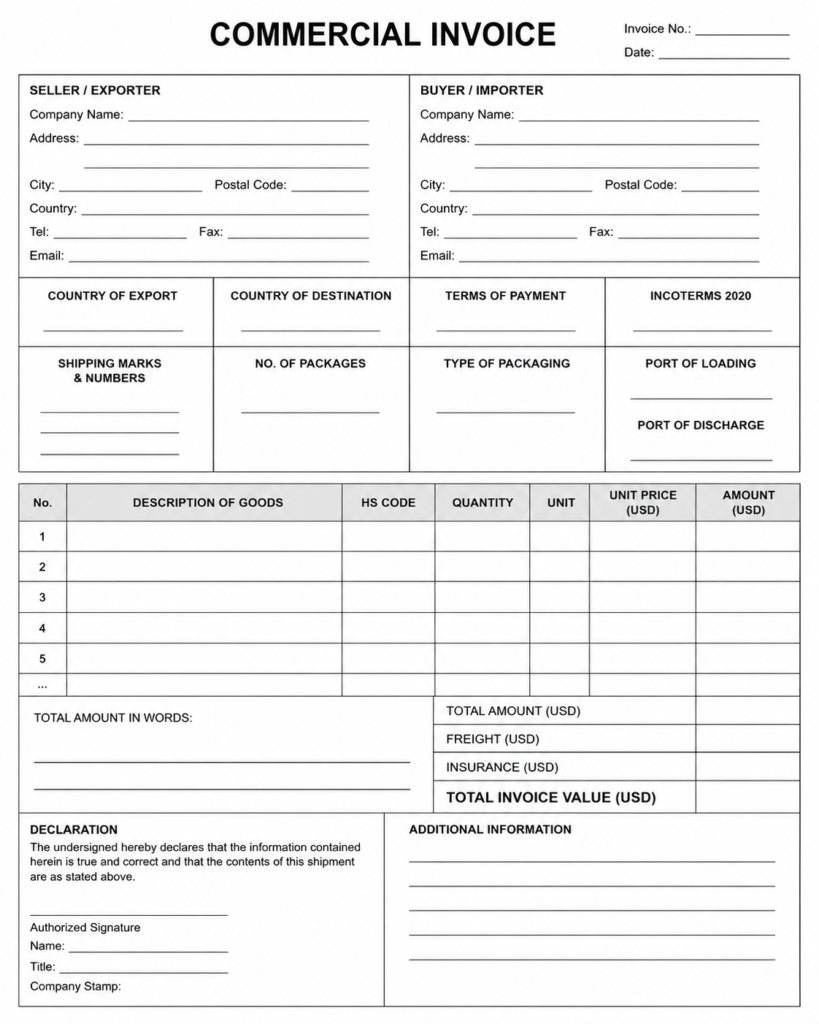
The product line section is the part of the commercial invoice where each product is listed separately. This helps customs authorities identify the goods, verify the HTS code, check the country of origin, and calculate import duties based on the declared value.
| HTS Code | Complete Description | Origin | Quantity | Unit Price | Total Value |
|---|---|---|---|---|---|
| 9403.60 | Wooden hotel bedside table for guest room use | China | 200 pcs | $45 | $9,000 |
| 8504.40 | LED power adapter with plastic shell for indoor lighting product | China | 500 pcs | $3.50 | $1,750 |
| 6109.10 | Cotton knitted short sleeve T-shirt for men | China | 1,000 pcs | $2.80 | $2,800 |
Each product line should include a clear description, correct HTS code, country of origin, quantity, unit price, and total value. The information should match the packing list, purchase order, supplier invoice, and other shipping documents to avoid customs delays.
To create a commercial invoice for importing from China to the USA, follow a clear process.
Check the full legal names, addresses, and contact details of both the buyer and seller. Avoid using short names, nicknames, or incomplete company names.
Enter the invoice number, invoice date, reference number, shipping method, port of loading, port of entry, and final destination.
If the cargo is already booked, add the bill of lading number, air waybill number, tracking number, or container number.
Do not use generic product names. A correct commercial invoice should describe the goods clearly enough for customs classification.
For each item, include:
Product name
Material
Function
Model number if available
Use
Quantity
Unit value
Country of origin
Ask the supplier for the HS code, but confirm the U.S. HTS code with your customs broker. A wrong code may affect duty rates, taxes, and customs compliance.
Make sure the unit price, total value, freight charges, insurance charges, and currency are correct.
If the invoice includes freight or insurance, show those charges clearly.
The commercial invoice and packing list should not conflict.
Check:
Product names
Quantity
Carton count
Gross weight
Net weight
CBM
Shipping marks
Country of origin
This simple review can help avoid errors and save time during customs clearance.
DDP shipping is common for importers who want one logistics provider to handle pickup in China, export clearance, international shipping, U.S. customs clearance, duties, and final delivery.
However, DDP does not remove the need for a correct commercial invoice. The invoice should still include the seller, buyer, consignee, product description, HS code or HTS code, country of origin, quantity, unit price, total value, and terms of sale.
For DDP shipments, importers should pay close attention to:
Declared value
Product description
HTS code
Importer information
Final destination
Duty and tax responsibility
Customs broker arrangement
A clear invoice helps the freight forwarder and customs broker prepare the correct documents.
Amazon FBA shipments from China to the USA also need a commercial invoice. The consignee may be an Amazon warehouse, but the Importer of Record must be handled correctly.
Important details include:
Amazon warehouse address
FBA shipment ID
Product SKU
Carton labels
Correct product description
HTS code
Country of origin
Declared value
Importer information
Do not list Amazon as the importer unless the arrangement is correct. For most importers, Amazon is only the delivery destination, not the Importer of Record.
A freight forwarder can help importers manage international shipping from China to the USA and reduce documentation mistakes.
A professional freight forwarder can help check:
Commercial invoice templates
Commercial invoice form details
Packing list
Bill of lading
Air waybill
HS code and HTS code information
Country of origin
Shipping marks
Carton details
Customs clearance documents
Final delivery information
Tonlexing helps importers ship goods from China to the USA by sea freight, air freight, express, DDP, and door to door delivery. Our team can assist with supplier coordination, document review, customs clearance support, and final delivery planning.
If you are not sure whether your invoice is complete, you can send your product details, supplier invoice, packing list, and destination address for review before shipment.
Yes. Most international shipments with commercial value need a commercial invoice for customs clearance. It helps customs officials review product details, value, origin, and parties involved.
Use a clear commercial invoice form that includes seller, buyer, consignee, invoice number, shipment details, product description, HS code or HTS code, quantity, unit price, total value, country of origin, terms of sale, and signature.
A pro forma invoice is a preliminary bill used before the final sale. A commercial invoice is the final invoice used for customs clearance, payment records, and import declaration.
Not always. A commercial invoice is commonly used as a customs invoice for international trade, but some countries may require a special customs invoice format.
If the invoice is incomplete or inaccurate, customs authorities may delay the shipment, ask for corrections, question the value, or request additional documents.
Useful freight, customs and importing resources related to this shipping guide.
Learn the difference between a commercial invoice, packing list, and bill of lading in international shipping. Understand customs clearance, carg...
Read guide →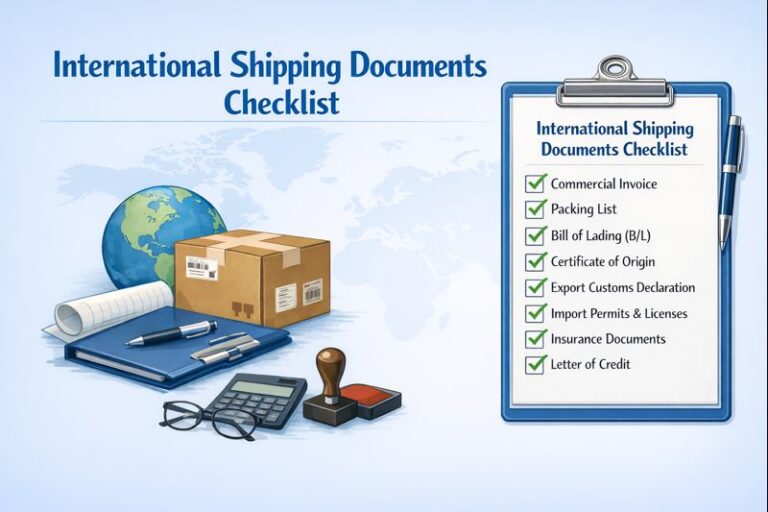
International Shipping Documents Checklist Verified & Reviewed · Last updated January 2026 International shipping fails for boring reasons: a shi...
Read guide →
Importing goods from China can be highly profitable—but only when you understand the necessary documents and import requirements. Whether you’re...
Read guide →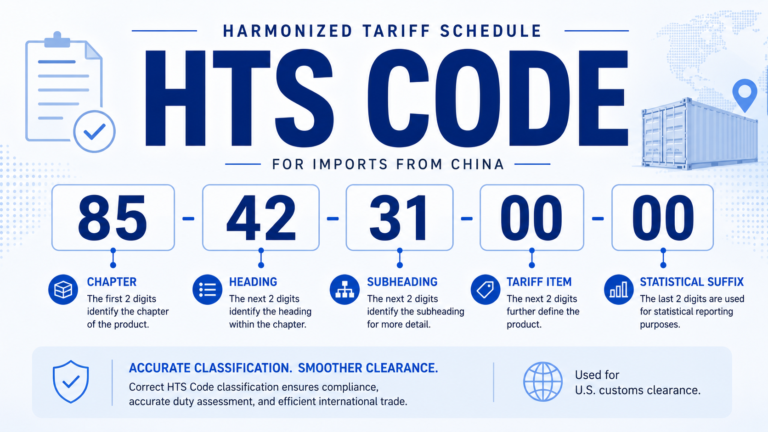
HTS Code for Imports from China: A Complete Guide for U.S. Importers Verified & Reviewed · Last updated April 2026 When importing goods from Chin...
Read guide →Importer of Record IOR in the USA Verified & Reviewed · Last updated March 2026 Importer of Record (IOR) in the USA determines who is legally res...
Learn more → Useful Resource Complete Guide to Customs Clearance from China to the USA: Key Steps and ConsiderationsWhen shipping goods from China to the USA, customs clearance plays a crucial role in ensuring a smooth and timely process. This guide will break...
Learn more →WhatsApp us