

China to USA Import Duties: Customs Duty, Tariffs, and Import Tax Guide
- Verified & Reviewed · Last updated May 2026
Importing goods from China to the United States involves more than just shipping costs. Import duties, HTS codes, Section 301 tariffs, MPF, HMF, and other applicable fees all contribute to the total landed cost. Understanding how CBP calculates customs duty and additional import taxes is essential for businesses to plan effectively, avoid unexpected charges, and remain compliant with evolving U.S. trade regulations.
This guide explains the key components of the U.S. import cost structure, how tariffs are applied to Chinese goods, and practical steps to estimate total duties before shipment.
HTS Duty Rates
Section 301 Tariffs
MPF & HMF Fees

- Experienced China-based logistics specialists
Table of Contents
China to USA Import Duties: Quick Overview
China to USA import duties are calculated based on the product’s HTS code, customs value, country of origin, and applicable duties. Many Chinese imports may be subject to base HTS duties plus additional tariffs under U.S. trade measures.
A typical import cost structure may include:
| Cost Element | What It Means |
|---|---|
| HTS duties | Base customs duty based on the Harmonized Tariff Schedule |
| Section 301 tariffs | Additional tariffs on many Chinese goods |
| Reciprocal tariffs | Extra tariffs that may apply under current U.S. trade measures |
| IEEPA tariffs | Tariffs or measures connected with emergency economic powers, where applicable |
| Merchandise processing fee | CBP processing fee for many formal entries |
| Harbor maintenance fee | Fee for sea freight cargo entering through U.S. ports |
| Excise tax | Federal tax on specific regulated goods |
| Customs broker fee | Service cost for customs entry filing and compliance support |
The exact amount should always be checked by product classification. Two goods shipped in the same container can have very different duty rates.
What Are Import Duties from China to the USA?
Import duties are taxes charged when goods imported from another country enter the United States. For goods imported from China, the importer of record is usually responsible for paying duties and taxes during customs clearance.
Import duties from China may include:
Base customs duty
Additional duties under Section 301
Reciprocal tariffs or IEEPA tariffs
Merchandise processing fee
Harbor maintenance fee
Excise tax for regulated goods
Other applicable fees required by U.S. customs rules
U.S. Customs and Border Protection, also known as CBP, enforces customs laws, collects duties and taxes, and applies trade remedy measures on imported goods. CBP states that it enforces trade remedy measures for duties and quotas on imported goods.
The Role of the Harmonized Tariff Schedule
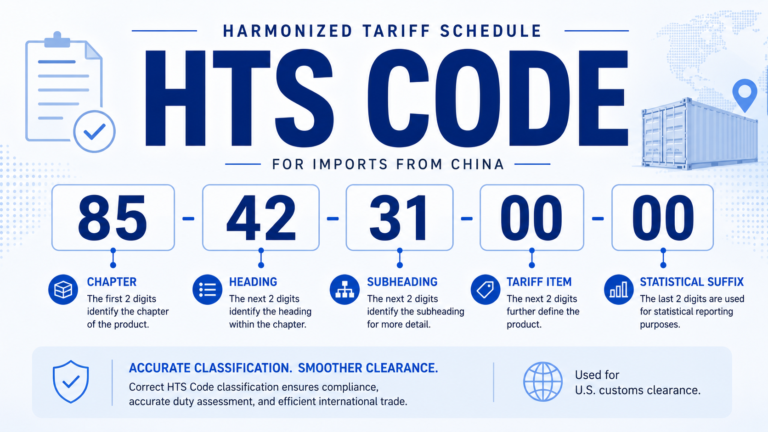
The Harmonized Tariff Schedule is the main reference for determining U.S. import duty rates. Every product imported into the United States must be classified under a specific HTS code.
Many importers confuse HS codes and HTS codes. HS codes are used internationally as the foundation of product classification, while U.S. HTS codes provide more detailed tariff classification for U.S. customs purposes.
For example, “furniture” is not enough for duty calculation. Wooden furniture, metal furniture, upholstered wooden furniture, office furniture, bedroom furniture, and furniture parts may fall under different HTS codes. Each commodity code may have a different customs duty rate and may also be affected by additional tariffs.
Before shipping, importers should confirm:
Product name
Material
Function
End use
Country of origin
HTS classification
Declared value
Applicable duties
Additional tariffs
Entry type
Incorrect tariff classification can lead to underpaid duties, customs delays, penalties, or post-entry reviews.
How Are Import Duties from China Calculated?
To calculate import duty from China to the USA, importers first need to identify the correct HTS code and duty rate. The basic formula is:
Customs value × duty rate = base customs duty
Then importers need to add any additional duties, import tariffs, reciprocal tariffs, IEEPA tariffs, and applicable fees.
A simplified calculation process looks like this:
| Step | What to Check |
|---|---|
| Step 1 | Confirm the product’s HTS classification |
| Step 2 | Determine the declared value |
| Step 3 | Apply the base HTS duty rate |
| Step 4 | Add Section 301 tariffs if applicable |
| Step 5 | Add reciprocal tariffs or IEEPA tariffs if applicable |
| Step 6 | Add MPF, HMF, and other applicable fees |
| Step 7 | Add customs broker, cargo insurance, and delivery costs |
Some online summaries use CIF value as a quick estimate for duties. However, U.S. customs valuation can depend on transaction value, invoice terms, freight separation, assists, discounts, and other documentation details. Importers should verify the correct customs value before entry.
Core Elements of the U.S. Import Cost Structure for Chinese Goods
The total cost of importing goods from China to the United States is determined by several key components. Understanding these elements can help importers plan their landed costs accurately and avoid surprises. The four main pillars are: base duty rate, Section 301 tariffs, mandatory processing fees, and logistics and handling costs.
Customs Valuation: The Starting Point
All U.S. import duties and taxes are calculated as a percentage of the shipment’s customs value. CBP (U.S. Customs and Border Protection) typically uses the FOB (Free on Board) value, which represents the actual cost of the goods, excluding international shipping and insurance. The declared value forms the baseline for calculating both standard HTS duties and additional tariffs.
Stacked Duty Rates
The total duty applied to Chinese imports is a combination of multiple layers:
Standard Base Duty: Determined by the product’s 10-digit Harmonized Tariff Schedule (HTS) code, this applies to all imports from countries without a free trade agreement. Rates typically range from 0% to 15%, depending on the commodity classification.
Section 301 Tariffs (China-Specific): This is an additional duty applied on many Chinese imports in response to trade enforcement measures. Depending on the product category, it can add 7.5%, 25%, 30%, or more on top of the base duty. Commonly affected products include electronics, machinery, medical devices, solar modules, and other strategic goods.
These stacked duties explain why the effective tariff on many Chinese goods can approach 30% or more, even for everyday consumer items.
Mandatory Customs Fees
Beyond base and additional tariffs, commercial shipments must also pay government processing fees:
Merchandise Processing Fee (MPF): Applied on almost all formal entries (shipments over USD 2,500). The 2026 rate is 0.3464% of the shipment value, with a minimum of approximately USD 32 and a maximum of around USD 666.
Harbor Maintenance Fee (HMF): Charged only on ocean freight shipments, at 0.125% of the cargo value. Air freight shipments are exempt from this fee.
These fees are administered by CBP and are mandatory for U.S. import compliance.
Logistics and Handling Costs
In addition to government-imposed duties and fees, importers must account for operational expenses associated with shipping and clearing goods:
International Freight: Costs for sea or air transport from China to the U.S.
Customs Brokerage Fees: Paid to a licensed customs broker to prepare and submit legal entry documentation and ensure compliance with U.S. customs rules.
Customs Bond: A required insurance guarantee that duties and taxes will be paid. Importers can use a Single Entry Bond for one shipment or a Continuous Bond for frequent importers over a year.
Example: Calculating Import Duties for Chinese Goods Shipped to the U.S.
To illustrate how U.S. import duties and fees stack together, consider a practical example for a shipment from China.
Scenario:
A U.S. importer purchases goods from China with a declared customs value of USD 20,000. The product falls under an HTS code with a 5% base duty and is subject to Section 301 tariffs at 25%.
Step-by-Step Duty Calculation:
| Cost Component | Calculation | Estimated Amount |
|---|---|---|
| Base HTS Duty | 20,000 × 5% | USD 1,000 |
| Section 301 Tariff | 20,000 × 25% | USD 5,000 |
| Merchandise Processing Fee (MPF) | 20,000 × 0.3464% (formal entry) | USD 69 |
| Harbor Maintenance Fee (HMF) | 20,000 × 0.125% (ocean freight only) | USD 25 |
| Customs Broker Fee | Typical flat or percentage-based service fee | USD 100–200 (estimate) |
| Estimated Total Duties & Fees | Base Duty + Section 301 + MPF + HMF + Broker | ~USD 6,200–6,300 |
Key Points to Note:
Stacked Tariffs: The total duty includes both the base HTS duty and the Section 301 tariff, reflecting how Chinese imports are currently taxed under U.S. trade enforcement measures.
Processing Fees: MPF and HMF are mandatory for formal entries, with HMF applying only to ocean shipments.
Customs Broker Fees: Engaging a licensed customs broker ensures compliance with CBP rules and accurate filing of import documents.
Total Landed Cost: Beyond duties and fees, importers should also account for freight, insurance, cargo handling, and any additional operational costs when calculating the total landed cost.
This example demonstrates why the effective duty on Chinese goods can be significantly higher than the base HTS rate alone, sometimes approaching 30% or more, especially for products affected by Section 301 tariffs.
Formal Entry, Informal Entry, and Low-Value Shipments
When importing goods from China to the United States, the type of customs entry determines how import duties, fees, and taxes are assessed. U.S. Customs and Border Protection (CBP) distinguishes between formal entry, informal entry, and special provisions for low-value shipments.
Formal Entry
Formal entry is required for higher-value commercial shipments or regulated products. Key points include:
Typically required for shipments valued over USD 2,500.
CBP requires full documentation, including a commercial invoice, packing list, HTS classification, country of origin, and a customs bond.
Duties and fees, such as HTS duties, Section 301 tariffs, MPF, and HMF, are calculated and collected during entry.
Importers often use a licensed customs broker to ensure compliance and avoid delays.
Formal entry ensures that CBP can properly assess all applicable duties and taxes and that the shipment meets U.S. import regulations.
Informal Entry
Informal entry applies to shipments that are lower in value or otherwise qualify for simplified processing:
Usually for shipments under USD 2,500 (with exceptions for regulated products).
Documentation requirements are lighter, and customs clearance is faster.
Duties and taxes still apply, including Section 301 tariffs if the goods originate from China.
Informal entry can apply to smaller e-commerce shipments, samples, or low-risk consumer products.
Even when processed informally, importers remain responsible for paying all legally applicable duties and taxes.
Low-Value Shipments and De Minimis Exemption
Historically, low-value shipments (commonly USD 800 or less) could enter the U.S. duty-free under the de minimis exemption. However, significant regulatory changes have affected this:
As of August 29, 2025, the de minimis exemption has been suspended for many imports, including most Chinese goods.
Even small parcels, postal shipments, e-commerce orders, and samples may now require formal or informal entry and payment of import duties, Section 301 tariffs, and applicable fees.
Exceptions are extremely limited, primarily for unsolicited gifts valued under USD 100 or temporary imports for exhibition, repair, or testing.
Importers should verify the current CBP rules before shipping low-value items to avoid unexpected duties, penalties, or shipment delays.

Common Product Categories and Duty Considerations
Different types of Chinese imports face varying HTS duties, Section 301 tariffs, and other applicable fees. Understanding how U.S. customs treats each product category can help importers estimate import duties and total landed costs more accurately.
Everyday Consumer Goods
Most consumer products imported from China, such as household items, kitchenware, clothing, toys, and electronics accessories, usually carry moderate HTS duties.
Base duties often range from 2.5% to 6%, but Section 301 tariffs can significantly increase the total cost.
Even everyday items may be affected by cumulative tariffs, including MPF, HMF, and other CBP-administered fees.
Electronics and Components
Electronics and related components often face stricter tariff treatment:
Finished products, circuit boards, chargers, sensors, or industrial electronic parts may fall under different HTS codes.
Certain components are subject to Section 301 tariffs or other trade enforcement measures.
Accurate classification is critical to avoid underpayment or penalties, as CBP carefully reviews declared value and HTS codes for these products.
Furniture and Home Goods
Furniture imports, including upholstered wooden furniture, metal furniture, and office furniture, require careful HTS classification:
Different materials, construction methods, and product uses can change duty rates.
Section 301 tariffs may apply to certain consumer or industrial furniture items.
Importers should review both base HTS duties and additional tariffs before shipping.
Steel and Aluminum Products
Steel and aluminum articles may incur multiple tariff layers:
Section 232 tariffs under the Trade Expansion Act apply for national security reasons.
Section 301 tariffs on Chinese steel and aluminum can stack with Section 232 duties, resulting in high total duty rates.
CBP evaluates customs value and HTS classification to apply all relevant tariffs correctly.
Medical and Health Products
Medical products, including syringes, needles, gloves, masks, and other devices, may be subject to Section 301 tariffs or other special trade measures.
Certain medical products have been prioritized in tariff exclusions, but most still require formal entry and payment of duties and fees.
Accurate HTS classification and declared value are essential to ensure compliance and avoid delays.
Clean Energy and Strategic Goods
Clean energy products and strategic imports, such as electric vehicles, solar panels, lithium-ion batteries, wafers, and critical mineral components, face heightened scrutiny:
Many are subject to higher Section 301 tariffs, sometimes 50% or more, depending on the category.
Importers must verify country of origin, HTS codes, and cumulative tariff obligations before shipping.
CBP enforces these duties alongside standard import duties, MPF, and HMF, increasing the total landed cost significantly.
Temporary Imports
Goods temporarily imported for exhibition, repair, or testing may qualify for special treatment:
Temporary Importation under Bond (TIB) allows entry without immediate payment of duties, provided goods are re-exported within a prescribed period.
Proper documentation, including HTS codes, declared value, and purpose of import, is required by CBP.
Why U.S. Tariff Rules on Chinese Imports Keep Changing
U.S. tariff rules on Chinese imports are shaped by trade policy, national security concerns, domestic industries, retaliatory tariffs, and broader negotiations between the United States and China. Tariffs affect importers because the final duty is not based on freight cost alone. It depends on product classification, country of origin, declared value, current tariff rates, and any additional trade measures in force at the time of entry.
In recent years, President Trump and later administrations used several legal tools to adjust import tariffs, including Section 301 of the Trade Act, Section 232 of the Trade Expansion Act, and authorities related to the International Emergency Economic Powers Act. These measures have been used to respond to trade practices, protect domestic industries, support national security goals, and seek a better deal for U.S. goods and U.S. exports.
President Trump signed executive orders that changed how some U.S. imports were treated, including measures affecting low-value shipments, reciprocal tariffs, and emergency tariff rules. Some of these measures have faced court challenges, including cases involving the Supreme Court and lower federal courts.
China does not have a broad preferential trade agreement with the United States that removes normal duty exposure for most China-origin goods. Therefore, goods imported from China may still face base HTS duties, additional duties, reciprocal tariffs, merchandise processing fee, harbor maintenance fee, and other applicable fees.
Importers should review current tariff rules before shipping, especially when handling high-value cargo, regulated goods, or products affected by new tariffs, tariff increases, exclusions, or the exclusion process.
Who Pays Import Duties from China to the USA?
In most cases, the importer of record is responsible for paying import duties, customs duty, import tax, and applicable fees.
Who pays commercially depends on the Incoterms and sales agreement:
| Trade Term | Duty Responsibility |
|---|---|
| EXW | Buyer usually handles export, shipping, customs clearance, and U.S. duties |
| FOB | Buyer usually pays international shipping and U.S. import duties |
| CIF | Seller pays freight and insurance to the destination port, but buyer usually pays U.S. duties |
| DDP | Seller or logistics provider may arrange duty-paid delivery |
Importers should confirm duty responsibility before shipment. A low freight quote may not include customs duty, additional tariffs, customs broker fees, MPF, HMF, or final delivery.
How DDP Shipping Helps Manage Duties and Taxes
DDP shipping from China to the USA can simplify the import process for buyers who want one provider to manage the full shipping chain.
A DDP solution may include:
Supplier pickup in China
Export customs clearance
International shipping
U.S. customs clearance coordination
Duty and tax handling
Final delivery to the U.S. address
DDP shipping is useful for:
E-commerce sellers
Amazon FBA shipments
Small businesses
Importers without customs experience
Buyers who want a clearer total cost
Shipments requiring door-to-door delivery
However, DDP shipping must still be compliant. The provider should use accurate product descriptions, correct HTS classification, real declared value, and proper country of origin.
How to Reduce Duty Risk Before Shipping
Before importing goods from China to the United States, importers should take these steps:
Confirm the product’s exact tariff classification.
Check base HTS duties.
Review Section 301 tariffs.
Check reciprocal tariffs and current trade measures.
Confirm whether IEEPA tariffs or related provisions apply.
Verify country of origin.
Prepare a complete commercial invoice and packing list.
Use a realistic declared value.
Confirm whether formal entry or informal entry applies.
Work with a customs broker for complex or high-value shipments.
Compare standard shipping and DDP shipping options.
Estimate the total cost before placing a large order.
This guide is for general information only and does not constitute legal advice. For high-value cargo, regulated goods, unclear classification, or tariff disputes, importers should seek professional advice from a licensed customs broker, trade attorney, or compliance specialist.
Frequently Asked Questions
Yes. Most goods imported from China to the USA may be subject to import duties, customs duty, import tax, additional tariffs, or applicable fees. The final amount depends on the product’s HTS classification, declared value, country of origin, and current customs rules.
Customs duties are calculated by applying the correct duty rate to the declared customs value. Importers may also need to add Section 301 tariffs, reciprocal tariffs, IEEPA-related measures, merchandise processing fee, harbor maintenance fee, excise tax, and other applicable fees.
HTS duties are the base customs duty rates listed in the Harmonized Tariff Schedule. Section 301 tariffs are additional duties applied to many Chinese imports under U.S. trade enforcement actions.
A customs broker cannot remove legally applicable duties, but a customs broker can help classify products correctly, prepare entry documents, review applicable duties, check possible exclusions, and reduce the risk of delays or penalties.
Yes. U.S. tariff rules can change because of executive orders, trade negotiations, court decisions, Section 301 reviews, national security actions, and new regulations. Importers should check current tariff rates before shipping goods from China.
Related China to USA Customs & Duty Guides
Need Help Estimating Import Duties from China to the USA?
- Check HTS duty rates and Section 301 tariffs
- Estimate duties, MPF, HMF, and customs fees
- Get support for customs clearance and DDP shipping
Get a clear landed cost estimate before shipping your goods from China to the United States.