Related Guide
Building Materials Shipping from China
Building Materials Shipping from China Verified & Reviewed · Last updated May 2026 Building materials shipping from China helps importers, contra...
Read guide →An added benefit for eligible new customers shipping with Tonlexing.
Check Eligibility & Get a Quote →Subject to cargo eligibility, insurer approval and policy terms.
Coverage and insured value depend on the cargo, route and written insurer confirmation before shipment. Policy exclusions, deductibles and claims terms apply. The US$500,000 figure is a maximum coverage limit, not a guaranteed claim payment. Insurance premiums are not represented as free unless expressly confirmed in your quote.


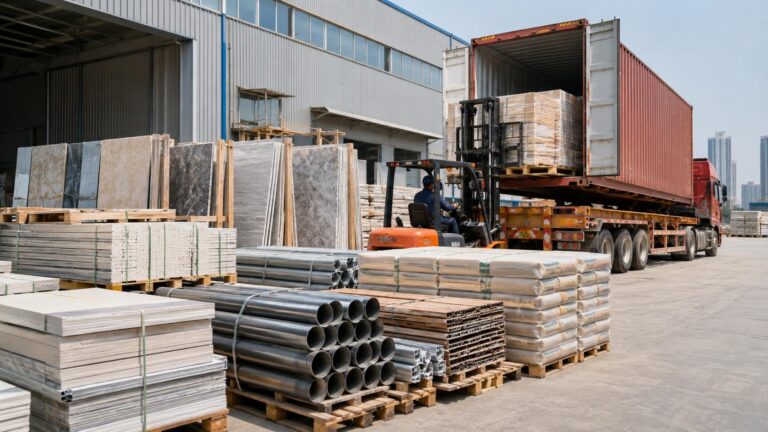
Shipping building materials from China to the UK requires careful planning of freight, product requirements, and delivery. Common cargo includes tiles, flooring, doors, windows, timber, and other construction materials.
Compare FCL and LCL shipping, freight costs, transit times, UK customs clearance, and delivery options for your shipment.
Sea Freight
FCL & LCL
UK Customs Clearance
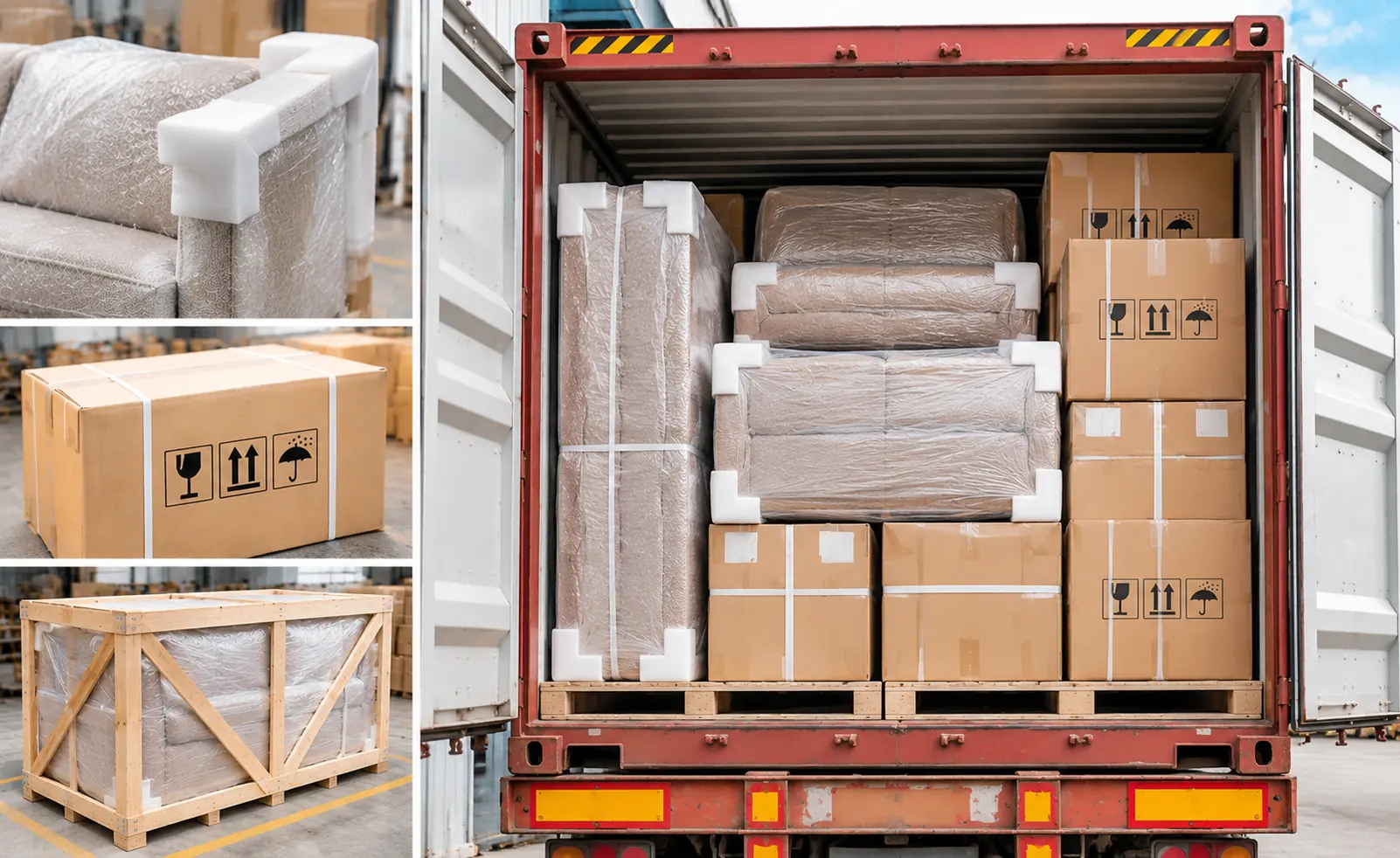
Yes. UK businesses can import many types of building materials from China for construction, renovation, wholesale, and distribution. Common products include ceramic tiles, marble, granite, flooring, doors, windows, bathroom fittings, timber, insulation, roofing materials, and metal sections.
Before placing an order, check five important points:
Product classification: Identify the material, intended use, and correct UK commodity code. Similar products can have different tariff classifications.
Product compliance: Check whether the goods are covered by construction product regulations, safety standards, testing, or conformity marking requirements.
Supplier documents: Request technical specifications, test reports, declarations, and other relevant records from Chinese suppliers.
Import responsibilities: Confirm who will act as the importer, submit the customs declaration, and account for import duty and VAT.
Delivery arrangements: Decide whether the goods will go to a warehouse, distributor, retailer, or construction site.
Great Britain and Northern Ireland may have different product and customs arrangements. Confirm the rules for the actual destination rather than assuming that one set of requirements applies throughout the UK.
A product that can be exported from China is not automatically compliant for sale or installation in the UK. Checking these requirements before paying the supplier can prevent problems later.
For a general overview, see our guide to shipping from China to the UK.
China has manufacturers producing materials for residential construction, commercial buildings, renovation, and fit-out projects. The most appropriate shipping arrangement depends on the product’s dimensions, weight, fragility, and handling requirements.
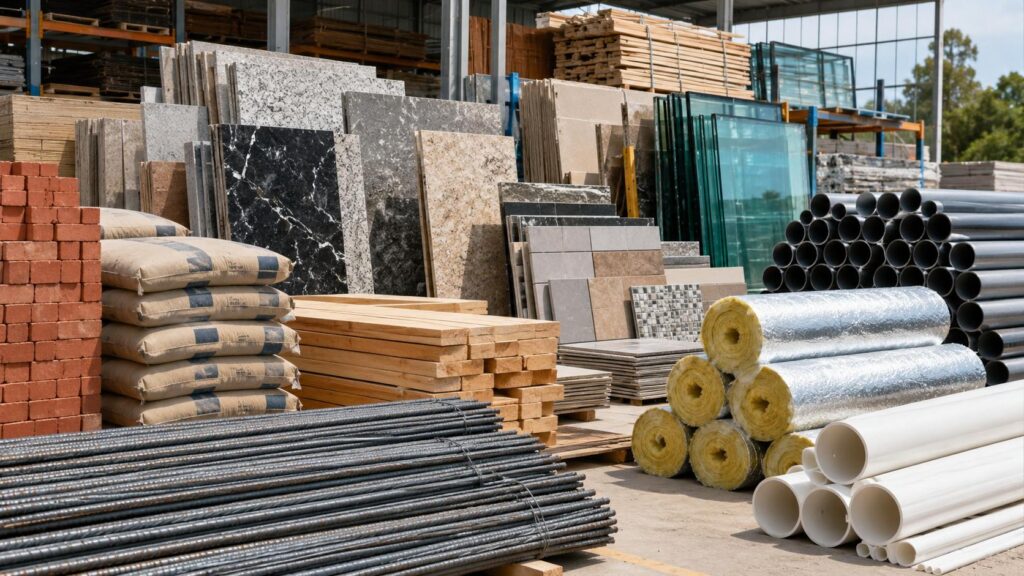
Ceramic tiles, porcelain floor tiles, marble, and granite are among the most common building materials imported from China. These products are relatively heavy, so shipments may reach container weight limits before using all available space.
Use strong cartons, stable pallets, and edge protection to prevent cracks and chipping during transportation. Polished stone may also require additional surface protection. Importers purchasing ceramic tiles from China should confirm carton dimensions, pallet weights, and total shipment volume before booking.
Chinese manufacturers export interior and exterior doors, aluminium windows, frames, and glass panels in various sizes and specifications. These products can occupy considerable container space, particularly when protective frames or wooden crates are required.
Glass needs adequate cushioning and edge protection, while finished doors and window frames should be protected against scratches and deformation. For doors and windows shipped from China, accurate dimensions are essential for container planning.
Toilets, washbasins, bathtubs, shower enclosures, bathroom cabinets, and taps often combine ceramic, glass, and metal components. Each item needs suitable cushioning to prevent impact damage during loading and unloading.
When importing sanitary ware from China, make sure carton labels and packing lists clearly identify each model, colour, and quantity, especially for mixed shipments.
Wooden flooring, engineered wood, plywood, roofing sheets, waterproofing products, insulation panels, and exterior cladding are also widely available from Chinese suppliers.
Timber products may require moisture protection, while long panels need adequate support to prevent bending. Certain timber and chemical-based materials may also be subject to specific sourcing, import-control, or safety requirements.
Steel profiles, aluminium sections, brackets, fasteners, and other construction components are commonly used in building and renovation projects. Their weight and irregular dimensions can create additional loading challenges.
Before shipping, confirm bundle dimensions, gross weight, corrosion protection, and securing arrangements. Long materials should be properly supported to prevent movement or deformation during transportation.
Choosing reliable suppliers is just as important as choosing the shipping method. A low unit price does not guarantee good product quality. Differences in material grade, thickness, finish, and tolerances can affect installation and the total landed cost.
Start with basic due diligence. Check the supplier’s registered business details, factory location, production capability, export experience, and references for similar products.
Establish whether you are dealing with a Chinese factory, a trading company, or an export company. Confirm who is responsible for manufacturing, quality control, and export documents.
When comparing Chinese manufacturers, request factory information, product catalogues, technical specifications, and examples of previous export orders. A video call or factory visit can help you understand production processes, but it should not replace independent checks for a large purchase.
Prepare a written specification before requesting quotations. Include:
Material, dimensions, and thickness.
Colour, finish, and product model.
Technical performance and testing requirements.
Quantity per carton and total order quantity.
Minimum order quantity (MOQ).
Production lead time and delivery arrangements.
Two products may look similar in photographs but differ in quality or technical performance. Clear specifications help buyers effectively communicate requirements and compare product pricing on the same basis.
Where practical, order samples before confirming a bulk purchase. Check dimensions, finish, colour consistency, workmanship, and other product-specific features. Keep an approved sample or signed specification as the reference for mass production.
Quality control can take place at three stages:
Pre-production: Check raw materials, approved samples, and production arrangements.
During production: Inspect selected goods to identify variations while the factory can still correct them.
Pre-shipment: Check finished products, quantities, labels, visible defects, and export packing before release.
Inspection criteria should match the goods. Tile inspections may focus on dimensions, surface finish, and breakage, while door and window inspections may cover frames, hardware, glass, and operation.
Learn more about pre-shipment inspection in China.
When negotiating prices, compare the same specifications, quantities, and delivery terms. Price negotiation should not focus only on the lowest unit price.
Ask whether the quotation includes export packing, labels, testing, inland transport, or other services. Confirm payment terms, deposits, production milestones, and procedures for defective goods in writing.
A sourcing agent may help identify factories, compare quotations, and coordinate inspections. A freight forwarder focuses on cargo collection, export arrangements, international transport, and delivery coordination.
For orders from several suppliers, agree who will collect the goods, check quantities, arrange warehouse consolidation, and prepare export documents.
Before importing building materials from China, check whether the products meet the applicable UK safety and performance requirements. Regulations depend on the material, intended use, and destination market. Great Britain and Northern Ireland may also have different requirements.
Products such as structural materials, insulation, doors, windows, and fire-resistant components may be subject to specific construction product standards. Importers should confirm the applicable requirements before placing an order. The UK construction product regulations provide guidance for products placed on the Great Britain market.
UKCA and CE marking requirements vary by product category. Not every building material requires these markings. Ask Chinese manufacturers for relevant test reports and conformity documents, and verify that they cover the exact product being purchased.
Pay particular attention to fire performance for insulation and doors, thermal performance for windows, and structural performance for load-bearing materials. Confirm that the products meet the specifications required for their intended use before shipment.
The right shipping method depends on cargo volume, gross weight, product type, delivery schedule, and final UK location. For most bulk building materials, sea freight is the practical starting point because it can handle heavy and bulky cargo at a lower cost per unit than air freight.
FCL is suitable for large orders of tiles, stone, flooring, doors, windows, and metal materials. One shipping container is reserved for a single shipment, giving the importer more control over loading and reducing shared-cargo handling.
A 20ft container is often considered for dense goods such as tiles and stone. A 40ft container may make more sense for lighter but bulkier products, such as insulation or window frames.
The decision must account for both volume and payload. Do not choose a container based on CBM alone.
LCL is useful when an order does not fill a full container. Importers share space with other cargo and pay according to the applicable volume or weight calculation.
It can work well for small quantities, samples, bathroom fittings, and mixed materials from different Chinese suppliers.
LCL usually involves consolidation and deconsolidation at warehouses, which means additional handling. Fragile goods need strong protection, and buyers should compare destination handling and minimum charges before assuming LCL is the cheapest option.
Air freight is generally not economical for bulk building materials because heavy and oversized cargo can be expensive to move by air.
It can make sense for urgent samples, replacement parts, small fittings, or high-value items needed to keep a construction project moving.
Air charges are based on chargeable weight, which considers actual and volumetric weight. Bulky cartons may therefore cost more than expected even when their gross weight is relatively low.
| Shipping Method | Best For | Main Advantage | Main Consideration |
|---|---|---|---|
| FCL | Large or heavy orders | Dedicated container and loading control | Container cost and payload limits |
| LCL | Small or mixed shipments | Pay for shared space | Extra handling and destination charges |
| Air Freight | Samples and urgent parts | Faster transport | High cost for heavy or bulky cargo |
For most bulk orders, compare FCL and LCL first. See sea freight from China to the UK and FCL vs. LCL shipping to the UK.
Shipping cost depends on cargo volume, gross weight, origin location, destination port, transport method, and delivery requirements.
Heavy tiles and stone may reach a container’s weight limit quickly, while insulation, windows, and other bulky products may use more space than weight.
The following figures are reference estimates for port-to-port transport. Ocean freight rates can change with carrier capacity, fuel surcharges, routing, and booking date.
| Shipping Method | Typical Cargo | Indicative Freight Rate | Transit Time |
|---|---|---|---|
| LCL | Small orders, around 1–13 CBM | $75–$150 per CBM or 1,000 kg | 32–42 days |
| 20ft FCL | Dense goods, tiles, stone, hardware | $1,500–$2,700 | 30–38 days |
| 40ft FCL / High Cube | Bulky goods, insulation, windows | $2,800–$4,600 | 30–38 days |
| Air Freight | Samples and urgent parts, 100+ kg | $5.00–$7.50 per kg | 4–7 days |
These are indicative rates, not guaranteed offers. Actual prices depend on booking date, China origin, UK destination port, cargo dimensions, gross weight, carrier availability, and service scope. Port-to-port rates do not automatically include all origin and destination charges.
A freight quote should show which services are included and which will be charged separately.
Origin charges in China: Factory collection, domestic trucking, export customs declaration, warehouse handling, terminal charges, and documentation where applicable.
International freight: Ocean or air transport, plus applicable carrier surcharges.
Destination charges in the UK: Terminal handling, documentation, release fees, customs clearance service, and local charges.
Import duty and VAT: Based on the commodity code, customs value, origin, and applicable tax rules.
Final delivery: Trucking from the UK port to a warehouse or construction site, plus special unloading or waiting-time costs.
Ask the freight forwarder whether the quote is port-to-port, port-to-door, or door-to-door. A low base freight price may exclude destination handling, customs clearance, and inland delivery.
For shipments around 13–15 CBM or more, it may make sense to compare a 20ft full container against LCL. This is a planning guide, not a fixed break-even point.
The result depends on cargo weight, LCL minimum charges, warehouse handling, container rates, and UK destination fees.
Dense building materials may reach the weight limit before using all container space. Ask for both options using the same cargo details, then compare the total landed cost rather than the headline freight price.
For more details, see our shipping cost from China to the UK guide.
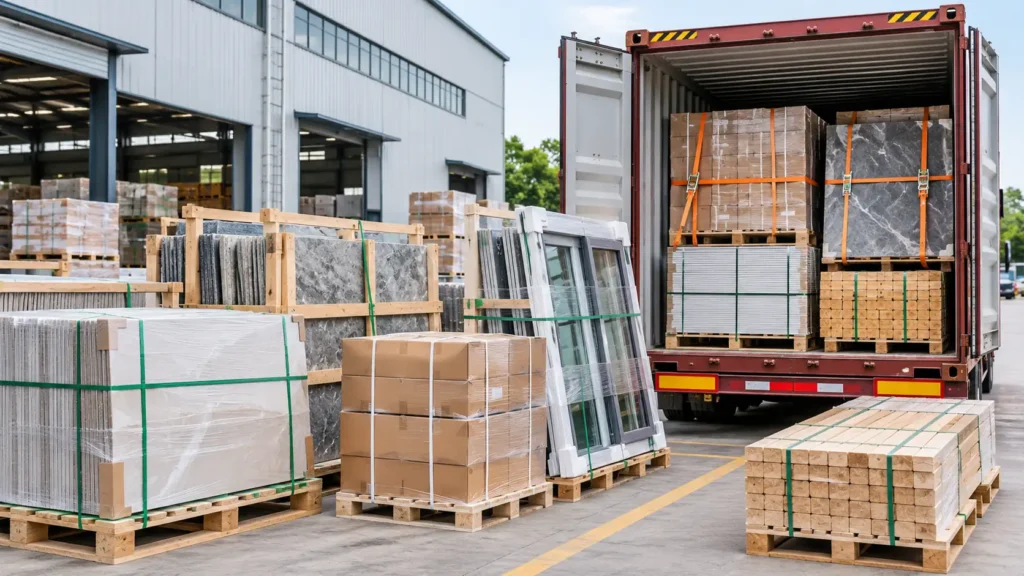
Good packing and loading protect cargo from impact, vibration, moisture, and movement. The method should reflect the material and its weight rather than relying on one standard export solution.
Different products require different protection:
Tiles and stone: Use strong cartons, pallets, corner protection, and separators to reduce cracks and surface damage.
Doors and windows: Protect glass, corners, frames, and finished surfaces with foam, cardboard, or suitable wooden supports.
Timber and flooring: Use moisture-resistant wrapping and keep the products dry before loading.
Metal profiles: Bundle long or heavy pieces securely and use protective material to prevent scratches and corrosion.
Sanitary ware: Use individual cushioning and strong cartons to protect ceramic and glass components.
For large or fragile shipments, wooden crates or reinforced pallets may provide additional protection. If solid wood packaging is used for international transport, check whether ISPM 15 treatment and marking requirements apply.
Before loading, confirm the total gross weight, package dimensions, pallet quantity, and container payload. Heavy building materials should be distributed properly across the container floor rather than concentrated in one area.
Use blocking, bracing, or lashing where necessary to prevent cargo from shifting during transportation. Avoid excessive stacking that could crush cartons or damage fragile products.
For dense materials such as tiles, stone, and metal products, check the container’s weight limit as well as available CBM. For bulky materials such as insulation and window frames, focus on efficient use of container space.
A clear loading plan helps reduce cargo damage and makes unloading at the UK warehouse or construction site safer and more efficient.
Customs clearance is an important step when importing building materials from China to the UK. Preparing the correct importer information, commodity codes, customs value, and shipping documents before arrival can help avoid delays and unexpected charges.
For imports into Great Britain, businesses generally need a GB EORI number. Customs declarations are submitted through the UK’s Customs Declaration Service (CDS), either by the importer or an appointed customs agent or freight forwarder.
Before shipping, confirm who will act as the importer, who will submit the declaration, and who will be responsible for import duty and VAT. These details should also match the agreed shipping terms.
Each building material needs the appropriate commodity code, which determines the applicable customs duty and helps identify additional import requirements. Floor tiles, stone, timber, doors, windows, and aluminium products may all have different classifications.
Importers should also confirm the customs value and applicable VAT before shipment. Duty and VAT should be included when calculating the total landed cost rather than comparing freight charges alone.
The official UK Trade Tariff can be used to check commodity codes and current import requirements.
Common documents for building material shipments include:
Commercial invoice with product descriptions, quantities, values, and currency
Packing list showing packages, dimensions, and gross and net weights
Bill of lading for sea freight shipments
Certificate of origin when required for a specific customs or commercial purpose
Product or technical documents where applicable
Make sure product descriptions, quantities, weights, and values are consistent across the documents. For mixed shipments, list each type of building material separately instead of using a general description such as “building materials.”
A reliable freight forwarder can help coordinate customs clearance, shipping documents, and delivery after the cargo is released.
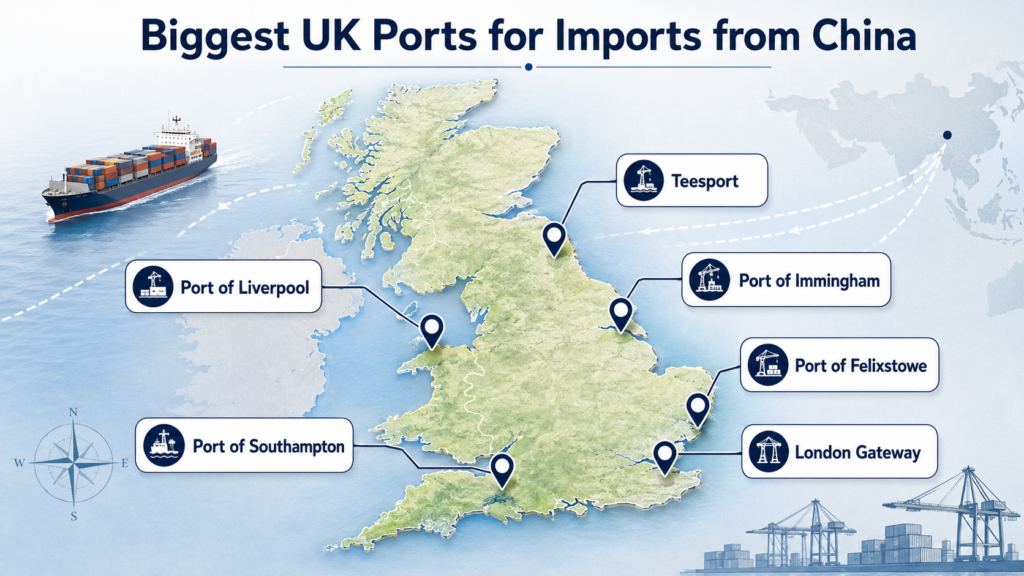
The best UK port depends on carrier services from China, routing, final delivery postcode, port charges, and inland transport. The closest port is not always the cheapest once trucking and handling are included.
Felixstowe: A major container port that may work for cargo destined for eastern England and the Midlands, depending on the service and onward transport.
Southampton: An option for some shipments serving southern England. Compare vessel schedules and delivery costs to the final address.
London Gateway: Can be practical for certain deliveries to London and southeast England, subject to carrier routing and terminal arrangements.
Liverpool: May be worth comparing for cargo destined for northwest England when the shipping service and inland route are appropriate.
Before selecting a UK port, confirm the delivery postcode, container availability, vehicle access, unloading space, appointment requirements, and site restrictions.
For direct construction-site delivery, check whether a container truck can reach the location and whether the required equipment is available.
Even experienced buyers can face avoidable problems when a shipment is not planned carefully.
Choosing a supplier on price alone: Lower prices may come with different specifications, inconsistent quality, or weaker export support. Compare like-for-like quotations and check the supplier before paying.
Skipping samples and quality control: Product photos cannot confirm dimensions, finish, or performance. Order samples where practical and arrange inspection for significant orders.
Using an incorrect commodity code: A wrong classification can affect duty and import requirements. Confirm the code for each product type before export.
Underestimating cargo weight: Tiles, stone, and metal materials can exceed practical container or road limits. Check pallet weights and loading plans, not just CBM.
Ignoring destination costs: Port charges, customs clearance, and inland delivery change the total cost. Ask for a clear breakdown instead of comparing only base freight.
Forgetting site access: A construction site may have limited space, delivery windows, or no forklift. Confirm access and unloading arrangements before the cargo leaves China.
Good planning and clear communication help reduce disputes between buyers, suppliers, transport providers, and the receiving team.
Yes. UK businesses can import tiles, stone, flooring, doors, windows, sanitary ware, timber, insulation, and metal products. Requirements depend on the product, intended use, commodity code, and destination.
Costs depend on cargo volume, weight, origin, destination, method, and delivery requirements. Indicative port-to-port rates may be $75–$150 per CBM or 1,000 kg for LCL, $1,500–$2,700 for a 20ft FCL, and $2,800–$4,600 for a 40ft FCL.
Chinese manufacturers may offer competitive prices and a broad product range. However, compare product quality, inspection, compliance, freight, import duty, VAT, and delivery. A lower supplier price does not always mean a lower landed cost.
Yes. Commercial shipments continue to move from China to the UK by sea and air. Routes, schedules, capacity, and freight rates can change, so confirm current services before booking.
Some port-to-port services take around 30–42 days, depending on the shipping method, origin and destination ports, carrier schedule, and transshipment. Allow extra time for collection, export customs, UK customs clearance, and inland delivery.
Useful freight, customs and importing resources related to this shipping guide.
Building Materials Shipping from China Verified & Reviewed · Last updated May 2026 Building materials shipping from China helps importers, contra...
Read guide →
China has established itself as a global hub for construction materials, offering a diverse range of high-quality products at competitive prices...
Read guide →
Explore sea freight from China to UK, including sea freight costs, transit times, ocean freight options, customs clearance, full container load...
Read guide →
FCL vs LCL Shipping to the UK: Costs & Transit Times Verified & Reviewed · Last updated February 2026 FCL vs LCL shipping to the UK affects total...
Read guide →Customs Clearance in the UK Verified & Reviewed · Last updated February 2026 Customs clearance in the UK is the process of declaring goods to HMR...
Learn more → Useful Resource Shipping Cost from China to UK (2026 Guide)Shipping Cost from China to UK (2026 Guide) Verified & Reviewed · Last updated June 2026 Shipping cost from China to UK in 2026 typically ranges...
Learn more →WhatsApp us