
Related Guide
How Long Does Shipping from China Take? (2026 Guide)
Compare shipping time from China by air, sea, and express shipping. Check transit times and delivery speed for different countries.
Read guide →An added benefit for eligible new customers shipping with Tonlexing.
Check Eligibility & Get a Quote →Subject to cargo eligibility, insurer approval and policy terms.
Coverage and insured value depend on the cargo, route and written insurer confirmation before shipment. Policy exclusions, deductibles and claims terms apply. The US$500,000 figure is a maximum coverage limit, not a guaranteed claim payment. Insurance premiums are not represented as free unless expressly confirmed in your quote.


The cargo ready date (CRD) is when goods are packed and available for pickup. Shipping cut-off dates are carrier or terminal deadlines for cargo delivery and required documentation before departure.
Aligning the CRD with CY, CFS, SI, and VGM cut-offs allows sufficient time for pickup, customs clearance, and port delivery, helping avoid missed sailings and extra costs.
Cargo Ready Date
Shipping Cut-Offs
FCL & LCL Shipping
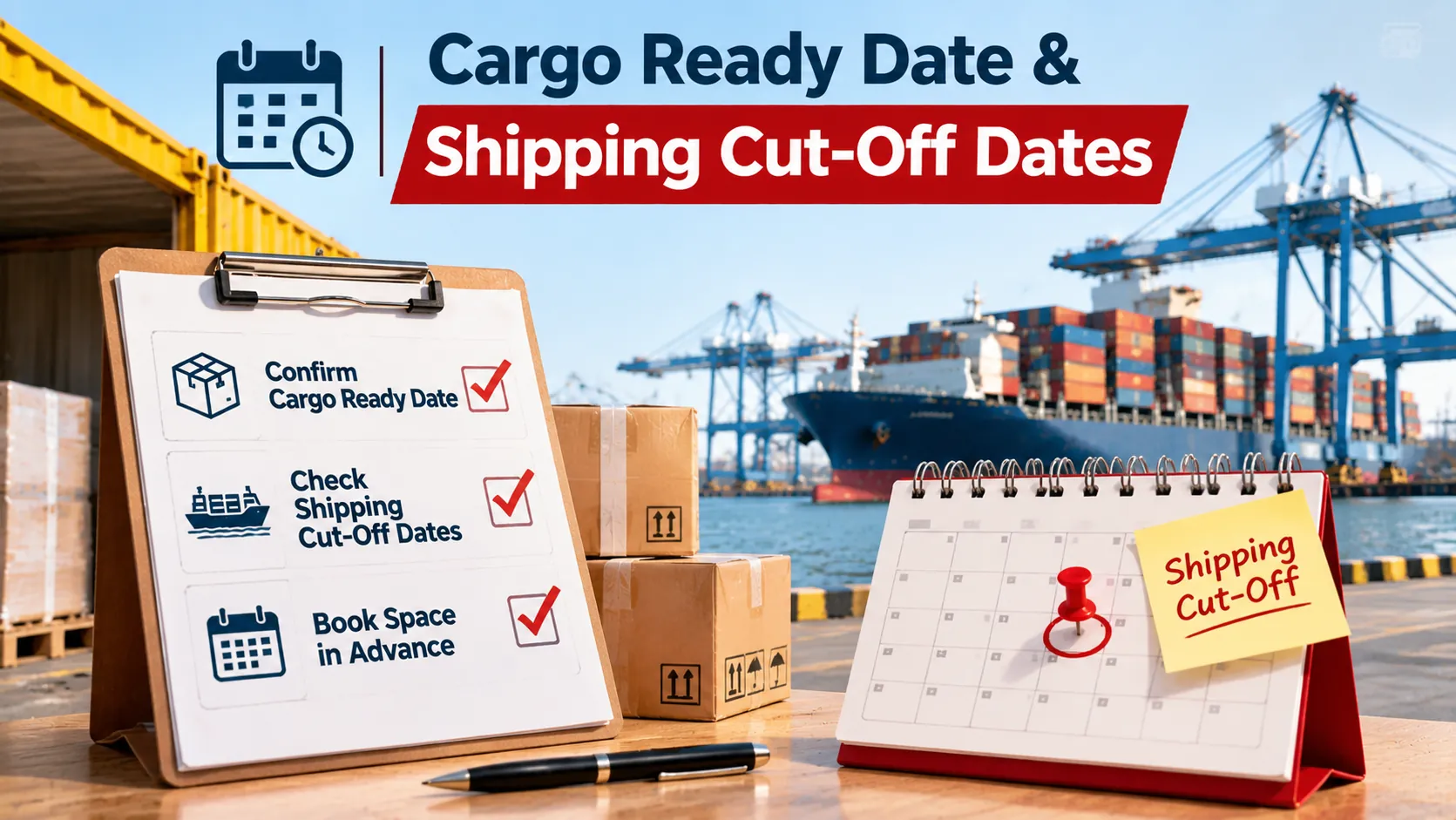
A cargo ready date (CRD) refers to the earliest date when goods are fully prepared and available for collection or handover at the agreed pickup point. It is normally confirmed by the manufacturer or exporter and used to organize the next stages of transportation.
Manufacturing completion alone does not mean that cargo is ready. Products must also meet the agreed packaging, inspection, labeling, and handover requirements.
Before confirming a CRD, the factory should check that:
Production quantities match the purchase order.
Quality inspection has been completed and the goods released.
Export packaging and shipping marks are in place.
Carton dimensions, gross weight, and packing details are available.
Products are accessible for collection or warehouse receiving.
Any outstanding preparation work has been finished.
For example, a factory may finish production on June 5 but need another two days for inspection and packaging. If the goods cannot be collected until June 7, June 7 should be recorded as the cargo ready date.
For orders involving customized products or multiple manufacturers, importers should allow time for quality checks before confirming collection. A pre-shipment inspection in China can help identify defects, quantity discrepancies, and packaging issues before the goods leave the factory.
The supplier or exporter normally sets the CRD because they control production, packaging, and product release.
However, the importer and freight forwarder should verify that the proposed date fits the confirmed booking and transportation arrangements.
The CRD is commonly used to organize:
Factory pickup and inland trucking.
Empty equipment release and container stuffing for FCL orders.
CFS receiving for LCL cargo.
Export documentation and customs procedures.
Delivery before the applicable operational cut-offs.
If the manufacturer changes the agreed date, the importer should notify the logistics provider immediately. Even a one-day change can affect truck availability, warehouse appointments, and the planned sailing.
A shipping cut-off is the latest date or time by which a specific cargo-handling or documentation requirement must be fulfilled.
There is no single cut-off for every operation. Different parties establish separate acceptance windows according to the vessel schedule, port procedures, cargo type, and booking conditions.
The main types include CY, CFS, documentation, VGM, and customs-related cut-offs.
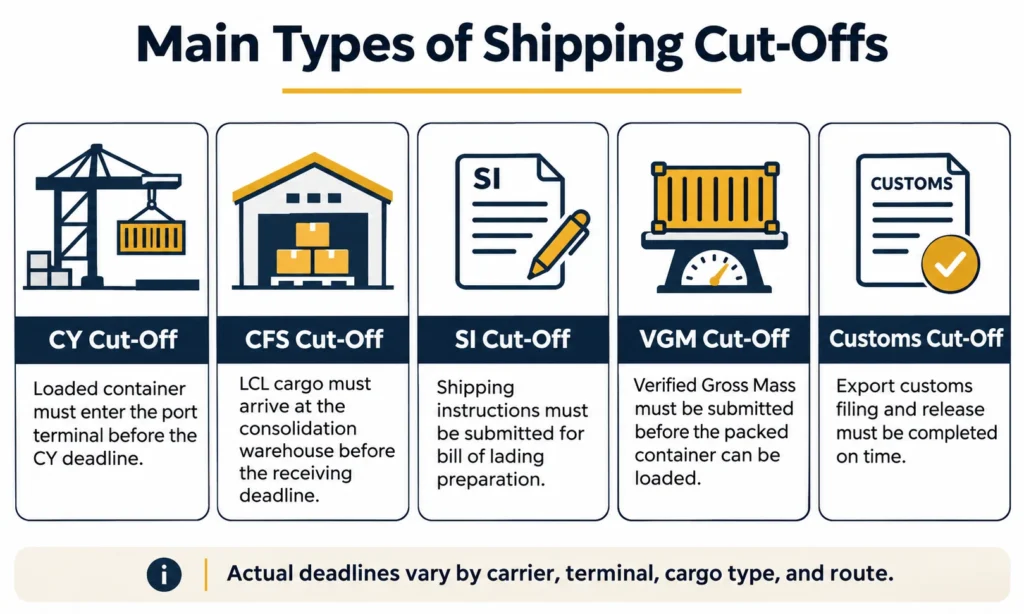
The CY cut-off is the last time a packed export container can enter the designated container yard at the port for a particular sailing.
For FCL shipments, the exporter must arrange equipment collection, cargo stuffing, sealing, and inland transportation before this deadline.
The process generally involves:
Collecting an empty container from the assigned depot.
Moving it to the factory or loading location.
Stuffing the cargo and applying the container seal.
Arranging trucking to the designated container yard.
Completing the terminal gate-in procedure.
The CY cut-off is particularly important because a container arriving after the receiving window may not be accepted for the booked sailing.
The actual time is determined by the carrier and terminal operators. Although some services have a CY cut-off around one or two days before departure, this is not a universal rule.
Importers should check the latest gate-in notice and container yard (CY) arrangements rather than rely on a general estimate.
The CFS cut-off applies to Less than Container Load (LCL) cargo. It is the latest time individual goods can be delivered to the designated Container Freight Station (CFS) for consolidation.
Unlike FCL cargo, LCL goods are received separately before being combined with other orders in a shared container.
The receiving process includes:
Delivering individual packages to the designated CFS facility.
Checking package quantities, marks, and cargo condition.
Recording the receiving details in the facility’s system.
Sorting goods according to their export bookings.
Consolidating the cargo for onward transportation.
The CFS cut-off usually comes before the corresponding container yard gate-in time because the facility needs sufficient time to complete consolidation.
When goods come from several factories, China warehousing and consolidation services can help organize receiving, checking, and combined export arrangements.
The documentation cut-off is the latest time for submitting required export and transport information.
One important document-related milestone is the Shipping Instructions (SI) cut-off. SI provides the details required by the carrier to prepare the bill of lading.
Typical information includes:
Shipper and consignee details.
Notify party information, where applicable.
Cargo descriptions and package quantities.
Gross weight and measurement.
Shipping marks and container details, where required.
The information must match the actual cargo and commercial documents. Incorrect consignee details, incomplete descriptions, or weight discrepancies can lead to amendments and additional charges.
Importers should prepare the commercial invoice and packing list before the SI submission window. For a clearer understanding of their respective roles, see commercial invoice, packing list and bill of lading.
VGM stands for Verified Gross Mass. It is the verified total gross mass of a packed container, including cargo, packaging, pallets, securing materials, and container tare weight.
Under the SOLAS container weight verification requirements, the shipper must provide the verified weight to the carrier and terminal before the unit can be loaded onto the vessel.
The VGM cut-off is the final submission time specified for the booking.
The shipper should:
Obtain the verified gross mass using an accepted weighing method.
Check the container number and weight information.
Submit the information through the required carrier or terminal system.
Confirm that the submission has been received before the applicable cut-off.
A packed container without a valid VGM submission cannot be loaded onto the vessel under SOLAS requirements.
The VGM cut-off and CY cut-off may be different. Meeting one does not automatically mean the other requirement has been satisfied.
For more detailed information, read our guide to container VGM in international shipping.
Export customs clearance is another important milestone in the process. The exporter must provide the required declaration information and obtain customs release according to the applicable regulations.
Depending on the port and export arrangement, customs procedures may need to be completed before gate-in or vessel loading.
Commonly required information includes:
Commercial invoice.
Packing list.
Export declaration details.
Product descriptions and HS codes.
Relevant permits or certificates, where applicable.
Customs inspections, missing documents, or inconsistent cargo descriptions can interrupt the process. Exporters should therefore prepare the necessary information before the planned collection date.
Some goods require additional acceptance procedures and earlier arrangements.
Dangerous goods: Require appropriate classification, declarations, and carrier approval.
Reefer cargo: Needs temperature settings, equipment arrangements, and special handling instructions.
Oversized cargo: May require special equipment, handling arrangements, and advance terminal approval.
The applicable cut-off depends on the cargo category and the carrier’s acceptance requirements.
The main difference is who controls each date and what it represents. The CRD confirms when goods are available, while a cut-off defines the last acceptable time for a particular transport or documentation operation.
| Comparison | Cargo Ready Date (CRD) | Shipping Cut-Off |
|---|---|---|
| Meaning | Goods are prepared and available for pickup | Latest time for a required operation |
| Controlled by | Supplier or exporter | Carrier, terminal, warehouse, or authority |
| Purpose | Confirm cargo availability | Ensure timely cargo and document processing |
| Applies to | Product preparation and handover | Cargo acceptance and documentation |
| Timing | Before transportation begins | Before the relevant operational milestone |
| If missed | Pickup arrangements may change | Booking may roll over to another sailing |
CRD should also be distinguished from ETD (Estimated Time of Departure). ETD refers to the expected departure time of the vessel, not the date when goods become ready or the final time for port acceptance.
A shipment can have a confirmed CRD but still miss its scheduled departure if collection, export procedures, or terminal receiving are not completed in time.
The CRD and individual cut-offs form a connected process. Each milestone must be arranged in the correct order so that cargo can move from the factory to the port without missing the booked sailing.
A typical FCL process follows this sequence:
| Stage | Main Activity |
|---|---|
| 1. Booking confirmation | Confirm vessel schedule and applicable cut-off times |
| 2. Cargo ready date | Factory finishes packing and releases the goods |
| 3. Cargo pickup | Arrange trucking and container stuffing |
| 4. Documentation | Submit SI and prepare export information |
| 5. Customs and VGM | Complete export formalities and submit verified weight |
| 6. CY gate-in | Deliver the packed unit to the designated yard |
| 7. Vessel departure | Cargo is accepted for loading and the ship departs |
The exact sequence of documentation, VGM submission, customs release, and gate-in can vary by carrier and port.
For example, some carriers require VGM before gate-in, while others specify a different submission arrangement. Always follow the instructions issued for the individual booking.
For LCL cargo, the process differs because goods must first arrive at the CFS facility. Receiving, checking, and consolidation take place before the combined unit is sent for port acceptance.
For most shipments, allow 3–7 business days between the cargo ready date (CRD) and the applicable cut-off. The recommended buffer depends on the transport method, distance to the port, cargo handling requirements, and export customs procedures.
| Shipping Mode | Recommended Buffer (CRD to Cut-Off) | What This Buffer Covers |
|---|---|---|
| Ocean FCL (Full Container) | 3–5 business days | Empty container pickup, factory loading, drayage to port, export customs clearance, and VGM filing |
| Ocean LCL (Less than Container Load) | 5–7 business days | Trucking to the CFS warehouse, cargo measurement and labeling, and customs clearance before CFS cut-off |
| Air Freight | 1–3 business days | Pickup, delivery to the airport cargo terminal, security screening, and air waybill processing |
These are recommended planning buffers rather than fixed carrier requirements. Always check the confirmed booking schedule and the latest cut-off notices before arranging cargo collection.
Some shipments need additional preparation time beyond the standard allowance.
Long Inland Transit: Add 2–5 extra days if the factory is far from the port or requires rail or barge transportation instead of local drayage.
Complex Customs or Inspections: Add 2–3 extra days for dangerous goods, agricultural inspections, or first-time export registrations.
Peak Seasons and Holidays: Add 3–7 extra days ahead of major holidays, such as Lunar New Year, or during Q4 peak shipping periods when trucking capacity tightens and port congestion increases.
Supplier Reliability: Add 2–4 extra days if the supplier has a history of missing production deadlines or requires third-party quality inspections before pickup.
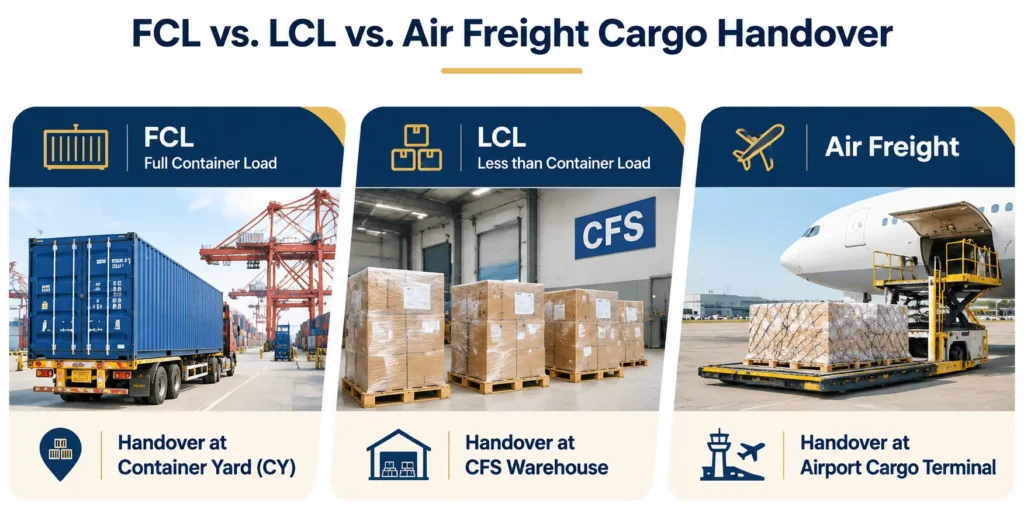
Yes. Each transport method has different cargo handover procedures and acceptance deadlines. The main differences are the delivery location, handling requirements, and documents that must be submitted before departure.
| Shipping Mode | Main Cut-Off | What Must Be Completed |
|---|---|---|
| FCL Ocean Freight | CY Cut-Off | Container stuffing, port gate-in, customs procedures, and VGM submission |
| LCL Ocean Freight | CFS Cut-Off | Cargo delivery to the consolidation warehouse, receiving checks, measurement, and documentation |
| Air Freight | Cargo Acceptance Cut-Off | Airport cargo delivery, security screening, weight verification, and air waybill processing |
For FCL, the loaded container must reach the designated terminal within the carrier’s receiving window. LCL cargo must arrive at the CFS warehouse earlier to allow time for checking and consolidation. Air freight follows airline-specific acceptance schedules, which may include separate cargo and documentation deadlines.
Unlike ocean freight, air freight does not use CY or VGM cut-offs. Importers should confirm the applicable deadlines with the carrier or freight forwarder before arranging pickup.
Missing a shipping cut-off can affect the booked vessel schedule, cargo handling arrangements, and final delivery time. The consequences depend on which deadline is missed and whether the carrier or terminal can approve an alternative arrangement.
Common consequences include:
Shipment Rollover: If a loaded container arrives after the CY cut-off, it may be moved to the next available sailing, subject to carrier approval and space availability.
Additional Charges: Delayed cargo may incur extra warehouse storage, terminal handling, trucking, or container-related costs, depending on the applicable service terms.
Documentation Delays: Late shipping instructions or VGM submissions can delay bill of lading preparation or prevent the container from being accepted for loading.
Longer Delivery Time: A change in the vessel schedule can delay arrival at the destination port and affect warehouse receiving, inventory planning, and onward transportation.
Late gate arrangements or alternative submission windows may sometimes be available, but they require confirmation from the carrier and relevant terminal. Contact your freight forwarder as soon as a deadline is at risk to review the available options.
Good shipment management starts with clear communication between suppliers, importers, carriers, and freight forwarders. The following practices help prevent delays and keep cargo aligned with the planned vessel schedule.
Confirm Cargo Readiness with Suppliers: Check production status, packaging, inspection results, and actual cargo availability. If the supplier cannot meet the agreed CRD, notify the freight forwarder immediately and review alternative arrangements.
Check the Latest Carrier Cut-Off Schedule: Confirm CY, CFS, SI, and VGM deadlines for the booking. Monitor carrier notifications and vessel schedule updates to identify any changes.
Set Internal Deadlines and Arrange Pickup Early: Build sufficient time for factory collection, empty container release, inland transportation, warehouse receiving, and export customs clearance. Confirm truck availability and loading arrangements in advance.
Prepare Shipping Documents in Advance: Check commercial invoices, packing lists, cargo descriptions, weights, quantities, and consignee details before submitting shipping instructions. Correcting discrepancies early helps avoid documentation delays.
Coordinate with Your Freight Forwarder: Keep all parties informed about changes to cargo availability, pickup arrangements, and vessel schedules. Early communication makes it easier to adjust the booking or arrange the next available sailing if necessary.
A professional freight forwarder can help coordinate cargo collection, documentation, customs procedures, consolidation, and international transportation.
Tonlexing helps importers arrange sea freight, air freight, export customs procedures, warehousing, and door-to-door delivery from China, with support for coordinating cargo readiness and carrier requirements.
Cargo Ready Date (CRD) is the day when goods are fully prepared and available for collection or handover at the agreed location. It normally includes completed production, packaging, labeling, and required inspection.
CRD indicates when goods are available for pickup. ETD (Estimated Time of Departure) indicates the expected time when the vessel leaves the departure port. The goods must be prepared and accepted through the required procedures before departure.
A cut-off date is the final acceptance time for a specific cargo or documentation requirement. Common examples include CY, CFS, SI, and VGM cut-offs.
There is no universal number of days. The required preparation time depends on the factory location, inland transport, cargo type, customs procedures, and carrier requirements. Importers should work backward from the confirmed cut-off schedule.
A container that misses the CY cut-off may not be accepted for the booked vessel. It may need to be rescheduled for another departure, potentially resulting in additional handling, storage, and transportation charges.
Useful freight, customs and importing resources related to this shipping guide.
Compare shipping time from China by air, sea, and express shipping. Check transit times and delivery speed for different countries.
Read guide →
How to Negotiate with Chinese Suppliers Verified & Reviewed · Last updated September 2026 Negotiating with Chinese suppliers involves more than a...
Read guide →
Shipping from Multiple Suppliers in China Verified & Reviewed · Last updated May 2026 Shipping from multiple suppliers in China can be difficult...
Read guide →
Warehouse Consolidation in China — Faster, Smarter Global Shipping A consolidation warehouse combines cargo from multiple suppliers into one ship...
Read guide →Pre-Shipment Inspection in China for Importers Verified & Reviewed · Last updated July 2026 A pre-shipment inspection helps importers identify de...
Learn more → Useful Resource Factory Audit in China: Complete Guide for ImportersFactory Audit in China: Complete Guide for Importers Verified & Reviewed · Last updated October 2026 A factory audit in China helps importers ver...
Learn more →WhatsApp us