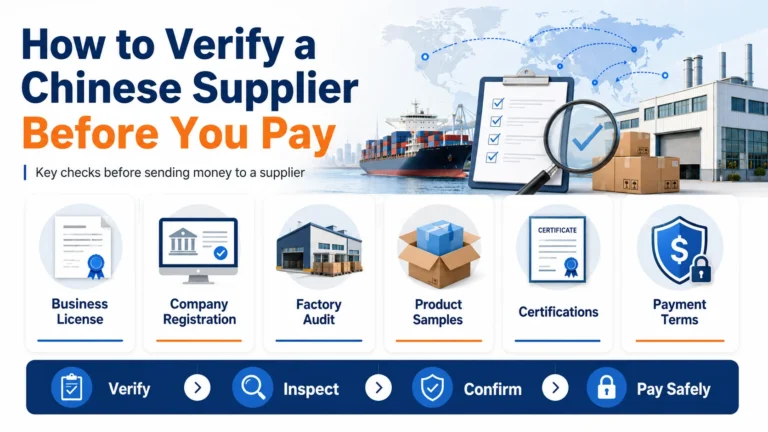
Related Guide
How to Verify a Chinese Supplier Before You Pay
How to Verify a Chinese Supplier Before You Pay Verified & Reviewed · Last updated July 2026 Before you pay a Chinese supplier, do not rely only...
Read guide →

Negotiating with Chinese suppliers involves more than asking for a lower price. The goal is to secure competitive terms while protecting product quality, payment terms, lead times, and the long-term supplier relationship.
Learn how to prepare for negotiations, compare supplier quotations, negotiate pricing and MOQ, improve payment terms, and reduce sourcing risks when buying from China.
Price Negotiation
MOQ & Payment Terms
Supplier Negotiation Tips
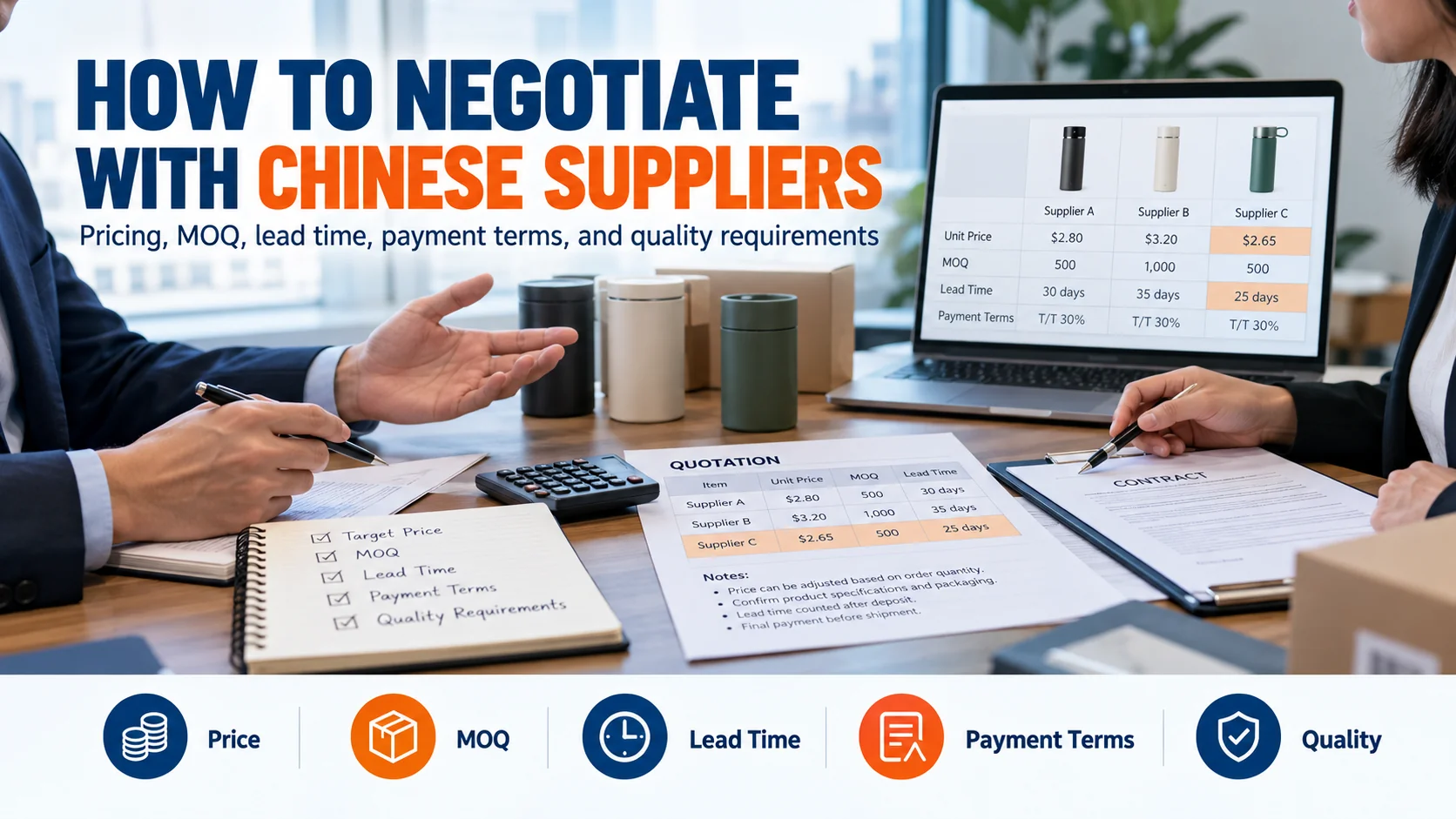
Good business negotiations start before the first price discussion. If you do not know exactly what you are buying, what comparable suppliers are charging, or which terms matter most to your business, it becomes difficult to judge whether an offer is competitive.
Before negotiating, obtain quotations from several qualified suppliers using the same RFQ or product specification. This gives you a clearer market benchmark and makes unusual pricing easier to identify.
Make sure each quotation is based on the same:
Product model and technical specifications
Materials and grades
Dimensions, colors, finishes, and accessories
Order quantity and MOQ
Packaging requirements
Quality requirements
Incoterm such as EXW or FOB
Production lead time
A quotation is only useful when the scope is comparable. One factory may appear cheaper because it uses a different material, excludes export packaging, or quotes EXW while another supplier quotes FOB.
Before contacting the supplier, decide what you want to improve and what you are not willing to compromise.
Your negotiation plan should include:
Target price
Acceptable price range
Preferred MOQ
Payment terms
Required production lead time
Product quality standards
Packaging requirements
Inspection requirements
You should also understand your walk-away point. If a supplier cannot meet a critical specification, certification requirement, quality standard, or delivery deadline, a lower price may not make the deal worthwhile.
Price negotiation cannot replace supplier due diligence.
Before committing to a large order, confirm the supplier’s business information, manufacturing or sourcing capability, experience with similar products, relevant certifications, and ability to meet your production requirements.
A competitive price means little if the supplier cannot reliably deliver the product you ordered.

Negotiating with Chinese suppliers does not require mastering every aspect of Chinese business culture. However, understanding how relationships, trust, and communication can affect commercial discussions may make negotiations smoother.
The concept of guanxi is often discussed in relation to Chinese business. For an overseas buyer, it can be understood practically as trust and relationships built through repeated interactions.
Suppliers may become more flexible when a customer demonstrates:
Consistent order potential
Reliable payment
Clear purchasing forecasts
Professional communication
Stable product requirements
Realistic delivery expectations
Long-term business can therefore become useful negotiating leverage.
However, avoid telling every supplier that you will order 100,000 units next month when you only intend to place a small trial order. Credible projections are more valuable than exaggerated promises.
Price, quality, and delivery problems sometimes require difficult conversations. You can be direct without attacking the supplier personally.
Instead of saying: “Your price is ridiculous.”
A more productive approach is: “We have compared several quotations based on the same specification, and your current price is above our target. Can you help us understand which costs are creating the difference?”
This keeps the negotiation focused on facts and gives the supplier an opportunity to explain or adjust the quotation.
Unclear communication can create serious problems around production and shipping.
If a supplier replies with phrases such as “we will try,” “should be okay,” or “maybe no problem,” ask for a specific confirmation.
For example: “Can you confirm whether the complete order can be ready for shipment by May 20?”
The more important the issue is, the less room there should be for different interpretations.
Negotiating a lower price with Chinese suppliers works best when the request is supported by clear commercial reasons. Instead of repeatedly asking for the “best price,” understand what affects the quotation and identify which variables can realistically be adjusted.
A good price negotiation should reduce unnecessary costs without changing the agreed materials, specifications, product quality, or delivery requirements.
Before challenging the price, make sure you understand exactly what the supplier has quoted.
Ask the supplier to clarify major cost-related items where relevant, such as:
Materials and key components
Product specifications and customization
Packaging
Tooling or setup charges
Testing or certification requirements
Incoterms and included origin charges
You do not necessarily need the supplier’s complete internal cost structure or profit margin. The objective is to identify which parts of the quotation are driving the price.
Customized packaging, premium materials, special finishes, or low-volume production may all increase the unit cost. Once the main cost drivers are clear, you can decide whether any non-essential requirement can be adjusted.
Before challenging the price, make sure you understand exactly what the supplier has quoted.
Ask the supplier to clarify major cost-related items where relevant, such as:
Materials and key components
Product specifications and customization
Packaging
Tooling or setup charges
Testing or certification requirements
Incoterms and included origin charges
You do not necessarily need the supplier’s complete internal cost structure or profit margin. The objective is to identify which parts of the quotation are driving the price.
Customized packaging, premium materials, special finishes, or low-volume production may all increase the unit cost. Once the main cost drivers are clear, you can decide whether any non-essential requirement can be adjusted.
If the supplier cannot reduce the price under the current conditions, look for variables that may reduce their production or handling costs.
You may be able to exchange:
| What You Want | What You May Offer |
|---|---|
| Lower unit price | Higher but realistic order quantity |
| Lower packaging cost | Standard supplier packaging |
| Better pricing | More flexible production schedule |
| Reduced customization cost | Standard colors, sizes, or components |
| Better repeat-order terms | Stable purchasing forecast |
This “give and get” approach is usually more effective than asking the supplier to reduce the price without changing anything.
The lowest unit price does not necessarily mean the best deal. Buyers can often create more value by negotiating several commercial terms together.
If the supplier’s MOQ is too high, ask about a smaller trial order, mixed models or colors, or a higher unit price for a lower initial quantity.
For a new supplier relationship, a manageable trial order may be safer than buying excessive inventory simply to reach the lowest price level.
Payment terms affect both your cash flow and purchasing risk.
Depending on the supplier relationship, you can discuss:
Deposit percentage
Timing of the balance payment
Payment after inspection
Payment before shipment
Improved terms for future repeat orders
There is no single payment structure that is suitable for every supplier or product. New supplier relationships may require different terms from established long-term partners.
For customized products, tooling can be as important as the unit price. Confirm who owns the molds or tooling, who is responsible for maintenance, and whether the tooling can be transferred if necessary.
Other negotiable items may include:
Sample fees
Sample fee refunds after a production order
Custom packaging charges
Labeling requirements
Spare parts
Production lead time
Rush-order costs
These terms can sometimes provide more commercial value than another small reduction in product price.
Supplier prices should also be compared using the same Incoterm.
For example, an EXW price may exclude factory pickup, export procedures, origin handling, and other shipping-related costs. A higher FOB quotation may already include some of these expenses.
When comparing suppliers, consider the total landed cost rather than only the factory unit price.
A product that appears cheaper at the factory can become more expensive after freight, customs duties, destination charges, and final delivery are added.
A price reduction is not a real saving if product quality falls.
One of the biggest risks during price negotiation is accepting a lower price without confirming whether the supplier has changed the materials, components, packaging, or manufacturing process.
Before approving the final price, make sure both parties are quoting the same product.
Depending on the product, specifications may include:
Material and grade
Dimensions and tolerances
Color and surface finish
Components and accessories
Performance requirements
Labels and packaging
Certification requirements
If the product specification changes after the price has been agreed, the supplier may need to provide a new quotation.
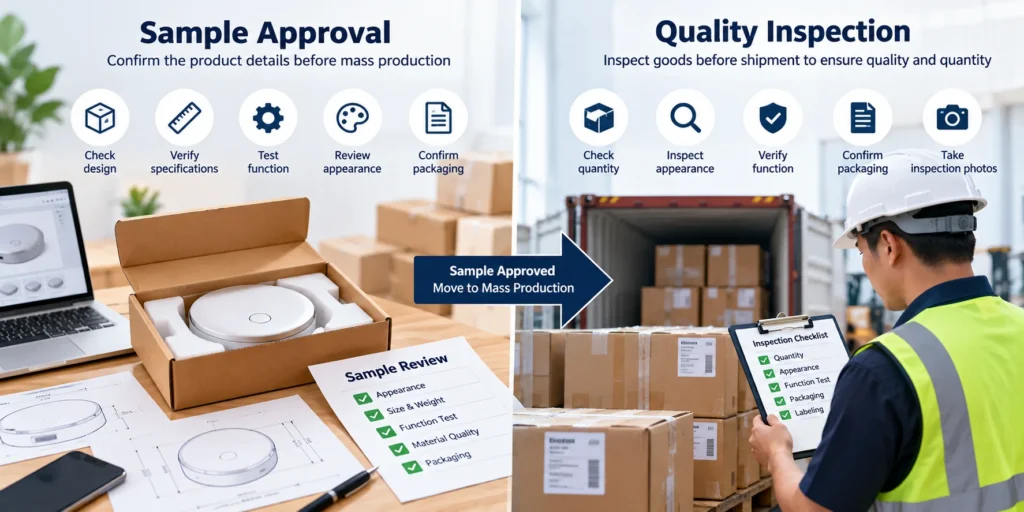
For products where appearance, dimensions, or performance cannot be fully described in writing, approve a final sample before mass production.
The purchase order or specification should clearly identify which sample or version has been approved.
This provides both parties with a clearer reference if the finished products differ from expectations.
Inspection requirements should be discussed before production rather than introduced immediately before shipment.
Depending on the product and order value, quality control may include:
Pre-production checks
During-production inspection
Loading supervision
Also clarify what happens if goods fail the agreed requirements. Rework, replacement, rejected quantities, and other corrective actions should not be left completely undefined.
Strong negotiating leverage comes from having realistic alternatives rather than threatening the supplier.
If you depend entirely on one factory and urgently need the goods, your ability to negotiate becomes weaker. Maintaining more than one qualified supplier can give you greater flexibility when discussing price, capacity, or delivery schedules.
Useful sources of leverage include:
Multiple qualified suppliers
Comparable market quotations
Flexible order timing
Realistic volume forecasts
Repeat-order potential
Ability to adjust non-critical specifications
Avoid fake competitor quotations or unrealistic sales projections. They may create short-term pressure but can damage trust if the supplier realizes the information is not genuine.
A good supplier relationship should still allow you to negotiate firmly on price, product quality, payment, and delivery.
A negotiation is not finished simply because a supplier says “OK” in a chat message.
Important commercial terms should appear in formal documents such as the quotation, purchase order, specification sheet, proforma invoice, or relevant supply agreement.
The final documents should clearly confirm:
Product specifications
Unit price
Order quantity and MOQ
Payment terms
Production lead time
Packaging requirements
Tooling ownership where applicable
Inspection requirements
Incoterm
Shipping schedule
Handling of defects or rework
WeChat and other messaging apps can be useful for daily communication, production photos, and quick questions. However, if an important price, specification, quantity, or delivery term changes, update the relevant formal documents as well.
Maintaining a clear paper trail reduces disagreements about what was finally approved.
Many unsuccessful negotiations are caused by poor preparation rather than the supplier refusing to cooperate.
Common mistakes include:
Negotiating before finalizing the product specification
Comparing quotations based on different materials or Incoterms
Focusing entirely on the lowest unit price
Promising unrealistic future order volumes
Accepting vague answers about product quality or lead time
Ignoring payment terms while negotiating price
Failing to confirm tooling or packaging requirements
Leaving important negotiated changes only in chat messages
The objective should not be to extract every possible concession from the supplier. A commercially sustainable agreement is usually more valuable than a price that the factory cannot realistically maintain.
There is no standard discount percentage. Negotiating room depends on the product, materials, order quantity, market conditions, supplier margin, and specifications. Compare several like-for-like quotations before deciding whether a price is high.
Give the supplier a commercial reason to review the quotation. You can discuss order quantity, comparable market prices, standard packaging, specification adjustments, or repeat-order potential rather than simply asking for the “best price.”
Evaluate more than the quoted number. Check the specifications, quantity, packaging, Incoterm, lead time, and payment terms, then compare the offer with other qualified suppliers.
Focus on the deposit amount, balance payment timing, inspection arrangements, and whether better terms may become available after successful repeat orders. The appropriate structure depends on the supplier relationship and transaction risk.
Finalize the product specifications first and ask the supplier exactly how the lower price will be achieved. Use approved samples and inspection requirements where necessary, and do not accept unapproved changes to materials, components, or quality standards simply to reduce the unit price.
Useful freight, customs and importing resources related to this shipping guide.
How to Verify a Chinese Supplier Before You Pay Verified & Reviewed · Last updated July 2026 Before you pay a Chinese supplier, do not rely only...
Read guide →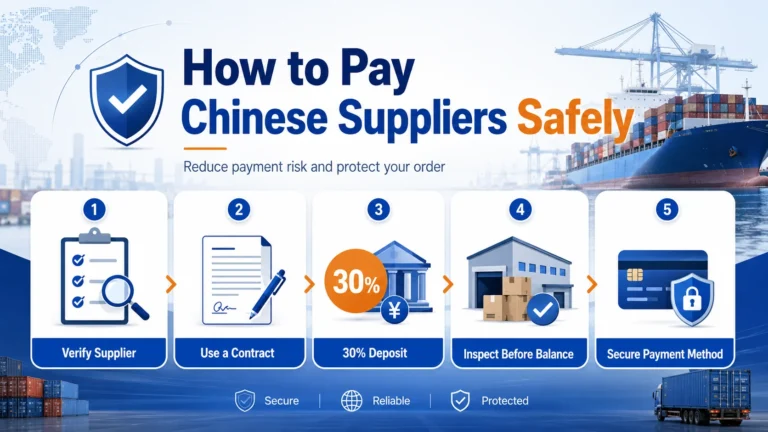
How to Pay Chinese Suppliers Safely Verified & Reviewed · Last updated July 2026 Paying Chinese suppliers safely is one of the most important ste...
Read guide →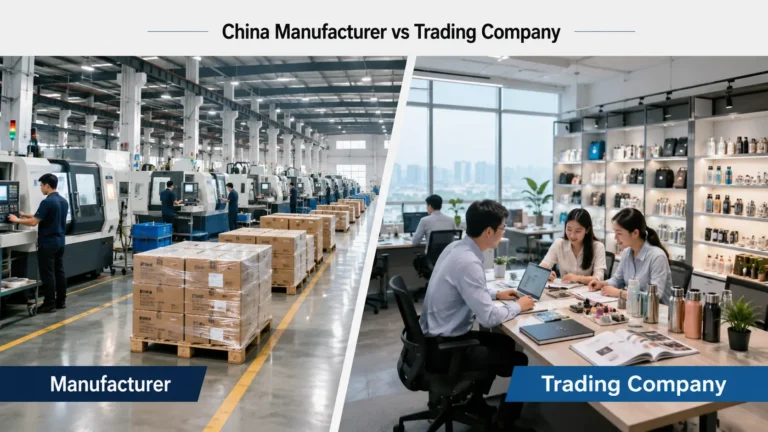
China Manufacturer vs Trading Company Verified & Reviewed · Last updated July 2026 Choosing between a China manufacturer and a trading company ca...
Read guide →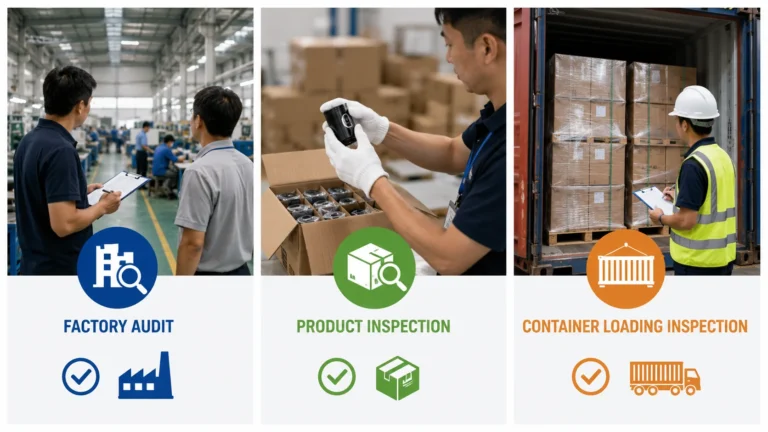
Factory Audit vs Product Inspection vs Container Loading Inspection Verified & Reviewed · Last updated July 2026 Factory audit, product inspectio...
Read guide →Alibaba vs Made-in-China vs Global Sources: Which Platform Is Best? Verified & Reviewed · Last updated July 2026 Alibaba, Made-in-China, and Glob...
Learn more → Useful Resource Top 20 Trusted China Wholesale Websites for Global Buyers in 2026Top 20 Trusted China Wholesale Websites for Global Buyers in 2026 Verified & Reviewed · Last updated July 2026 Finding the right China wholesale...
Learn more →WhatsApp us