Related Guide
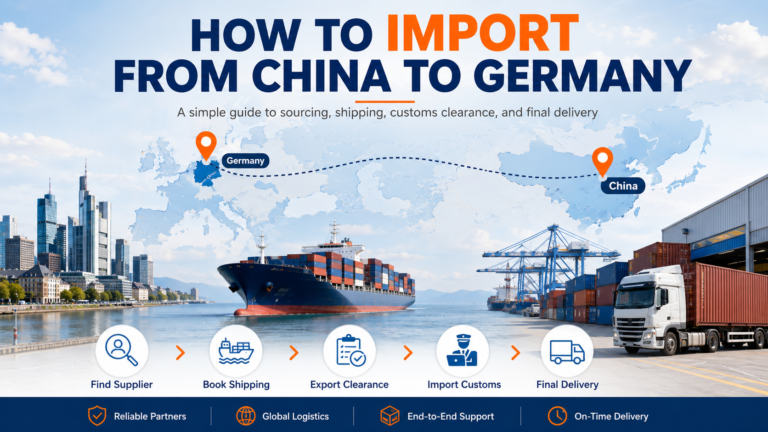
How to Import from China to Germany
How to Import from China to Germany Verified & Reviewed · Last updated June 2026 Importing from China to Germany involves more than choosing a su...
Read guide →

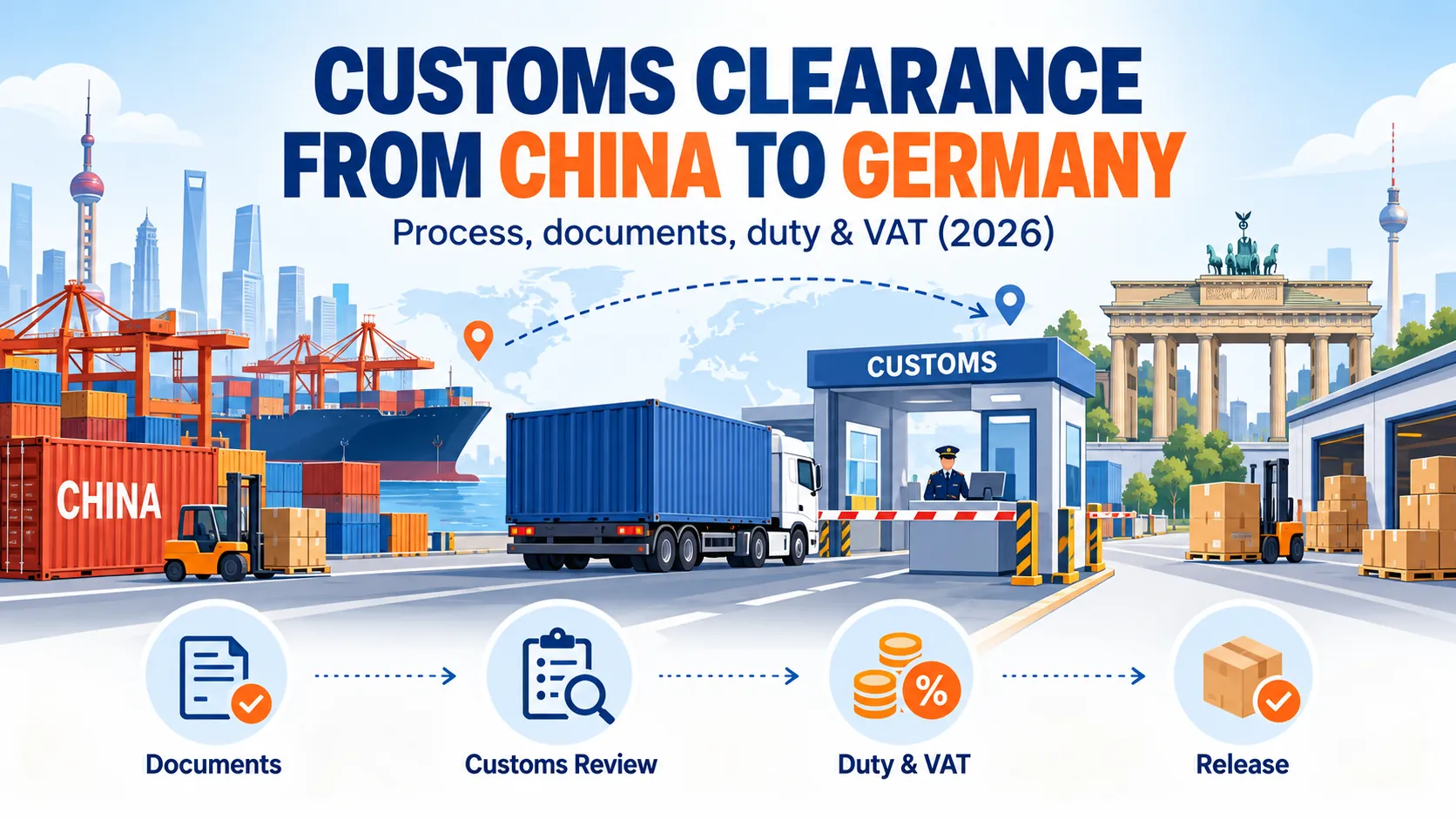
Customs clearance from China to Germany involves preparing import documents, submitting customs declarations, and paying applicable duties and VAT. Germany generally applies 19% import VAT, while customs duties depend on product classification and customs value.
This 2026 guide covers German customs procedures, EORI requirements, import duties, VAT calculations, clearance costs, and processing times, helping importers avoid delays and arrange smooth cargo delivery.
Customs Clearance Process
Import Duties & VAT
Clearance Time
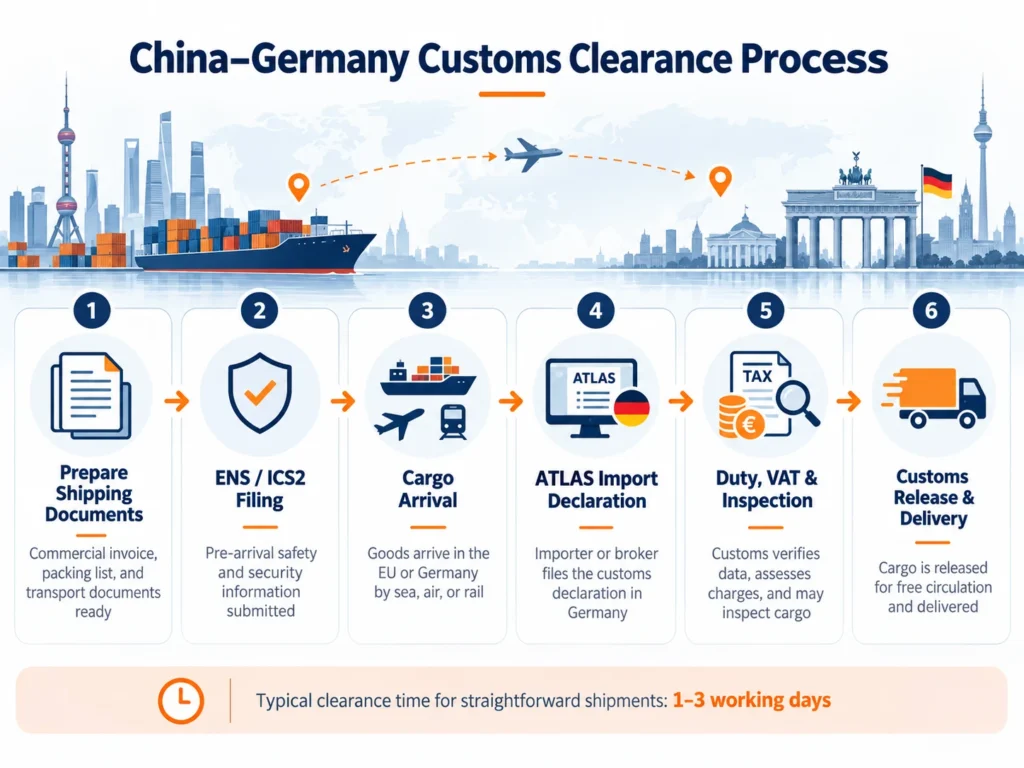
Goods imported from China are subject to the EU Union Customs Code and German customs regulations. The process is broadly similar for sea freight, air freight, and rail freight, although arrival procedures and cargo handling arrangements differ.
The standard import clearance process involves six stages:
Confirm importer details: Verify the EORI number, product classification, and any applicable import restrictions.
Prepare shipping documents: Collect the commercial invoice, packing list, transport documents, and required certificates.
Complete pre-arrival filings: The responsible party submits an Entry Summary Declaration (ENS) through the EU Import Control System 2 (ICS2), where required.
Submit the import declaration: The importer or authorised customs representative files the declaration, generally through Germany’s ATLAS system.
Complete customs assessment: Authorities verify the information, determine duties and taxes, and conduct inspections where necessary.
Obtain cargo release: Once the applicable requirements are satisfied, the goods can be released for free circulation and delivered.
ICS2 and ATLAS serve different purposes. ICS2 handles advance safety and security information, while ATLAS supports German electronic customs procedures.
Cargo entering Europe through another EU country may also move under a customs transit procedure before final import clearance in Germany. For example, shipments arriving in Rotterdam can continue under customs control to a German destination when the appropriate transit arrangements are used.
Importers must provide accurate commercial and transport documents to identify the shipment, establish its customs value, and support the import declaration.
The requirements depend on the product, shipping method, and applicable EU regulations.
| Document | Purpose |
|---|---|
| Commercial Invoice | Identifies the buyer, seller, goods, quantity, value, currency, and Incoterms |
| Packing List | Details packages, dimensions, cargo contents, and gross/net weight |
| Bill of Lading (B/L) | Provides transport details for sea freight |
| Air Waybill (AWB) | Provides shipment information for air freight |
| EORI Information | Identifies the relevant economic operator |
| Proof of Origin | Supports origin verification where required |
| Import Licences or Certificates | Supports compliance with product-specific requirements |
The commercial invoice should include precise product descriptions, quantities, unit prices, total value, and agreed delivery terms. The packing list must correspond to the actual cargo, including package quantities and weights.
For FCL (Full Container Load) and LCL (Less Than Container Load) shipments arriving through Hamburg or Bremerhaven, consistent documentation helps avoid discrepancies during verification and release.
Importers should also confirm that the declared commodity codes match the products being shipped.
Certain goods require supporting documents before they can enter the German market.
Depending on the product, these may include:
CE compliance documentation: For products covered by applicable EU conformity legislation
RoHS or REACH documentation: For relevant electrical equipment, chemicals, and other regulated products
Import permits: For restricted or controlled goods
Origin evidence: Where required for tariff or trade measures
These documents are not universally mandatory. Product-specific requirements should be confirmed before export clearance in China.
Commercial importers need appropriate registration and accurate tariff classification before submitting declarations in Germany.
An EORI (Economic Operators Registration and Identification) number identifies businesses involved in customs activities within the EU.
German businesses: Generally need an EORI number for commercial customs operations.
Businesses in other EU countries: Can generally use their existing EU-issued EORI number.
Non-EU businesses: May require registration depending on their role in the customs procedure.
An EORI number is different from a VAT identification number.
For DDP shipments, the seller must confirm that the importer and customs representation arrangements meet the applicable legal requirements.
| Classification | Digits | Purpose |
|---|---|---|
| HS Code | 6 | International commodity classification |
| CN Code | 8 | EU Combined Nomenclature |
| TARIC Code | 10 | EU tariffs and trade measures |
| German Import Code | 11 | National import declaration requirements |
A code used for Chinese export clearance may not provide all the details required for German import declarations.
Importers should verify the correct classification through the EU TARIC database or Germany’s EZT-online system, particularly for products subject to anti-dumping duties or additional restrictions.
Germany uses ATLAS (Automatisiertes Tarif- und Lokales Zollabwicklungssystem) to process electronic customs declarations.
A declaration normally includes importer information, commodity codes, customs value, country of origin, transport details, and supporting references.
An authorised representative can submit the declaration on the importer’s behalf.
Before shipping, the parties should establish who will act as the importer, handle the declaration, and settle any applicable duties and taxes.
The total cost of importing goods from China includes customs duties, import VAT (Einfuhrumsatzsteuer), and additional clearance-related charges.
Statutory taxes should be calculated separately from freight costs, brokerage services, and destination handling fees.
Germany applies the EU Common Customs Tariff. The applicable duty rate depends on the product’s TARIC classification, customs value, origin, and relevant trade measures.
The customs value generally includes the transaction value and qualifying freight and insurance expenses up to the EU entry point.
0% Duty: Many laptops, computers, and certain electronic products qualify for standard duty-free treatment.
Clothing: Many textile clothing categories carry standard duties of approximately 8%–12%, depending on classification.
Footwear: Rates vary by material and product type, with some categories exceeding 16%.
Additional Duties: Certain Chinese products may be subject to anti-dumping or countervailing measures.
Actual rates must be checked using the correct commodity code and current EU tariff measures.
2026 Low-Value Import Rule: Since July 1, 2026, the EU has applied a temporary €3 customs duty per tariff-classification item to qualifying low-value e-commerce and postal consignments with an intrinsic value not exceeding €150. The previous general low-value customs duty exemption has been abolished. This is not a flat €3 charge per parcel or physical unit, and the measure should be distinguished from standard commercial freight imports.
Germany’s import VAT follows the country’s domestic VAT rates:
19% Standard Rate: Applies to most commercial goods, including machinery, electronics, clothing, and vehicles.
7% Reduced Rate: Applies to selected products, including certain food items and books.
The VAT assessment base generally includes the customs value, applicable import duties, and qualifying additional expenses, such as transportation to the first destination.
Products with a 0% customs duty rate may still be subject to import VAT.
Eligible VAT-registered businesses may recover import VAT as input tax, subject to German tax regulations.
The following example illustrates the calculation method published by German Customs, adapted to a hypothetical shipment from China.
Assume a commercial shipment has a goods value of €10,000, freight costs of €1,200 to the EU entry point, and additional inland transportation costs of €300.
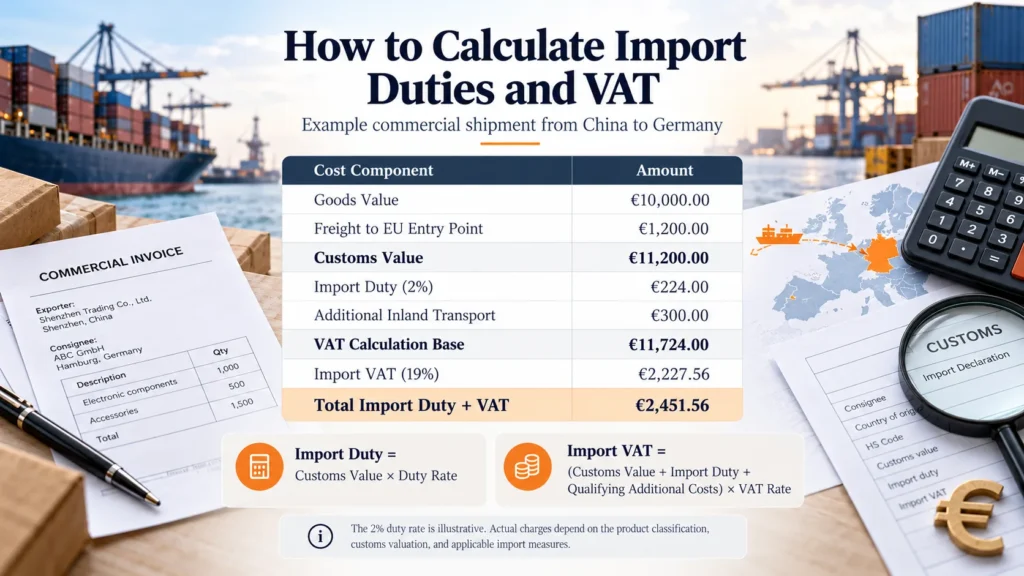
Import Duty = Customs Value × Duty Rate
Import VAT = VAT Assessment Base × VAT Rate
The following example illustrates the calculation method published by German Customs, adapted to a hypothetical shipment from China.
Assume a commercial shipment has a goods value of €10,000, freight costs of €1,200 to the EU entry point, and additional inland transportation costs of €300.
Besides statutory duties and VAT, shipments may incur service charges related to declaration processing and cargo handling.
Common expenses include:
Customs Brokerage: Preparing and submitting declarations
Terminal Handling: Processing cargo at ports and airports
Inspections: Additional examination and associated handling charges
Storage and Demurrage: Charges resulting from extended storage or container delays
Inland Delivery: Transportation to the final destination
For ocean freight through Hamburg or Bremerhaven, FCL and LCL shipments may involve different handling costs. Air cargo arriving through Frankfurt has separate airport procedures.
These charges vary by shipment and provider. Import duties, VAT, and destination services may not be included in a basic brokerage quotation.
Customs clearance in Germany typically takes 1–3 working days for straightforward commercial shipments, provided the documents are complete and no additional inspections are required. Some shipments may be released on the same day, while complex declarations or cargo examinations can take longer.
The actual clearance time depends on documentation accuracy, cargo type, customs workload, and inspection requirements.
| Clearance Situation | Estimated Time |
|---|---|
| Standard clearance with complete documents | 1–3 working days |
| No additional checks | Same-day release possible |
| Additional document verification | Several working days |
| Physical inspection or compliance review | Several days or longer |
These are operational planning estimates, not guaranteed German Customs processing times.
Customs clearance time is different from international shipping transit time. For shipments from China to Germany, indicative freight transit times include:
Sea Freight (FCL): Approximately 28–38 days for ocean freight from major Chinese ports to Germany.
Sea Freight (LCL): Approximately 32–42 days, allowing additional time for cargo consolidation and deconsolidation.
Air Freight: Approximately 5–8 days for standard air cargo arrangements to Germany.
Rail Freight: Approximately 12–18 days on selected faster China–Germany rail services, although actual transit can take 18–24 days or longer.
These ranges vary by origin, destination, shipping routes, carrier schedules, and service scope. Door-to-door delivery may require additional time for pickup, customs processing, and inland transportation.
Even when cargo arrives on schedule, several factors can delay release:
Documentation Issues: Missing invoices, incorrect HS/TARIC codes, or inconsistent declared values
Customs Inspections: Physical examinations or additional regulatory checks
Payment Delays: Outstanding import duties, VAT, or unresolved payment arrangements
Product Compliance: Missing certificates or import permits for regulated goods
To reduce delays, importers should verify the required documents before departure and coordinate customs declarations with their freight forwarder or customs broker.
The shipping method influences where cargo enters Europe, which transport documents are used, and how goods become available for import clearance.
Sea freight is widely used for machinery, furniture, construction materials, and other commercial cargo moving from China to Germany.
Major German seaports include Hamburg and Bremerhaven, where shipments may arrive as FCL or LCL cargo.
FCL (Full Container Load): Uses dedicated container capacity. Delivery depends on the completion of the relevant customs and carrier release requirements.
LCL (Less Than Container Load): Combines shipments from multiple shippers. Cargo deconsolidation and warehouse handling may add time before delivery.
Importers should consider container availability, terminal handling, and destination charges when comparing ocean freight quotations.
Air freight from China to Germany is commonly selected for urgent, time-sensitive, or high-value cargo.
Frankfurt Airport is a major German air cargo gateway. Shipments are supported by air waybill information, cargo declarations, and applicable security filings.
Although air freight offers shorter international transit times than sea transport, customs inspections or missing documentation can still delay delivery.
For smaller shipments, express carriers may provide integrated transportation and clearance services, depending on the selected service.
Rail freight connects China with European logistics hubs, including Duisburg in Germany.
Some rail shipping routes enter the EU through another member state before continuing toward their German destination.
Where appropriate, cargo may move under a customs transit procedure, allowing import formalities to be completed at an authorised destination rather than the first EU entry point.
Border transfers, rail schedules, and transit arrangements should be confirmed for each shipment.
DDP (Delivered Duty Paid) and DAP (Delivered at Place) determine how import responsibilities are allocated between the seller and buyer.
| Responsibility | DDP | DAP |
|---|---|---|
| Main Freight Transportation | Seller | Seller |
| Import Clearance | Seller | Buyer |
| Import Duties and Taxes | Seller | Buyer |
| Delivery to Named Place | Seller | Seller |
Under DDP, the seller is responsible for import clearance and applicable duties and taxes. Under DAP, those responsibilities generally fall to the buyer.
However, DDP does not automatically make a Chinese supplier eligible to act as the German importer. The parties must establish a legally compliant importer and representation arrangement.
Before accepting a door-to-door quotation, verify the included services, tax responsibilities, and delivery conditions.
Importing products into Germany also involves EU product safety, environmental, and market access requirements.
Customs release does not automatically mean that goods comply with every rule governing their sale or use in Germany.
CE marking is mandatory only for products covered by legislation requiring it.
Depending on the product, importers may need conformity assessments, EU Declarations of Conformity, technical documentation, and appropriate safety information.
Electrical equipment, machinery, toys, and other regulated products may also be subject to RoHS, REACH, or additional EU requirements.
Importers should establish the applicable standards before ordering goods from their suppliers.
Certain Chinese products may be subject to anti-dumping or countervailing duties, which should be checked through EU TARIC.
Restricted categories, including some chemicals, food products, and medical goods, may require permits or additional official controls.
The EU Carbon Border Adjustment Mechanism (CBAM) entered its definitive phase on January 1, 2026.
CBAM covers specified products in sectors including iron and steel, aluminium, cement, fertilisers, electricity, and hydrogen.
For the relevant industrial goods, importers exceeding the annual 50-tonne threshold generally face CBAM authorisation requirements. Electricity and hydrogen are subject to different threshold treatment.
Businesses importing affected products should confirm the relevant authorisation, emissions, and declaration obligations before shipment.
Documentation errors and unresolved regulatory requirements are among the main causes of shipment delays. Early verification can reduce additional handling expenses and interruptions to delivery schedules.
German customs authorities may request clarification when the declared information does not match the commercial or transport records.
Common issues include:
Incorrect HS/TARIC Codes: Can lead to incorrect duty calculations or additional checks.
Inconsistent Documents: Differences in quantities, weights, or product descriptions may delay processing.
Unsupported Customs Values: Inaccurate or understated values can result in reassessment or penalties.
How to avoid: Verify the product classification, invoice value, origin, and packing information with your supplier and customs representative before dispatch.
Authorities may hold shipments for document reviews, physical examinations, or product safety checks.
For regulated goods, missing technical documentation or required import permits can prevent release. The importer should establish the specific reason for any hold rather than assuming it is a routine delay.
How to avoid: Check product compliance requirements before shipping and maintain the supporting records needed to respond to official requests.
If cargo is held, coordinate with the customs representative to provide the requested information and resolve the outstanding issue.
Tonlexing provides freight forwarding and customs clearance coordination services for businesses shipping commercial cargo from China to Germany.
By coordinating transportation, documentation, and destination handling, importers can manage shipments through a more organised logistics process.
Depending on the cargo and agreed service scope, Tonlexing can assist with:
Shipping Documentation: Reviewing commercial invoices, packing lists, and cargo details
Customs Clearance Coordination: Arranging declaration support through appropriate representatives
Freight Transportation: Coordinating sea freight, air freight, rail freight, and multimodal services
FCL and LCL Shipping: Managing full container and consolidated cargo arrangements
DDP and Door-to-Door Solutions: Coordinating import and delivery arrangements where feasible
Destination Logistics: Supporting cargo release, inland transportation, and final delivery
The legal importer, customs representation, duties, VAT, and service responsibilities should be confirmed before shipment.
Whether you are importing machinery, electronics, consumer products, or general commercial cargo, Tonlexing can help coordinate a suitable transportation and clearance solution.
For an accurate quotation, provide your product description, available HS code, invoice value, cargo weight and dimensions, pickup location in China, and destination address in Germany.
Contact Tonlexing for a tailored freight, customs clearance, and door-to-door shipping quotation from China to Germany.
Straightforward commercial shipments may clear within approximately 1–3 working days, while inspections or documentation issues can extend processing time.
The duty depends on the product’s TARIC code, customs value, origin, and applicable trade measures. Germany also generally applies 19% import VAT, with a reduced 7% rate for eligible goods.
Businesses involved in relevant commercial customs operations generally require an EORI number. The exact requirements depend on their role and establishment.
Yes. Under an appropriate customs transit procedure, shipments can enter the EU through another member state and complete import clearance in Germany.
Under DDP terms, the seller is responsible for import clearance and applicable duties and taxes. The importer arrangement and charges included in the quotation should be confirmed before shipping.
Useful freight, customs and importing resources related to this shipping guide.
How to Import from China to Germany Verified & Reviewed · Last updated June 2026 Importing from China to Germany involves more than choosing a su...
Read guide →
Shipping from China to Germany includes efficient logistics via air and ocean freight. Compare transit times, shipping costs, and import requirem...
Read guide →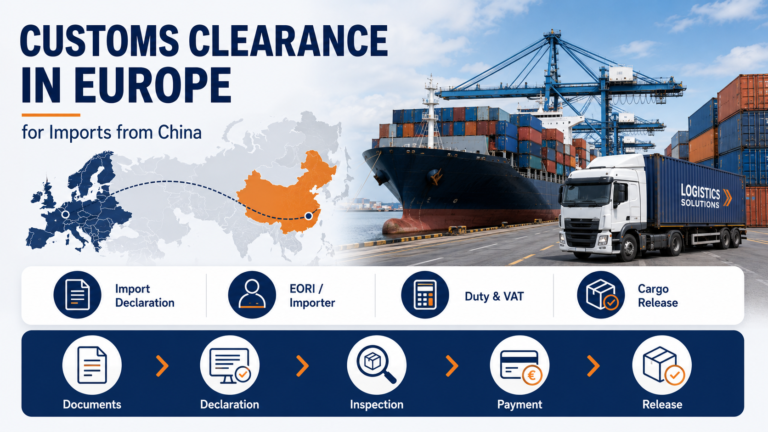
Customs Clearance in Europe for Imports from China Verified & Reviewed · Last updated July 2026 Customs clearance in Europe for imports from Chin...
Read guide →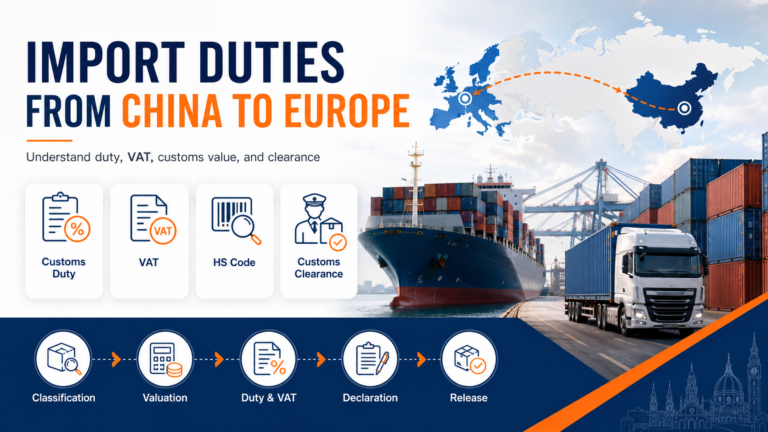
Import Duties from China to Europe Verified & Reviewed · Last updated July 2026 Import duties from China to Europe depend on the HS code, customs...
Read guide →EORI Number Explained: Do You Need It to Import from China? Verified & Reviewed · Last updated July 2026 An EORI number is usually required when...
Learn more → Useful Resource Documents Required to Import from China (2025 Guide)Importing goods from China can be highly profitable—but only when you understand the necessary documents and import requirements. Whether you’re...
Learn more →WhatsApp us