Related Guide
Electronics Import and Shipping Guide from China
Importing electronics from China has become a lucrative business opportunity for companies and individuals worldwide. China is the global leader...
Read guide →

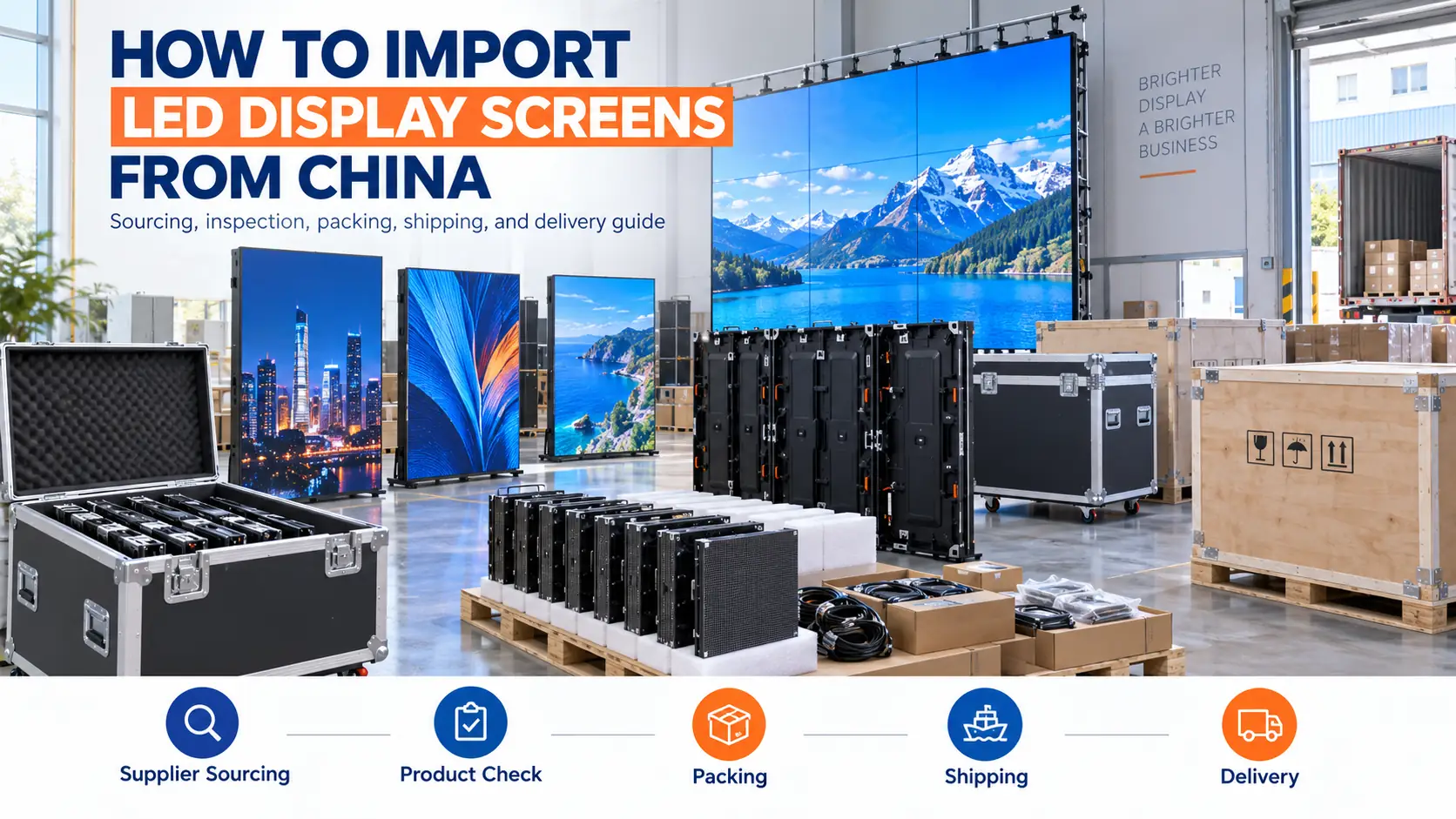
Importing LED display screens from China can be a cost-effective way to source indoor displays, outdoor advertising screens, rental LED products, fine-pitch video walls, and customized display systems.
Learn how to define specifications, compare suppliers, review quotations, inspect products, arrange packing, manage shipping, handle customs clearance, and calculate the total landed cost.
Product Specifications
Supplier Comparison
Shipping & Customs
Before contacting LED display manufacturers in China, prepare a clear technical specification for your project. A request such as “I need a P3.91 LED screen” is not enough for suppliers to prepare an accurate and comparable quotation.
The final price and performance of an LED display screen depend on several connected factors, including the installation environment, pixel pitch, cabinet structure, component quality and maintenance method. If these details are not defined in advance, different suppliers may quote completely different products even when the display size and pixel pitch appear to be the same.
A clear specification sheet helps you compare LED screen suppliers on the same basis and reduces the risk of ordering a display that does not fit the actual project.
Start with the installation environment because it affects brightness, weather protection and cabinet design.
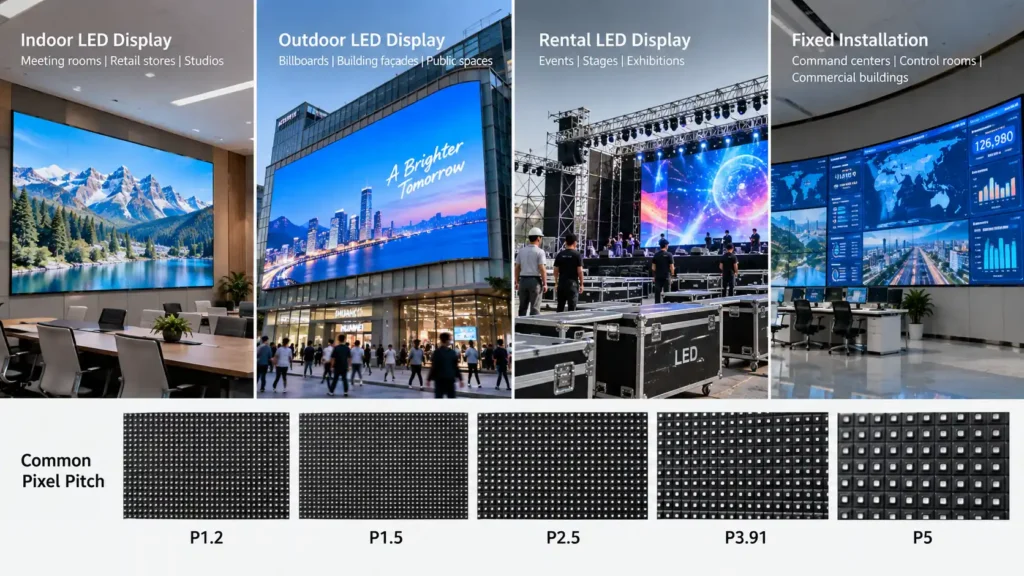
Indoor LED Displays: Indoor screens are commonly used in meeting rooms, retail stores, studios and exhibition spaces. They usually operate at lower brightness levels and may use a finer pixel pitch for closer viewing. Typical brightness requirements are often around 800–1,200 nits, depending on ambient light and application.
Outdoor LED Displays: Outdoor screens must remain visible under stronger daylight and withstand rain, dust and changing weather conditions. Fully exposed installations often use IP65-rated front protection, while brightness may reach 5,000–8,000+ nits depending on sunlight exposure and display orientation.
Do not simply specify “indoor” or “outdoor.” Tell the supplier whether the screen will be exposed to direct sunlight, installed under cover, mounted on a building façade or used in another specific environment.
Pixel pitch is the distance between adjacent LED pixels, measured in millimeters. A smaller pitch provides higher pixel density and is generally better for closer viewing, but it also increases cost.
| Pixel Pitch | Typical Use |
|---|---|
| P1.2–P1.8 | Fine pitch meeting rooms, control rooms and premium indoor displays |
| P2–P2.5 | Retail, corporate displays and commercial interiors |
| P3–P4 | Events, stages, rental applications and general commercial displays |
| P5 and above | Large outdoor LED screens and longer viewing distances |
These ranges are practical references rather than fixed rules. The right choice depends on viewing distance, display dimensions, content type and budget.
When requesting a quotation, provide the required width and height so the supplier can calculate the cabinet layout and final resolution accurately.
The cabinet structure should match how the LED display screen will be installed and used.
Rental LED screens are designed for repeated transportation, assembly and dismantling. They commonly use lightweight die-cast aluminum cabinets, quick-lock systems and flight cases so the screens can be moved efficiently between events.
Fixed-installation LED screens are designed to remain in one location for an extended period. Depending on the project, manufacturers may use steel, aluminum or other cabinet structures optimized for permanent installation, structural strength and maintenance.
The difference is important because cabinet material affects:
total screen weight
installation speed
transportation volume
durability
maintenance access
shipping cost
A rental cabinet is not automatically better than a fixed cabinet. The right choice depends on how often the screen will be moved and how it will be installed.
Two LED displays with the same pixel pitch and cabinet size can perform very differently because of their internal components.
Ask the supplier to specify the LED lamp package, driver IC, power supplies, receiving cards and display controller hardware instead of quoting only the finished screen model.
The LED lamp package affects brightness, color consistency and long-term reliability. The driver IC influences grayscale and video performance, especially for displays used on stage, in studios or on camera. Power supplies also matter because their quality can affect heat generation and operating stability.
For larger LED display projects, the manufacturer should be able to provide clear component specifications and supporting technical information.
Maintenance access should be considered before the cabinet design is finalized, because it affects installation space and future repair work.
Front-service LED displays allow modules, power supplies and other serviceable components to be accessed from the front. This design is well suited to wall-mounted screens or installations where there is little or no space behind the display.
Rear-service LED displays are maintained from the back of the cabinet. They are more suitable for installations where sufficient service space is available behind the screen and technicians can access the rear structure safely.
The right choice depends mainly on the installation layout. For example, a rear-service cabinet may create maintenance problems if the screen is mounted directly against a wall, while front service can simplify repairs in space-limited installations.
Confirm the maintenance method with the supplier before production so the cabinet structure matches the actual installation conditions.
Once the technical specifications are clear, the next step is to identify suppliers that can actually produce the required configuration consistently. China has a large LED display manufacturing industry, but suppliers differ significantly in production capability, component sourcing, quality control and after-sales support.
The goal is not simply to find the lowest quotation. A reliable LED display manufacturer should be able to explain how the screen is built, provide clear component specifications and support the project from production through testing and delivery.
When sourcing LED displays in China, you may encounter several types of suppliers.
LED display manufacturers usually control production directly and are often better suited to customized projects, repeat orders and buyers who need detailed technical specifications.
Trading companies may source from several factories and offer a wider product range. This can be useful when purchasing different types of display products, but it is important to understand which factory will actually manufacture your order.
Project suppliers or system integrators may provide additional services such as display configuration, control system setup, structural guidance and installation support.
None of these options is automatically better. The right supplier depends on the size, complexity and technical requirements of your project.
Shenzhen is one of the main LED display manufacturing hubs in China and has a well-developed electronics supply chain.
Many LED screen manufacturers and supporting suppliers in Shenzhen specialize in products such as:
indoor and outdoor LED displays
rental LED screens
fine pitch displays
LED video walls
cabinets and structural components
power supplies and receiving hardware
display controllers and accessories
This concentration can make component sourcing, customization, inspection and export logistics more efficient.
However, a Shenzhen address alone does not prove manufacturing capability. Some companies operate their own factories, while others outsource production. Buyers should verify the actual production location before placing a large order.
A supplier should be evaluated on more than price and product photos.
Check the following areas before confirming the order:
Factory capability: Does the company operate its own production line?
Product focus: Does it regularly manufacture the type of LED screen you need?
Project experience: Has it completed projects with similar size, application or technical requirements?
Component transparency: Can the supplier identify the LED package, power supplies, receiving hardware and other key components?
Quality assurance: What inspections and aging tests are performed before shipment?
Technical documentation: Can the manufacturer provide drawings, specifications and test information?
Warranty: What is covered and how are replacement parts handled?
Spare parts: Can compatible components be supplied with the original order?
After-sales support: How are technical problems handled after installation?
For larger LED display projects, ask the supplier to provide factory photos, production videos or evidence of similar completed projects.
After shortlisting several LED display suppliers, send each supplier the same specification sheet and compare the quotations on the same basis.
Do not focus on the total price first. Two LED displays with the same pixel pitch and screen dimensions may use different cabinets, components, controllers, spare-parts packages and warranty terms. These differences can have a major impact on product quality and the final project cost.
Check whether each quotation matches the specification you requested.
Compare the main items side by side:
pixel pitch and final resolution
cabinet size, quantity and material
brightness and refresh rate
LED modules and key electronic components
power supplies and receiving cards
control system and video processor
included accessories and spare parts
If one quotation is significantly cheaper, identify exactly where the difference comes from.
A lower price may reflect a different cabinet material, lower-cost components or fewer included accessories rather than a better offer.
Some quotations show only the LED display itself, while others include a more complete package.
Confirm whether the price includes:
control hardware
power and signal cables
mounting accessories
spare LED modules
spare power supplies and receiving cards
flight cases or plywood cases
software configuration
technical support
Also ask whether installation structures, on-site installation or commissioning are excluded.
This helps prevent unexpected costs after the order is confirmed.
MOQ and production lead time vary according to the manufacturer, product type and level of customization.
Before placing the order, confirm:
minimum order quantity
expected production time
testing time before shipment
warranty period
warranty coverage
replacement-parts procedure
after-sales support
For warranty terms, do not look only at the number of years. Confirm which components are covered and how replacement parts will be supplied if a failure occurs.
Payment terms should be linked to clear production milestones.
A typical order may follow this sequence:
Deposit → Production → Testing / Inspection → Approval → Balance Payment → Shipment
For larger or customized LED display projects, confirm the inspection arrangement before paying the final balance.
The purchase contract should clearly record the approved technical specification, component configuration, production schedule, payment terms, warranty and any agreed spare parts.
Finally, make sure the quotation clearly states the shipping term, such as EXW, FOB, CIF or DDP.
These terms include different levels of transportation responsibility, so they should not be compared as if they were the same price basis.
For example, an EXW quotation may appear lower but still require additional factory pickup and export costs in China.
Before confirming the order, make sure you know exactly where the supplier’s responsibility ends and which costs are included.
A good quotation should make the product specification, commercial terms and responsibilities clear before production begins.
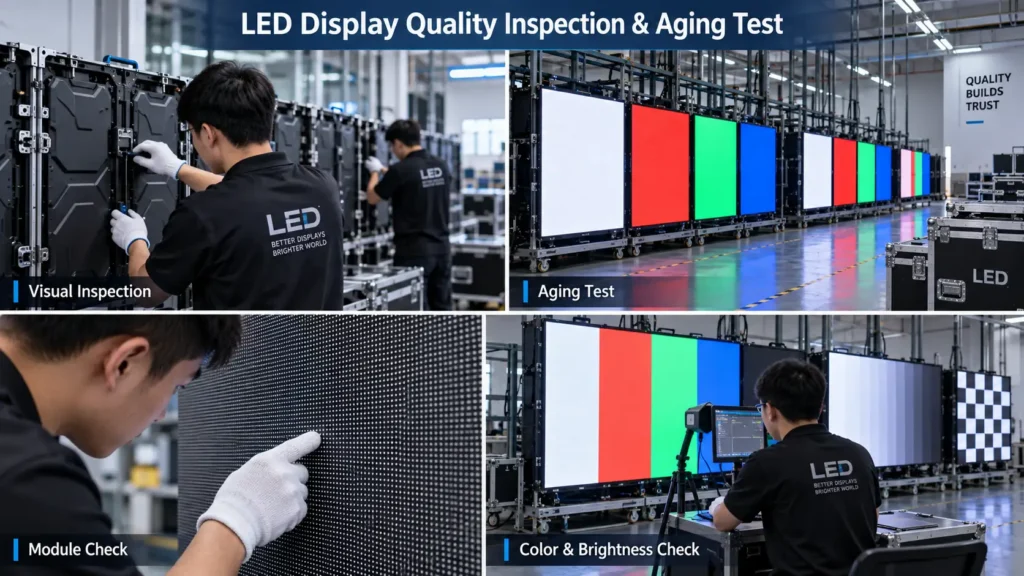
Before shipment, inspect the finished LED display to confirm that it matches the approved specifications and works properly. Problems found at the factory are much easier and cheaper to correct than after the goods arrive overseas.
Verify the model, quantity, cabinet size, pixel pitch, main components and accessories against the purchase order.
The LED screen should also be powered on and tested for:
dead or abnormal pixels
color and brightness consistency
cabinet alignment
signal and power stability
control system operation
For larger projects, ask the supplier to provide photos, videos or test records before shipment approval.
Before packing, make sure the agreed spare parts, cables, power supplies, receiving cards and other accessories are included.
Then check that the LED displays are packed securely in suitable flight cases or plywood cases, with the package quantity, dimensions and weight matching the final packing list.
For high-value or customized orders, a third-party pre-shipment inspection can provide additional verification before the goods leave China.
LED display screens contain sensitive electronic components and should be protected against impact, pressure, vibration and moisture.
The correct packing method depends on whether the products are rental screens, fixed displays or replacement components.
Flight cases are widely used for rental LED screens. They provide strong protection and can be reused when the screens are transported between events. For rental companies, this can be more practical than disposable export packaging.
Before shipment, confirm:
cabinets per case
case dimensions
gross weight
wheel protection
internal cushioning
Plywood cases are commonly used for fixed LED display products and one-way international shipments.
They can protect cabinets during sea freight and destination handling.
The internal structure should prevent movement and protect vulnerable corners, connectors and screen surfaces.
The final packing list should show:
number of cases
dimensions
gross weight
net weight
product description
case numbering
Accurate packing information is essential for freight quotation, container planning and customs clearance.
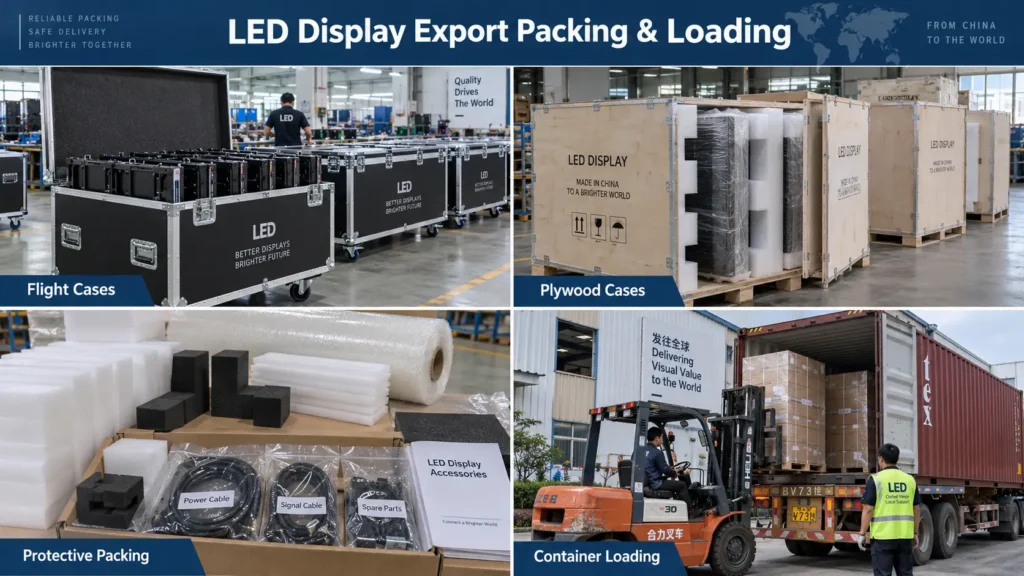
The best shipping method depends on cargo volume, urgency, destination and packaging. A small replacement shipment may be suitable for air freight, while a complete LED wall can require LCL or FCL sea freight.
For LED display shipments from China, the logistics process may include factory pickup, export handling, international transport, customs clearance and final delivery.
Air freight is suitable for:
urgent orders
replacement components
small high-value shipments
event-related projects with tight deadlines
Air freight charges are based on chargeable weight, so both actual weight and package dimensions matter.
Large flight cases can create high volumetric weight. Always obtain final packing dimensions before requesting the freight rate.
LCL can be suitable when the cargo is too large for economical air freight but does not fill a container.
Because the shipment shares container space with other cargo, it may be handled several times during consolidation and deconsolidation.
For this reason, strong export packaging is especially important.
FCL is usually more practical for large LED display projects. A full container can reduce intermediate handling and provide better control over loading. For large shipments, container planning should begin before production is completed.
The supplier can provide estimated packing data so the freight forwarder can calculate container utilization.
Door-to-door shipping can combine:
factory pickup in China
export handling
international freight
customs coordination
final delivery
This option can simplify the process for importers that do not already have their own logistics network.
Cargo insurance should be considered for high-value LED display shipments. Electronic products can be sensitive to moisture, vibration and handling damage. Keep inspection records and packing photos before shipment in case they are needed for a claim.
Customs preparation should begin before the LED display shipment leaves China. The main tasks are confirming the correct HS classification, preparing consistent shipping documents and checking whether the destination country requires additional compliance certificates or import permits.
Because LED display systems can include complete screens, modules, controllers, power supplies and other components, not every item in the shipment will necessarily use the same customs classification.
Complete LED display screens are generally classified within HS heading 8528, but the exact subheading depends on the product function and the tariff schedule of the importing country.
Common reference headings include:
| Product Type | Common HS Heading | Notes |
|---|---|---|
| Complete LED display screens / video walls | 8528 | Final subheading depends on product function and destination country |
| LED display parts or modules | 8529 may apply | Depends on whether the item is a part or a complete functional display |
| Individual LED lamps / diodes | 8541 | Applies to semiconductor light-emitting components rather than complete displays |
Importers should avoid copying an 8- or 10-digit code from another country or supplier quotation without verification. National tariff schedules often extend the international HS code with additional digits.
Before shipment, provide the customs broker with the product specifications, component list and intended use so the final classification can be confirmed.
A typical LED display shipment may require:
Commercial Invoice – product description, quantity, unit value, total value and Incoterm
Packing List – number of packages, dimensions, gross weight and net weight
Bill of Lading or Air Waybill – transport document for sea or air freight
Certificate of Origin – when required by the destination country or trade arrangement
Product Specifications – useful for customs classification and technical review
Compliance or Test Documents – where required for the destination market
Insurance Certificate – if cargo insurance has been arranged
The Commercial Invoice, Packing List and transport documents should use consistent product descriptions, quantities and weights. Differences between documents can trigger customs questions or delay clearance.
Import duties and taxes depend on the destination country, HS classification and product configuration. Depending on the market, importers may also need to account for VAT, GST or other local taxes.
LED display products may also be subject to requirements related to:
electrical safety
electromagnetic compatibility
labeling
environmental compliance
radio-frequency functions
installation standards
Suppliers may provide documents such as CE, RoHS or FCC-related reports, but these should be checked against the actual LED display product and destination market rather than assumed to apply universally.
For smoother customs clearance, send the Commercial Invoice, Packing List and product specifications to your freight forwarder or customs broker for review before the cargo departs China.
The supplier’s quotation is only one part of the total import cost. To understand the real budget, calculate the landed cost from the factory in China to the final destination.
A practical formula is:
Product Cost + Spare Parts + Export Packing + China Pickup + International Freight + Insurance + Import Duty & Tax + Customs Clearance + Destination Charges + Final Delivery
The final amount can vary significantly even when two LED screens have the same size or pixel pitch.
The product itself is usually the largest cost component.
Price can change according to:
pixel pitch
display dimensions
cabinet material
brightness
LED component quality
control hardware
customization
spare-parts package
Fine pitch LED displays generally cost more because they use a higher pixel density and more electronic components.
This is why buyers should compare the complete technical configuration rather than relying on a single price per square meter.
Packing method also affects the shipping budget.
Rental LED screens are often packed in reusable flight cases, while fixed-installation displays may use plywood cases. Different packing methods change the total cargo volume and weight.
For air freight, chargeable weight can be affected by both actual and volumetric weight.
For sea freight, the main factors are cargo volume, LCL or FCL service, destination port and local handling charges.
Accurate package dimensions and weights are therefore essential before requesting a final freight quotation.
A lower factory price does not always mean a lower total cost.
For example, savings on the product can quickly disappear if the shipment requires expensive air freight, additional packing, missing spare parts or unexpected destination charges.
Before confirming the order, compare suppliers using the total landed cost, not only the unit price.
This gives you a more realistic view of what the LED display will actually cost once it reaches the final destination.
Define the product specification first, then find suitable LED display manufacturers in China, request comparable quotations, confirm payment terms, inspect the finished products, arrange export packing and choose the appropriate shipping method. Before departure, confirm the HS classification, import documents and destination-country customs requirements.
Many Chinese LED display manufacturers are located in Shenzhen and the surrounding Pearl River Delta region. Shenzhen has a strong electronics supply chain, but buyers should still verify the actual factory and quality assurance process before placing an order.
The correct pixel pitch depends on viewing distance, display dimensions, application and budget. Fine pitch LED displays are generally used for closer viewing, while larger pitches are more suitable for longer distances.
Common spare parts may include power supplies, receiving cards, cables, connectors and replacement display components. The correct quantity depends on the project size and maintenance plan.
Air freight is better for urgent, smaller or high-value shipments. LCL and FCL sea freight are usually more practical for larger LED display projects.
Useful freight, customs and importing resources related to this shipping guide.
Importing electronics from China has become a lucrative business opportunity for companies and individuals worldwide. China is the global leader...
Read guide →
China is the world’s leading manufacturer and exporter of LED lights, offering a wide variety of high-quality and cost-effective options. Whether...
Read guide →
How to Source Electronics from Shenzhen and Ship Overseas Verified & Reviewed · Last updated July 2026 Shenzhen is one of China’s leading electro...
Read guide →
Pre-Shipment Inspection in China for Importers Verified & Reviewed · Last updated July 2026 A pre-shipment inspection helps importers identify de...
Read guide →Sea freight is the most cost effective shipping method for large volumes and container load cargo. It is ideal for businesses looking to reduce s...
Learn more → Useful Resource Air Freight from ChinaAir freight from China is the best option for time sensitive and high value shipments. It offers fast delivery, reliable transit times, and effic...
Learn more →WhatsApp us