
How to Ship Goods After the Canton Fair

After the Canton Fair, buyers need to arrange shipping for samples, trial orders, or bulk purchases from Chinese suppliers. The process involves confirming orders, collecting cargo details, choosing the right freight method, and coordinating supplier pickup or warehouse consolidation in China.

This guide covers shipping options, multi-supplier consolidation, customs documentation, and freight costs to help you arrange international delivery efficiently.

Post-Canton Fair Shipping

Samples & Bulk Orders

Cargo Consolidation

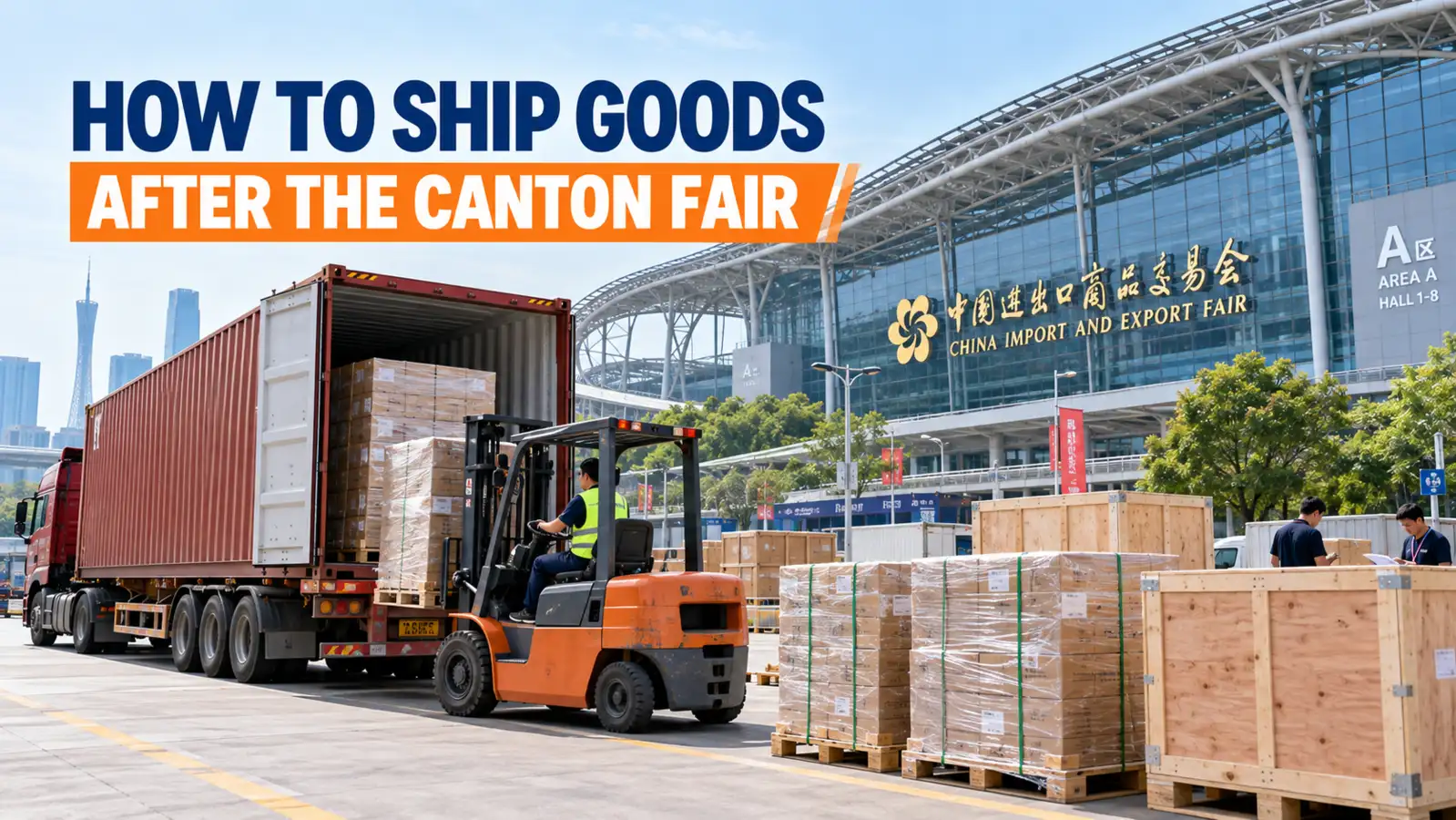
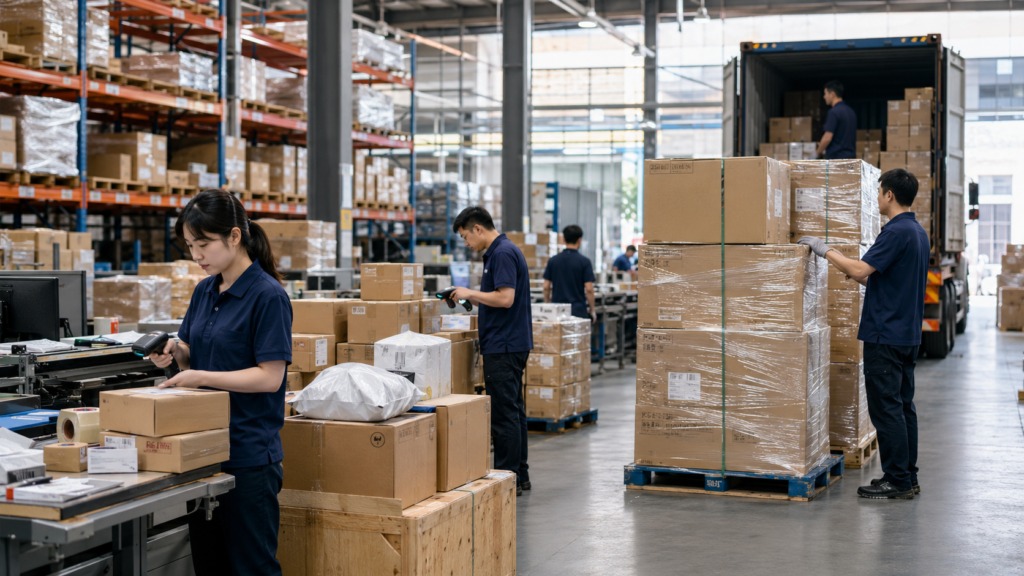
Shipping goods after the Canton Fair with trucks and cargo at a logistics warehouse in China
10,000+ international shipments handled    Global sea, air & DDP shipping solutions    24/7 shipment tracking & customer support

Table of Contents

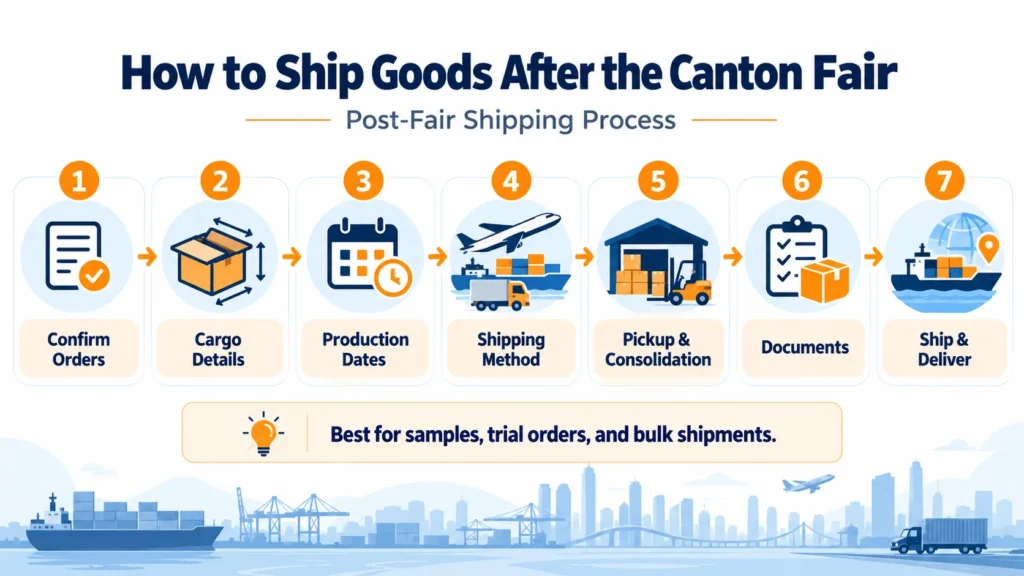
How to Ship Goods After the Canton Fair: 7 Steps

Shipping goods after the Canton Fair requires coordination between buyers, suppliers, and freight forwarders. From confirming purchase orders to arranging final delivery, each step helps ensure that your products are ready for export and reach their destination without unnecessary delays.

Follow these seven steps to organize your post-fair shipments:

  1. Confirm Orders: Finalize product specifications, quantities, prices, and payment terms with each supplier.

  2. Collect Cargo Details: Obtain product descriptions, carton dimensions, gross weight, and estimated volume (CBM).

  3. Confirm Production Dates: Check when each supplier’s goods will be ready for collection.

  4. Choose a Shipping Method: Compare express courier, air freight, LCL, FCL, and rail freight based on your cargo and destination.

  5. Arrange Pickup and Consolidation: Collect goods from suppliers or send them to a designated warehouse in China for consolidation.

  6. Inspect and Prepare Documents: Check product quantities and packaging, and prepare the commercial invoice, packing list, and other required documents.

  7. Arrange Shipping and Delivery: Complete export customs procedures, monitor transportation, and arrange import clearance and final delivery.

Planning these steps early helps prevent shipping delays, avoid unnecessary handling costs, and keep multiple supplier orders organized.

What Information Should You Collect from Each Supplier?

Before arranging shipping, collect the following information from each supplier. Accurate details help your freight forwarder calculate shipping costs, coordinate cargo pickup, and prepare export arrangements.

InformationDetails to Collect
Supplier DetailsCompany name, contact person, phone number, email, booth number, and factory address
Product InformationProduct descriptions, specifications, materials, quantities, and unit prices
Cargo DetailsNumber of cartons, dimensions, gross weight, and total volume (CBM)
Production ScheduleEstimated completion date and cargo-ready date
Shipping TermsAgreed Incoterms and export arrangements
Special RequirementsProduct certificates, permits, and special packaging needs

Ask suppliers to confirm the final carton dimensions and gross weight once production and export packaging are complete, as preliminary figures may change.

Also, confirm whether each supplier can handle export declarations or requires an export agent. For electronics, building materials, and other regulated products, check applicable certification and import requirements in the destination country.

Which Shipping Method Is Best for Canton Fair Goods?

The right shipping method depends on your cargo volume, weight, product type, delivery deadline, and destination country. Buyers should compare total transportation costs rather than choosing a method based only on the initial freight rate.

Here are the main shipping options available after the Canton Fair.

Express Courier

Express courier services are suitable for small samples, documents, and lightweight orders that need to arrive quickly.

International courier companies can collect packages from suppliers or designated warehouses in China and deliver them to the recipient’s address, subject to destination coverage and customs requirements.

Best for:

  • Product samples and prototypes

  • Small test orders

  • Urgent documents

  • Lightweight parcels

Courier charges are generally calculated using actual or volumetric weight, whichever is higher under the carrier’s pricing rules.

Air Freight

Air freight is a practical option for commercial shipments that need faster transportation than ocean freight but are too large or expensive to send through standard express services.

It is commonly used for electronics, high-value products, urgent stock replenishment, and medium-sized orders.

Best for:

  • Time-sensitive commercial cargo

  • High-value products

  • Medium-sized shipments

  • Goods that cannot wait for a longer ocean transit schedule

Air freight costs depend on chargeable weight, route, cargo dimensions, and applicable handling requirements.

LCL Sea Freight

Less than Container Load (LCL) shipping allows several importers to share space in one shipping container.

It is suitable when your order does not occupy an entire container. This option can also work well for buyers purchasing from multiple Canton Fair suppliers, provided the goods are compatible and consolidation is practical.

Best for:

  • Small and medium-sized commercial orders

  • Buyers without enough cargo for a full container

  • Multiple compatible shipments

  • Businesses looking to reduce the cost of shipping smaller quantities by sea

LCL shipments involve additional consolidation and deconsolidation handling, so buyers should compare the complete charges before booking.

FCL Sea Freight

Full Container Load (FCL) shipping means booking an entire container for your cargo.

Common container options include 20-foot and 40-foot containers, with the appropriate choice depending on cargo volume, weight, loading requirements, and destination restrictions.

Best for:

  • Large-volume orders

  • Bulk purchases from manufacturers

  • Regular commercial shipments

  • Buyers who need greater control over container loading

FCL can reduce cargo handling compared with LCL because the goods remain in the same container during the main transportation process.

Rail Freight

Rail freight can be an alternative for suitable shipments from China to Europe. It offers another transportation option between air and ocean freight in terms of transit time and cost.

Availability depends on the destination, route, cargo type, and current service arrangements.

Best for:

  • Suitable commercial shipments to European destinations

  • Buyers comparing rail and ocean transportation

  • Cargo that requires a different balance of cost and transit time

Door-to-Door Shipping

Door-to-door shipping covers transportation from the supplier’s location or a designated warehouse in China to the buyer’s specified delivery address.

Depending on the agreed service, it may include domestic pickup, export handling, international transportation, customs clearance coordination, and final delivery.

DDP and DAP are Incoterms that define delivery responsibilities and cost allocation. They are not separate transportation methods.

Choose the option that matches your cargo and import requirements.

How to Consolidate Orders from Multiple Canton Fair Suppliers

Many international buyers purchase products from several exhibitors during the Canton Fair. For example, a buyer may order electronics from one manufacturer, home products from another, and building materials from a third supplier.

Shipping every order separately can increase transportation and handling costs. A more organized approach is to use a China warehouse consolidation service to receive and combine compatible shipments from different suppliers.

China Warehouse Consolidation Service-Combine Multiple Suppliers Into One Shipment

Why Consolidate Orders?

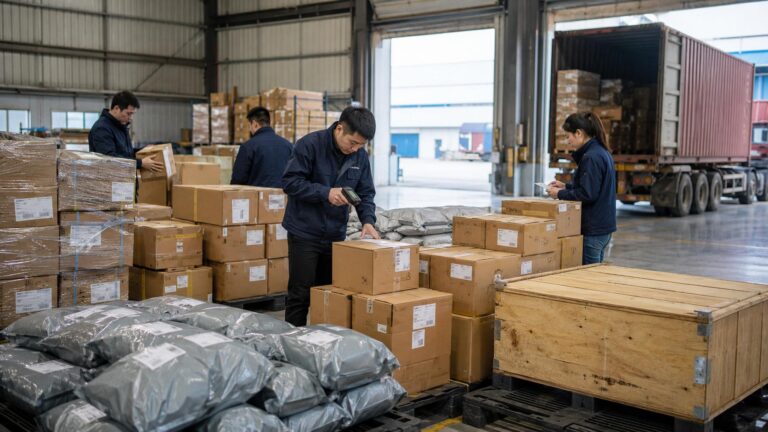
Cargo consolidation allows goods from different suppliers to be collected at one warehouse, checked, measured, and prepared for combined international transportation.

Potential benefits include:

  • Combining compatible orders into one shipment

  • Reducing repeated international freight arrangements

  • Simplifying shipment documentation and coordination

  • Improving visibility of different supplier orders

  • Arranging one coordinated delivery where practical

However, consolidation does not automatically guarantee lower costs. Domestic pickup, warehouse handling, storage, repacking, and destination charges must also be considered.

How China Warehouse Consolidation Works

A typical consolidation process includes the following steps:

  1. Arrange supplier deliveries: Ask each supplier to send the finished goods to the designated warehouse or arrange factory pickup.

  2. Receive and identify cargo: The warehouse checks carton quantities, shipping marks, and basic cargo condition against the supplied information.

  3. Measure and weigh goods: Confirm the actual dimensions, gross weight, and total volume of each shipment.

  4. Check packaging: Identify damaged cartons, unsuitable packaging, or products that require additional protection.

  5. Prepare consolidated cargo: Group compatible goods and arrange suitable export packaging and container loading.

  6. Complete shipping arrangements: Confirm the final cargo details, documentation, freight booking, and export procedures.

Guangzhou and Shenzhen are common locations to consider for supplier collection and warehouse coordination. Depending on where your suppliers are based, other locations in China may also be more practical.

What If Different Suppliers Finish at Different Times?

Not every supplier will complete production on the same date. Some orders may be ready within a few days, while customized products may require several weeks.

You do not necessarily need to wait until every supplier has finished.

Consider these options:

  • Consolidate all orders together if the waiting period is short and storage costs are reasonable.

  • Ship completed orders first if other suppliers have significant production delays.

  • Arrange separate shipments when the cargo has different delivery deadlines or transportation requirements.

The best arrangement depends on the total cost, cargo readiness, and delivery priorities.

How to Inspect and Pack Goods Before Shipping

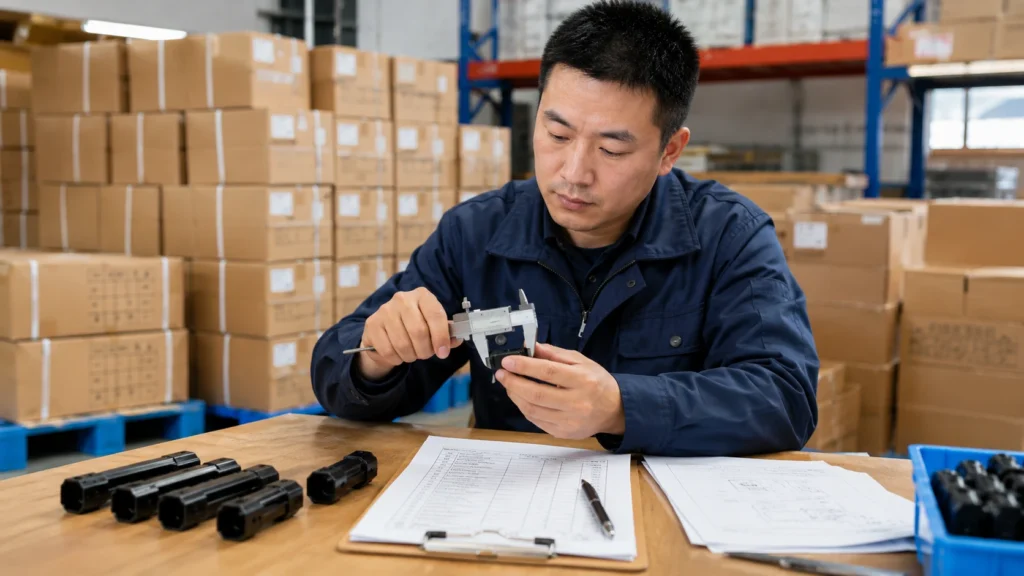
Before international transportation, make sure the products match the purchase agreement and are packed appropriately for export.

Poor packaging, incorrect quantities, and damaged goods can cause problems during transportation and customs inspection.

Verify Product Quantity and Specifications

Compare the received goods with the purchase order and supplier packing list.

Check:

  • Product models and specifications

  • Ordered and received quantities

  • Colors, sizes, and product variations

  • Visible damage or missing items

  • Product labels and shipping marks

If the shipment contains different products from multiple suppliers, maintain separate cargo records to avoid mixing orders.

Arrange Pre-Shipment Inspection

For larger commercial orders, consider arranging a pre-shipment inspection (PSI) before the final balance payment and cargo release.

An independent inspection can help verify product quality, workmanship, quantity, packaging, and compliance with the agreed specifications.

A warehouse receiving check is not a substitute for a full product quality inspection. If quality verification is important, arrange the inspection with the supplier or an independent inspection provider.

Confirm Export Packaging

Check that the packaging is suitable for the selected transportation method and expected handling conditions.

Depending on the products, this may include:

  • Strong export cartons and protective materials

  • Appropriate pallets or wooden crates

  • Moisture protection for sensitive goods

  • Clear shipping marks and carton identification

  • Suitable stacking and loading arrangements

Wood packaging used for international shipments may need to meet applicable ISPM 15 requirements.

For electronics, products containing batteries, and other regulated cargo, confirm the relevant transportation restrictions and documentation before booking.

What Shipping Documents and Customs Requirements Are Needed?

Shipping goods after the Canton Fair requires accurate documentation for export customs clearance in China and import clearance in the destination country. The required documents depend on the product type, shipping method, and destination regulations.

DocumentPurpose
Commercial InvoiceShows product descriptions, quantities, declared values, and buyer and seller details
Packing ListProvides carton quantities, dimensions, gross weight, and packing details
Bill of Lading (B/L)Main transport document for ocean freight
Air Waybill (AWB)Transport document for air freight
Export Customs DeclarationProvides shipment information for Chinese export customs procedures
Certificate of OriginConfirms the country of origin when required
Product Certificates and PermitsDemonstrate compliance with applicable import regulations

Not every shipment requires all these documents. For example, air freight uses an Air Waybill rather than an ocean Bill of Lading. Additional certificates or permits may be required for regulated products.

Check Customs Requirements Before Shipping

Before dispatch, confirm the following with your supplier or freight forwarder:

  • HS Code Classification: Ensure products are classified correctly to determine applicable duties and import requirements.

  • Export Compliance: Confirm that the goods meet Chinese export requirements and that the exporter can complete the necessary customs procedures.

  • Destination Regulations: Check whether the products require import licenses, safety certifications, testing reports, or special labeling.

  • Duties and Taxes: Calculate applicable import duties, VAT, GST, and other taxes based on the destination country’s regulations.

  • Customs Broker: Arrange a licensed customs broker or suitable clearance service when required.

Confirm Incoterms with Your Supplier

Incoterms define how transportation costs, risks, and responsibilities are divided between the seller and buyer.

Common arrangements include:

  • EXW: The buyer generally takes responsibility for arranging collection from the seller’s premises and subsequent transportation.

  • FOB: The seller handles the agreed export-side responsibilities and delivery of goods on board the nominated vessel at the specified port.

  • CIF: The seller arranges the agreed ocean freight and insurance to the named destination port, while other import-side responsibilities remain with the buyer.

  • DAP: The seller arranges delivery to the agreed destination, while the buyer generally handles import clearance and applicable import duties and taxes.

  • DDP: The seller assumes the agreed delivery responsibilities, including import clearance and applicable duties and taxes, subject to its ability and legal eligibility to act as the importer or arrange the required import procedures.

Make sure the agreed Incoterm includes a clearly identified place or port. This helps avoid misunderstandings about transportation costs and customs responsibilities.

How Much Does It Cost to Ship Goods After the Canton Fair?

The cost of shipping goods after the Canton Fair depends on cargo weight, volume, shipping method, supplier location, and final destination. Buyers should compare different freight options before choosing a shipping solution.

Estimated Shipping Costs from China

The following figures are indicative reference rates for China-to-US shipments. Actual prices vary depending on the route, cargo specifications, season, and carrier availability.

Shipping MethodEstimated CostBest For
Express Courier$6–$12/kgSmall samples and urgent parcels
Air Freight$4–$8/kgTime-sensitive commercial shipments
LCL Sea Freight$50–$140/CBMSmall and medium-sized orders
20GP Container$1,200–$3,500Large-volume shipments
40HQ Container$1,800–$5,000Bulk commercial orders

These figures are for reference only, not fixed quotations. Peak-season demand, cargo dimensions, available capacity, and destination charges can affect the final shipping cost.

For orders from multiple suppliers, compare individual shipments with warehouse consolidation to determine whether combining cargo offers better overall value.

What Affects Your Shipping Price?

Several factors determine the final freight rate:

  • Cargo Weight and Volume: Heavier or larger shipments generally cost more. Air freight is charged by actual or volumetric weight, while LCL rates are commonly based on chargeable volume or weight.

  • Shipping Method: Express, air, sea, and rail freight have different pricing structures.

  • Supplier Locations: Collecting goods from multiple factories or cities can increase domestic transportation costs.

  • Cargo Type: Fragile, oversized, or specially regulated products may require additional handling.

  • Destination and Season: Shipping rates vary by destination, route availability, and peak-season demand.

For orders from multiple suppliers, compare individual shipments with warehouse consolidation to determine whether combining cargo offers better overall value.

Common Mistakes When Shipping Goods After the Canton Fair

Even after successfully negotiating with suppliers, buyers can encounter avoidable problems during shipping.

Watch out for these common mistakes:

  • Choosing a shipping method too early: Confirm the final cargo dimensions, weight, and destination before comparing freight options.

  • Shipping from multiple suppliers without comparing consolidation: Separate shipments may increase handling and international transportation costs, but consolidation should also account for storage and domestic pickup fees.

  • Ignoring different production schedules: Confirm each supplier’s cargo-ready date instead of assuming all orders will be completed together.

  • Using incorrect customs information: Make sure commercial invoices, packing lists, product descriptions, and HS codes are accurate.

  • Overlooking export packaging: Check carton strength, moisture protection, shipping marks, and special handling requirements.

  • Comparing incomplete freight quotations: Check origin and destination charges, customs services, and final delivery costs before choosing a forwarder.

  • Waiting until the last minute to arrange shipping: Contact your freight forwarder early enough to coordinate warehouse receiving, cargo inspection, and transportation booking.

A clear shipping plan helps buyers avoid unnecessary delays and manage their import costs more effectively.

Why Choose Tonlexing for Shipping After the Canton Fair?

After meeting suppliers and confirming purchases at the Canton Fair, international buyers need a reliable logistics partner to coordinate the movement of goods from China to their destination countries.

Tonlexing provides international freight forwarding and logistics coordination for businesses importing products from China.

Our services include:

  • Supplier Pickup Coordination: Arrange cargo collection from factories and supplier warehouses in China.

  • Warehouse Consolidation: Coordinate receiving and consolidation for compatible goods from multiple suppliers.

  • Air Freight: Arrange air transportation for urgent and time-sensitive commercial shipments.

  • Sea Freight: Provide LCL and FCL shipping solutions for different cargo volumes.

  • International Express: Arrange courier services for samples, documents, and small parcels.

  • Customs Clearance Coordination: Assist with export and import documentation and customs procedures.

  • Door-to-Door Shipping: Coordinate transportation from China to the buyer’s designated delivery address.

Whether you purchase from one exhibitor or several manufacturers across different Chinese cities, Tonlexing can help evaluate your cargo details and coordinate a suitable shipping arrangement.

Request a freight quote from Tonlexing by providing your supplier locations, product descriptions, cargo dimensions, gross weight, estimated ready date, and destination. Our team can help you compare shipping options and organize your post-Canton Fair shipments.

Frequently Asked Questions