
Related Guide
Rail Freight from China
Shipping from China / Rail Freight from China International Rail Freight Services · China to Europe & Eurasia Rail Freight from China Move cargo...
Read guide →

Rail freight from China to the Netherlands depends on shipping costs, transit times, railway routes, customs requirements, and final delivery arrangements.
This guide covers rail freight costs from China to the Netherlands, including China-Europe railway routes, FCL and LCL shipping options, customs clearance procedures, and door-to-door delivery solutions for commercial shipments.
Rail Freight
FCL & LCL Shipping
Door-to-Door Shipping
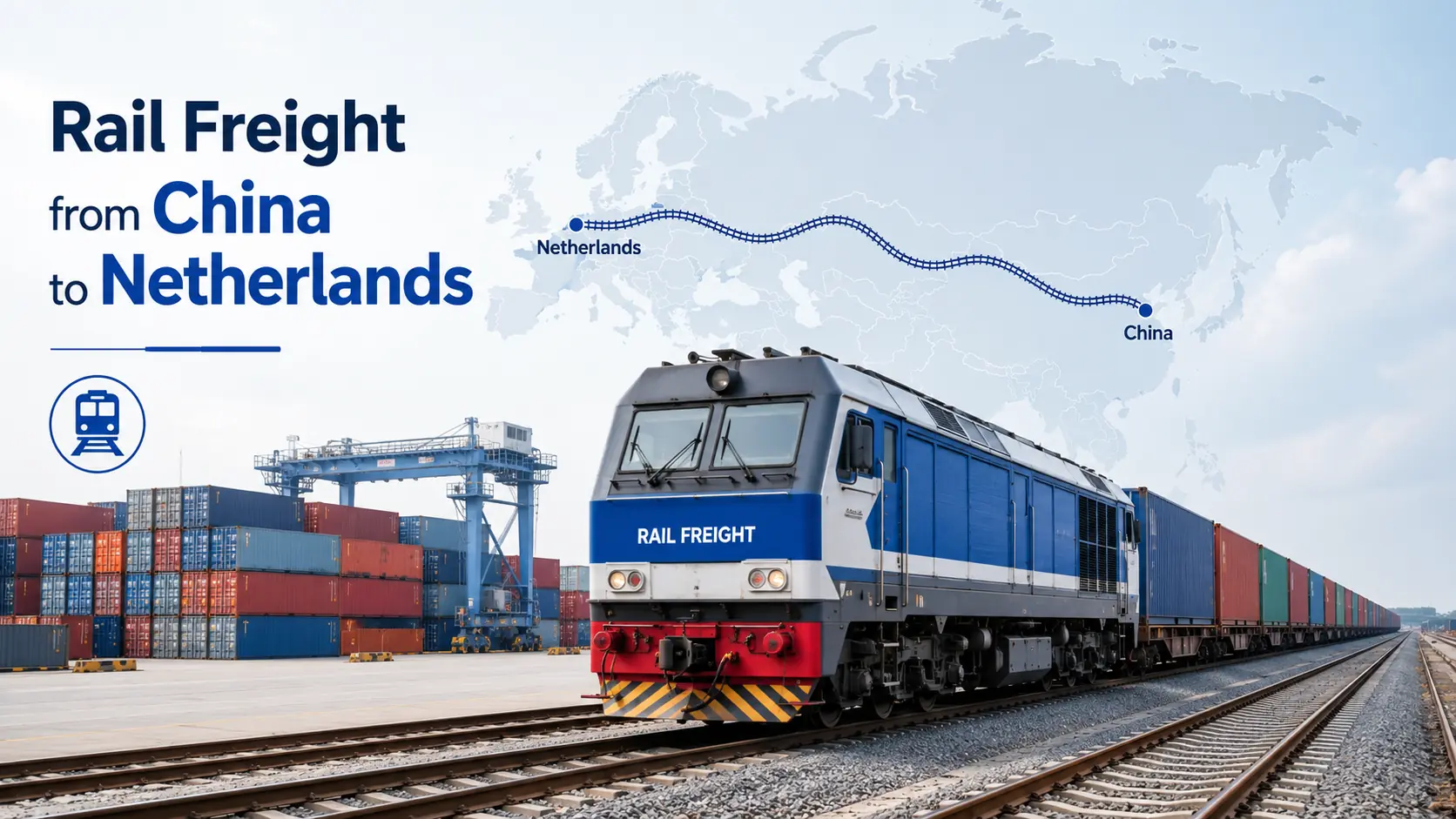
Rail freight connects China’s major industrial regions with European distribution centers through international railway networks. It provides an efficient transport option for companies that need a balance between delivery time, transportation costs, and supply chain stability.
The main advantages of rail freight include shorter delivery times than sea shipping, lower costs than air cargo, and flexible options for different shipment sizes.
| Item | Details |
|---|---|
| Transit Time | Approximately 15–25 days |
| Shipping Options | FCL, LCL, Door-to-Door |
| Railway Network | China-Europe Railway Express |
| China Departure Hubs | Xi'an, Chengdu, Chongqing, Zhengzhou |
| Netherlands Hubs | Rotterdam, Tilburg |
| Suitable Cargo | Electronics, automotive parts, consumer goods, machinery |
For businesses moving goods between China and Europe, rail freight is often selected as a middle-ground shipping solution. It helps companies maintain inventory levels while avoiding the long waiting periods associated with ocean shipping.
The cost of rail freight from China to the Netherlands depends on multiple factors, including the departure location, cargo volume, container type, railway route, and final delivery requirements.
Unlike a simple point-to-point transportation service, international rail freight involves several stages, including export handling in China, railway transportation, border operations, customs clearance, and delivery within the Netherlands.
Typical rail freight costs include:
| Shipment Type | Estimated Cost |
|---|---|
| 20ft Container (FCL) | USD 2,800–4,500 |
| 40ft Container (FCL) | USD 4,000–5,700 |
| LCL Rail Freight | USD 260/CBM |
The final quotation may vary depending on the shipment requirements and current transportation conditions.
Several factors influence the total shipping costs from China to the Netherlands:
Departure city in China: Different railway hubs have different inland transportation charges and service availability.
Container type: Full container load shipments usually provide better cost efficiency for larger cargo volumes.
LCL requirements: Less than container load shipments depend on cargo volume, consolidation arrangements, and handling requirements.
Customs requirements: Export and import procedures can affect the final transportation cost.
Final delivery location: Door-to-door services include additional local transportation after railway arrival.
When calculating the real cost of importing goods, businesses should consider the complete logistics process rather than only the rail freight rate.
The total landed cost may include:
Export handling charges in China
International rail transportation fees
Customs clearance costs
Import duties and taxes
Final delivery expenses
Considering the total landed cost helps importers avoid hidden costs and choose the most suitable transport method.
The typical transit time for rail freight from China to the Netherlands is around 15–25 days. The actual delivery time depends on the departure city, selected route, customs procedures, border crossings, and final delivery arrangements.
Compared with sea freight, which usually requires around 30–40 days, rail freight offers shorter transit times while maintaining more competitive pricing than air freight.
Typical delivery times from major Chinese railway hubs include:
| China Origin | Estimated Transit Time |
|---|---|
| Xi'an | 15–20 days |
| Zhengzhou | 15–25 days |
| Chengdu | 18–25 days |
| Chongqing | 18–25 days |
For door-to-door shipments, additional time may be required for supplier pickup, export customs clearance, Netherlands import procedures, and final delivery.
Rail freight transit times can be influenced by:
Customs clearance procedures
Border crossings and railway transfers
Railway schedules
Cargo inspections
Local delivery arrangements
Professional freight forwarders help coordinate these stages to reduce delays and improve delivery reliability.
Choosing between rail freight, sea freight, and air freight depends on shipment urgency, cargo volume, and budget requirements.
Sea freight remains the most cost-effective option for large volumes, while air freight is mainly used for urgent shipments or high-value goods. Rail freight provides a balanced solution between these two options.
| Shipping Method | Transit Time | Cost Level | Best For |
|---|---|---|---|
| Air Freight | 3–7 days | High | Urgent shipments, high-value goods |
| Rail Freight | 15–25 days | Medium | Commercial cargo requiring balanced cost and speed |
| Sea Freight | 30–40 days | Low | Large volumes and non-urgent shipments |
Rail transportation is suitable for companies that need faster delivery than sea freight without the high costs of air freight.
Rail freight is commonly used for:
Electronics and technology products
Automotive parts
Consumer goods
Industrial equipment
Regular supply chain shipments
For businesses shipping large volumes, sea freight may still provide lower transportation costs. However, rail freight can help reduce inventory waiting time and improve supply chain flexibility.
Rail freight from China to the Netherlands is mainly operated through the China-Europe Railway Express, connecting major manufacturing regions in China with European logistics hubs. Unlike sea freight routes that rely on ocean ports, rail services use a network of inland railway terminals and European distribution centers to move containerized cargo across continents.
The exact route depends on the departure city in China, available rail services, border conditions, and the final destination in the Netherlands. Different routes allow freight forwarders to select suitable transportation solutions based on transit time, cost requirements, and cargo characteristics.
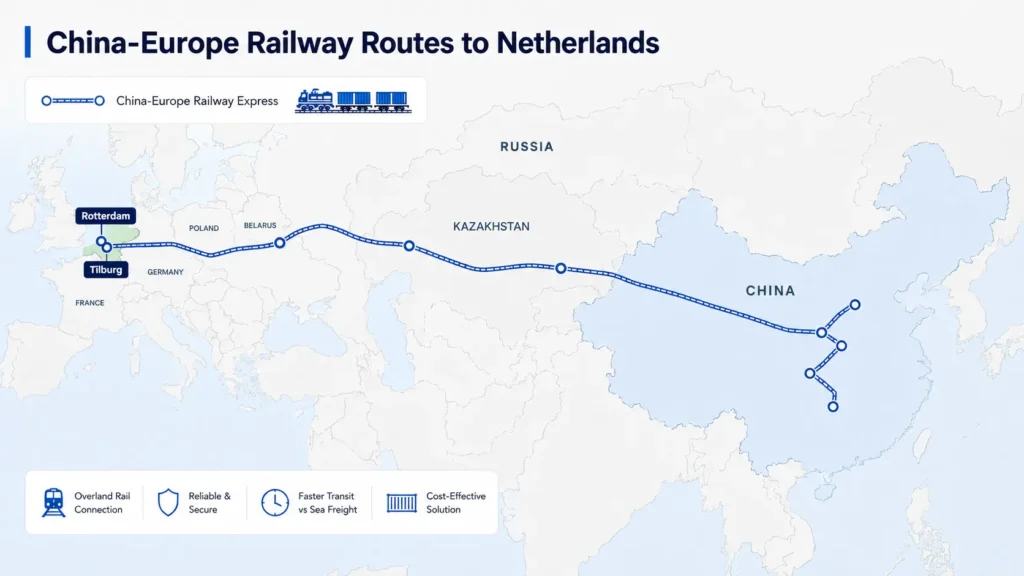
A typical China-Europe rail route to the Netherlands follows:
China → Kazakhstan → Central Asia → Europe → Netherlands
The shipment usually starts from major Chinese railway hubs and travels west through Central Asia before entering Europe. After arriving in the Netherlands, cargo can be transported by truck to the final delivery location.
Rail freight services to the Netherlands are available from several important railway hubs in China, including:
Xi’an – One of the main China-Europe Railway Express hubs, serving regular rail connections to Europe.
Chengdu – An important departure point for cargo from southwest China, especially electronics and manufacturing products.
Chongqing – A key western China logistics hub with international rail connections.
Zhengzhou – A central China railway hub supporting international container transportation.
After entering Europe, rail cargo can be connected to logistics centers in the Netherlands, including:
Rotterdam – One of Europe’s largest logistics gateways with strong rail and distribution infrastructure.
Tilburg – An important inland logistics location for European distribution and final delivery.
China-Europe rail freight involves multiple countries and railway systems, which may require container handling at certain border crossings due to different rail gauges and operational procedures.
Transit times can be affected by:
Railway capacity and schedules
Border processing procedures
Customs clearance requirements
Seasonal demand and international conditions
For importers shipping from China to the Netherlands, choosing the right railway route depends on the cargo origin, delivery location, required transit time, and overall shipping costs. A professional freight forwarder can help arrange suitable rail transport and coordinate the entire shipping process.
Rail freight from China to the Netherlands is available for both full container load (FCL) and less than container load (LCL) shipments. The right option depends on cargo volume, shipment frequency, budget requirements, and delivery expectations.
For companies shipping larger quantities, FCL rail freight usually provides better cost efficiency and simpler handling. For smaller shipments, LCL rail freight allows importers to share container space with other cargo without booking an entire container.
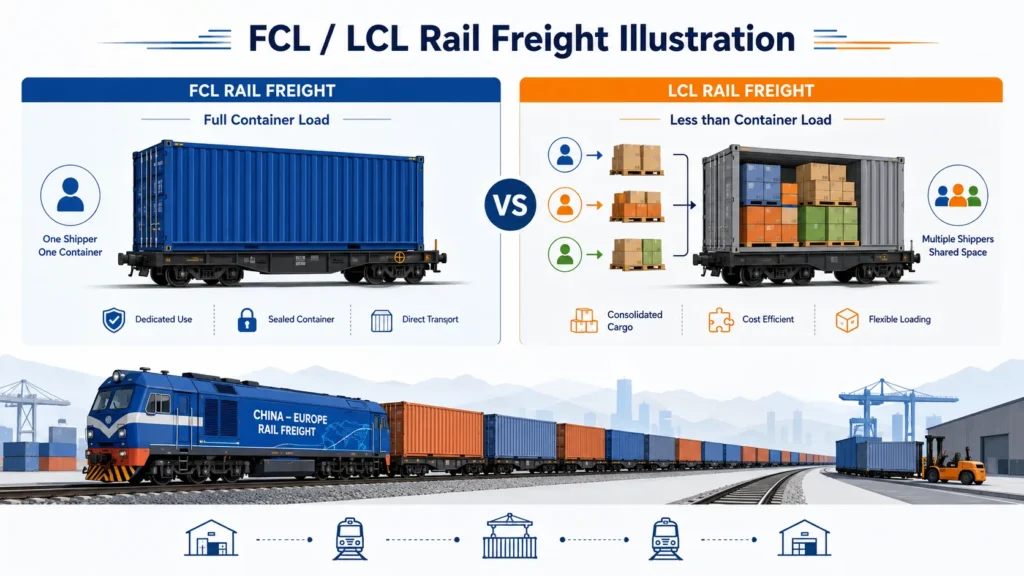
FCL rail freight is suitable for businesses that have enough cargo to fill a standard container or require dedicated container space.
Advantages include:
Lower handling frequency compared with consolidated shipments
Better protection for larger-volume cargo
More predictable transportation arrangements
Suitable for regular commercial shipments
FCL rail transport is commonly used for:
Machinery and equipment
Automotive parts
Electronics
Consumer goods
Manufacturing materials
For importers shipping larger volumes from China to the Netherlands, FCL provides better control over the transportation process and inventory planning.
LCL rail freight is designed for smaller shipments that do not require a full container. Cargo from different suppliers or customers is consolidated into one container and transported together.
LCL is suitable for:
Smaller volumes
Trial orders
Multiple supplier purchases
Businesses testing new markets
However, LCL shipments may involve additional consolidation and handling procedures, which can affect the overall delivery time compared with FCL shipments.
Choosing between FCL and LCL depends on shipment size, urgency, and the required level of cost control.
Door-to-door rail shipping provides a complete logistics solution that covers the entire process from supplier pickup in China to final delivery in the Netherlands.
Instead of managing multiple transportation providers, importers can work with one freight forwarder to coordinate international shipping, customs clearance, and local delivery.
The entire process usually includes the following stages:
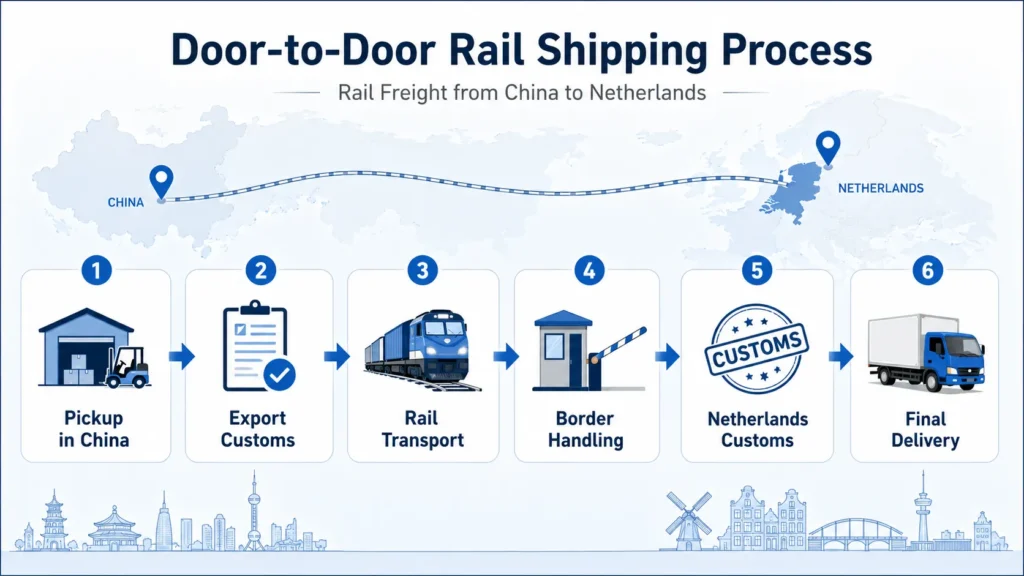
The shipment begins with collecting goods from the supplier or warehouse.
Before transportation starts, importers should provide accurate shipment details, including:
Product description
Quantity
Weight and dimensions
Packaging information
Delivery address
Before leaving China, cargo must complete export procedures.
Common documents include:
Commercial invoice
Packing list
Shipping details
Export information
After export clearance, containers are transported through China-Europe railway networks toward the Netherlands.
During international transportation, containers may pass through several border points where railway operations and customs procedures are completed.
Proper coordination helps reduce delays caused by transfer requirements.
After arrival in the Netherlands, shipments must complete import procedures according to Dutch customs and EU customs regulations.
After customs clearance, cargo is transported to the final destination by truck or other local delivery methods.
Door-to-door service is especially useful for companies that want simpler supply chain management and better control over the entire delivery process.
Customs clearance is an important step when shipping goods from China to the Netherlands by rail. After the cargo arrives in the Netherlands, importers must complete customs procedures before the goods can be released for final delivery or distribution across Europe.
Because the Netherlands is part of the European Union customs system, rail freight shipments must comply with EU customs regulations and Dutch import requirements. Proper preparation of shipment documents helps avoid delays, additional costs, and unnecessary inspections.
Importers usually need to prepare the following documents:
Commercial Invoice – Provides details about the seller, buyer, product description, quantity, and declared value of the shipment.
Packing List – Shows the package information, including the number of cartons, weight, dimensions, and packing details.
HS Code – Used to classify goods and determine applicable import duties and regulatory requirements.
EORI Number – Required for businesses involved in customs activities within the European Union.
Rail Transport Documents – Provide shipment details and support the customs declaration process.
The amount of import duties depends on the product type, HS code classification, and customs value of the goods. Importers should confirm the correct classification before shipping to avoid unexpected charges.
In addition to customs duties, imported goods are generally subject to Dutch import VAT. The standard VAT rate in the Netherlands is 21% for most products.
The final import cost may include:
Customs duties
Import VAT
Customs handling fees
Local delivery charges
Incorrect documentation is one of the most common reasons for customs delays. Importers can reduce risks by preparing accurate shipment information before the cargo leaves China.
Important points include:
Confirming the correct HS code before shipment
Preparing complete commercial invoices and packing lists
Providing accurate cargo descriptions and declared values
Checking product-specific import requirements
Working with an experienced freight forwarder for customs coordination
A reliable logistics partner can help manage customs clearance, coordinate with Dutch customs authorities, and ensure rail freight shipments move smoothly from arrival terminals to final delivery locations.
Rail freight is commonly selected by businesses that need a balance between transportation speed and cost. It is especially suitable for commercial goods that have higher value or require more predictable delivery compared with sea freight.
Typical products shipped by rail from China to the Netherlands include:
Electronics and electrical products
Automotive parts
Machinery and industrial equipment
Consumer goods
General commercial cargo
Rail freight is particularly attractive for goods that are:
Too expensive for regular sea shipping due to long transit times
Too large or heavy for economical air freight
Suitable for standard container transportation
However, some products may require additional checks or may not be suitable for international rail transport due to safety regulations, restrictions, or special handling requirements.
Importers should confirm cargo requirements before booking rail transportation, especially for:
Dangerous goods
Temperature-sensitive products
Restricted items
Choosing a reliable freight forwarder for rail freight from China to the Netherlands requires more than comparing transportation rates. Importers need a logistics partner that can coordinate cargo pickup, rail transportation, customs clearance, and final delivery to ensure the shipment moves smoothly from origin to destination.
Tonlexing provides flexible rail freight solutions for businesses shipping commercial cargo between China and the Netherlands, including FCL, LCL, and door-to-door shipping services.
With experience handling international shipments, Tonlexing helps customers manage different stages of the logistics process, including:
China export coordination: Supporting supplier communication, cargo pickup, shipment preparation, and rail booking arrangements from major Chinese departure cities.
FCL and LCL rail freight solutions: Providing suitable options for both large-volume shipments and smaller cargo based on container requirements, budget, and delivery schedules.
Customs clearance support: Assisting with shipment documentation, customs procedures, and coordination to help reduce delays during import and export processes.
Door-to-door delivery service: Managing transportation from supplier pickup in China to final delivery in the Netherlands, simplifying international shipping for importers.
By combining rail transport, customs coordination, and local delivery arrangements, Tonlexing helps businesses create a more efficient and reliable supply chain between China and the Netherlands.
Rail freight from China to the Netherlands usually takes around 15–25 days for the international rail journey. The final door-to-door delivery time may vary depending on pickup, customs clearance, and local transportation.
Rail freight costs from China to the Netherlands vary depending on the departure city, container size, cargo volume, railway route, and delivery requirements. A 20ft container (FCL) typically costs around USD 2,800–4,500, while a 40ft container (FCL) is approximately USD 4,000–5,700. For smaller shipments, LCL rail freight is usually calculated based on cargo volume, with reference rates around USD 260/CBM.
Yes. Rail freight is generally more cost-effective than air freight, especially for medium-sized commercial shipments. It provides a balance between transportation speed and shipping costs.
Yes. LCL rail freight is available for smaller shipments that do not require a full container. Cargo is consolidated with other shipments before international transportation.
Common documents include a commercial invoice, packing list, HS code information, EORI number, and transportation documents required for customs declaration.
Useful freight, customs and importing resources related to this shipping guide.
Shipping from China / Rail Freight from China International Rail Freight Services · China to Europe & Eurasia Rail Freight from China Move cargo...
Read guide →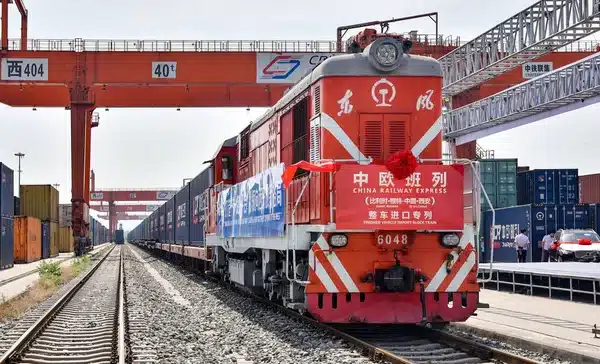
Railway freight has become an increasingly popular shipping solution for businesses looking to transport goods from China to Europe. The rise of...
Read guide →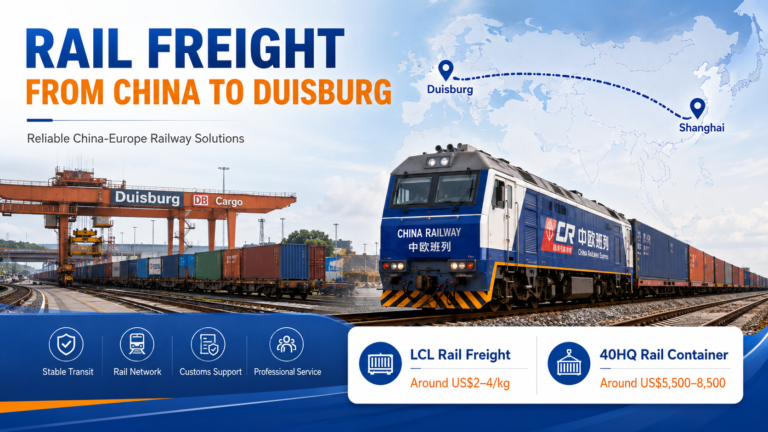
Rail Freight from China to Duisburg: Cost, Transit Time and Routes Verified & Reviewed · Last updated June 2026 Rail freight from China to Duisbu...
Read guide →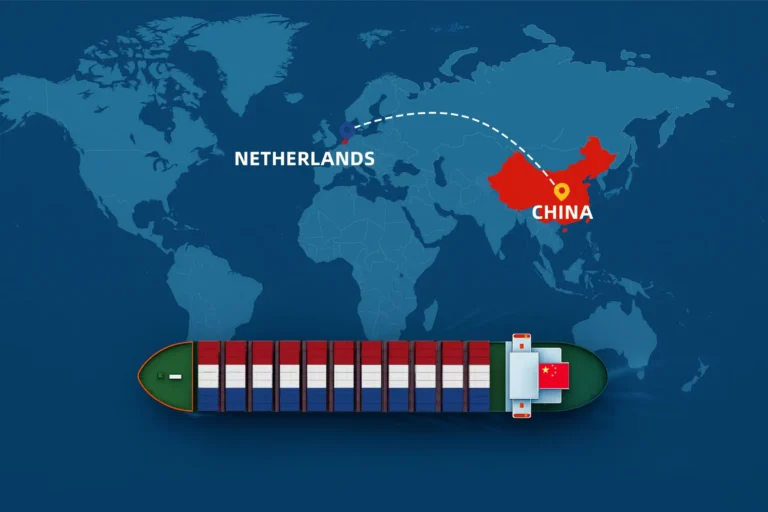
Shipping from China to the Netherlands – Sea, Air & DDP in 2026 Reliable shipping from China to the Netherlands for importers, distributors, and...
Read guide →Customs Clearance in the Netherlands Verified & Reviewed · Last updated June 2026 Customs clearance in the Netherlands is required when goods ent...
Learn more → Useful Resource Shipping Cost from China to NetherlandsShipping Cost from China to Netherlands (2026 Guide) Verified & Reviewed · Last updated June 2026 Shipping cost from China to the Netherlands in...
Learn more →WhatsApp us