
Related Guide
Rail Freight from China
Shipping from China / Rail Freight from China International Rail Freight Services · China to Europe & Eurasia Rail Freight from China Move cargo...
Read guide →

Rail freight from China to Duisburg is a practical shipping solution for importers who need faster delivery than sea freight and lower cost than air freight.
This guide explains rail freight from China to Duisburg, covering China Europe freight trains, transit times, rail freight costs, main routes through Central Asia and Europe, customs clearance, FCL and LCL options, and door-to-door delivery to Germany and other European destinations.
Rail freight cost
Transit time range
Door to Door service
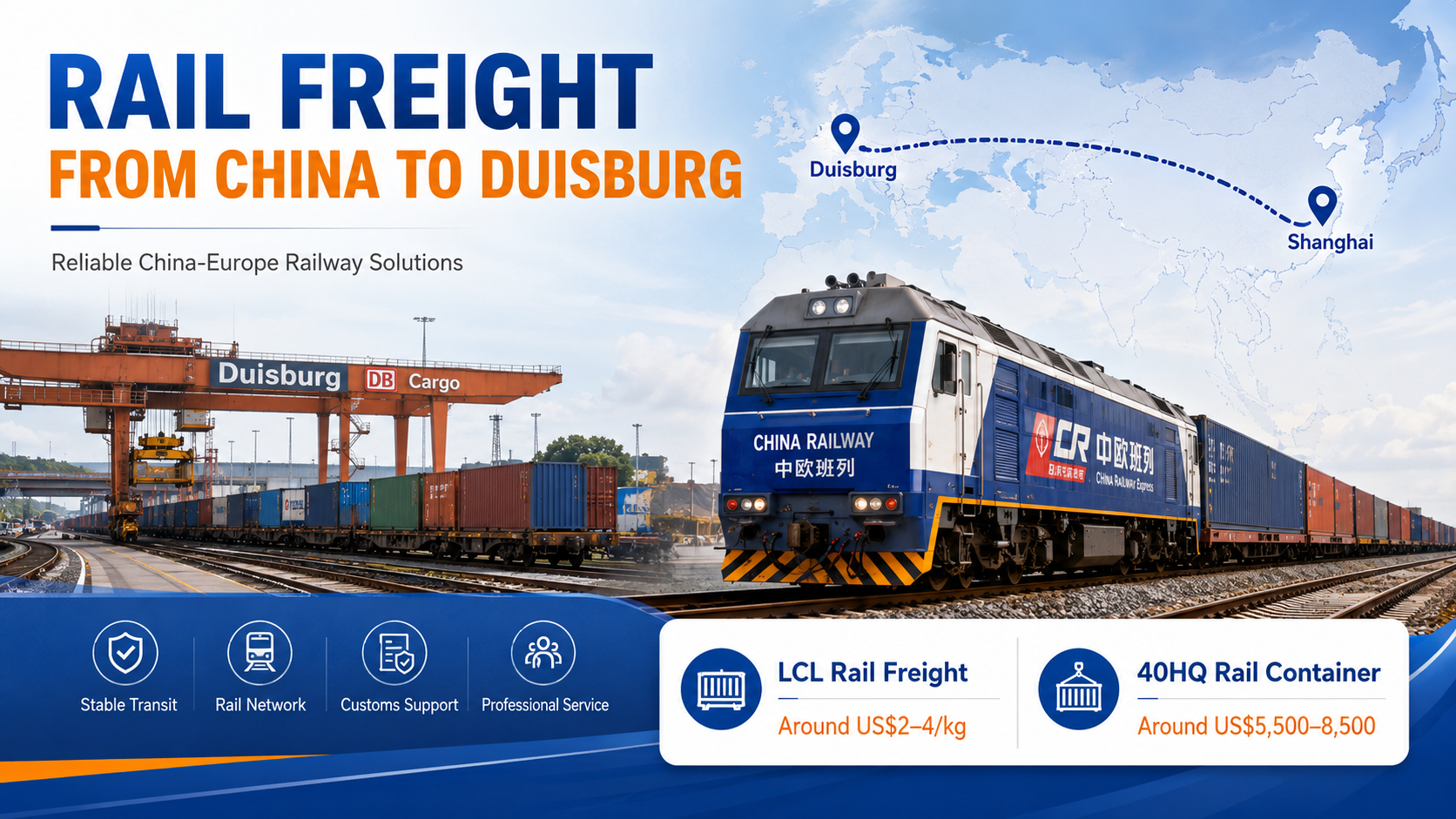
Rail freight from China to Duisburg connects Chinese manufacturing areas with European inland markets by train. Most cargo is transported in containers and moves through Central Asia, Russia, Belarus, Poland, and Germany before arriving in Duisburg.
Compared with sea freight, rail freight offers much shorter transit times. Compared with air freight, it is more cost effective for medium and large shipments. This makes rail transport a strong middle option for importers who need faster delivery but still want to control logistics costs.
Main advantages of rail freight include:
Faster transit than sea freight
Lower cost than air freight
Stable schedules on major China Europe freight trains
Suitable for FCL and LCL shipments
Good access to inland Germany and other European cities
Better supply chain planning for regular imports
Common goods transported by rail include electronic products, machinery, automotive parts, apparel, furniture, tools, household goods, industrial equipment, and e-commerce cargo.
Duisburg plays an important role in China Europe freight trains because it is not only an arrival city, but also a major logistics hub. The city handles over 4 million TEUs annually through its multimodal network and is widely known as one of the largest inland ports in Europe.
This strong container handling capacity makes Duisburg a strategic arrival point for rail cargo from China. After arrival, containers can be transferred to trucks, barges, warehouses, or other railway services for final delivery across Europe.
Duisburg is especially useful for delivery to:
Germany
Eastern Europe
The UK
For UK shipments, cargo can continue through ferry routes or transport plans connected with the Channel Tunnel, depending on the final destination and customs requirements.
China Europe freight trains developed quickly with the support of the Belt and Road Initiative. This wider road initiative improved land transportation links between Asia and Europe and created a practical alternative to traditional sea transportation and air transportation.
In 2024, 19,392 China-Europe freight trains operated throughout the year. This shows that rail transport is no longer only a backup option, but a regular supply chain solution for international trade between China and Europe.
The Europe freight train service is now used by many types of companies, including:
Manufacturers exporting from China
European importers needing faster restocking
E-commerce sellers managing inventory cycles
Automotive and machinery companies
Retailers shipping seasonal products
Logistics companies building China-Europe supply chains
For importers who need stable schedules, predictable arrival, and better cost control, China Europe freight trains have become an important part of modern logistics planning.
Rail freight from China to Duisburg operates through the China-Europe Railway Express network, linking major manufacturing and logistics centers in China with Germany’s largest inland logistics hub. Most trains travel west through Central Asia, Russia, Belarus, and Poland before entering Germany and arriving in Duisburg.
Because rail gauges differ between China, the former Soviet rail network, and Europe, containers are transferred at designated border terminals during transit. This is a standard procedure and is carefully coordinated by railway operators to ensure cargo continues moving efficiently.
Xi’an has become one of the busiest hubs for China Europe freight trains and serves as a major consolidation center for cargo from northern, western, and central China. Thanks to its high train frequency and extensive route network, Xi’an is often the preferred departure city for regular rail shipments to Europe.
Typical cargo includes:
Electronics and consumer products
Automotive components
Machinery and industrial equipment
Furniture and household goods
E-commerce shipments
Under normal conditions, rail freight from Xi’an to Duisburg usually takes around 11 to 14 days.
Chongqing was one of the first Chinese cities to launch direct rail freight services to Europe and remains an important gateway for southwestern China. The route is widely used by electronics manufacturers, automotive suppliers, and industrial exporters.
Compared with coastal shipping routes, Chongqing offers a faster inland connection to Europe and helps reduce transportation time for factories located in western China.
Transit time from Chongqing to Duisburg is typically around 14 to 18 days, depending on train schedules and border operations.
In addition to Xi’an and Chongqing, China Europe freight trains to Duisburg also depart from several other logistics hubs across China. These cities connect different manufacturing regions and provide flexible routing options for exporters.
Major departure cities include:
Chengdu
Zhengzhou
Wuhan
Yiwu
Suzhou
Shanghai
Shenzhen
Guangzhou
Cargo from Southeast Asia can also be consolidated in China and connected to the rail network, allowing importers to move goods from multiple suppliers through a single rail freight solution to Duisburg and other European destinations.
Rail freight transit time from China to Duisburg is usually around 12 to 18 days for station-to-station service. Door-to-door delivery normally takes around 20 to 25 days because it includes pickup, warehouse handling, customs clearance, arrival handling, and final delivery.
The actual transit time depends on the origin city, train schedule, border handling, customs process, railway capacity, and terminal operation in Poland or Germany. Fixed train numbers and regular schedules can help improve delivery planning, but importers should still allow some buffer time during peak seasons.
| Route or Service | Estimated Transit Time |
|---|---|
| Xi’an to Duisburg | Around 11–14 days |
| Chongqing to Duisburg | Around 14–18 days |
| Chengdu to Duisburg | Around 15–20 days |
| China to Duisburg door to door | Around 20–25 days |
| China to Germany by sea freight | Around 30–45 days |
| China to Germany by air freight | Around 3–7 days |
Possible delay factors include:
Border congestion
Customs inspection
Container availability
Railway capacity
Weather conditions
Terminal operation in Poland or Germany
Rail is much faster than sea freight and more affordable than air freight. This makes it suitable for goods that need faster arrival but do not require emergency delivery by air.
Rail freight cost from China to Duisburg depends on cargo weight, cargo volume, departure city, container type, train schedule, customs requirements, and final delivery address. In general, rail is more expensive than sea freight but much cheaper than air freight.
For many importers, the value of rail is not only the basic freight rate. Faster arrival can reduce inventory pressure, support seasonal sales, and improve cash flow. This is especially important for e-commerce stock, spare parts, electronic products, machinery, and products with fixed delivery windows.
| Shipping Option | Estimated Cost Reference | Best For |
|---|---|---|
| LCL rail freight | Around US$2–4/kg | Small and medium cargo |
| 40HQ rail container | Around US$5,500–8,500 | Full container shipments |
| Door-to-door rail freight | Quoted case by case | Importers needing final delivery |
A complete rail quote should include more than the train freight rate. Importers should check whether the quotation includes pickup, warehouse handling, export customs declaration, railway freight, transit documents, customs clearance, terminal handling, and final truck delivery.
Main cost factors include:
Cargo weight and volume
FCL or LCL shipping mode
Departure city in China
Train space and schedules
Container availability
Customs declaration requirements
Final delivery distance in Europe
Before booking, the freight forwarder should confirm the product name, HS code, packing details, cargo value, and whether the goods can be transported by rail.

Rail freight from China to Duisburg can be shipped as either FCL (Full Container Load) or LCL (Less than Container Load). The right option depends on cargo volume, shipment value, delivery requirements, and budget.
For larger shipments, FCL usually provides better efficiency and cargo security. For smaller shipments, LCL offers a more flexible and cost-effective solution while still benefiting from faster transit times than sea freight.
FCL rail freight means your cargo occupies the entire container. This option is commonly used for larger shipments, high-value products, and regular import orders.
Because the container is dedicated to one customer, there is less cargo handling during transit, which helps reduce the risk of damage and improves shipment security.
FCL rail freight is often chosen for:
Machinery and industrial equipment
Automotive components
Furniture and household goods
Electronics and commercial cargo
Large-volume shipments
For importers with enough cargo to fill a container, FCL is usually the most efficient rail shipping option.
LCL rail freight means your cargo shares container space with shipments from other customers. This option is ideal when the shipment volume is not large enough to justify a full container.
LCL helps reduce transportation costs while still providing faster transit times than traditional sea freight. It is commonly used by small and medium-sized businesses importing goods from China to Europe.
LCL rail freight is suitable for:
E-commerce products
Spare parts
Apparel and retail goods
Samples and trial orders
Small and medium cargo shipments
Although LCL is more economical for smaller shipments, it may require additional consolidation and deconsolidation handling, which can slightly increase transit time compared with FCL rail freight.
Customs clearance is one of the most important stages of rail freight from China to Duisburg. Even when the train arrives on schedule, customs issues can still cause delays if documents are incomplete, product information is inaccurate, or the declared value does not match the shipment.
Before cargo can be loaded onto a China-Europe freight train, export customs declaration must be completed in China. The information provided to customs should match the actual shipment, including product descriptions, quantities, weight, packaging details, and cargo value.
Common export documents include:
Packing list
Export customs declaration
Rail waybill
For regulated products, additional certificates or licenses may be required before export approval is granted.
After arrival in Duisburg, the shipment must complete import customs clearance before final delivery can be arranged. German customs authorities may review the cargo value, product classification, and supporting documents to determine whether duties, VAT, or additional inspections apply.
Importers should normally prepare:
EORI identification number
Commercial invoice
Packing list
Rail transport documents
Product certificates if required
Customs authorization documents when applicable
For some rail routes, transit documentation may also be prepared in Chinese, English, and Russian to support customs procedures along the journey. Working with an experienced freight forwarder can help reduce customs delays and ensure compliance with both Chinese and European regulations.
Rail transport is suitable for goods that need better speed than sea freight and lower cost than air freight. It is especially useful for medium and high-value cargo that must arrive within a predictable delivery window.
Common goods transported by train include:
Apparel and retail products
Automotive components
Machinery and equipment
Electronics and electronic products
Premium furniture
Tools and hardware
Household goods
E-commerce products
Industrial equipment
Construction-related goods
Pharmaceuticals that meet rail and customs requirements
High-value products like machinery, premium furniture, electronics, and industrial equipment are often transported by rail because faster arrival helps reduce inventory pressure. Rail freight also generally emits lower carbon emissions than air transport, which can support more sustainable logistics planning.
Some cargo needs to be checked before booking. Liquids, powders, batteries, chemicals, dangerous goods, and temperature-sensitive cargo may require special confirmation or may not be accepted by railways. A freight forwarder should review the cargo details before arranging transport.
Door-to-door rail freight service includes the full shipping process from the supplier’s warehouse in China to the final delivery address in Germany or Europe. This service is useful for customers who do not want to coordinate several logistics providers.
A complete door service can include supplier pickup, warehouse consolidation, export customs declaration, train booking, rail transport, cargo tracking, import customs clearance, and final truck delivery. The main benefit is that one provider manages the full journey from China to Europe.
Door-to-door rail freight is especially helpful when:
The importer has multiple suppliers in China
The customer has limited logistics staff
The buyer has no customs broker in Germany
The shipment needs delivery to several European countries
A general manager or purchasing team wants simpler cost control
This service can cover delivery from Duisburg to Germany, Poland, the Netherlands, Belgium, France, Eastern Europe, and the UK, depending on the final address and customs requirements.
Tonlexing Logistics Ltd provides rail freight service from China to Duisburg for LCL, FCL, and door-to-door shipments. The service can be arranged from major Chinese cities such as Xi’an, Chongqing, Chengdu, Zhengzhou, Wuhan, Yiwu, Shanghai, Shenzhen, Guangzhou, and other manufacturing areas.
Tonlexing helps customers compare rail freight, sea freight, air freight, and combined logistics solutions based on cargo type, shipping cost, transit times, customs requirements, and final destination. The goal is to create a cost effective plan that supports the customer’s supply chain.
Tonlexing can assist with:
Supplier pickup in China
Warehouse consolidation
Export customs declaration
Train booking
Cargo tracking
Customs clearance in Europe
Final delivery to Duisburg or other European destinations
For importers shipping to Germany, the UK, Poland, France, the Netherlands, Belgium, and Eastern Europe, Tonlexing can help simplify the process and reduce communication between multiple logistics providers.
Rail freight from China to Duisburg usually takes around 12 to 18 days for station-to-station service. Door-to-door delivery often takes around 20 to 25 days, depending on pickup city, train schedule, customs process, and final destination.
LCL rail freight may cost around US$2 to US$4 per kg as a general reference. A 40HQ rail container may cost around US$5,500 to US$8,500. The final price depends on cargo size, weight, departure city, route, season, customs requirements, and delivery address.
Yes. Rail freight is usually much cheaper than air freight, especially for medium and large shipments. It is slower than air, but it offers a better balance between cost and transit time.
Yes. Rail freight is usually faster than sea freight. Sea shipping from China to Germany may take around 30 to 45 days, while the train to Duisburg often takes around 12 to 18 days.
Yes. Door-to-door rail freight can include pickup in China, rail transport to Duisburg, customs clearance in Europe, and final delivery to Germany or other European destinations.
Useful freight, customs and importing resources related to this shipping guide.
Shipping from China / Rail Freight from China International Rail Freight Services · China to Europe & Eurasia Rail Freight from China Move cargo...
Read guide →
Railway freight has become an increasingly popular shipping solution for businesses looking to transport goods from China to Europe. The rise of...
Read guide →
Rail Freight from China to Germany Verified & Reviewed · Last updated June 2026 Rail freight from China to Germany offers a balanced shipping sol...
Read guide →
With the rise of global trade and the expansion of transport networks, rail freight has become a popular and reliable method for shipping goods f...
Read guide →Shipping from China to Germany includes efficient logistics via air and ocean freight. Compare transit times, shipping costs, and import requirem...
Learn more → Useful Resource Shipping Cost from China to GermanyShipping Cost from China to Germany (2026 Guide) Verified & Reviewed · Last updated June 2026 Shipping cost from China to Germany in 2026 typical...
Learn more →WhatsApp us