Related Guide
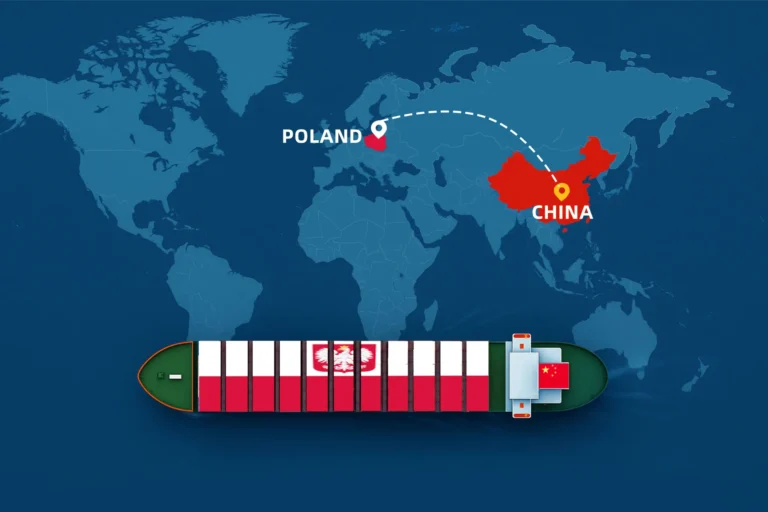
Shipping from China to Poland
Shipping from China to Poland – Rail, Sea & Door-to-Door in 2026 Fast, reliable shipping from China to Poland for B2B importers, eCommerce seller...
Read guide →

Shipping from China to Gdansk offers flexible logistics solutions for importers moving cargo from China to Poland by sea freight, rail freight, air freight, and express shipping.
This guide explains China to Gdansk shipping options, transit time, shipping cost, customs clearance in Poland, and door-to-door delivery solutions, including FCL, LCL, rail freight, air freight, and DDP shipping.
Shipping method / Mode
Transit time range
DDP / Door to Door
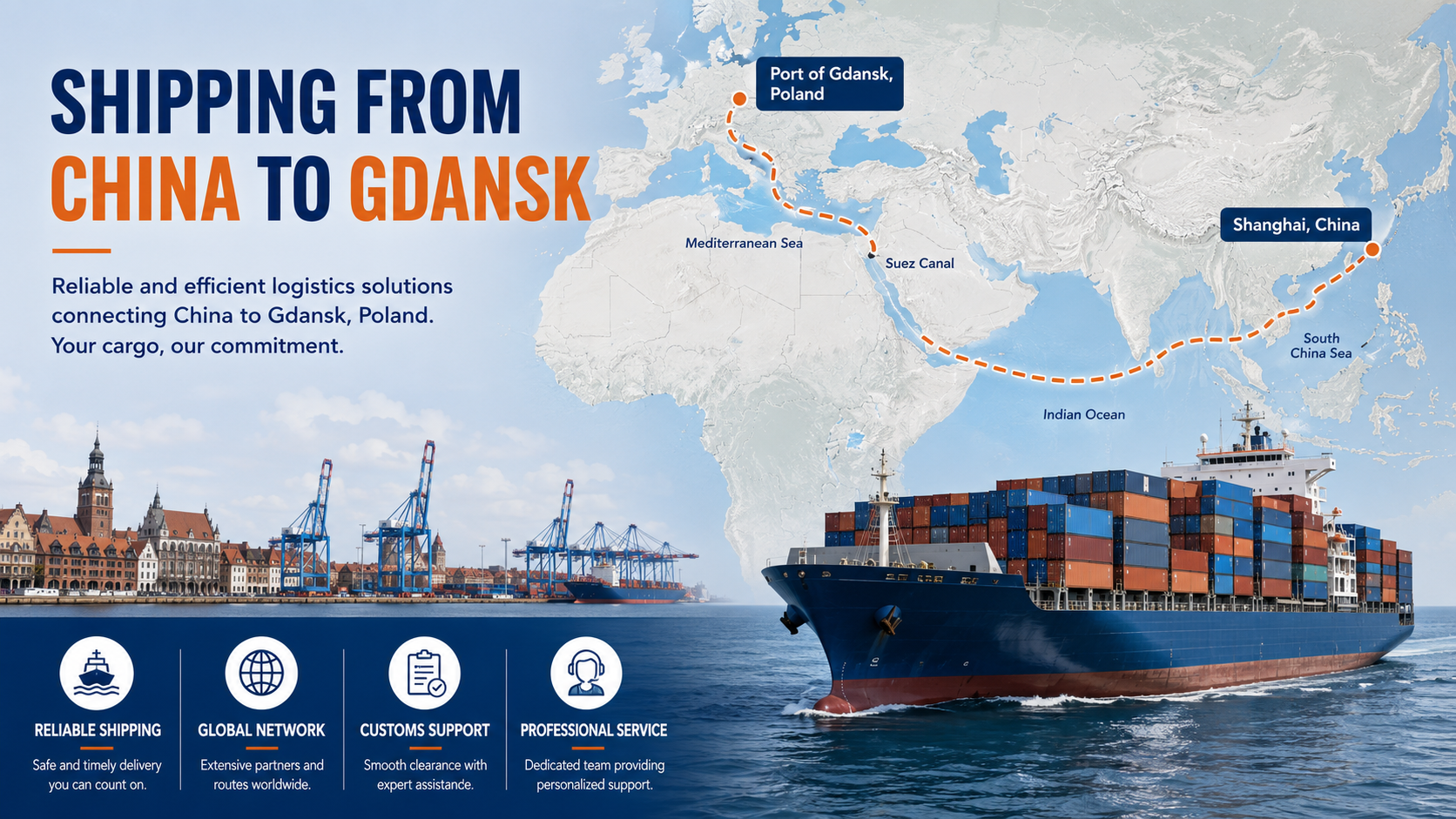
When shipping from China to Gdańsk, importers can choose from several transportation methods depending on cargo type, budget, and delivery urgency. The most commonly used solutions include sea freight, rail freight, air freight, and express shipping. Each method offers a different balance between cost efficiency, transit time, and cargo capacity, making it important to select the right option based on your shipping needs.
Below is a breakdown of the main shipping options available for China to Poland logistics through the Port of Gdańsk and other EU entry points.
Sea freight, also known as ocean freight, is the most widely used shipping method for transporting goods from China to Gdańsk, especially for bulk cargo and full container shipments. Cargo is shipped by container vessel from major Chinese ports to the Port of Gdańsk, which serves as a key gateway for imports into Poland and Central Europe.
This method is highly suitable for businesses that prioritize cost efficiency over speed. It is commonly used for industrial and commercial cargo with stable delivery timelines.
Typical applications include machinery, furniture, building materials, textiles, automotive parts, and general cargo. FCL is ideal when cargo volume exceeds 15 cubic meters.
Key advantages of sea freight:
Lowest cost per unit for large volume shipments
Suitable for full container and consolidated cargo
Stable schedules with regular vessel departures
Flexible FCL and LCL shipping options
FCL (Full Container Load) is recommended when shipment volume is large enough to fill a container, while LCL (Less than Container Load) is ideal for smaller shipments that do not require a full container.
Rail freight has become a strong alternative to sea freight for China to Poland shipping routes. Cargo moves via the China-Europe Railway Express and typically enters Europe through Poland before final delivery to Gdańsk by truck.
Compared with sea freight, rail freight significantly reduces transit time while maintaining reasonable shipping costs, making it suitable for medium-volume and time-sensitive cargo.
Typical use cases for rail freight include:
Consumer electronics and retail goods
Automotive parts and industrial components
E-commerce and warehouse replenishment cargo
Medium-volume commercial shipments
Key advantages of rail freight:
Faster than sea freight (around 14–22 days)
More cost-efficient than air freight
Stable China–Europe railway schedule
Suitable for Central and Eastern Europe distribution
Rail freight is especially useful for importers shipping to multiple EU destinations beyond Gdańsk, including Warsaw, Łódź, and other inland logistics hubs.
Air freight is the fastest shipping option for transporting goods from China to Gdańsk. It is mainly used for urgent, high-value, or time-sensitive shipments where delivery speed is the top priority.
Since not all cargo flights land directly in Gdańsk, shipments are often routed through Warsaw Chopin Airport or other major European airports before being transported by truck to the final destination, often with carriers such as Air China supporting China-Poland air links.
Air freight is commonly used for electronics, spare parts, medical supplies, fashion products, and commercial samples. Although air freight is more expensive, rates are around USD 7.40 per kg as of June 2026, and it is typically 5–8 times more expensive than sea freight.
Key advantages of air freight:
Fastest transit time (around 5–7 days)
High reliability for urgent shipments
Strong security for high-value goods
Suitable for small to medium cargo volume
Although air freight is more expensive than sea or rail transport, it plays an important role in time-critical supply chains where delays are not acceptable, often routing through Warsaw Chopin Airport or other major European hubs with carriers such as Air China.
Express shipping is designed for small parcels, samples, and urgent documents that require fast door-to-door delivery. It is typically handled by international courier services with integrated tracking and customs processing.
This method is ideal for lightweight cargo that does not require pallet or container transport.
When to use express shipping:
Small shipments under courier weight limits
Product samples and test orders
Urgent documents or contracts
Time-critical e-commerce parcels
Key advantages:
Fast delivery in 2–5 business days
Door-to-door convenience
Simple customs handling process
Real-time shipment tracking
However, express shipping becomes expensive for heavier cargo and is not suitable for bulk or container-level shipments.
In addition to standard transport methods, many importers and other shippers choose door-to-door or Delivered Duty Paid (DDP) shipping from China to Gdańsk. These solutions combine pickup, international transport, customs clearance, and final delivery into a single service.
This option is especially popular among importers who want a simplified shipping process without dealing with multiple carriers or customs brokers.
Typical door-to-door process includes:
Pickup from supplier in China
Export customs clearance
International transport by sea, rail, or air
Import customs clearance in Poland
Final delivery to warehouse or address in Gdańsk
Key advantages:
Simplified logistics management
One-stop shipping solution
Reduced coordination workload
Suitable for small and medium importers
DDP shipping is particularly useful for e-commerce sellers and first-time importers who want predictable landed costs.
The shipping cost from China to Gdańsk depends on the shipping method, cargo volume, cargo weight, container size, origin city, destination address, customs requirements, and overall market freight rates.
The following cost references are used for early budget planning. Final shipping rates should always be confirmed before booking, as prices may change due to seasonality, fuel surcharges, space availability, port congestion, and carrier adjustments.
| Shipping Method | Estimated Cost Reference | Estimated Transit Time | Best For |
|---|---|---|---|
| Sea Freight 20GP | USD 2,430–2,970 | 30–45 days | Heavy cargo and full container shipments |
| Rail Freight 20GP | USD 3,960–4,840 | 14–22 days | Faster container delivery to Poland |
| Air Freight | From USD 7.40 per kg | 5–7 days | Urgent and high-value cargo |
| Express Shipping | USD 10–15 per kg | 2–5 business days | Small parcels and samples |
| LCL Shipping | USD 35–60 per CBM | 35–50 days | Small and medium shipments below container load |
The main logistics corridor for shipping from China to Gdańsk is the Asia–Europe trade route, connecting major Chinese export hubs with Poland via sea, rail, and multimodal transport. Depending on cost, transit time, and cargo type, importers typically use three primary routes to move goods into Gdańsk and wider Central and Eastern Europe.
This is the most cost-effective and widely used route for large-volume container shipping from China to Gdańsk. Goods are transported by container ship from major Chinese ports and delivered directly to the Port of Gdańsk via established Asia–Europe shipping lanes.
The Path:Ships depart from major Chinese ports (Shanghai, Ningbo, Shenzhen, Qingdao) → cross the South China Sea → pass through the Malacca Strait → cross the Indian Ocean → enter the Red Sea → transit the Suez Canal → pass the Mediterranean Sea → move through the Atlantic and North Sea → enter the Baltic Sea → arrive at the Port of Gdańsk
Transit Time:Around 30–45 days depending on vessel schedule, port congestion, and seasonal demand
Alternative Route:If the Suez Canal route is disrupted, vessels may reroute via the Cape of Good Hope in South Africa, which extends transit time by approximately 10–14 days and increases fuel costs
When sea freight is too slow and air freight is too expensive, rail freight provides a balanced solution for shipping from China to Poland and Gdańsk. Cargo is transported through the China–Europe railway network and enters Europe via Poland before final truck delivery.
The Path:Cargo is loaded in inland China hubs (Xi’an, Zhengzhou, Chengdu, Chongqing) → travels through Kazakhstan → Russia or Belarus → enters the European Union via Poland (Małaszewicze rail terminal) → transferred to rail or truck → delivered to Gdańsk. Return rail flows also connect with inland hubs in Germany, especially Duisburg, a major Europe–China rail logistics center.
Transit Time:Around 14–22 days depending on route and border clearance
Final Leg to Gdańsk:After customs clearance or rail gauge transfer in Poland, cargo is delivered by truck or domestic rail directly to Gdańsk and surrounding logistics zones
If direct vessel services to Gdańsk are not available, cargo may be shipped via transshipment hubs in Western Europe. This is a common alternative routing structure for China to Poland shipments.
The Path:
Cargo is shipped from China → arrives at major European hub ports such as Rotterdam, Hamburg, or Antwerp → container is transferred to feeder vessels → shipped through the North Sea and Baltic Sea → delivered to the Port of Gdańsk
Transit Time:
Around 40–55 days depending on transshipment waiting time and port congestion
Key Feature:
This route increases flexibility when direct sailings are limited, but may involve additional handling and longer total transit time
Customs clearance in Poland is a key process for all shipments arriving from China to Gdańsk and other EU entry points. As a member of the European Union, Poland follows EU customs regulations, which means imported goods must go through document review and the assessment and payment of VAT and customs duty before they can be released for final delivery, with the integrated tariff used to confirm applicable rates and restrictions.
To clear goods entering Poland, importers must ensure all essential documents and import details are correctly prepared before arrival.
EORI Number: Required for all EU importers to process customs declarations
Commercial Invoice: Declares product description, value, Incoterms, and seller/buyer details
Packing List: Includes carton count, weight, volume, and packaging information
Bill of Lading / Air Waybill: Transport document for sea, air, or rail shipments
HS Codes: Used for tariff classification and duty calculation Verify applicable tariffs and restrictions in the EU TARIC and Poland’s ISZTAR integrated tariff systems.
Product Certificates: Required for regulated or controlled goods
Accurate documentation is essential to avoid delays at Polish customs and ensure faster release at the Port of Gdańsk or inland terminals.
Import duties and taxes are calculated based on EU tariff rules and the declared CIF value of goods (cost, insurance, and freight). Poland applies standard EU customs procedures for all imports from China.
Customs Duty: Typically ranges from 0% to 12% depending on HS code
VAT Rate: 23% applies to most imported goods in Poland
Tax Base: Calculated on CIF value (goods + freight + insurance)
Proper HS code classification is critical, as it directly affects duty rates, import restrictions, and total landed cost.
The customs clearance process generally follows a structured workflow once cargo arrives in Poland or the EU entry point.
Submission of import declaration
Document verification by customs authorities
HS code and duty rate assessment
VAT and duty calculation
Payment of import taxes (if applicable)
Cargo release for delivery
For sea freight shipments, clearance usually takes place at the Port of Gdańsk or designated inland customs terminals. For air freight, clearance is handled at airports such as Warsaw Chopin Airport or Gdańsk Lech Wałęsa Airport.

Dangerous goods (DG cargo) and special cargo shipped from China to Gdańsk require strict compliance with international transport regulations due to safety risks during handling, storage, and transportation. These shipments must be correctly classified, declared, and packaged before acceptance by carriers.
Dangerous goods refer to products that may pose risks to safety, health, or the environment during transport. Special cargo includes shipments that require additional handling due to physical or chemical properties.
Common DG cargo types include:
Lithium batteries and battery-powered products
Chemicals and liquids
Flammable or corrosive materials
Aerosols and pressurized containers
Magnetic materials
Machinery containing oil or fuel
Powders or industrial substances
Not all transport methods are suitable for dangerous goods. Acceptance depends on carrier regulations and cargo classification.
Sea freight: Most commonly used for DG cargo
Rail freight: Limited acceptance depending on product type
Air freight: Strictly controlled, only approved DG cargo allowed
Express shipping: Very limited, mainly small battery products
Sea freight remains the most flexible option for most DG shipments from China to Poland.
Shipping costs from China to Gdańsk can vary significantly depending on cargo volume, transport mode, routing, and customs requirements. While freight rates are influenced by market conditions, importers can still reduce total logistics costs through better planning, optimized shipping methods, and improved cargo preparation.
The key to cost reduction is not only choosing the cheapest freight option, but also improving efficiency across the entire supply chain, including packaging, consolidation, and customs clearance.
Selecting the most suitable transport mode is one of the most effective ways to control shipping costs.
Sea freight is the most cost-efficient option for large volume shipments
Rail freight offers a balance between cost and transit time
Air freight should be used only for urgent or high-value cargo
Express shipping is suitable only for small parcels and samples
Choosing the wrong method often leads to unnecessary logistics expenses.
Shipping cost is heavily influenced by cargo size, weight, and space utilization. Poor packaging can increase volumetric weight or CBM, leading to higher charges.
Maximize container utilization for FCL shipments
Avoid unnecessary empty space in cartons or pallets
Use standardized packaging sizes when possible
Consolidate multiple small shipments into one load
Efficient packing directly reduces per-unit shipping cost.
For importers buying from multiple suppliers in China, consolidation can significantly reduce costs.
Combine shipments from different suppliers into one container
Reduce LCL handling fees and multiple origin charges
Improve overall freight efficiency for Europe-bound cargo
Consolidation is especially useful for shipments to Gdańsk when cargo volume is not large enough for a full container.
Origin and routing choices also impact total shipping cost.
Use the nearest major Chinese port to reduce inland trucking cost
Avoid unnecessary transshipment routes when direct service is available
Choose rail routes only when time savings justify the cost difference
Compare multiple carrier options for China to Poland routes
Proper routing selection helps avoid hidden logistics expenses.
Last-minute bookings often result in higher freight rates due to limited space availability.
Book early during peak seasons
Avoid shipping close to holidays or congestion periods
Lock in rates when market prices are stable
Plan regular shipments instead of urgent one-off bookings
Advance planning helps secure more stable and competitive rates.
Customs-related delays and penalties can increase total landed cost significantly.
Ensure correct HS codes before shipment
Prepare accurate commercial invoices and packing lists
Confirm EU import requirements in advance
Avoid under-declared or inconsistent cargo values
Smooth customs clearance in Poland helps reduce storage fees and unexpected charges at destination.
A professional freight forwarder can help optimize routing, consolidate cargo, and negotiate better carrier rates.
Access to better sea, rail, and air freight pricing
Guidance on cost-efficient shipping routes to Gdańsk
Support with customs clearance and documentation
Reduced risk of delays and additional charges
A well-structured logistics plan often reduces total shipping cost more than focusing on freight rates alone.
The shipping cost depends on cargo weight, volume, container size, shipping method, origin port, delivery address, customs clearance, and freight market conditions. Sea freight is usually the cheapest option for large shipments, while air freight and express shipping cost more but deliver faster.
Sea freight from China to Gdańsk usually takes around 30–45 days. LCL shipping may take longer because of consolidation and deconsolidation. Rail freight from China to Poland usually takes around 14–22 days, while air freight to Poland averages 5–7 days. Express shipping can deliver in about 2–5 business days.
Sea freight is usually the most economical method for large shipments and full container cargo. For smaller shipments, LCL shipping can be more cost-effective than booking a full container.
Yes. Rail freight from China to Poland is available through China-Europe railway routes. Cargo usually arrives at a rail hub in Poland or Europe, then moves by truck to Gdańsk or the final delivery address.
Yes. Air freight can be arranged from major Chinese airports to Warsaw Chopin Airport, Gdańsk Lech Wałęsa Airport, or other European airports, followed by truck delivery to Gdańsk. It is suitable for urgent, high value, and time sensitive cargo.
Useful freight, customs and importing resources related to this shipping guide.
Shipping from China to Poland – Rail, Sea & Door-to-Door in 2026 Fast, reliable shipping from China to Poland for B2B importers, eCommerce seller...
Read guide →Shipping Cost from China to Poland (2026 Guide) Verified & Reviewed · Last updated May 2026 Shipping cost from China to Poland in 2026 typically...
Read guide →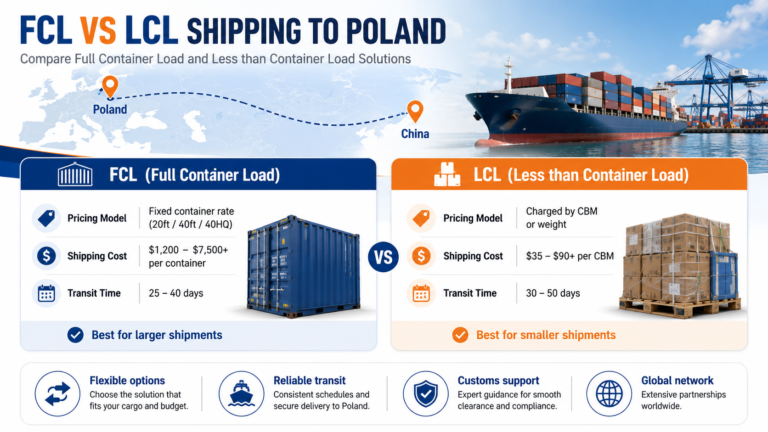
FCL vs LCL Shipping to Poland Verified & Reviewed · Last updated June 2026 FCL vs LCL Shipping to Poland from China is one of the most common que...
Read guide →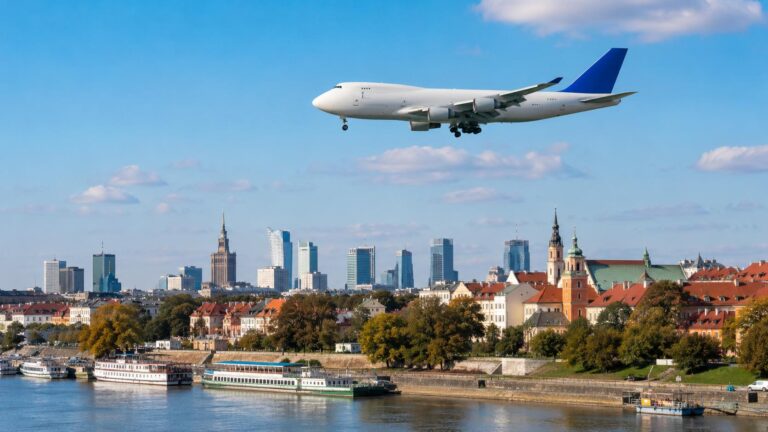
Air Freight from China to Poland Verified & Reviewed · Last updated May 2026 Air freight from China to Poland is a fast and reliable shipping opt...
Read guide →20ft 40ft Container Shipping Costs from China to Poland Verified & Reviewed · Last updated May 2026 20ft and 40ft container shipping costs from C...
Learn more → Useful Resource DDP Shipping from China to PolandDDP Shipping from China to Poland Verified & Reviewed · Last updated May 2026 Shipping costs for DDP shipments from China to Poland vary dependin...
Learn more →WhatsApp us