Related Guide
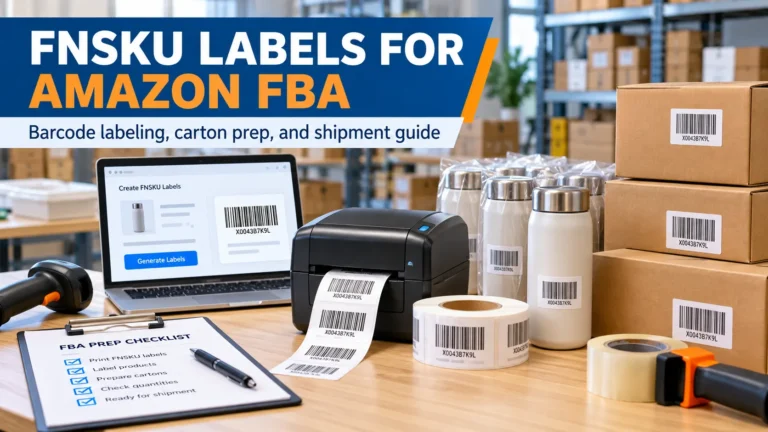
FNSKU Labels for Amazon FBA
FNSKU Labels for Amazon FBA: Requirements, Size & How to Print Verified & Reviewed · Last updated October 2026 FNSKU labels are used to identify...
Read guide →

SKU, UPC, and FNSKU serve different purposes when importing products from China for Amazon FBA. SKU tracks internal inventory, UPC identifies retail products, and FNSKU tracks seller-specific FBA inventory.
This 2026 guide compares barcode requirements, Amazon FBA labeling rules, and how to prepare product labels with Chinese suppliers before shipping.
SKU vs UPC vs FNSKU
Amazon FBA Barcodes
China Supplier Labeling
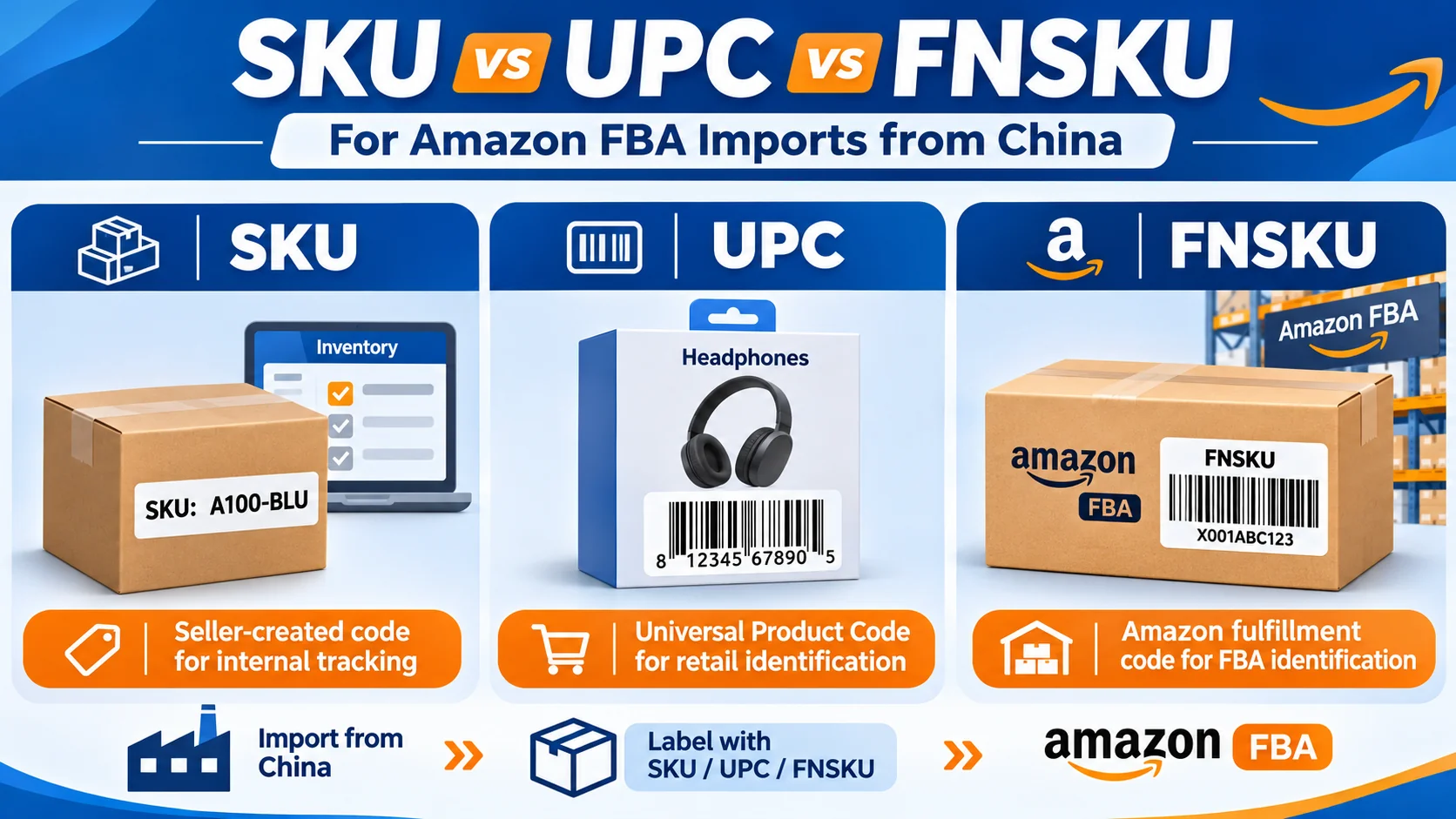
| Feature | SKU | UPC | FNSKU |
|---|---|---|---|
| Full Name | Stock Keeping Unit | Universal Product Code | Fulfillment Network Stock Keeping Unit |
| Assigned By | Seller | Brand owner using a GS1-issued GTIN | Amazon |
| Identifies | Seller's inventory or offer | A retail product | Seller-specific FBA inventory |
| Main Purpose | Internal inventory tracking | Product identification | Amazon warehouse tracking |
| Barcode | Not required | Yes | Yes |
| Where Used | Inventory systems and Seller Central | Product packaging and retail channels | Individual FBA units |
The three identifiers are not interchangeable. A seller may use all three for the same product, but each serves a different purpose.
What about ASIN?
ASIN stands for Amazon Standard Identification Number. It identifies a product in Amazon’s catalog, while an FNSKU identifies inventory associated with a specific seller’s FBA offer.
An SKU is an internal alphanumeric code created by a seller to organize and track inventory. It helps distinguish products, variations, and stock quantities within a business.
Unlike UPC and FNSKU, an SKU does not need to be a scannable barcode.
Amazon sellers use SKUs to manage product listings, monitor stock levels, organize purchasing records, and communicate with suppliers.
For example, a seller importing ceramic mugs from China might use:
MUG-BLACK-12OZ
MUG-WHITE-12OZ
MUG-BLUE-16OZ
Each code identifies a particular product variation. This makes it easier to match purchase orders, supplier packing lists, and inventory records.
Use a consistent SKU structure that includes product type, color, size, or model.
For example, BOTTLE-BLK-750ML identifies a black 750 ml bottle.
Provide the corresponding SKU in your purchase order and product specifications. This helps Chinese suppliers identify the correct products and reduces the risk of mixing variations during production and packing.
Remember that a seller SKU is for internal organization. It does not replace the product identifier required for listing creation or the barcode required for FBA inventory tracking.
A UPC is a standardized product identifier used in retail. The common UPC-A format contains 12 digits and represents a GTIN-12.
Unlike an SKU, a UPC is not an internal code that sellers can create freely. For new products, businesses should obtain legitimate product identifiers through GS1 and ensure that the product and brand information matches the registered records.
When creating a new Amazon listing, sellers generally need a valid product identifier, such as a UPC, EAN, or another accepted GTIN.
Amazon uses this information to identify the product and match it with the correct catalog entry. If the product already has an existing ASIN, sellers may be able to add an offer to that listing instead of creating a new product page.
A UPC is particularly important for private label products because it provides a standardized product identifier that can also be used across other retail channels.
Generally, each separately sold product variation requires its own GTIN.
For example, if you sell a bottle in three colors and two sizes, you will generally need six unique product identifiers.
The same principle applies to different models and package quantities. Using one UPC for several distinct variations can cause product identification and listing problems.
Some private label products do not have an existing manufacturer barcode. In eligible cases, sellers can apply for a GTIN exemption through Amazon Seller Central.
A GTIN exemption may allow you to create a listing without a UPC, but it does not automatically remove FBA barcode requirements. If the product is not eligible for manufacturer barcode tracking, an Amazon barcode is generally required for each sellable unit.
An FNSKU is an Amazon-specific barcode used to identify inventory in Amazon’s fulfillment network. Amazon generates this identifier for the seller’s FBA offer.
FNSKU labels typically begin with the letter X and connect physical products to the correct seller-specific FBA inventory.
After creating a product listing and preparing an FBA offer, sellers can access the applicable FNSKU information in Seller Central when Amazon Barcode labeling is required.
The seller can download the FNSKU label file and provide it to the Chinese manufacturer or a third-party labeling provider.
The same FNSKU is normally used for multiple identical units belonging to the same seller offer and product variation. It is not an individual serial number for every unit.
FNSKU labels are required when a product must use an Amazon barcode instead of a manufacturer barcode.
Common situations include:
Resellers sending inventory to US FBA under the 2026 barcode rules.
Products without an eligible manufacturer barcode.
Products that do not qualify for manufacturer barcode tracking.
Sellers who select Amazon barcode tracking for eligible offers.
Each sellable unit must have the correct, visible, and scannable barcode.
For more information about label printing and placement, see our FNSKU label requirements and printing guide.
A UPC identifies the retail product and can be used across different sales channels. An FNSKU identifies inventory associated with a specific seller’s FBA offer.
For example, two sellers may sell the same product under the same ASIN. They can share the same manufacturer UPC, but their FBA inventory may have different FNSKUs.
A product can have a valid UPC and still require an FNSKU sticker. Having a UPC does not automatically make an item eligible for manufacturer barcode tracking.
Amazon updated its US FBA barcode requirements for inventory shipped on or after March 31, 2026. The change affects how brand owners and resellers identify products sent to Amazon fulfillment centers.
Eligible brand owners can continue using manufacturer barcodes, while resellers must use Amazon barcodes even when their products already have UPC or other manufacturer barcodes.
Brand owners with the Brand Representative selling role in Amazon Brand Registry can use eligible manufacturer barcodes without applying additional Amazon barcode stickers.
The product must also meet Amazon’s manufacturer barcode eligibility requirements. Generally, it must:
Be in new condition.
Have a single, scannable UPC, EAN, or ISBN matching one ASIN.
Be associated with a brand enrolled in Amazon Brand Registry.
Be registered to the brand represented by the seller.
Simply enrolling a brand in Brand Registry does not automatically make every product eligible.
Starting March 31, 2026, resellers who do not have the Brand Representative role in Amazon Brand Registry must use Amazon barcodes for US FBA inventory.
This applies even when products already have manufacturer barcodes printed on their retail packaging.
The existing UPC may still identify the product in Amazon’s catalog, but an FNSKU label is required for FBA inventory tracking.
Products without an eligible manufacturer barcode must use an Amazon barcode, regardless of whether the seller is a brand owner or reseller.
This includes eligible private label products that receive a GTIN exemption but do not have a manufacturer barcode.
| Seller Type | Manufacturer Barcode | Amazon Barcode |
|---|---|---|
| Eligible brand owner | Allowed if the product meets eligibility requirements | Required if the product is not eligible |
| Reseller / wholesale seller | Not accepted for US FBA inventory under the new rules | Required |
| Product without eligible manufacturer barcode | Not available for tracking | Required |
These rules apply to the US Amazon marketplace. Always check the barcode eligibility and instructions displayed in Seller Central before preparing inventory.
The right barcode depends on your seller status, product eligibility, and Amazon’s US FBA requirements in 2026.
Private label with Brand Registry: Use a UPC or other eligible manufacturer barcode if you have the Brand Representative role and the product meets Amazon’s requirements. Otherwise, use an FNSKU.
Private label without Brand Representative eligibility: Use an Amazon barcode for US FBA inventory, even if the retail packaging already displays a UPC.
Wholesale and resale products: Use an FNSKU for US FBA inventory under the 2026 rules.
Products without eligible manufacturer barcodes: Use an FNSKU, including products with an approved GTIN exemption.
Certain expiration-dated, topical, restricted, or other product types may have additional barcode requirements. Confirm the applicable rules in Seller Central before production and shipment.
Preparing the correct labels before your cargo leaves China can help prevent receiving delays, barcode errors, and additional handling.
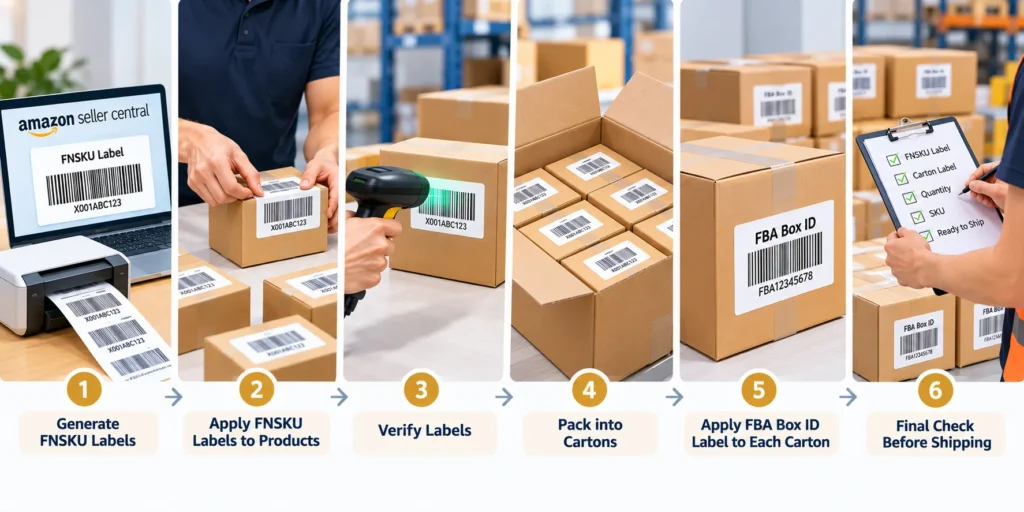
Prepare a product identification sheet for your supplier, including:
Product name and model.
Seller SKU for each variation.
UPC or other valid product identifier, if applicable.
FNSKU requirements based on your Amazon barcode preference.
Quantity for each product variation.
If Amazon Barcode is required, open the relevant inventory or shipment workflow in Seller Central and download the original FNSKU label PDF.
Check the product title, SKU, barcode, and quantity before sending the file to your supplier. Do not manually recreate or substitute barcode files.
Organize label files by SKU or product variation so the factory can match each label with the correct product.
Ask your supplier to print a sample and send a photo for approval before mass labeling. This helps identify incorrect barcodes or product mismatches early.
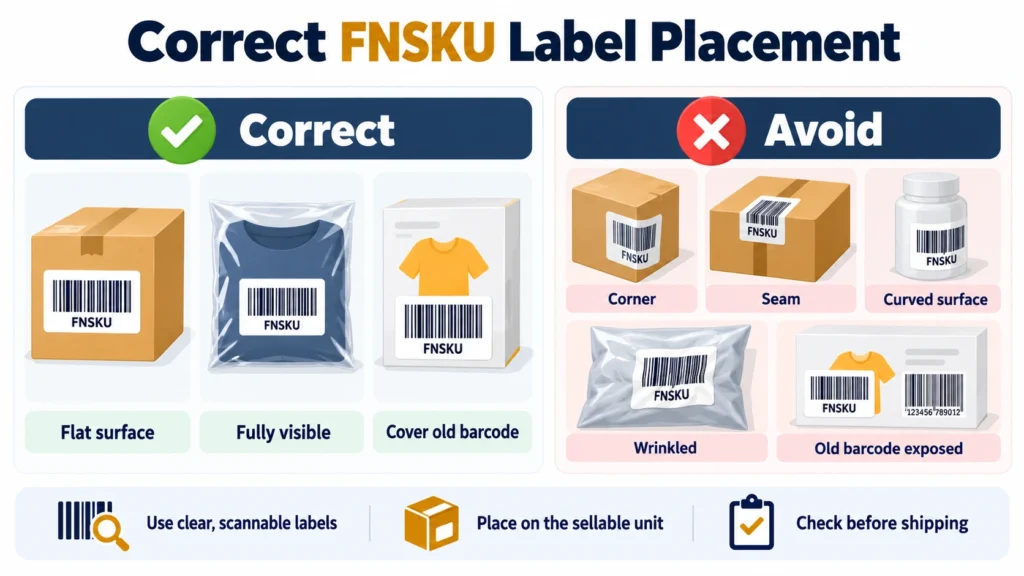
When Amazon Barcode is required, apply the correct FNSKU sticker to every sellable unit, not just the master carton.
Follow Amazon’s labeling requirements:
Print in black on white, non-reflective labels with removable adhesive.
Use an accepted label size between 1 × 2 inches and 2 × 3 inches.
Print at the correct scale without resizing the original PDF.
Place the barcode on a flat, accessible surface.
Cover other visible scannable product barcodes, except serial number barcodes and Transparency authentication codes.
Make sure the FNSKU remains visible and scannable after protective packaging is completed.
For products eligible to use manufacturer barcodes, keep the correct UPC or other approved barcode visible instead of applying an unnecessary FNSKU sticker.
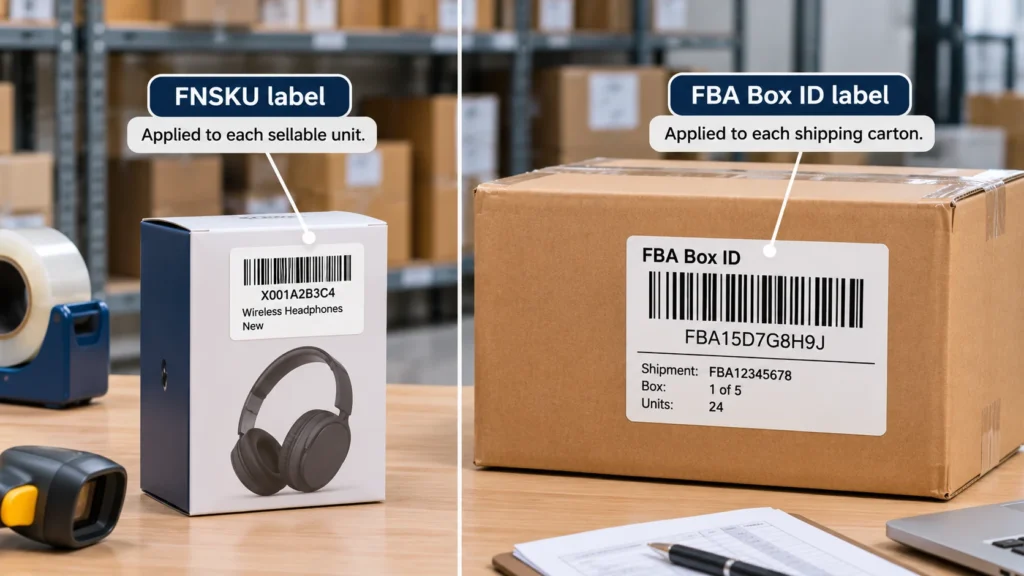
FNSKU labels and FBA Box ID labels serve different purposes. An FNSKU identifies an individual sellable unit, while an FBA Box ID identifies a specific shipping carton.
After creating the FBA shipping plan, download the corresponding box labels from Seller Central. Each carton must have its own correct FBA Box ID label.
Before shipment, check that:
Each carton has the correct box label.
The barcode is visible and scannable.
Carton quantities match the shipping plan.
Carrier shipping labels are correctly attached.
For more details, see our guides to Amazon FBA warehouse requirements and how to create an Amazon FBA shipment.
Important 2026 update: Amazon stopped offering US FBA prep and item labeling services for shipments created on or after January 1, 2026. Sellers should arrange product preparation and required unit labeling with their Chinese supplier or a third-party service provider before inventory reaches Amazon.
Incorrect barcode labeling can cause inventory identification problems and delays at Amazon fulfillment centers. When importing from China, avoid these common mistakes:
Using One UPC for Multiple Variations: Different product sizes, colors, or models generally require separate product identifiers.
Mixing Up SKU, UPC, and FNSKU: Each serves a different purpose. Always provide the correct label file for each product.
Leaving Other Barcodes Visible: When FNSKU labeling is required, cover other scannable product barcodes according to Amazon’s requirements.
Incorrect Unit and Carton Labels: Apply FNSKU labels to individual sellable units and the correct FBA Box ID labels to shipping cartons.
Check all product labels, quantities, and carton information with your Chinese supplier before shipment.
SKU is an internal inventory code created by the seller. UPC is a standardized product identifier used in retail. FNSKU is an Amazon-specific barcode that identifies seller-specific FBA inventory.
Not always. Eligible brand owners can use manufacturer barcodes without additional Amazon barcode stickers. Resellers must use FNSKU labels for US FBA inventory under the rules effective March 31, 2026.
No. An ASIN identifies a product in Amazon’s catalog, while an FNSKU identifies inventory associated with a seller’s FBA offer. They serve different functions in Amazon’s fulfillment system.
Generally, yes. Different sizes, colors, styles, and package quantities normally require separate GTINs. Each variation should also have its own appropriate Seller SKU and corresponding FBA inventory identification.
Yes. You can download the correct FNSKU label files from Seller Central and send them to your Chinese supplier. The factory can print and apply the labels before export. Always verify the product-to-label match and barcode readability before the cargo leaves China.
Useful freight, customs and importing resources related to this shipping guide.
FNSKU Labels for Amazon FBA: Requirements, Size & How to Print Verified & Reviewed · Last updated October 2026 FNSKU labels are used to identify...
Read guide →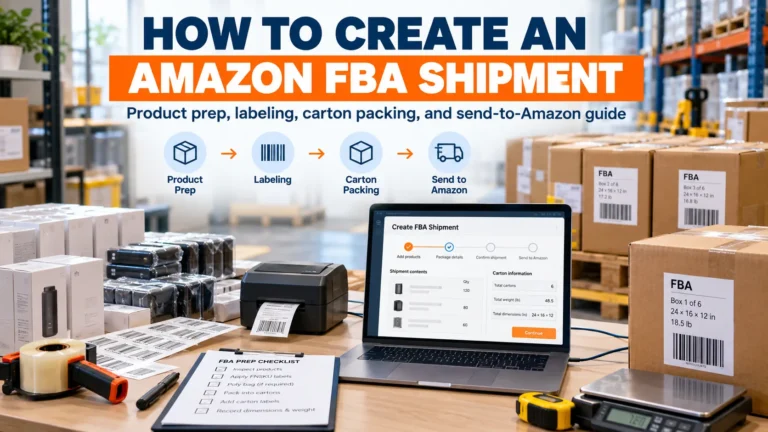
How to Create an Amazon FBA Shipment: Send to Amazon Step by Step (2026) Verified & Reviewed · Last updated October 2026 Creating an Amazon FBA s...
Read guide →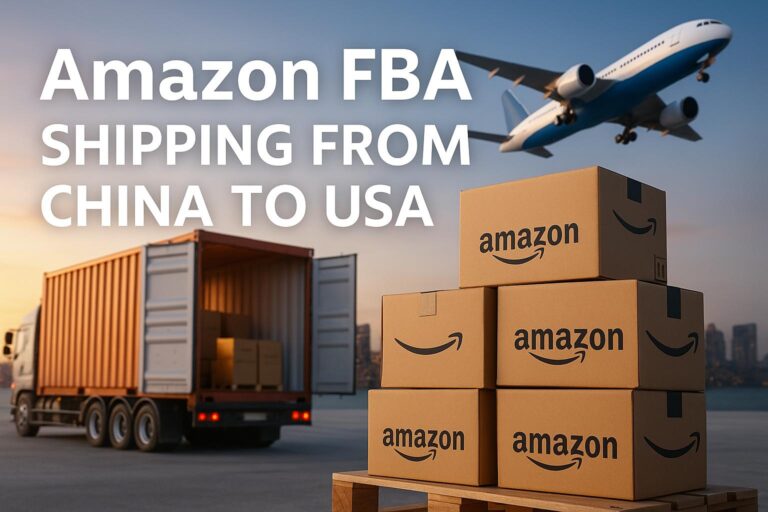
Why FBA Shipping from China Is Crucial for Amazon Sellers Shipping products from China to Amazon FBA in the USA has become a core strategy for ma...
Read guide →
Amazon FBA Inbound Placement Service & Shipment Splits Verified & Reviewed · Last updated September 2026 Amazon FBA inbound placement affects whe...
Read guide →Amazon GWD vs AWD vs 3PL Verified & Reviewed · Last updated October 2026 Amazon GWD, AWD, and independent 3PLs offer different solutions for inve...
Learn more → Useful Resource Amazon FBA Warehouse Requirements for Outer Box Size and Pallet Standards: A Comprehensive GuideSelling on Amazon FBA (Fulfillment by Amazon) can be a lucrative business venture, but it’s essential to adhere to Amazon’s strict warehouse requ...
Learn more →WhatsApp us