Related Guide
Shipping from China to Belgium
Shipping from China to Belgium – Sea, Air & DDP in 2026 Fast, reliable shipping from China to Belgium for B2B importers, eCommerce sellers,and pr...
Read guide →

Shipping containers from China to Belgium is a common choice for importers moving furniture, machinery, electronics, textiles, auto parts, construction materials, retail goods, and bulk shipments. For most commercial cargo, container shipping remains one of the most cost effective shipping solutions in international logistics because it can transport goods with large cargo volume at a lower unit cost than air freight.
This guide explains 20ft, 40ft, and 40HQ container shipping costs from China to Belgium, covering major routes to Antwerp, Zeebrugge, and nearby European hubs, as well as FCL shipping, LCL shipping, rail freight, transit time, customs duties, and door to door delivery options.
Container size / Rates
Transit time range
FCL / LCL
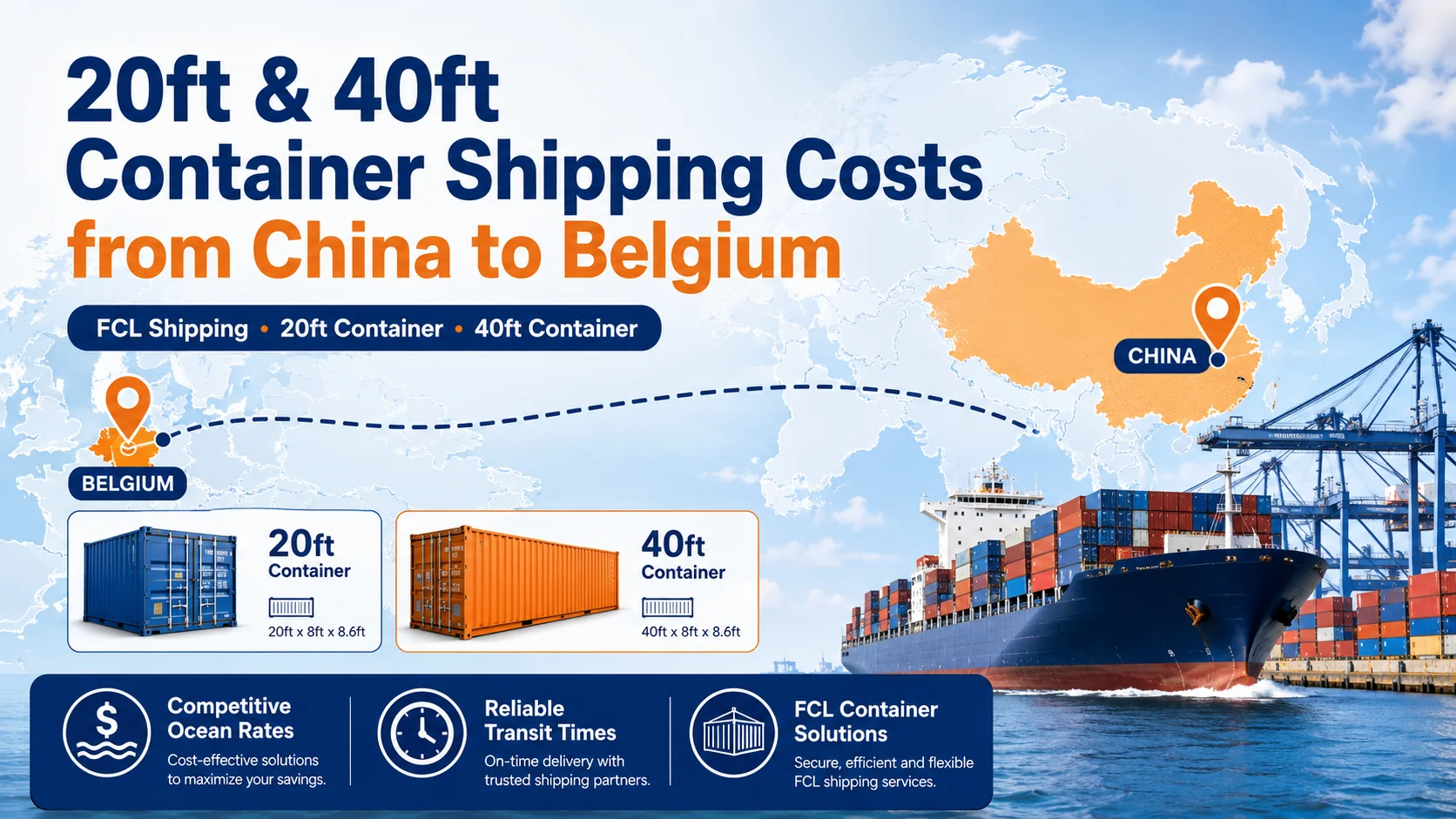
The total cost to ship a container from China to Belgium is usually based on ocean freight rates, origin charges, destination port fees, customs fees, and inland container transport. Many importers only compare base shipping rates, but the final invoice often includes several extra charges.
For standard dry shipping containers, estimated average costs are:
| Container Size | Estimated Shipping Costs | Capacity | Best For |
|---|---|---|---|
| 20ft Container | $1,500 – $3,000 | About 33 CBM | Heavy cargo, machinery, tiles, metals |
| 40ft Container | $2,500 – $4,500 | About 67 CBM | Furniture, textiles, retail goods |
| 40ft High Cube Container | $2,800 – $5,000 | About 76 CBM | Bulky cargo, light but large goods |
A 40ft container usually costs only 10% to 30% more than a 20ft container on some shipping routes when the market is stable. This is why 40ft containers often provide better value per cubic meter for high-volume cargo. However, during peak seasons, limited container space and strong demand can make the cost difference much larger.
The cost to ship a container from China to Belgium depends heavily on container size. A 20ft container, 40ft container, and 40HQ container have different loading capacities, cargo uses, and cost per cubic meter. Importers should choose the right container based on cargo volume, cargo weight, product type, and overall shipping costs.
A 20ft container from China to Belgium usually costs around $1,500 to $3,000 by sea freight. This container size is often used for heavy cargo that reaches the weight limit before filling the entire container space.
A 20ft container offers about 33 CBM of loading capacity and is suitable for dense cargo such as:
Machinery and industrial equipment
Metal parts and hardware
Ceramic tiles and stone products
Building materials
Tools and spare parts
Other heavy commercial cargo
For importers shipping heavy but compact goods, a 20ft container can help reduce overall shipping costs because you do not need to pay for the extra space of a 40ft container.
A 40ft container from China to Belgium usually costs around $2,500 to $4,500, depending on the shipping line, shipping routes, port fees, fuel costs, and delivery time.
A 40ft container provides about 67 CBM of loading space, making it a better option for larger shipments such as furniture, textiles, packaging materials, electronics, consumer products, and wholesale cargo.
Although the total shipping cost of a 40ft container is higher than a 20ft container, the cost per cubic meter is usually lower. This makes it more cost effective for high-volume cargo.
A 40HQ container from China to Belgium usually costs around $2,800 to $5,000. A 40HQ container has the same length as a standard 40ft container but provides extra height and more loading space.
A 40HQ container offers about 76 CBM of capacity, making it suitable for bulky but lightweight goods such as:
Sofas and furniture
Mattresses and home décor products
Large cartons
Plastic products
E-commerce cargo
Lightweight retail goods
If your cargo is light but takes up a lot of space, a 40HQ container can improve loading efficiency and reduce the cost to ship each unit.
Container shipping from China to Belgium mainly uses the Asia to Northern Europe route, one of the most important shipping routes in global trade. Container ships take weeks to travel from China to Belgium, and transit time can vary based on the shipping line, port calls, weather, congestion, and vessel schedules.
Most container shipping services from China to Belgium depart from major Chinese export hubs. Shipping from these major ports is often more cost effective because there are more vessels, more shipping companies, and better container availability.
Common origin ports include:
Shanghai to Antwerp is a major shipping route for container transport. Ningbo, Shenzhen, and Qingdao are also widely used by exporters because they connect to many international shipping services.
The Port of Antwerp is the main destination for sea freight from China to Belgium. It is one of the most important container gateways in Europe and handles large volumes of international trade.
Common destination options include:
Antwerp Port
Zeebrugge Port
Rotterdam Port as a nearby transit hub
Inland delivery to Brussels, Liège, Ghent, Charleroi, and other Belgian cities
Rotterdam is a key hub for containers from China. Some shipments may arrive in Rotterdam before moving by truck or rail freight into Belgium. This can be useful when shipping schedules, port congestion, or carrier availability make Rotterdam a better option.
Container shipping costs usually include more than the basic ocean freight rate. Many importers ask, “How much does it cost to ship a container?” but the answer depends on whether the quote is port-to-port, door-to-port, or door to door.
A standard container shipping quote may include:
Ocean freight from China to Belgium
Origin port fees in China
Documentation fees
Export customs declaration
Destination port fees in Belgium
Customs clearance service
Inland container transport if needed
Base shipping rates usually exclude customs duties, import VAT, inspection fees, storage, demurrage, and some local charges. Before booking, always confirm what is included in the container shipping service, especially if your cargo details require special handling, customs documents, or door to door services.
The final shipping costs can be higher than the base container shipping rates. These key factors are common in international freight because local charges, fuel costs, cargo details, and operational costs change throughout the entire shipping process.
Important additional charges include:
Terminal handling fees: usually around $150 to $400 per container
Documentation fees: often $50 to $200 per shipment
Port congestion surcharges: usually $200 to $500 per container
Bunker Adjustment Factor: fuel-related surcharge linked to global oil prices
Customs fees: charged for import clearance and document processing
Customs duties and VAT: based on product HS code and cargo value
Inland haulage: trucking from Antwerp or another port to the final warehouse
Special cargo surcharges: for dangerous goods, oversized cargo, refrigerated containers, open-top containers, flat-rack containers, and other non-standard shipping containers
Fuel prices can increase shipping costs by 5% to 10%. During peak seasons, shipping rates can spike 30% to 50% because more importers compete for limited container space.
When shipping goods from China to Belgium, importers usually choose between FCL shipping, LCL shipping, and LCL freight options for smaller shipments.
FCL shipping is usually the best choice when your cargo volume is large enough to use most of a container. It gives better cargo security, fewer handling steps, and more stable delivery time compared with shared container transport.
FCL shipping is suitable for:
Cargo over 15–20 CBM
Heavy machinery, furniture, textiles, electronics, and bulk shipments
High-value shipments that need better protection
Importers who need more control over shipping schedules
Goods shipped directly from China to Antwerp or other Belgium destinations
For larger shipments, FCL shipping usually offers better cost effectiveness because the cost per cubic meter is lower than LCL shipping.
LCL shipping, also known as LCL freight, is a cost effective solution for smaller shipments that do not require an entire container. Your freight forwarder consolidates your goods with other shipments at the origin warehouse in China, then ships them together in one container.
LCL shipping is suitable for:
Cargo below 15 CBM
Samples, small commercial orders, and trial shipments
Importers who want to reduce initial shipping costs
Goods that are not urgent or highly fragile
Businesses that ship smaller quantities from multiple suppliers
However, LCL shipping may involve longer handling time because goods need consolidation in China and deconsolidation after arrival in Belgium. Extra warehouse handling, documentation fees, and customs clearance steps may also affect the final shipping costs.
Rail freight from China to Belgium is a practical option for importers who need faster delivery than sea freight but want lower shipping costs than air freight. It is commonly used for electronics, machinery parts, automotive parts, retail products, e-commerce goods, and time-sensitive commercial cargo.
Rail freight usually takes 18–25 days from major rail hubs in China to Belgium or nearby European rail terminals. The final delivery time depends on the departure city, rail route, customs clearance, container availability, and inland transport after arrival.
Compared with sea freight, rail freight offers a shorter delivery time. Compared with air freight, it provides better cost effectiveness for larger shipments.
Common rail freight departure hubs in China include:
Chengdu
Chongqing
Xi’an
Zhengzhou
Wuhan
Yiwu
Hefei
Most rail freight shipments enter Europe through major inland rail corridors and are then delivered to Belgium by truck or regional rail service.
Rail freight is suitable when importers need a balance between shipping costs and delivery speed. It is often chosen when sea freight is too slow but air freight is too expensive.
Rail freight is a good option when:
Sea freight cannot meet the delivery deadline
Air freight costs are too high
Cargo has a medium delivery schedule
Goods are valuable but not urgent enough for air shipping
Importers need more stable delivery time than ocean freight
Container shipping from China to Belgium usually takes 30–45 days by sea freight, depending on the origin port, shipping line, vessel schedule, and port congestion. Most shipments arrive at Antwerp Port, while some containers may use Rotterdam as a nearby European hub before inland delivery to Belgium.
Typical transit times:
Shipping Method | Estimated Delivery Time | Best For |
|---|---|---|
Sea Freight | 30–45 days | 20ft, 40ft, 40HQ containers |
Rail Freight | 18–25 days | Faster container transport |
Air Freight | 3–7 days | Urgent cargo |
Express Shipping | 2–5 days | Samples and small parcels |
Shipping schedules from major Chinese ports such as Shanghai, Ningbo, Shenzhen, Qingdao, and Guangzhou are usually available every week. During peak seasons, container availability, port congestion, and limited vessel space may extend the delivery time.
To ensure timely delivery, importers should book container space 2–4 weeks in advance, confirm the latest sailing schedule, and work with a reliable freight forwarder to compare shipping routes, shipping rates, and carrier options.
Belgium is one of Europe’s most important logistics gateways, with most container shipments from China arriving through Antwerp-Bruges Port. All imported goods must complete customs clearance before they can be released for distribution within Belgium or other European Union countries.
Belgian customs procedures are highly digitalized and follow European Union customs regulations. Proper documentation, accurate HS code classification, and correct tax declarations are essential to avoid delays, inspections, and unexpected customs fees.
Before importing goods into Belgium, importers should ensure they meet the necessary customs requirements.
Key requirements include:
Valid EORI Number
Accurate HS Code classification
Import declarations submitted through EU customs systems
Compliance with ICS2 security filing requirements
Product certifications when required by EU regulations
Incorrect declarations can result in customs inspections, duty reassessments, additional charges, and shipment delays.
Belgian customs authorities typically require the following documents before releasing cargo:
Bill of Lading
Certificate of Origin when applicable
Import License for controlled products
CE Compliance Documents for regulated goods
Product testing certificates if required
All shipping documents should contain consistent information regarding cargo value, quantity, weight, consignee details, and product descriptions.
When shipping goods from China to Belgium, importers generally need to pay customs duties and Belgian import VAT.
Typical charges include:
Customs duties based on HS code classification
Belgian import VAT of 21%
Customs processing fees
Inspection fees if customs authorities select the shipment for examination
The final amount depends on the product category, customs value, freight charges, and applicable EU tariff rates.
For regular importers, Belgium offers a significant cash-flow advantage through the ET 14.000 VAT Deferment License.
Without this license, import VAT is usually paid immediately when goods arrive in Belgium. With ET 14.000 authorization, importers can defer VAT payment and declare it through their periodic VAT return instead of paying it at the port.
Benefits include:
Improved cash flow
Lower upfront import costs
Faster customs processing
Reduced capital tied up during import operations
Many non-EU businesses use a Belgian Fiscal Representative to access this arrangement and simplify customs compliance.
The customs clearance process is generally efficient when documents are complete and accurate.
Estimated processing times:
Standard customs clearance: 1–2 business days
Documentary review: 1–3 business days
Physical inspection: 5–10+ business days
Additional compliance checks: case dependent
Delays are most commonly caused by incorrect HS codes, missing certificates, inaccurate cargo values, or incomplete customs documentation.
To ensure timely delivery and reduce overall shipping costs, importers should:
Verify all customs documents before shipment departure
Use accurate HS code classifications
Declare the correct cargo value
Confirm EU compliance requirements before shipping
Prepare certificates and licenses in advance
Work with a reliable freight forwarder and customs broker
An experienced freight forwarder can coordinate customs clearance, shipping services, and inland delivery, helping importers move goods efficiently from China to Belgium while minimizing customs-related risks.
A reliable freight forwarder can help importers manage container shipping from China to Belgium more efficiently. The right shipping partner should compare shipping services, check shipping schedules, book space with shipping companies, arrange customs clearance, and coordinate inland delivery.
Many shipping companies operate on the China to Northern Europe route, including major carriers such as MSC, Maersk, CMA CGM, COSCO, Hapag-Lloyd, Evergreen, and Orient Overseas Container Line. A freight forwarder can compare these carrier options and choose the most suitable shipping line based on rate, space, transit time, and destination service.
A good freight forwarder should provide:
Clear container shipping rates
FCL and LCL shipping options
Port-to-port and door to door services
Customs clearance support
Cargo insurance options
Accurate estimated delivery time
Timely delivery updates
Cost effective solutions for different cargo types
For importers handling regular international trade between China and Belgium, working with an experienced freight forwarder can improve delivery speed, reduce hidden charges, and help ensure timely delivery.
A 20ft container from China to Belgium usually costs around $1,500 to $3,000 by sea freight. The final cost depends on the origin port, destination port, shipping routes, container availability, port fees, and customs clearance requirements.
A 40ft container from China to Belgium usually costs around $2,500 to $4,500. The price can vary depending on shipping rates, fuel costs, peak season demand, container availability, and vessel space.
Sea freight from China to Belgium usually takes 30 to 45 days port to port. Rail freight may take around 18 to 25 days, while air freight usually takes 3 to 7 days.
Sea freight is usually the cheapest shipping method for full container load and bulk shipments. LCL shipping can be more cost effective for smaller shipments that do not require an entire container.
Customs duties are usually not included in basic container shipping rates. Duties, VAT, customs fees, and import taxes depend on the cargo value, HS code, and Belgian customs requirements.
Useful freight, customs and importing resources related to this shipping guide.
Shipping from China to Belgium – Sea, Air & DDP in 2026 Fast, reliable shipping from China to Belgium for B2B importers, eCommerce sellers,and pr...
Read guide →
Shipping Cost from China to Belgium (2026 Guide) Verified & Reviewed · Last updated May 2026 Shipping cost from China to Belgium in 2026 typicall...
Read guide →
How long does it take to ship from China to Belgium? This is one of the most common questions importers ask when sourcing goods from Asia. Shippi...
Read guide →
Sea Freight from China to Belgium Verified & Reviewed · Last updated June 2026 Sea Freight from China to Belgium is a cost effective shipping sol...
Read guide →When it comes to air freight from China to Belgium, importers and exporters often consider it the most reliable option for urgent or high-value s...
Learn more → Useful Resource DDP shipping from China to BelgiumIn recent years, trade between China and Belgium has grown rapidly, driven by the increasing demand for electronics, machinery, textiles, and con...
Learn more →WhatsApp us