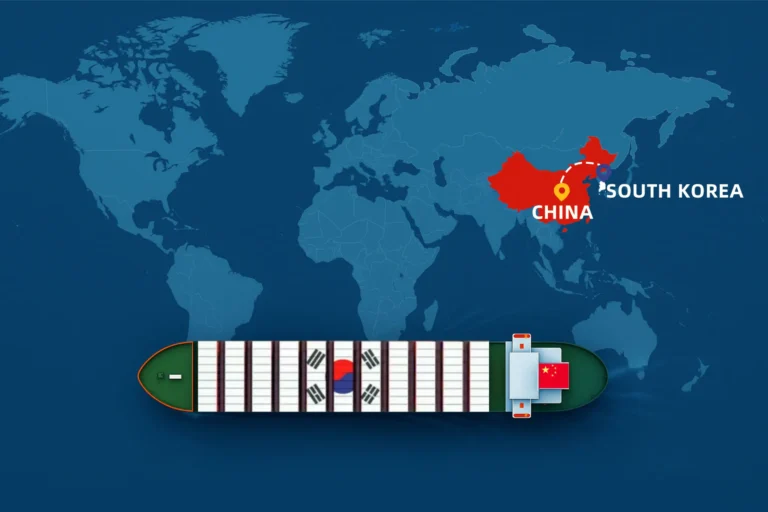
Related Guide
Shipping from China to South Korea
Shipping from China to South Korea – Sea, Air & DDP in 2026 Fast, reliable shipping from China to Korea for B2B importers,industrial cargo, and g...
Read guide →

20ft and 40ft container shipping costs from China to South Korea vary depending on ocean freight rates, container size, shipping routes, destination port, and final delivery requirements.
This guide explains the average price to ship a container from China to South Korea, including 20ft, 40ft, and 40HQ container rates, sea freight transit times, major ports such as Busan and Incheon, customs clearance, DDP door-to-door service, and total shipping costs.
Container Rates
Transit time range
DDP / Door to Door
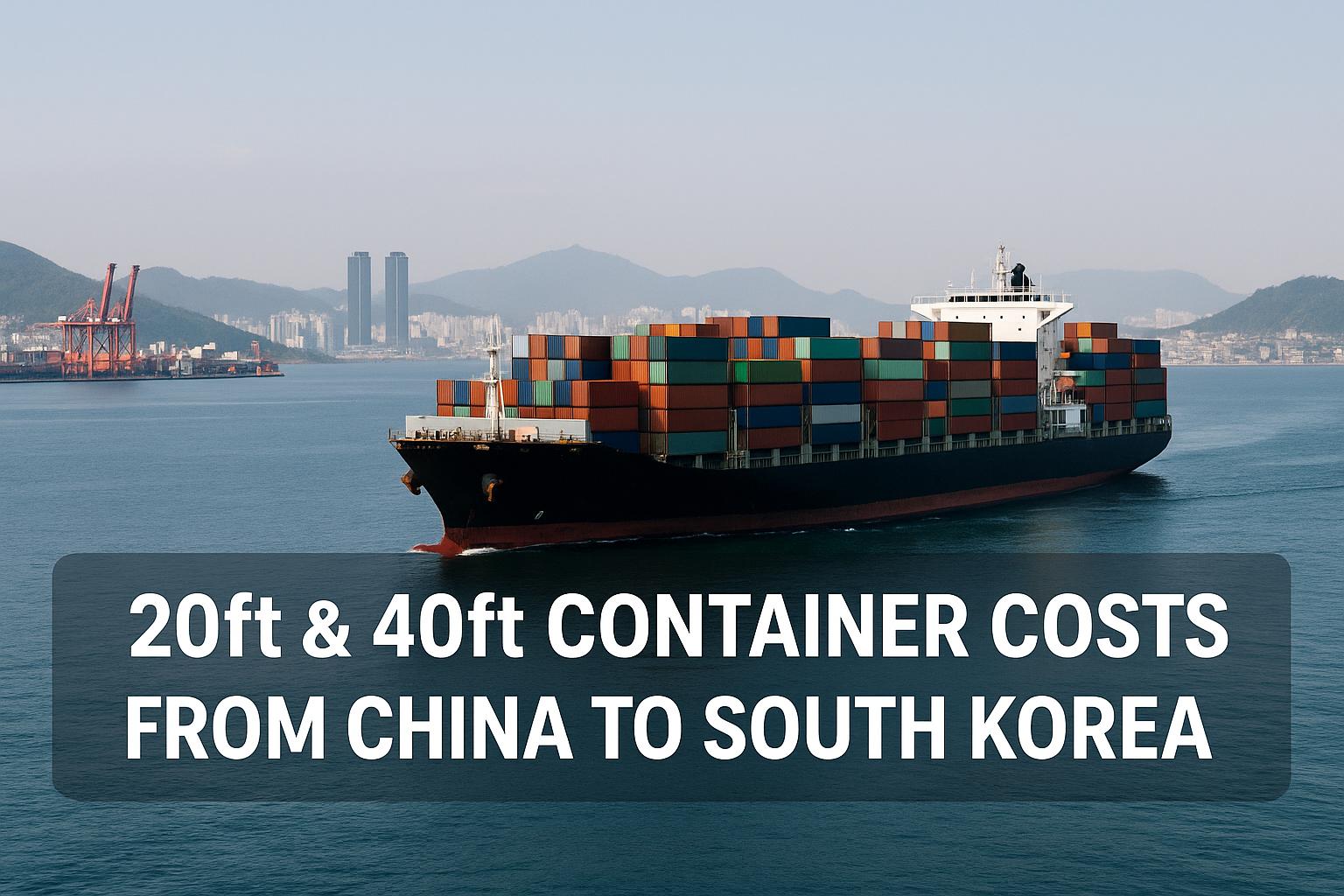
Container shipping from China to South Korea is usually cheaper than long-distance routes because the sailing distance is short and vessel departures are frequent. For most importers, ocean freight is the most cost-effective option for bulk cargo, while air freight is better for urgent or high-value shipments.
In 2026, the estimated shipping costs are:
| Shipping Option | Average Price 2026 | Transit Time | Best For |
|---|---|---|---|
| 20ft Container | USD 315–650 | 2–6 days | Heavy and compact cargo |
| 40ft Container | USD 380–900 | 2–6 days | Larger commercial shipments |
| 40HQ Container | USD 560–1,050 | 2–6 days | Bulky or high-volume goods |
| LCL Shipping | USD 25–55/CBM | 3–8 days | Smaller shipments |
These prices are market references for general cargo. The final quote may change based on the shipping location in China, destination port, container availability, cargo weight, cargo volume, port handling fees, destination charges, customs requirements, and delivery service.
Choosing the right container size affects shipping cost, loading efficiency, and cargo safety. For shipments from China to South Korea, the best choice depends on cargo weight, cargo volume, packaging size, and whether the goods are heavy, bulky, or time-sensitive.
A 20ft container is usually suitable for heavy and compact cargo. These goods often reach the weight limit before the container is fully used by volume, so a smaller container can be more practical than booking a larger one.
Common cargo includes:
Machinery
Metal parts
Tiles and stone products
Hardware and tools
Building materials
A 40ft container is a practical choice when your cargo needs more loading space but does not reach the maximum weight limit too quickly. It is often more cost-effective than booking two smaller shipments because the cost per CBM can be lower when the container is fully used.
This option works well for:
Furniture and home goods
Electronics and appliances
Textiles and garments
Packaging materials
Retail stock and e-commerce goods
For importers shipping regular commercial orders from China to South Korea, a 40ft container offers a good balance between capacity, cost, and handling efficiency.
A 40HQ container provides extra height compared with a standard 40ft container, making it suitable for goods that take up space but are not extremely heavy. The additional height is useful when cartons, furniture, or finished products cannot be stacked efficiently in a standard container.
This option is commonly used for:
Bulky furniture
Home appliances
Display racks
Plastic products
Large cartons
High-volume consumer goods
For lightweight and bulky shipments, a 40HQ container can improve loading efficiency and reduce the shipping cost per unit.
Sea freight is the most common shipping method for container shipping from China to South Korea. It is cost effective for large shipments, regular imports, and commercial cargo that does not require urgent delivery.
Sea freight from China to South Korea usually takes 2–6 days port-to-port. When pickup, export clearance, port handling, import declaration, and final delivery are included, the full shipping process usually takes around 5–10 days.
Sea freight is suitable for:
Full container load shipments
LCL shipments
Heavy cargo
Furniture and household goods
Machinery and industrial parts
Building materials
Retail and e-commerce goods
General commercial shipments
Because this is a high-frequency trade route, importers can usually find regular sailings from Shanghai, Ningbo, Qingdao, Shenzhen, Guangzhou, and Tianjin to major ports in South Korea.
When shipping from China to South Korea, you can choose between Full Container Load (FCL) and Less than Container Load (LCL) depending on cargo size, urgency, and budget.
FCL shipping means your goods occupy the entire container. This option is usually better for larger shipments, high-value goods, fragile cargo, or regular commercial imports.
A 20ft container is often used for heavy cargo, while a 40ft or 40HQ container is suitable for larger volume. Since the cargo is not mixed with other shipments, the full container option usually provides faster handling, better security, and more predictable delivery.
FCL is often recommended when:
Cargo volume is over 15 CBM
Cargo weight is high
The importer needs the entire container
The shipment requires lower handling risk
The delivery schedule must be more predictable
LCL shipping allows importers to share container space with other shipments. It is more suitable for smaller shipments that do not need a full container.
LCL costs are usually calculated by cubic meter, making it a practical choice for small orders, sample shipments, and trial imports. However, LCL shipments may take longer because cargo needs consolidation at origin and separation after arrival.
LCL is usually suitable when:
Cargo volume is below 10–15 CBM
The shipment is not urgent
The importer wants to avoid booking a full container
The order is small or irregular
A freight forwarder can compare FCL and LCL options to help decide which shipping method offers the best balance of price, speed, and cargo safety.
The China–South Korea trade corridor is among the most efficient in Asia, supported by modern major ports and frequent shipping routes operated by global shipping companies such as COSCO, MSC, and Maersk.
Shanghai Port: The busiest port worldwide, offering daily sailings to Busan and Incheon with short ocean freight times of 2–4 days.
Ningbo-Zhoushan Port: Competitive pricing and strong export capacity, ideal for East China manufacturers.
Qingdao Port: Closest to South Korea; transit to Incheon or Busan can be as quick as 48 hours.
Shenzhen Port: Serves Guangdong-based exporters; frequent connections to Busan and other major ports.
Guangzhou Port: Supports FCL and LCL consolidation with seamless door shipping across South China.
Busan Port: Handles over 70% of South Korea’s container load; known for rapid customs process and strong connectivity.
Incheon Port: Strategically located near Seoul for fast door-to-door delivery; ideal for smaller or LCL shipments.
Other Ports: Gwangyang, Ulsan, and Pyeongtaek handle specialized cargo such as vehicles, steel, and bulk shipments.
Choosing the right shipping route affects cost and time:
Shanghai → Busan: Fastest and most economical.
Qingdao → Incheon: Ideal for North China factories.
Shenzhen → Busan: Best for South China exporters.
Your freight forwarder will advise which route minimizes transit and shipping costs while ensuring smooth customs clearance.
Smooth customs clearance is crucial for any shipment between China and South Korea. Both countries maintain efficient systems, and documentation accuracy ensures fast processing.
Most container shipments from China to South Korea require the following documents:
Bill of lading
Certificate of origin if claiming FTA benefits
Importer business information
Product certificates if required
Insurance document if cargo insurance is purchased
The commercial invoice should show the seller, buyer, product name, quantity, unit price, total value, currency, HS code, and trade terms. The packing list should show carton quantity, gross weight, net weight, package dimensions, and cargo volume.
Typical taxes include:
Customs duty: 0–13% depending on product type
VAT: 10% on the CIF value
FTA benefits: zero tariffs on eligible goods
Your freight forwarder or customs broker handles all import customs clearance, ensuring compliance and reducing extra shipping costs.
Tip: For simplified logistics, choose Delivered Duty Paid (DDP) — your freight forwarder pays all taxes upfront, providing a single all-inclusive final price with door-to-door delivery.
DDP shipping is one of the most convenient shipping solutions for importers moving cargo from China to South Korea. Under Delivered Duty Paid (DDP) terms, the freight forwarder manages the entire shipping process, including pickup in China, export declaration, international transportation, import clearance, duty and VAT payment, and final delivery to the consignee’s address.
For businesses that want a predictable landed cost and minimal logistics coordination, DDP shipping can simplify international trade and reduce operational workload.
A typical DDP shipment from China to South Korea may include:
Cargo pickup from the supplier
Warehouse consolidation if needed
Export customs declaration in China
Sea freight or air freight transportation
Import customs clearance in South Korea
Customs duty and VAT payment
Local trucking and final delivery
Shipment tracking throughout the journey
With DDP service, importers receive a single quotation covering most transportation and customs-related costs.
Door-to-door shipping means the cargo is collected directly from the supplier and delivered to the final destination without the importer arranging separate logistics providers.
This service is suitable for:
Small and medium-sized businesses
E-commerce sellers
First-time importers
Companies without a local customs broker
Buyers sourcing from multiple suppliers in China
Door-to-door service can be arranged for both FCL and LCL shipments, as well as air freight cargo.
The best way to reduce shipping costs is to choose the correct shipping method and container size based on your cargo. A freight forwarder can compare sea freight, air freight, FCL shipping, LCL shipping, and door-to-door delivery to find the most cost effective option.
Importers can reduce costs by:
Booking space early before peak seasons
Choosing the nearest suitable port pair
Using full container load when cargo volume is large
Using LCL shipping for smaller shipments
Consolidating cargo from different suppliers
Preparing accurate documents before shipment
Checking HS codes in advance
Avoiding unnecessary storage and demurrage
Comparing container shipping rates from different carriers
For larger shipments, FCL shipping is usually more efficient. For small orders, LCL shipping allows importers to share container space and pay only for the volume used.
Tonlexing provides professional freight forwarding services for importers who need to ship a container from China to South Korea. Whether you are shipping a 20ft container, 40ft container, 40HQ container, or smaller LCL cargo, our team helps you compare freight rates, and control the total shipping cost.
Tonlexing can help with:
Sea freight from China to South Korea
FCL shipping and LCL shipping
20ft, 40ft, and 40HQ container booking
Cargo consolidation from multiple suppliers
Export declaration in China
Import handling in South Korea
DDP door-to-door delivery
Air freight for urgent shipments
Transparent quotes with clear destination charges
Shipping documents checking and cargo tracking
With an experienced freight forwarder, importers can reduce delays, avoid hidden costs, and keep the shipping process simple from pickup to delivery.
The average price to ship a container from China to South Korea is usually USD 315–650 for a 20ft container, USD 380–900 for a 40ft container, and USD 560–1,050 for a 40HQ container. The final price depends on freight rates, container availability, destination charges, and delivery service.
Yes. For large shipments, it is usually cheaper to ship a container from China by sea freight than by air freight. Container shipping offers a lower cost per cubic meter and is suitable for furniture, machinery, electronics, textiles, auto parts, building materials, and commercial shipments.
Sea freight from China to South Korea usually takes 2–6 days port-to-port. Door-to-door delivery usually takes around 5–10 days, depending on pickup location, destination port, import handling, and inland trucking.
Choose FCL shipping if your cargo is large, heavy, fragile, or time-sensitive. Choose LCL shipping if your shipment is small and does not need an entire container. Less-than-container load may be more cost-effective for shipments below 10–15 CBM.
Container rates change because ocean freight rates are affected by vessel space, fuel prices, seasonal demand, port congestion, and carrier rate adjustments. Even on short shipping routes, freight rates may increase before holidays or during peak seasons.
Useful freight, customs and importing resources related to this shipping guide.
Shipping from China to South Korea – Sea, Air & DDP in 2026 Fast, reliable shipping from China to Korea for B2B importers,industrial cargo, and g...
Read guide →
Shipping Cost from China to South Korea (2026 Guide) Verified & Reviewed · Last updated May 2026 Shipping cost from China to South Korea in 2026...
Read guide →
How long does it take to ship from China to South Korea? For businesses importing goods or individuals purchasing from Chinese suppliers, knowing...
Read guide →
Sea freight is the most cost effective shipping method for large volumes and container load cargo. It is ideal for businesses looking to reduce s...
Read guide →Air Freight from China to South Korea Verified & Reviewed · Last updated June 2026 Air freight from China to South Korea is a fast and reliable s...
Learn more → Useful Resource DDP Shipping from China to South KoreaDDP Shipping from China to South Korea Verified & Reviewed · Last updated June 2026 DDP shipping from China to South Korea is a practical door-to...
Learn more →WhatsApp us