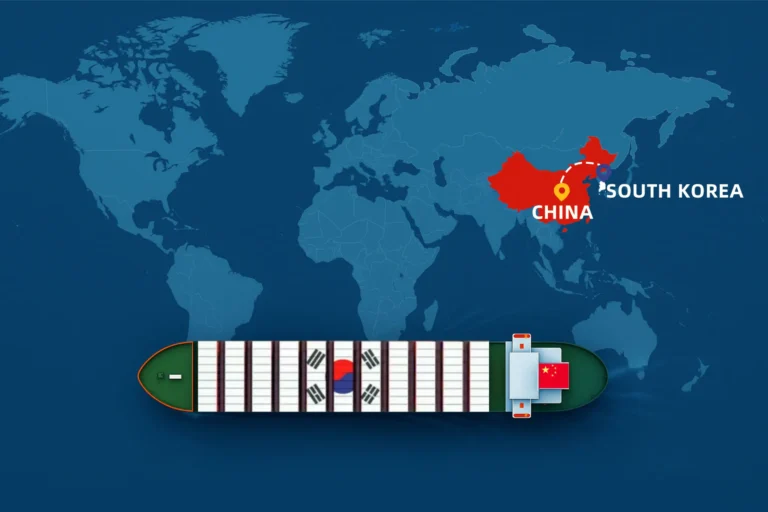
Related Guide
Shipping from China to South Korea
Shipping from China to South Korea – Sea, Air & DDP in 2026 Fast, reliable shipping from China to Korea for B2B importers,industrial cargo, and g...
Read guide →

Shipping cost from China to South Korea in 2026 typically ranges from $1.8–$3.5 per kg for air freight, from $4.0 per kg for express shipping, and from $15–$35 per CBM for LCL sea freight, depending on shipment size, cargo type, delivery speed, and final destination.
Shipping from China to South Korea is usually faster than many other international routes because the two countries are close and shipping services are frequent. Importers can choose sea freight, air freight, express shipping, or door-to-door delivery depending on cargo size, delivery time, and budget.
For regular commercial cargo, sea freight is often the most economical option, especially for LCL shipments, full container loads, pallets, cartons, machinery, and bulk goods. If the shipment is urgent or high-value, air freight or express courier can provide faster delivery to South Korea.
The final shipping cost is affected by cargo weight, volume, shipping route, port handling, customs duties, customs clearance, and final delivery address. Comparing different shipping methods before booking can help reduce logistics costs and avoid unnecessary delays.
Shipping Cost
LCL / FCL Shipping
Door-to-Door Delivery

There are several shipping modes from China to South Korea. The right option depends on your shipment size, delivery deadline, cargo type, budget, and final destination.
| Shipping Method | Estimated Cost | Best For |
|---|---|---|
| LCL Sea Freight | From USD 15–35 per CBM | Small and medium cargo |
| FCL 20ft Container | From USD 320–450 per container | Heavy cargo or bulk goods |
| FCL 40ft Container | From USD 560–750 per container | Large-volume shipments |
| FCL 40HQ Container | From USD 600–800 per container | Large but lighter cargo |
| Air Freight | From USD 1.8–3.5 per kg | Urgent or high-value cargo |
| Express Shipping | From USD 4.0 per kg | Samples, documents, small parcels |
| Door-to-Door Shipping | Quoted by cargo details | Full logistics service |
| DDP Shipping | Custom quote | Delivered duty paid service |
These rates are for general planning only. Actual shipping costs may change based on cargo weight, cargo volume, product category, pickup location, final destination, customs process, port charges, and seasonal demand.
Each freight option has a different role in the logistics process.
Choose sea freight if:
Choose air freight if:
Choose express shipping if:
Choose door-to-door shipping if:
Sea freight from China to South Korea is the most common shipping method for bulk cargo, pallets, cartons, machinery, building materials, consumer goods, raw materials, e-commerce inventory, and regular commercial shipments.
Because the distance between China and South Korea is short, sea freight shipping can be very fast compared with many other international shipments. It is usually the most cost effective option when your cargo is not urgent and you want to reduce the cost per unit.
Sea freight is suitable for importers who care more about cost control than speed. It is often used for regular commercial shipping because it offers stable vessel schedules, flexible shipping routes, and lower logistics costs.
For many bulk cargo and full container shipments, ocean freight remains the most cost efficient option, making sea freight a practical choice for importers who want to reduce logistics costs.
Main advantages include:
Sea freight is also a practical choice when shipping goods from China to South Korea on a regular basis. If you import every month, working with a reliable sea freight forwarder can help plan shipments, book vessel space, compare shipping routes, and reduce unexpected charges.
LCL shipping means less than container load. It is suitable when your cargo does not fill an entire container. Your goods share space with other importers, and the shipping cost is usually calculated by cubic meter.
LCL shipping is commonly used for:
The main benefit of LCL shipping is cost efficiency. You do not need to pay for the entire container. However, LCL shipments may require more handling, consolidation, and deconsolidation, so the total shipping time may be slightly longer than FCL shipping.
FCL shipping means full container load. It is suitable when your cargo can fill a 20ft, 40ft, or 40HQ container, or when you want your goods to move in a dedicated container.
FCL shipping is better for:
For many importers, FCL shipping becomes more cost effective when the cargo volume is large enough. If your shipment is close to a full container, comparing LCL and FCL before booking is important.
Common sea freight routes from China to South Korea include:
For northern China cargo, Qingdao, Tianjin, and Dalian are often cost efficient choices because they are close to South Korea. For East China suppliers, Shanghai and Ningbo are commonly used for both LCL and FCL shipments. For South China suppliers, Shenzhen and Guangzhou are suitable for electronics, consumer goods, e-commerce inventory, and mixed cargo.
Major South Korean ports include:
Busan is suitable for large import volume and national distribution. Incheon is convenient for cargo delivered to Seoul and nearby areas. Pyeongtaek is often used for industrial cargo and North China routes.
Sea freight from China to South Korea usually takes about 2–8 days port to port. The actual shipping time depends on the origin port, destination port, vessel schedule, port congestion, and import procedures.
For example:
Door-to-door sea freight takes longer than port-to-port shipping because it includes supplier pickup, export clearance, destination clearance support, and final delivery in South Korea.
The right sea freight forwarder can help compare sailing schedules, port options, local charges, and delivery plans before shipment.
Air freight from China to South Korea is suitable for urgent shipments, electronics, samples, medical products, spare parts, high-value goods, and time-sensitive commercial cargo. It is much faster than sea freight but usually more expensive.
Air cargo is charged by chargeable weight. The airline compares the actual weight and volumetric weight of the shipment and charges based on the higher number. This means lightweight but bulky goods may have higher costs than expected.
Air freight is usually the right shipping option when:
For shipments over 100 kg, standard air freight services may be more cost effective than express courier. If the shipment is small and very urgent, parcel delivery may still be easier. If the shipment is larger and time-sensitive, air cargo is usually the better option.
For urgent air shipments, early booking is important because airline space can change quickly during busy periods.
Air freight cost from China to South Korea is affected by:
Because airport-to-airport service is sensitive to weight and volume, accurate cargo dimensions are important when requesting a rate.
Common departure airports in China include:
Most air cargo from China to South Korea arrives at Incheon International Airport before the import process and final delivery.
Air freight from major Chinese airports to South Korea usually takes 1–3 days airport to airport. However, the total shipping time may include supplier pickup, cargo handling, export documents, airline departure, destination clearance, and local delivery.
If your cargo has strict timing requirements, working with an experienced freight forwarder with advanced tracking capabilities can help monitor each stage of the shipping process and ensure timely delivery.
Express courier is the fastest and simplest option for documents, samples, small parcels, and lightweight packages. Courier services such as DHL, FedEx, UPS, and other express networks can deliver shipments from China to South Korea quickly.
Express shipping usually includes pickup, international transportation, customs process, and final delivery. This makes it convenient for small shipments because importers do not need to arrange separate trucking, document handling, or door delivery.
Express shipments are suitable for:
Express shipping is usually not the best choice for heavy cargo. If your shipment is over 100 kg, comparing express courier with air cargo is recommended. For regular commercial cargo with larger volume, sea freight or air cargo may provide better value.
Door-to-door shipping is a convenient solution for importers who want one freight forwarder to manage the entire logistics process from China to South Korea. This service can include supplier pickup, warehouse receiving, consolidation, export clearance, international freight, destination clearance support, and delivery to the final destination.
Door-to-door shipping from China to South Korea can include:
Door delivery can reduce communication work and help avoid repeated local charges. It is also helpful when the importer wants a hassle free shipping process and clear responsibility from pickup to delivery.
DDP shipping means delivered duty paid. Under this shipping term, the logistics provider or seller arranges transportation, duty-related handling, import procedures, and delivery to the agreed address.
DDP shipping can be useful for importers who want a simpler delivery solution and do not have experience with customs authorities or South Korean customs regulations. However, DDP must be handled carefully. Product type, HS code, declared value, customs duties, and import rules should be checked before shipment.
DDP is commonly used for:
E-commerce inventory
Small commercial shipments
Mixed goods from multiple suppliers
Importers who need a tax-inclusive delivery solution
Importers who want simplified door delivery
DDP is not always suitable for regulated products, restricted goods, or cargo that requires special certificates.
Transit time depends on shipping mode, origin city, destination city, customs process, port congestion, and final delivery requirements.
| Shipping Mode | Typical Transit Time | Notes |
|---|---|---|
| Sea Freight Port-to-Port | 2–8 days | Depends on origin and destination port |
| LCL Sea Freight | 5–8 days | Includes consolidation and handling time |
| FCL Sea Freight | 2–5 days | Fast and stable for full container cargo |
| Air Freight | 1–3 days | Airport-to-airport transit |
| Express Shipping | 1–3 days | Best for samples and small parcels |
| Air Door-to-Door | 3–6 days | Includes pickup, clearance support, and delivery |
| Sea Door-to-Door | 5–12 days | Suitable for regular commercial cargo |
Transit time is only one part of the total shipping plan. Importers should also consider document preparation, supplier readiness, port handling, container availability, and delivery appointment requirements.
To reduce delays, importers should:
If you need timely delivery, it is better to plan shipments early and confirm all documents before the cargo leaves China.

Shipping costs from China to South Korea can vary even on the same route. The final price depends on both international freight and local charges.
To control shipping costs, importers should compare the total landed cost, not only the basic freight rate. A complete quote should include pickup, international freight, customs clearance, local charges, and final delivery.
Customs clearance is an important part of shipping goods from China to South Korea. Even though the route is short, incomplete documents or incorrect product information can still cause customs delays, inspection, storage charges, or delivery problems.
Common customs documents include:
The commercial invoice should clearly show product name, quantity, unit value, total value, currency, seller, buyer, and shipping terms. The packing list should match the actual cartons, pallets, weights, and dimensions.
Common customs problems include:
A right freight forwarder can review documents before shipping and help reduce customs process risks. Smooth customs clearance depends on accurate documents, correct cargo details, and clear communication between importer, supplier, and logistics provider.
Shipping cost can be reduced through better planning, correct packing, and choosing the right shipping mode.
If you buy from different factories in China, warehouse consolidation can reduce repeated pickup charges, export handling fees, and minimum shipment charges. Consolidation is especially useful for LCL shipments and mixed goods.
LCL shipping is suitable for smaller shipments, but when cargo volume becomes large enough, full container load may offer better cost, better cargo control, and lower damage risk.
Before booking, compare:
For suppliers in northern China, Qingdao, Tianjin, or Dalian may be more cost efficient. For suppliers in East China, Shanghai or Ningbo may be better. For suppliers in South China, Shenzhen or Guangzhou may be more practical.
Large cartons, unnecessary pallets, irregular packing, and unused carton space can increase chargeable volume. Proper packing helps reduce CBM and protect goods during handling.
When container availability or airline space is tight, shipping rates may increase. Planning shipments in advance helps ensure timely delivery and reduce last-minute logistics costs.
The best shipping mode from China to South Korea depends on cargo size, urgency, budget, customs requirements, and final destination. Instead of choosing only by the lowest freight rate, importers should compare the total shipping cost, transit time, handling risk, and delivery requirements.
For documents, samples, and parcels under 30 kg, express shipping is usually the simplest option. It is fast, easy to arrange, and suitable for small shipments that do not require complex freight planning.
This option is best for:
Product samples
Documents
Small spare parts
Lightweight parcels
Urgent small shipments
For urgent cargo between 45 kg and 300 kg, air freight is often more suitable than sea freight. It costs more, but it can shorten delivery time and help avoid production or sales delays.
Air freight is a good choice for:
For cargo around 1–5 CBM, LCL sea freight is usually the most cost effective option. It allows importers to ship smaller cargo without paying for an entire container.
LCL shipping is suitable for:
For large shipments, heavy cargo, or cargo close to a full container load, FCL shipping is usually more stable and cost efficient. It gives better control over loading, container space, and cargo handling.
FCL shipping is recommended for:
If you buy from multiple suppliers in China, warehouse consolidation + sea freight can reduce repeated local charges. If you need delivery to Seoul, Busan, Incheon, Daegu, or another South Korean city, door-to-door shipping is more convenient because it covers pickup, freight, customs support, and final delivery.
For importers who want a simplified import process, DDP shipping may also be considered when the product type and customs requirements are suitable.
The cheapest option is not always the best option. The right shipping mode should match your cargo type, delivery deadline, customs requirements, and final destination.
Shipping from China to South Korea may seem simple because the distance is short, but the full shipping process still involves supplier pickup, export clearance, shipping documents, import procedures in South Korea, local charges, and final delivery. Working with an experienced freight forwarder can help reduce customs delays, control logistics costs, and make the process easier to manage.
A reliable freight forwarder can help you:
This is especially useful when you are shipping from multiple suppliers, arranging LCL shipping, booking a full container load, or sending commercial goods to Seoul, Busan, Incheon, Daegu, or other South Korean cities.
Tonlexing provides shipping services from China to South Korea by sea freight, air freight, express shipping, LCL, FCL, DDP, and door-to-door delivery. Our team can help compare shipping costs, confirm shipping routes, prepare documents, and choose a cost effective solution based on your cargo details.
We can support:
Shipping from China to South Korea can cost from around USD 15–35 per CBM for LCL shipping, from USD 320–450 for a 20ft container, from USD 560–750 for a 40ft container, and from around USD 1.8–3.5 per kg for air freight. The final cost depends on cargo size, weight, shipping mode, route, customs requirements, and delivery address.
Sea freight is usually the cheapest method for bulk cargo and large shipments. LCL shipping is suitable for smaller shipments, while full container load shipping is better for larger cargo volumes.
Sea freight usually takes around 2–8 days port to port, while air freight and express shipping usually take around 1–3 days. Door-to-door shipping may take longer because it includes pickup, customs process, and final delivery.
Yes. LCL shipping is available for cargo that does not fill a full container. It is usually charged by cubic meter and is suitable for small and medium shipments.
Yes. Tonlexing can arrange supplier pickup in China, export clearance, sea freight or air freight, import support in South Korea, and final delivery to cities such as Seoul, Busan, Incheon, Daegu, and Daejeon.
Useful freight, customs and importing resources related to this shipping guide.
Shipping from China to South Korea – Sea, Air & DDP in 2026 Fast, reliable shipping from China to Korea for B2B importers,industrial cargo, and g...
Read guide →
How long does it take to ship from China to South Korea? For businesses importing goods or individuals purchasing from Chinese suppliers, knowing...
Read guide →
Sea freight is the most cost effective shipping method for large volumes and container load cargo. It is ideal for businesses looking to reduce s...
Read guide →
Air Freight from China to South Korea Verified & Reviewed · Last updated June 2026 Air freight from China to South Korea is a fast and reliable s...
Read guide →DDP Shipping from China to South Korea Verified & Reviewed · Last updated June 2026 DDP shipping from China to South Korea is a practical door-to...
Learn more → Useful Resource 20ft & 40ft Container Shipping Costs from China to South Korea20ft & 40ft Container Shipping Costs from China to South Korea Verified & Reviewed · Last updated June 2026 20ft and 40ft container shipping cost...
Learn more →WhatsApp us