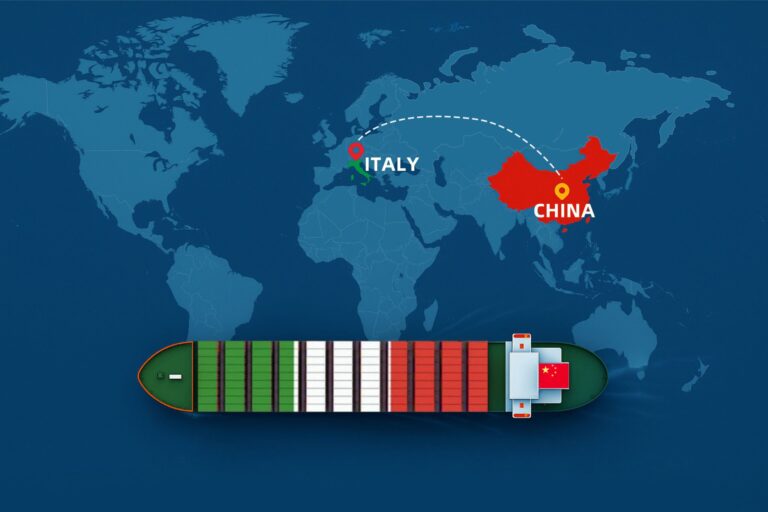


Freight Forwarder from China to Italy
- Verified & Reviewed · Last updated July 2026
Choosing the right freight forwarder from China to Italy means balancing shipping costs, transit time, customs clearance, cargo requirements, and delivery to the final business address.
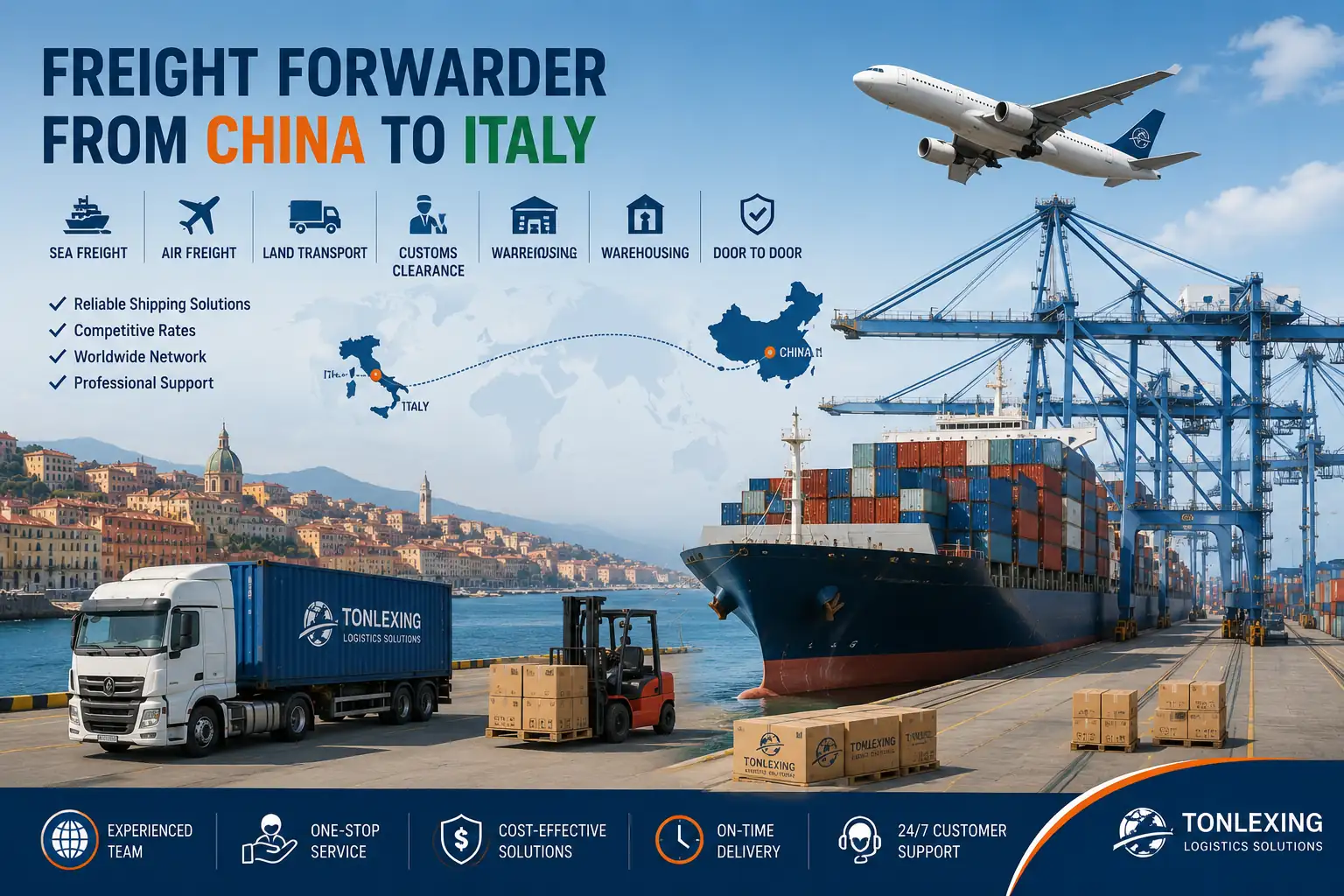
Tonlexing Logistics provides sea freight, air freight, rail freight, express shipping, and door-to-door services from China to Italy. Send your cargo details, supplier location, and Italian delivery postcode for an accurate quotation.
Shipping method / Mode
Shipping Costs & Time
Customs Clearance
- Experienced China-based logistics specialists
10,000+ international shipments handled Global sea, air & DDP shipping solutions 24/7 shipment tracking & customer support
Table of Contents
How to Choose the Right Freight Forwarder
A forwarder based at the shipping origin can simplify supplier communication, export procedures, warehouse handling and booking. This is particularly useful for EXW orders or goods collected from several factories in southern China, eastern China or inland manufacturing areas.
The right freight forwarder should understand China to Italy shipping routes and how cargo volume, urgency, product compliance and the final business address affect the shipping process.
Use this checklist before booking:
Route experience: Select a freight forwarder that regularly manages China to Italy shipments.
Customs support: Confirm whether Italian customs brokerage is included or coordinated through a destination partner.
Itemized pricing: Request separate origin, freight, destination, customs duties and delivery charges.
Cargo capability: Check support for full container load, LCL shipments, high value goods, batteries, machinery or oversized cargo.
Communication: Proactive updates and real time tracking help reduce avoidable delays.
Service coverage: Transportation services should match the shipment size, Incoterm, urgency and final destination.
A low base rate is not always the best value. Compare the total expected logistics cost and the responsibilities included in each offer.
Shipping Methods from China to Italy
The main shipping methods from China to Italy are sea freight, air freight, rail freight and express shipping. Each provides a different balance of transit time, cargo capacity and cost effectiveness.
| Shipping Method | Best For | Main Advantage | Main Limitation |
|---|---|---|---|
| Sea Freight FCL | Large commercial orders | Lower unit cost for a full container load | Longer transit time |
| Sea Freight LCL | Smaller shipments | Pay only for the shared container space | More handling and destination charges |
| Air Freight | Urgent or high-value goods | Faster delivery | Higher cost and chargeable-weight rules |
| Rail Freight | Medium-volume cargo, especially for northern Italy | Balanced cost and transit time | European terminal transfers may be required |
| Express Shipping | Samples, documents, and small parcels | Fast integrated door-to-door delivery | Expensive for heavy or bulky cargo |
Sea Freight
Sea freight is usually the cheapest way to ship large or heavy business cargo. Importers can use a full container load or LCL consolidation services depending on volume.
A full container load gives one shipper a 20GP, 40GP or 40HQ container. It can reduce handling and is suitable for large orders, fragile products or regular business supply.
LCL shipments share container space with other importers. This is practical for smaller shipments, but the quote should include consolidation, destination deconsolidation, terminal and delivery charges. A low rate per CBM may not represent the final Italy shipping cost.
See Tonlexing’s guide to sea freight from China to Italy for detailed FCL, LCL, port and route information.
Air Freight
Air freight is suitable for electronics, fashion inventory, components, replacement parts and other high value goods that require faster delivery. Standard air freight may be airport-to-airport or door to door, while express shipping is mainly designed for parcels.
Air freight charges use the greater of actual and volumetric weight. Importers should provide accurate carton dimensions because bulky lightweight cargo can have a much higher chargeable weight than its scale weight.
The air freight transit time depends on origin airport, flight schedule, routing, screening, customs handling and final delivery. The flight may take only a few days, but the complete service takes longer.
Tonlexing’s air freight from China to Italy guide explains airport options and chargeable weight in more detail.
Rail Freight
Rail freight provides a balance between sea transportation and air freight. It can suit importers that need faster movement than ocean service but want to control costs.
China–Europe rail services normally reach a European terminal before cargo continues to Italy by rail or truck. Rail freight can be used for machinery parts, automotive components, consumer products and regular inventory for northern Italy.
Check whether the quoted transit time covers only the main rail movement. Pickup, terminal handling, European transfer, customs procedures and delivery to the business address can extend the complete schedule.
Express Shipping
Express shipping is generally the simplest option for documents, samples, urgent parts and small parcels. Courier networks integrate pickup, air transport, customs presentation and delivery.
For heavier or bulky cartons, compare express shipping with standard air freight because courier pricing may become less cost effective.
Main China to Italy Shipping Routes
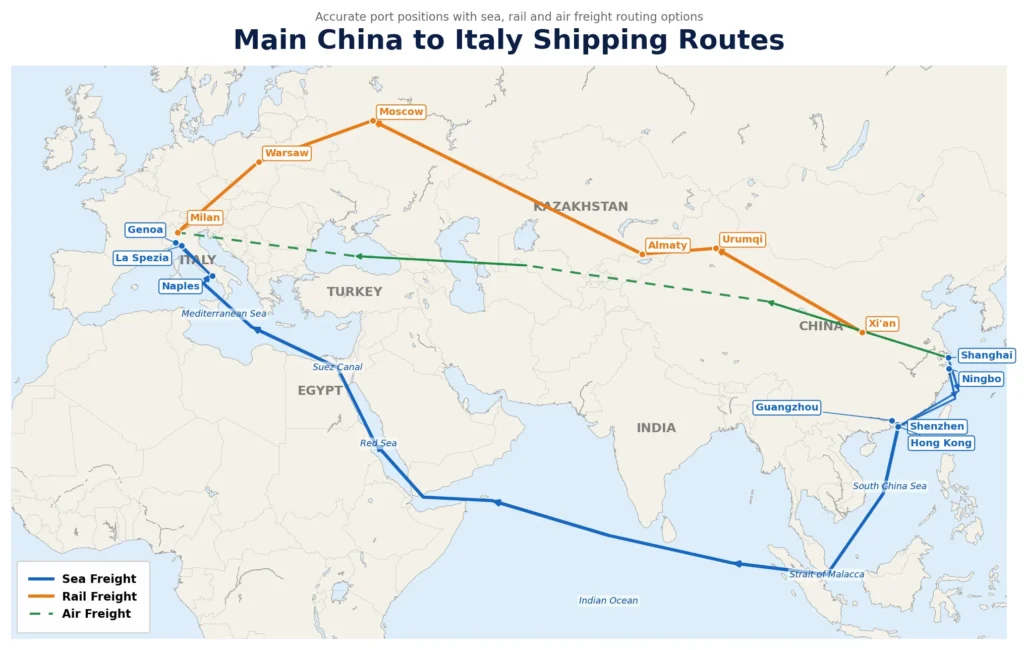
The best China to Italy shipping route depends on the supplier location, cargo type, transportation method and final delivery destination. A reliable freight forwarder should consider not only the nearest port, but also sailing schedules, inland transportation costs, handling fees and customs requirements.
Most shipments from China to Italy depart from major Chinese export hubs and arrive through Italy’s main seaports, airports or railway connections.
Major Chinese Ports and Departure Locations
Common departure ports for shipping from China to Italy include:
Shenzhen Port: Suitable for suppliers in southern China, including Shenzhen, Dongguan, Foshan and the Pearl River Delta manufacturing area.
Shanghai Port: A major choice for East China suppliers and regular container shipments.
Ningbo Port: Commonly used for Zhejiang, Yiwu and nearby manufacturing regions.
Qingdao and Tianjin Ports: Suitable for northern China suppliers and industrial cargo.
For EXW shipments, a freight forwarder usually arranges factory pickup and export handling. For FOB shipments, the supplier normally delivers the cargo to the agreed Chinese port before international transportation begins.
Main Italian Ports and Destinations
Italy has several important import gateways:
Genoa Port: One of the main ports serving northern Italy, including Milan, Turin and surrounding industrial areas.
La Spezia Port: Another important container gateway for northern and central Italy.
Venice and Trieste Ports: Often used for northeastern Italy.
Livorno and Naples Ports: Suitable for central and southern Italy depending on the shipping schedule.
For air freight, major routes usually connect Chinese airports such as Shanghai, Shenzhen, Guangzhou and Hong Kong with Italian gateways including Milan Malpensa and Rome Fiumicino.
Rail freight provides another option between sea and air transportation. China–Europe rail services can connect Chinese inland hubs with European terminals before continuing to Italy by rail or truck.
How to Select the Right Route
The cheapest route is not always the most cost-effective solution. Importers should compare:
Supplier location in China
Final delivery city in Italy
Cargo volume and weight
Required delivery time
Port handling and inland transportation costs
Tonlexing Logistics Insight: A suitable China–Italy shipping route should be selected based on the complete door-to-door cost, not only the ocean freight or air freight rate. The right route can help reduce unnecessary handling, delays and unexpected logistics costs.
China to Italy Shipping Costs and Transit Times (Updated July 2026)
When shipping from China to Italy, costs change with capacity, fuel surcharges, cargo type, route, season and final delivery requirements. The figures below are planning references supplied for this article and must be checked against Tonlexing’s live quotation before publication.
| Method | July 2026 planning reference | Quoted transit time | Scope note |
|---|---|---|---|
| 20GP sea freight | USD 4,320–5,280 | 25–34 days | Usually port-to-port |
| 40HQ sea freight | USD 6,390–7,810 | 25–34 days | Usually port-to-port |
| LCL sea shipping | Around USD 40/CBM | 26–38 days | Local charges may be separate |
| Rail freight | Live rate required | 12–15 days | Main rail movement only |
| Air freight | Around USD 7.30/kg | 3–7 days | Main airport movement |
| Express shipping | Live rate required | 3–5 days | Best for small parcels |
The complete delivery time is usually longer than the main transit time. Factory pickup, consolidation, cutoff dates, customs processes and delivery appointments must also be considered.
Read Tonlexing’s shipping cost from China to Italy guide for a fuller cost breakdown. Container importers can also review 20ft and 40ft container shipping costs from China to Italy.
What Changes the Final Italy Shipping Cost
The final China to Italy shipping cost depends on more than distance. Important factors include:
Weight and dimensions: Air freight uses chargeable weight, while LCL sea shipping is generally charged by volume or revenue ton.
Container load: A complete container can become more cost effective as volume increases.
Supplier location: Inland pickup adds domestic trucking and handling.
Final destination: A delivery in northern Italy may use a different gateway from Rome or Naples.
Incoterm: EXW, FOB, DAP and DDP shipping assign different costs and responsibilities.
Cargo type: High value, fragile, oversized, battery or regulated goods may need additional services.
Capacity and weather conditions: Peak periods and disruption can affect shipping costs and delivery time.
Documentation: Incorrect classification or missing documents can create inspection, storage and delay costs.
Tonlexing Logistics Insight
Do not compare a port-to-port quote with a door-to-door quote. First align the cargo data, Incoterm, route and final business address. Then compare included charges, exclusions, free time and delivery scope.
For LCL shipments, ask about destination CFS fees. For air freight, confirm chargeable weight. For rail freight, verify the European terminal and onward delivery plan.
Comparing several quotations? Tonlexing can help review the charge basis, route, included services and final delivery scope before booking.
Customs Clearance in Italy
Customs clearance is a critical step when shipping from China to Italy. Cargo arriving at major gateways such as Genoa Port, La Spezia Port, Trieste Port or Milan Malpensa Airport still requires correct documentation, product classification and import procedures before final delivery.
A reliable freight forwarder from China to Italy should help importers prepare documents, coordinate customs brokers and identify possible compliance issues before shipment departure.
Key Requirements for Italian Customs Clearance
Before shipping goods from China to Italy, importers should prepare accurate product and company information.
Important requirements include:
EORI Number: Companies importing goods into the European Union normally need an EORI number for customs operations. The importer information should match the commercial invoice, transport documents and customs declaration.
Correct HS Code: The HS code determines product classification, customs duties and possible compliance requirements. Incorrect classification may cause additional checks, delays or incorrect duty calculation.
Essential Documents: Most commercial shipments require a Commercial Invoice, Packing List, Bill of Lading or Air Waybill, HS code information and importer details. Additional certificates may be required depending on the product category.
Customs Duties and Import VAT in Italy
Import costs are not limited to international freight charges. When importing goods from China to Italy, buyers should also consider customs duties, import VAT and possible trade measures.
Italian Import VAT: The standard VAT rate is generally 22%. VAT is calculated based on the customs value, applicable customs duties and other relevant costs according to EU import rules.
EU Customs Duties: Customs duty rates depend on the HS code, product category and country of origin. Some products may have low or zero duty rates, while textiles, footwear and other categories may have higher rates.
Anti-Dumping Duties: Certain Chinese products may be subject to additional anti-dumping duties under EU trade regulations. Importers should confirm the latest requirements before shipping.
Choosing the Right Customs Clearance Method
The best customs solution depends on the importer’s business structure, VAT requirements and logistics experience.
Standard Import Clearance
Under a standard import process, the Italian buyer acts as the importer and manages customs procedures through its own EORI number or customs broker.
This option provides:
Direct control of import records
Clear VAT documentation
Better visibility of customs costs
It is commonly used by established Italian companies with regular imports from China.
DDP Shipping from China to Italy
DDP shipping can simplify international trade by combining transportation, customs clearance and final delivery into one service.
Before choosing DDP, importers should confirm:
Who acts as the importer of record
Whether duties and VAT are included
What customs documents will be provided
Whether the arrangement complies with Italian and EU requirements
For businesses without customs experience, a properly arranged DDP solution can reduce operational complexity.

Step-by-Step Shipping Process
A clear process for shipping from China to Italy helps business importers avoid delays and keep responsibilities visible.
Provide cargo details. Send the product information, HS code, commercial invoice, packing list, weight, dimensions, supplier address and final destination.
Compare shipping methods. Review sea freight, air freight, rail freight and express shipping according to urgency and budget.
Confirm the quotation. Check the Incoterm, included charges, exclusions, route and expected transit time.
Arrange pickup or warehouse delivery. Goods move from the supplier to the warehouse, port, airport or rail terminal.
Complete export handling. The forwarder coordinates booking, export declaration, labels and transport documents.
Manage international shipping. The cargo moves by sea, air, rail or courier with milestone updates.
Complete Italian customs and delivery. After release, goods move to the warehouse, project site or final business address.
Orders involving several suppliers can use consolidation services before export. Early document checks reduce the risk of shortages, incorrect packing and customs problems.
Common Shipping Mistakes When Importing from China to Italy
Many shipping problems are caused by poor preparation rather than the transportation itself. Importers can reduce delays and unexpected costs by understanding common mistakes before arranging their China to Italy shipment.
Common mistakes include:
Choosing a freight forwarder only by price: A low freight rate may exclude destination charges, customs handling, or final delivery costs. Always compare the complete shipping scope.
Providing inaccurate cargo information: Incorrect weight, dimensions, product descriptions, or HS codes can affect quotations, customs clearance, and transit schedules.
Ignoring import requirements: Some products require specific documents, certifications, or labeling before entering Italy. Checking compliance after the shipment arrives may cause unnecessary delays.
Confusing transit time with delivery time: Sea freight, rail freight, and air freight schedules usually refer to the main transportation stage. Factory pickup, customs clearance, and inland delivery should also be considered.
Using unsuitable shipping terms: Importers should understand the responsibilities under EXW, FOB, DAP, and DDP before booking to avoid unclear costs or responsibilities.
A professional freight forwarder can help review cargo details, shipping methods, documents, and customs requirements before departure, reducing risks throughout the shipping process.
Why Choose Tonlexing Logistics
Choosing the right freight forwarder from China to Italy requires more than comparing freight rates. Importers need a logistics partner that can coordinate suppliers, transportation, customs procedures and final delivery.
Tonlexing Logistics provides China-to-Italy shipping solutions including sea freight, air freight, rail freight, express shipping and door-to-door services. We help importers select suitable transportation methods based on cargo type, volume, delivery time and destination requirements.
Our services include:
Factory pickup and supplier coordination in China
FCL and LCL sea freight solutions
Air freight for urgent and high-value shipments
Rail freight between China and Europe
Cargo consolidation for multiple suppliers
Export documentation support
Customs clearance coordination
Final delivery arrangements in Italy
Request a quote with your product details, shipment volume and delivery address to find the right shipping option for your cargo.
Frequently Asked Questions
What is the cheapest way to ship from China to Italy?
Sea freight is normally the most cost effective solution for a large shipment or full container load. LCL may suit smaller shipments, but all origin, destination and delivery charges should be compared.
How long does sea shipping from China to Italy take?
The main sea freight transit time may be around 25–34 days, while LCL shipments may take about 26–38 days. Total delivery can be longer because of pickup, consolidation, customs and inland transport.
How long does air freight from China to Italy take?
The main air freight movement may take about 3–7 days. Door-to-door delivery can take longer depending on flight availability, screening, Italian customs and destination.
Is rail freight suitable for Italy shipping?
Rail freight can be a cost effective solution for medium-volume cargo, especially for northern Italy. Confirm the rail terminal, transfer plan, complete transit time and final trucking before booking.
What information is needed for a freight quote?
Provide the product name, HS code, carton quantity, packing list, dimensions, gross weight, total value, supplier address, final business address, cargo-ready date and preferred Incoterm.
Related Logistics Guides
Useful freight, customs and importing resources related to this shipping guide.
Related Guide
Shipping Cost from China to Italy
Shipping Cost from China to Italy (2026 Guide) Verified & Reviewed · Last updated April 2026 Shipping cost from China to Italy in 2026 typically...
Read guide →
Related Guide
DDP Shipping from China to Italy
DDP shipping from China to Italy is the most efficient solution for importers seeking all-inclusive logistics with no customs hassle or hidden fe...
Read guide →
Related Guide
20ft & 40ft Container Shipping Costs from China to Italy
20ft 40ft Container Shipping Costs from China to Italy Verified & Reviewed · Last updated June 2026 Shipping containers from China to Italy is on...
Read guide →
Useful Resource
How Long Does It Take to Ship from China to Italy?
How Long Does It Take to Ship from China to Italy is a question many importers ask when planning their supply chain. Shipping from China to Italy...
Learn more → Useful Resource Sea Freight from China to ItalySea Freight from China to Italy: Cost, Transit Time, Ports & Customs Guide Verified & Reviewed · Last updated June 2026 Sea freight from China to...
Learn more →