Related Guide
Shipping Factory Machines from China
Shipping Factory Machines from China Verified & Reviewed · Last updated July 2026 Shipping factory machines from China requires careful planning...
Read guide →

Importing industrial robots and automation equipment from China gives manufacturers access to robotic arms, AGVs, AMRs, and integrated automation systems. Successful importing requires reliable suppliers, verified specifications, and compliance with U.S. regulations.
This 2026 guide covers supplier verification, FCC restrictions, import duties, shipping costs, customs clearance, and final delivery to help buyers plan their shipments.
Import Costs
U.S. Regulations
Shipping & Delivery
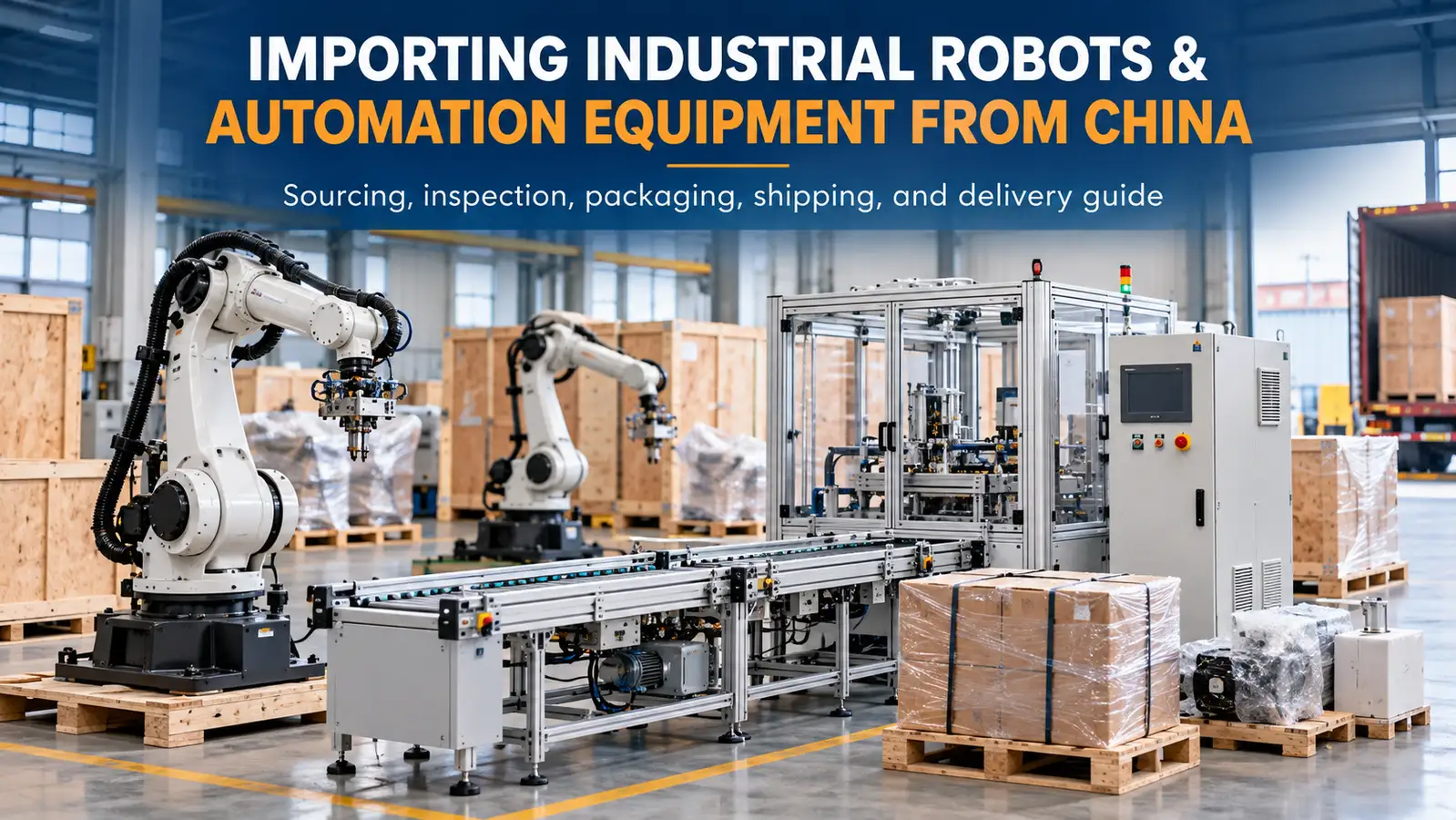
China manufactures a wide range of industrial robots and automation products for automotive assembly, electronics, metalworking, packaging, warehousing, and other manufacturing applications.
Importers can purchase individual robots, automation components, or complete systems designed for specific industrial operations.
| Equipment Type | Common Applications |
|---|---|
| Industrial Robots | Welding, assembly, material handling |
| Collaborative Robots | Inspection, machine tending, assembly |
| AGVs and AMRs | Warehouse transport, factory logistics |
| Automation Systems | Conveyors, packaging, robotic production lines |
Fixed industrial robots include articulated arms, SCARA robots, Cartesian systems, and other stationary machines. Mobile devices such as AGVs and AMRs are commonly used for internal transportation and automated warehouse operations.
Equipment may also include controllers, sensors, robotic grippers, machine vision devices, and programmable control systems.
Before purchasing, determine whether the order covers a standalone machine or an integrated system. This distinction affects technical requirements, customs classification, transportation arrangements, and installation responsibilities.
For additional purchasing guidance, see how to import machinery from China.
China is the world’s largest industrial robot market, supported by extensive manufacturing capabilities, component suppliers, and system integrators serving the global manufacturing industry.
According to the International Federation of Robotics (IFR), approximately 354,000 industrial robot units were installed in China in 2025, accounting for 59% of global installations. The World Robotics 2026 report highlights the country’s leading position in industrial automation and the continued expansion of its domestic robotics market.
Chinese manufacturers supply different categories of robots, from standard robotic arms to customized systems for complex industrial applications.
Key advantages include:
Wide product selection: Buyers can compare different robot models, controllers, automation products, and equipment configurations.
Manufacturing capabilities: Established suppliers may offer mechanical assembly, electrical integration, programming, and equipment testing.
Customization options: Manufacturers can adapt robotic systems to specific factory layouts, workpieces, and operating requirements.
Supplier availability: International buyers can evaluate multiple manufacturers and compare technical capabilities and service arrangements.
Maintenance support: Some suppliers maintain spare parts in stock and provide remote assistance, technical training, and replacement components.
The International Federation of Robotics also reports strong long-term growth in China’s industrial robot market. However, market size does not guarantee the quality of individual products.
When comparing equipment from China, Japan, or other manufacturing countries, buyers should evaluate reliability, compatibility, warranty coverage, and after-sales support rather than equipment price alone.
Importing industrial robots involves several connected stages, from defining technical requirements to factory inspection and international delivery.
The most practical approach is to confirm the equipment specifications and supplier responsibilities before negotiating the final purchase price.
Start by identifying the application, operating conditions, and performance expected from the equipment.
Provide potential suppliers with a written specification covering:
Payload and reach: Required lifting capacity, working radius, and movement range.
Operating performance: Repeatability, cycle time, speed, and application accuracy.
Electrical requirements: Voltage, frequency, power consumption, and control cabinet configuration.
System compatibility: PLC interfaces, communication protocols, software, and integration requirements.
Safety and maintenance: Protective equipment, emergency stops, spare parts, and technical support.
Industrial robots may use different electrical configurations, including 220V or 380V systems, depending on the model and intended market. Always confirm the manufacturer’s specifications and compatibility with the installation site.
For an integrated automation project, request drawings showing equipment dimensions, installation clearances, utility connections, and control interfaces.
Buyers can identify manufacturers through industry exhibitions, trade fairs, sourcing platforms, and direct factory contacts.
However, not every supplier advertising industrial robots operates its own manufacturing facility. Some companies are trading businesses or automation integrators.
Before selecting a supplier:
Verify its company registration, factory address, and business activities.
Request product specifications, quality records, and relevant certifications.
Review references from previous industrial projects.
Confirm whether key components are manufactured internally or sourced from third parties.
Check warranty terms, spare parts availability, and technical support arrangements.
Consider an independent factory inspection for high-value equipment.
Reliable suppliers should provide clear information about equipment specifications, manufacturing experience, testing procedures, and support for employees responsible for operation and maintenance.
For additional checks, review how to verify a Chinese supplier before you pay and the differences between factory audit and product inspection.
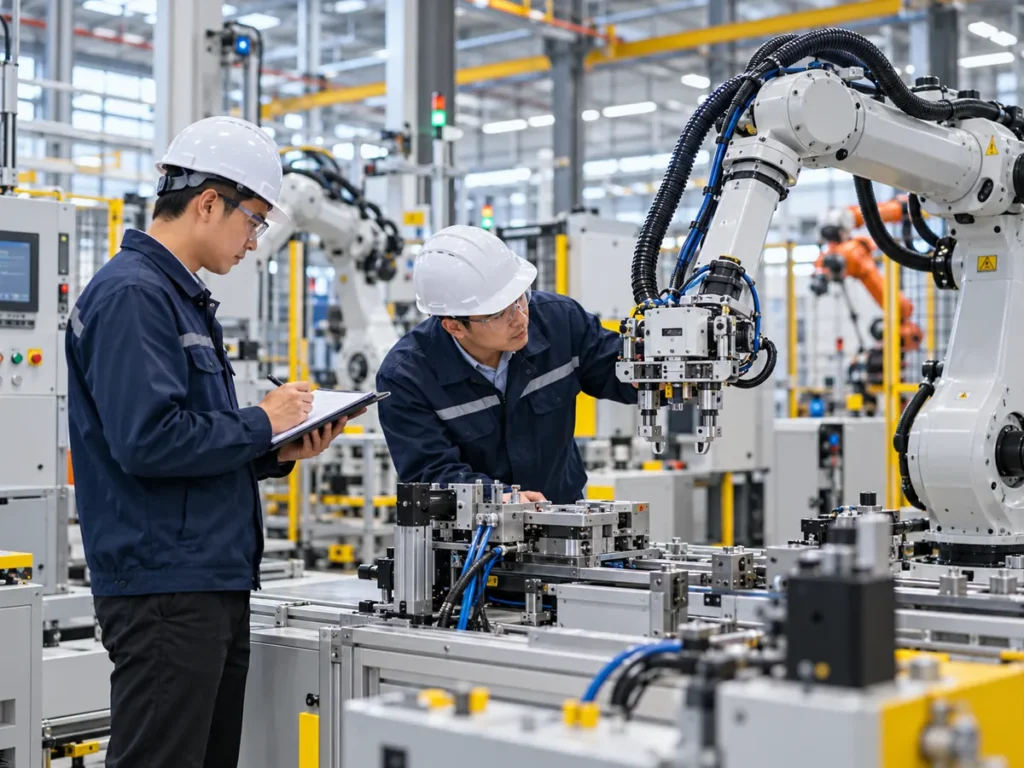
Request itemized quotations from shortlisted suppliers. Each quotation should identify the robot model, included accessories, control system, optional equipment, warranty, and delivery terms.
The purchasing contract should also specify:
Technical specifications and agreed equipment configuration.
Payment milestones and delivery responsibilities.
Factory Acceptance Testing (FAT) requirements.
Warranty coverage and replacement parts.
Installation, training, and after-sales support.
Some manufacturers request an advance payment before starting work, particularly for customized equipment. Deposit percentages vary and should be negotiated according to the supplier, contract value, and project risks.
For high-value orders, buyers may consider letters of credit or milestone-based payment arrangements. Additional precautions are explained in our guide on how to pay Chinese suppliers safely.
Planning an equipment purchase? Confirm the final packing dimensions, gross weight, pickup city, and destination with your supplier before requesting an international freight quotation.
Importing industrial robots and automation equipment from China into the United States requires accurate customs classification, tariff assessment, and product compliance checks. Requirements vary between fixed industrial robots, autonomous mobile robots (AMRs), and integrated automation systems.
Before placing an order, importers should confirm the applicable HTS code, U.S. import duties, and equipment authorization requirements to avoid unexpected costs or customs delays.
HTSUS code 8479.50.00.00 covers certain industrial robots not elsewhere specified or included. However, complete automation systems, mobile robots, controllers, and individual components may require different classifications.
Import duties depend on the equipment’s classification, country of origin, and applicable trade measures. Chinese products may also be subject to additional Section 301 tariffs or other duties.
The final tariff rate should be verified using the current U.S. Harmonized Tariff Schedule before calculating the total landed cost.
On July 28, 2026, the Federal Communications Commission (FCC) added certain foreign-produced advanced robotic devices to its Covered List, restricting new equipment authorizations for affected products.
These restrictions may cover qualifying autonomous mobile robots (AMRs), humanoid robots, and other connected mobile devices. Fixed industrial robots, including stationary robotic arms and SCARA robots, are excluded from this specific definition.
Previously authorized equipment and models receiving applicable conditional approvals may be treated differently. Importers should verify the exact model’s FCC authorization status before purchasing or shipping affected devices.
Besides tariffs and FCC restrictions, industrial robots must satisfy applicable U.S. electrical safety, product, and installation requirements. CE marking alone does not establish U.S. compliance, while UL or CSA certification requirements depend on the equipment and intended application.
Before shipment, importers should:
Verify product compliance: Request technical specifications, applicable certifications, and equipment authorization records.
Prepare customs documents: Confirm the commercial invoice, packing list, product descriptions, and declared value.
Review import responsibilities: Identify the importer of record and confirm customs clearance arrangements.
Working with a customs broker and freight forwarder helps coordinate documentation, tariff verification, and transportation before the equipment arrives in the United States.
The cost of importing industrial robots from China depends on the equipment price, U.S. import duties, shipping method, cargo dimensions, and installation requirements. Tariffs, specialized packaging, and inland delivery can significantly increase the total project budget.
Importers should calculate the total landed and installed cost rather than relying on the manufacturer’s quotation alone.
| Cost Component | What to Budget For |
|---|---|
| Equipment Purchase | Robot, controller, tooling, and accessories |
| Import Duties | Customs duties and additional tariffs |
| Freight and Insurance | International shipping, packaging, and insurance |
| Customs and Delivery | Brokerage, port fees, trucking, and unloading |
| Installation | Rigging, programming, and commissioning |
Total project cost = Equipment price + Freight and insurance + Import duties and fees + Destination delivery + Installation and integration.
Certain industrial robots classified under HTSUS 8479.50.00.00 have a general duty rate of 2.5%, with additional Section 301 tariffs potentially applying to Chinese-origin equipment.
The final duty rate depends on the confirmed classification, origin, applicable trade measures, and entry date. Complete automation systems and mobile robots may require different classifications.
Ocean freight is commonly used for heavy industrial robots, while air freight may suit urgent components. Shipping costs depend on cargo dimensions, weight, route, and container requirements.
Industrial machinery may also require reinforced wooden crates, moisture protection, and specialized loading equipment.
U.S. imports may incur the following customs fees:
Merchandise Processing Fee (MPF): 0.3464% for formal entries, subject to a minimum of $34.58 and a maximum of $670.86.
Harbor Maintenance Fee (HMF): 0.125% of cargo value for applicable ocean imports.
Customs brokerage, terminal handling, inland trucking, and unloading are additional expenses. Oversized machinery may require specialized trailers or lifting equipment.
Factory quotations may exclude mechanical installation, robotic grippers, controller programming, safety systems, and commissioning.
For customized automation equipment, confirm these services and any related charges before placing an order.
Shipping industrial robots and automation equipment from China requires careful planning due to their weight, dimensions, and sensitive mechanical components. The right transportation method depends on equipment size, packaging, delivery urgency, and destination requirements.
Ocean freight is generally suitable for complete robotic systems and heavy machinery, while air freight is more practical for urgent components and smaller equipment.
Importers can select from several transportation options:
Ocean Freight (FCL/LCL): Suitable for industrial robotic arms, controllers, and automation systems. FCL provides dedicated container space, while LCL may work for smaller, securely packed shipments.
Air Freight: Best for urgent replacement parts, compact robots, electronic controllers, and high-value components requiring faster delivery.
Oversized Cargo Shipping: Large automation lines and heavy machinery may require flat rack or open-top containers, depending on their dimensions and loading requirements.
For complete automation systems, confirm whether equipment can be disassembled and packed into standard containers before considering specialized transport.
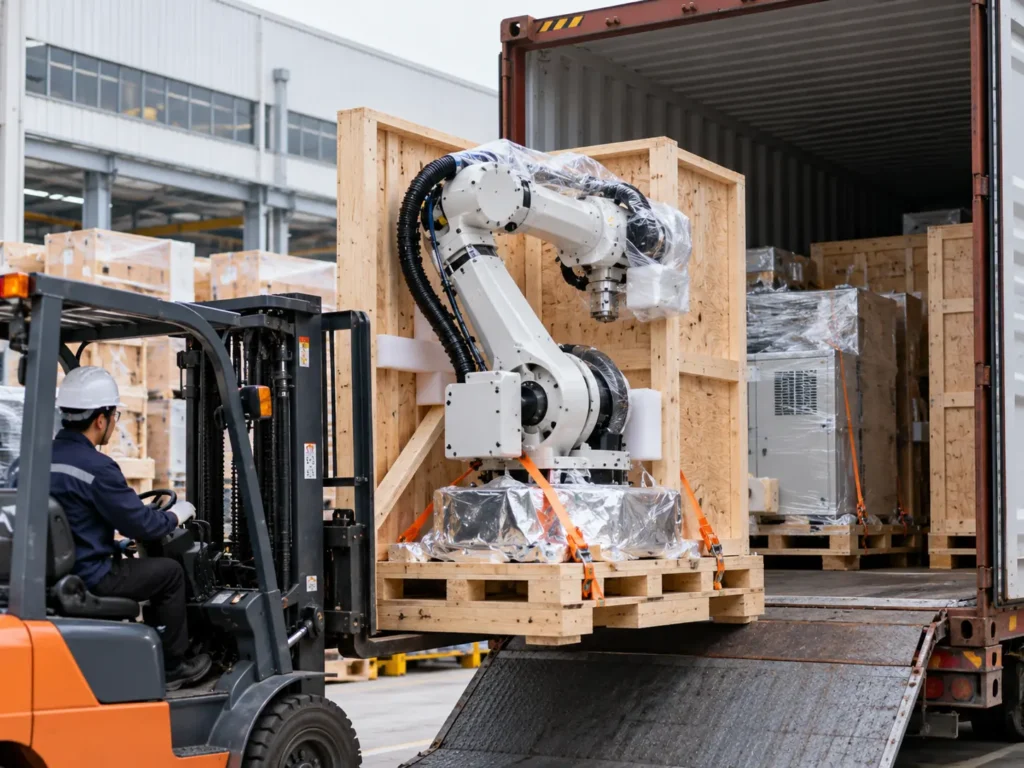
Industrial robots contain precision motors, sensors, control systems, and moving parts that require protection during international transportation.
Before shipping, suppliers should:
Secure moving components: Lock robotic arms and movable parts according to manufacturer instructions.
Use protective packaging: Apply suitable reinforced crates, cushioning, and moisture protection.
Mark handling requirements: Identify lifting points, center of gravity, package dimensions, and gross weight.
Protect electrical equipment: Pack controllers, sensors, and cables to reduce exposure to impact and moisture.
Check special cargo requirements: Confirm ISPM 15 compliance for regulated wooden packaging and applicable battery transport rules for AMRs.
Request packing photographs and a detailed packing list before cargo collection to help verify shipment readiness.
Total shipping time includes export preparation, international transit, customs clearance, and inland transportation. Actual schedules vary by origin, destination, carrier routing, and cargo handling requirements.
For large industrial robots, delivery planning should also consider:
Container and equipment availability: Confirm suitable transport equipment before booking.
Customs clearance: Prepare accurate cargo descriptions and shipping documents to reduce avoidable delays.
Inland delivery: Arrange appropriate trucks, cranes, or forklifts when specialized unloading is required.
For complete production lines, coordinate delivery with the installation schedule to avoid unnecessary storage and handling.
Need help shipping industrial robots from China? Contact Tonlexing with your equipment dimensions, gross weight, pickup location, and destination for a tailored freight and delivery plan.
Importing industrial robots from China requires accurate shipping documents and clear equipment acceptance procedures. Preparing these requirements before dispatch helps reduce customs delays, shipment discrepancies, and problems during installation.
For U.S.-bound shipments, importers should prepare the following documents according to the equipment type and applicable customs requirements:
Commercial Invoice: Identifies the buyer, seller, equipment description, quantity, and transaction value.
Packing List: Specifies the number of packages, dimensions, gross weight, and contents.
Bill of Lading or Air Waybill: Records the international transportation details.
Purchase Contract and Technical Specifications: Confirms the equipment model, configuration, and agreed commercial terms.
Compliance Documents: Includes applicable equipment authorization records, technical manuals, and other product-specific documentation.
For ocean shipments subject to Importer Security Filing (ISF), ensure the required information is submitted within the applicable deadline. Product descriptions, declared values, quantities, and package details should be consistent across the relevant documents.
For more details, see our guide to commercial invoice, packing list, and bill of lading.
Before shipment, verify that the industrial robot matches the purchase contract and approved technical specifications. For high-value or customized equipment, an independent inspection may help identify missing accessories, incorrect configurations, or physical damage.
Factory Acceptance Testing (FAT) should be agreed upon before manufacturing is completed. Depending on the application, testing may cover:
Robot model, serial number, and included accessories.
Payload, movement accuracy, and operating performance.
Controller functions, software, and communication interfaces.
Safety features and required technical documentation.
Record any defects or deviations and agree on corrective actions before shipment.
Before the equipment arrives in the United States, confirm the customs classification, applicable duties, import documentation, and customs broker arrangements. Resolve discrepancies promptly to avoid unnecessary clearance delays.
After delivery, Site Acceptance Testing (SAT) verifies that the installed equipment operates according to the agreed requirements under actual site conditions. Depending on the project, this may include system integration, safety checks, operator training, and production testing.
Confirm who is responsible for installation, commissioning, warranty support, and final sign-off. Clear acceptance criteria and documented responsibilities help prevent disputes between the buyer, equipment supplier, and system integrator.
Yes. Many industrial robots can be imported into the United States, subject to applicable customs, product safety, and regulatory requirements. Certain foreign-produced advanced mobile robotic devices are subject to FCC restrictions, while fixed, stationary industrial robots are excluded from that specific definition.
HTSUS 8479.50.00.00 covers certain industrial robots not elsewhere specified or included. The correct classification depends on the equipment’s function and configuration, and complete automation systems or individual components may require different codes.
Import costs depend on equipment specifications, purchase price, packaging, freight, import duties, destination handling, and installation. Request itemized equipment and shipping quotations to calculate the total project cost.
Delivery time depends on the shipping method, origin, destination, equipment dimensions, and customs procedures. Manufacturing, factory testing, packing, and inland transportation should also be included in the project schedule.
Certification requirements depend on the destination and equipment. CE marking is relevant to European requirements, while U.S. buyers should evaluate applicable electrical safety, equipment authorization, and workplace safety obligations. No single certification automatically satisfies every requirement.
Useful freight, customs and importing resources related to this shipping guide.
Shipping Factory Machines from China Verified & Reviewed · Last updated July 2026 Shipping factory machines from China requires careful planning...
Read guide →
Shipping CNC Machines Verified & Reviewed · Last updated April 2026 Shipping CNC Machines from China is a complex process that requires proper pl...
Read guide →
The United States is one of the largest importers of heavy machinery, sourcing equipment from China’s leading manufacturers to meet demands in in...
Read guide →
Shipping Oversized Cargo from China Verified & Reviewed · Last updated February 2026 Shipping oversized cargo from China depends on cargo dimensi...
Read guide →Pre-Shipment Inspection in China for Importers Verified & Reviewed · Last updated July 2026 A pre-shipment inspection helps importers identify de...
Learn more → Useful Resource Documents Required to Import from China (2025 Guide)Importing goods from China can be highly profitable—but only when you understand the necessary documents and import requirements. Whether you’re...
Learn more →WhatsApp us