

Merchandise Processing Fee MPF Explained for U.S. Imports from China

The Merchandise Processing Fee, commonly known as MPF, is a U.S. customs user fee charged by U.S. Customs and Border Protection for processing imported goods entering the United States.

This guide explains how MPF applies to imports from China, how the fee is calculated for formal and informal entries, what the minimum and maximum limits mean, and how importers can include MPF in their landed cost calculation.

MPF Calculation

Customs Duties

China Imports

Merchandise Processing Fee MPF for U.S. imports from China with customs documents and warehouse cargo
10,000+ international shipments handled    Global sea, air & DDP shipping solutions    24/7 shipment tracking & customer support

Table of Contents

What Is the Merchandise Processing Fee?

The Merchandise Processing Fee, commonly known as MPF, is a customs user fee charged by U.S. Customs and Border Protection for processing imported goods entering the United States. It is paid in addition to customs duties, tariffs, freight charges, insurance charges, and other import-related costs.

MPF applies to both informal and formal entries. Informal entries usually refer to goods valued at USD 2,500 or less, while formal entries apply to goods valued at over USD 2,500.

For most formal entries, MPF is charged as an ad valorem fee based on the entered value or customs appraised value of the shipment. The standard MPF rate is 0.3464%.

Formal entry MPF is subject to minimum and maximum limits. Based on the October 1, 2024 regulatory update, the common MPF structure is:

Entry TypeMPF Rate
Informal EntryFrom USD 2.53
Formal Entry MinimumUSD 32.71
Formal Entry MaximumUSD 634.62

For example, if goods imported from China have an entered value of USD 20,000, the MPF would be:

USD 20,000 × 0.3464% = USD 69.28

Because this amount falls between the minimum and maximum limits, the importer would pay USD 69.28 as the Merchandise Processing Fee.

MPF rates may change by fiscal year, and informal entry fees may vary by processing method. Importers should confirm the latest figures with CBP, a licensed customs broker, or their freight forwarder before shipment.

Does MPF Apply to Goods Imported from China?

Yes. MPF applies to most goods imported from China because China is not covered by a U.S. free trade agreement that removes this fee for general commercial imports.

Some goods qualifying under certain free trade agreements may be exempt from MPF, such as eligible goods under the Panama Trade Promotion Agreement, Peru Trade Promotion Agreement, Colombia Trade Promotion Agreement, CAFTA-DR, and other trade agreements.

However, these MPF exemptions usually do not apply to normal China-origin goods. This means importers shipping from China to the USA should usually include the merchandise processing fee in their landed cost calculation.

MPF commonly applies to:

  • Formal entries for shipments valued over USD 2,500

  • Informal entries for lower-value commercial goods

  • Ocean freight imports

  • Air freight imports

  • Express shipments when applicable

  • DDP shipments where the forwarder handles customs clearance

Importers should note that MPF rates may change by fiscal year, so the final amount should always be confirmed with CBP, a licensed customs broker, or the freight forwarder before shipment.

MPF Calculation Example for China Imports

For formal entries, the Merchandise Processing Fee is calculated using the entered value of the shipment multiplied by the current MPF rate of 0.3464%. After the calculation, the result must still fall within the CBP minimum and maximum limits for the applicable fiscal year.

The basic formula is:

MPF = Entered Value × 0.3464%

For Fiscal Year 2026, the commonly referenced limits are:

  • Minimum MPF: USD 33.58

  • Maximum MPF: USD 651.50

This means importers will generally encounter one of the following three situations.

Scenario 1: Standard MPF Calculation

If the calculated amount falls between the minimum and maximum limits, the importer pays the exact calculated fee.

Example:

  • Commercial cargo value: USD 50,000

  • Formula: USD 50,000 × 0.3464% = USD 173.20

  • Final MPF owed: USD 173.20

Because the calculated amount is within the allowed range, no minimum or maximum adjustment applies.

Scenario 2: Minimum MPF Applies

If the calculated fee is lower than the CBP minimum amount, the importer must still pay the minimum MPF.

Example:

  • Commercial cargo value: USD 5,000

  • Formula: USD 5,000 × 0.3464% = USD 17.32

  • Final MPF owed: USD 33.58

Although the calculation result is lower, the minimum fee requirement applies to the formal entry.

Scenario 3: Maximum MPF Applies

If the calculated fee exceeds the CBP maximum limit, the importer only pays the capped maximum amount.

Example:

  • Commercial cargo value: USD 250,000

  • Formula: USD 250,000 × 0.3464% = USD 866.00

  • Final MPF owed: USD 651.50

Because the calculated amount exceeds the legal maximum, the importer only pays the capped fee.

MPF vs Customs Duties, Tariffs, and HMF

Many importers confuse MPF with customs duties, tariffs, or Harbor Maintenance Fee. These charges are different and should be calculated separately.

Customs duties are based on the product HTS code and duty rate. Tariffs may apply to certain Chinese products depending on trade policy and product classification. MPF is a customs user fee charged for processing the entry.

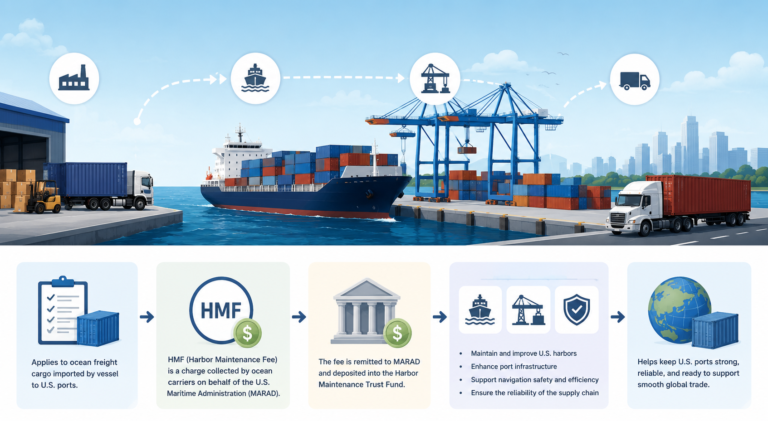
For ocean freight shipments, importers may also need to pay Harbor Maintenance Fee. HMF applies to ocean imports arriving at U.S. ports. Air freight is not subject to HMF, but it may still be subject to MPF.

A simple comparison:

FeeMain BasisApplies To
MPFEntry value and entry typeMost imports
Customs dutiesHTS code and duty rateDutiable goods
TariffsProduct and trade policyCertain products
HMFOcean import valueOcean freight only

This is why an importer may pay MPF even when the product has a low duty rate or zero duty.

Are Any Shipments Exempt from MPF?

Some shipments may be exempt from MPF, but exemptions are limited.

Common examples include qualified Section 321 shipments, certain free trade agreements, some returned goods, and specific goods qualifying under special customs programs. Personal effects may also be treated differently from normal commercial cargo, depending on the situation.

In some cases, a foreign trade zone may affect when duties and fees are paid, because goods can be admitted into the zone before formal U.S. entry. However, this does not mean every FTZ shipment automatically avoids MPF. The final treatment depends on how and when the goods enter U.S. commerce.

For China imports, most commercial shipments are still subject to MPF unless a specific exemption applies.

Importers should not assume a shipment is exempt just because:

  • The customs duty rate is 0%

  • The goods are shipped by air freight

  • The shipment is handled under DDP

  • The supplier says “tax included”

  • The shipment value is low but still requires formal entry

Handling fees for imported goods from China with freight forwarder checking customs documents

Why MPF Matters for Landed Cost

MPF may look small compared with freight or product cost, but it still affects the final landed cost.

A complete landed cost calculation for imports from China may include:

  • Product value

  • China local pickup and export handling

  • International freight

  • Insurance if purchased

  • Customs duties and tariffs

  • Merchandise Processing Fee

  • Harbor Maintenance Fee for ocean shipments

  • Customs broker fee

  • U.S. local transportation

  • Warehouse, storage, or exam-related fees when applicable

For ecommerce sellers, wholesalers, Amazon FBA importers, and regular B2B importers, even small fees can affect profit margin when shipments are frequent.

If you ignore MPF during cost planning, your final import cost may be higher than expected.

How to Reduce MPF Mistakes Before Shipping

The best way to avoid MPF-related problems is to prepare customs documents correctly before the cargo leaves China.

Importers should make sure the commercial invoice shows the correct product description, quantity, unit price, total value, currency, country of origin, and buyer and seller information. The packing list should match the shipment details, and the HTS code should be checked before customs clearance.

Common mistakes include using the wrong declared value, confusing product value with freight cost, assuming MPF is included in duties, and comparing DDP and FOB quotes without checking which customs fees are included.

A reliable freight forwarder or customs broker can help you:

  • Confirm whether the shipment needs formal entry or informal entry

  • Estimate MPF before shipment

  • Check whether HMF applies

  • Review customs documents

  • Confirm the entry value

  • Explain which fees are included in the quote

  • Reduce delays during customs clearance

Frequently Asked Questions

Need Help Calculating MPF for Your China Import?

  • Estimate MPF, customs duties, and tariffs
  • Check formal entry and informal entry requirements
  • Get China-to-USA freight and customs clearance support

Get clear shipping options, customs cost estimates, and landed cost support for your shipment from China to the USA.