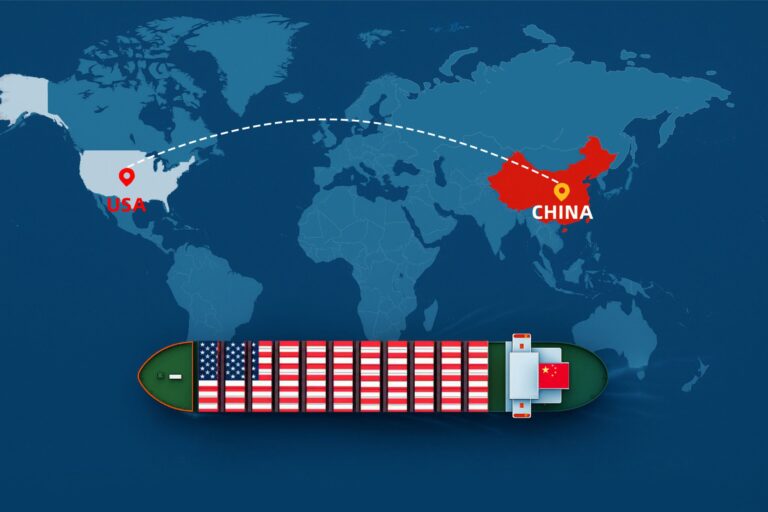
Related Guide
Shipping from China to the USA
Shipping from China to the USA includes air freight, sea freight, and DDP shipping options. Compare shipping costs, transit times, and US customs...
Read guide →

Sea freight shipping from China to the USA is one of the most cost-effective ways to move heavy, bulky, or high-volume cargo across the Pacific. It is widely used for furniture, machinery, electronics, textiles, building materials, auto parts, consumer goods, and bulk inventory.
This guide explains sea freight shipping from China to the USA, including FCL and LCL options, ocean freight costs, transit times, major ports, shipping routes, customs clearance, required documents, and practical ways to reduce total logistics costs.
Shipping method / Mode
Transit time range
DDP / Door to Door
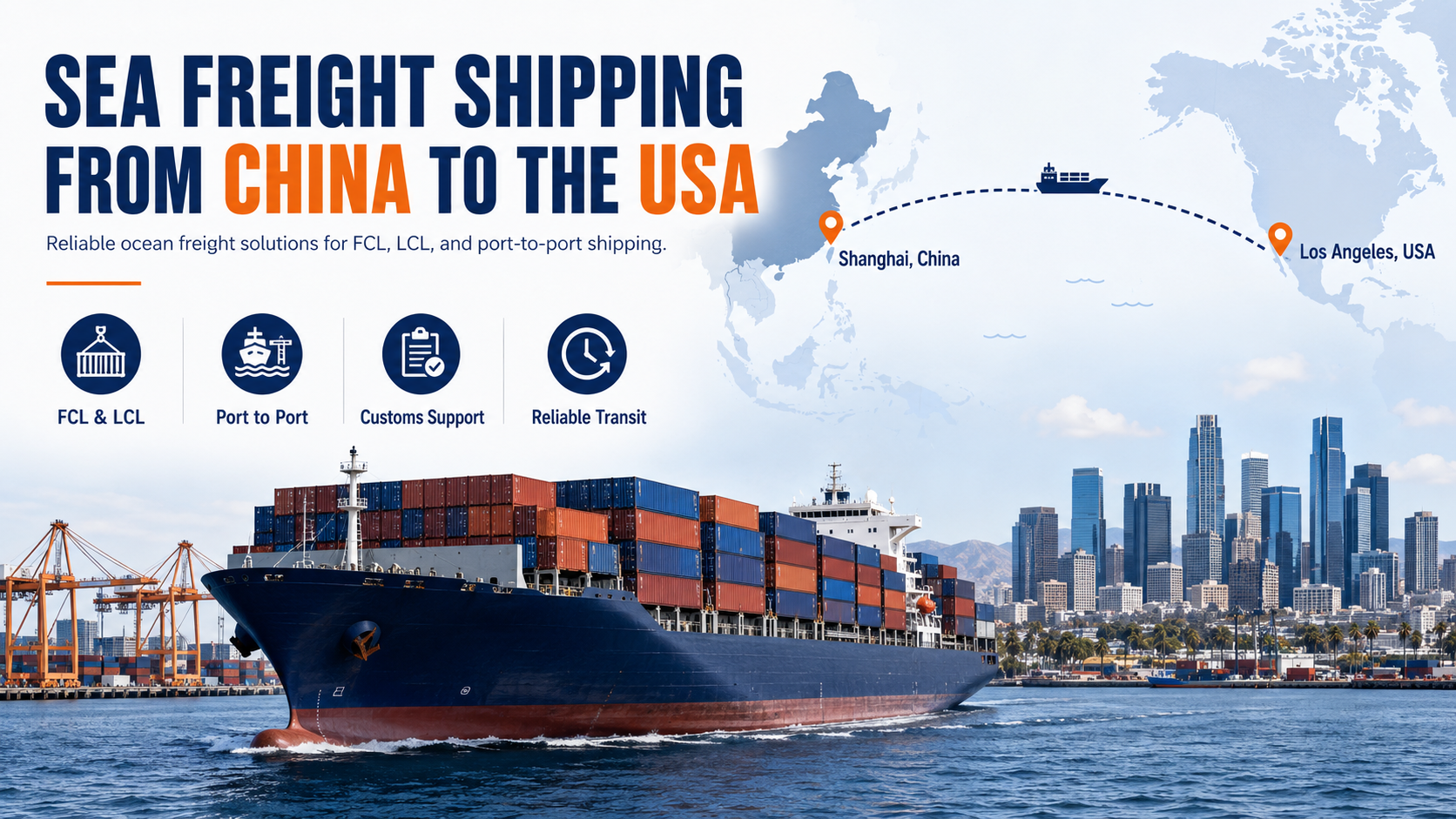
When shipping from China to the USA by sea freight, importers typically choose between FCL (Full Container Load) and LCL (Less than Container Load). The main difference is whether you use a full container or share space with other shipments.
FCL (Full Container Load) means your cargo uses an entire container, such as a 20ft, 40ft, or 40HQ container. The container is loaded at the origin, sealed, and shipped directly to the destination port or final delivery point without sharing space with other importers.
FCL shipping is ideal for:
Large-volume shipments
Heavy or dense cargo
Machinery and industrial equipment
Furniture and bulky goods
Wholesale inventory
Cargo requiring lower handling risk
Shipments needing stable schedules
FCL is generally more cost-effective when shipment volume is high enough to fill most or all of a container. It also reduces handling, which lowers the risk of damage or loss.
LCL (Less than Container Load) means your goods share container space with shipments from other importers. You only pay for the space you use, usually calculated in cubic meters (CBM).
LCL shipping is suitable for:
Small and medium shipments
Trial or sample orders
Cargo below full container volume
E-commerce and replenishment shipments
Importers without enough volume for a full container
Before loading, goods are consolidated at a warehouse in China and separated after arrival in the USA, which adds extra handling steps.
In general, LCL is better for smaller shipments, while FCL becomes more cost-effective when cargo volume is around 12–15 CBM or above.
| Shipping Method | Best For | Main Advantage | Limitation |
|---|---|---|---|
| LCL Shipping | Small and medium cargo | Pay only for used space | Longer handling time |
| 20ft FCL | Medium-volume shipments | Stable cost and good efficiency | Limited capacity |
| 40ft FCL | Large shipments | Lower unit shipping cost | Requires more cargo volume |
| 40HQ FCL | Bulky cargo | Maximum container space | Higher total cost |
Sea freight costs from China to the USA depend on shipment volume, container type, cargo weight, shipping route, origin port, destination port, seasonal demand, carrier capacity, customs clearance, and final delivery requirements.
Ocean freight rates are highly dynamic and can change weekly due to market demand, fuel prices, port congestion, and space availability. The following prices are for reference only and should always be confirmed with a freight forwarder before booking.
| Shipping Option | Estimated Cost (USD) | Best For | Notes |
|---|---|---|---|
| LCL Shipping | $60–180 per CBM | Small shipments | Pricing depends on volume, destination, and CFS handling charges |
| 20ft FCL (Full Container) | $2,200–5,500 | Medium-volume shipments | Best for dense or heavy cargo, stable unit cost |
| 40ft FCL (Full Container) | $3,300–8,000 | Large-volume shipments | Lower cost per unit compared to LCL |
| 40HQ FCL | $3,500–8,500 | Bulky or lightweight cargo | Common for furniture, retail, and e-commerce goods |
| Door-to-Door Sea Freight | All-in Quote | Full-service importers | Includes pickup, export customs, ocean freight, import clearance, and delivery |
The ocean freight rate only covers transportation from port to port. A complete landed cost includes additional origin and destination charges.
Hidden charges often have a greater impact on total shipping cost than ocean freight itself, so importers should always calculate the full landed cost instead of only comparing ocean freight rates.
Ocean freight time from China to the USA depends on destination coast, carrier route, shipping line, and whether you choose FCL or LCL shipping. West Coast routes are the fastest because vessels cross the Pacific directly, while East Coast and Gulf Coast shipments usually take longer due to Panama Canal routing or transshipment.
FCL shipping represents full container shipments (20ft or 40ft containers). Below are typical port-to-port transit times:
| Route | Transit Time | Use Case |
|---|---|---|
| Shanghai / Ningbo → Los Angeles / Long Beach | 13–20 days | Fast West Coast retail replenishment |
| Shenzhen / Yantian → Los Angeles / Long Beach | 13–20 days | Electronics and consumer goods |
| Nansha → US West Coast | 15–22 days | South China manufacturing exports |
| Shanghai / Ningbo → New York / New Jersey | 25–40 days | US Northeast distribution |
| Shenzhen → Savannah | 28–40 days | Southeast US commercial supply |
| China Major Ports → Houston | 28–45 days | Gulf Coast industrial cargo |
If you ship via LCL (Less than Container Load), expect an additional 7–14 days compared with FCL due to consolidation and deconsolidation processes.
At Origin (China): Cargo must wait for consolidation at CFS warehouse before loading
At Destination (USA): Container must be unpacked and sorted before final pickup
LCL is more flexible but slower due to extra handling steps.
Total delivery time for LCL shipments can stretch to 2–3 months when origin handling, customs, and inland transport are included.
Door-to-door sea freight from China to the USA is a complete logistics solution that covers the entire shipping process from the supplier’s address in China to the final delivery location in the United States.
It is widely used by importers who want a simple, all-in-one shipping method without managing multiple logistics steps such as export clearance, ocean freight booking, customs handling, and inland delivery.
Door-to-door sea freight means your freight forwarder provides a full shipping solution and handles the full shipping chain, including:
Pickup from supplier in China and moving the cargo from the factory to the Chinese shipping port
Export customs clearance
Inland trucking to port
Ocean freight shipping
Import customs clearance in the USA
Port handling and unloading
Final delivery to warehouse, business, or Amazon FBA
This service can be arranged under DDP (Delivered Duty Paid) or DDU (Delivered Duty Unpaid) terms depending on who pays duties and taxes, and the forwarder can handle customs clearance under the selected service terms.
Total delivery time depends on destination and shipping route:
West Coast USA: 18–25 days
East Coast USA: 30–45 days
Inland USA delivery: 35–50 days
Door-to-door shipping is longer than port-to-port shipping because it includes inland transportation and customs processing on both sides.
A complete door-to-door service usually includes, with cargo insurance available as optional protection:
Supplier pickup in China
Export documentation and customs clearance
Container loading and port handling
Ocean freight shipping
US import customs clearance
Duty and tax processing (if DDP)
Final trucking delivery to destination
Specialized handling may be required for perishable or hazardous cargo in door-to-door sea freight.
This makes it a preferred option for importers without a local logistics team in the USA, and insurance is important to protect goods against damage during shipping.
China’s major export ports are highly automated mega-container hubs that handle large volumes of ocean freight to the United States. The choice of origin port mainly depends on factory location, cargo type, and carrier routing availability.
China’s coastline features highly automated mega-ports. Selecting the right origin is primarily determined by your factory’s location.
Port of Shanghai: The world’s busiest container port, serving as the premier gateway for East China. It offers the highest density of transpacific sailings to both US coasts.
Port of Ningbo-Zhoushan: Located in Zhejiang Province, it features an excellent deep-water harbor and handles massive volumes of FCL cargo, heavy machinery, and consumer goods.
Port of Shenzhen (Yantian / Shekou): The vital electronics and high-tech gateway for South China. Yantian specializes in fast, direct transpacific loops favored by e-commerce brands and Amazon FBA sellers.
Port of Guangzhou (Nansha): A rapidly expanding automated port in the Pearl River Delta. It is highly cost-effective and provides seamless access for factories producing furniture, apparel, and hardware in Foshan, Zhongshan, and Shunde.
Port of Qingdao & Tianjin: The main marine hubs for Northern China. They handle heavy industrial goods, raw materials, steel, and machinery bound for North American destinations.
US ports are grouped geographically into three coastal ranges, each acting as a regional gateway for specific delivery zones.
US West Coast (USWC)
Los Angeles & Long Beach (LA/LB): The twin-port complex in Southern California that handles the vast majority of all transpacific container traffic. It provides the fastest ocean transit times (13–18 days) and connects directly to massive intermodal rail networks moving cargo to the US Midwest.
Seattle & Tacoma: The primary Pacific Northwest gateways, offering efficient clearance for goods heading to northern US destinations and western Canada.
US East Coast (USEC)
New York & New Jersey: The largest comprehensive port complex on the Atlantic coast. It is the destination of choice for cargo supplying the densely populated Northeast region.
Savannah: One of the fastest-growing container ports in North America, featuring extensive inland rail networks optimized for Southeast US distribution.
US Gulf Coast (USGC)
Houston: The dominant maritime gateway for America’s southern industrial corridor. Ideal for cargo destined straight for Texas, Oklahoma, and adjacent oil, gas, or agricultural supply lines.
Sea freight routes from China to the USA are divided into three main trade lanes: West Coast (USWC), East Coast (USEC), and Gulf Coast (USGC). Each route differs in transit time, shipping cost, and inland distribution efficiency depending on the final destination ZIP code and cargo type.
All transit times below are port-to-port estimates (FCL basis) unless otherwise specified.
This is the shortest, fastest, and most heavily trafficked maritime lane across the Pacific. Cargo moves directly east from China to major marine gateways in California, Washington, and Oregon.
Primary Ports: Los Angeles (LA), Long Beach (LB), Oakland, Seattle, and Tacoma.
Transit Time: 13–20 days port-to-port.
Best For: Shipments bound for California, Nevada, Arizona, the Pacific Northwest, and Western Amazon FBA centers. It is also used for intermodal transport, where containers land on the West Coast and move to the Midwest via rail blocks to save time.
This route serves the densely populated Atlantic coast. Vessels typically cross the Pacific, pass through the Panama Canal, and sail up the eastern seaboard.
Primary Ports: New York / New Jersey, Savannah, Charleston, Norfolk, and Miami.
Transit Time: 25–40 days (port-to-port).
Best For: Inventory destined for New York, Pennsylvania, Georgia, the Carolinas, and Florida. While it adds 2 to 3 weeks of water transit compared to the West Coast, it avoids cross-country rail or domestic trucking bottlenecks, delivering cargo straight to the East Coast distribution networks.
The Gulf Coast route targets the southern industrial and energy corridors of the United States. Vessels sail through the Panama Canal or use alternative transoceanic routings into the Gulf of Mexico.
Primary Ports: Houston, New Orleans, and Mobile.
Transit Time: 28–45 days (port-to-port).
Best For: Heavy industrial cargo, building materials, oil and gas equipment, and commercial goods heading straight to Texas, Louisiana, or adjacent Southern states.
Sea freight routes can be divided into two main types:
Direct routes: Faster transit, fewer handling steps, more stable schedule
Transshipment routes: Cargo transferred via hub ports (e.g., Busan, Singapore), usually cheaper but slightly longer transit time
Direct West Coast routes are preferred for time-sensitive shipments, while transshipment routes are often used for cost optimization.

Customs clearance and import tax rates for goods shipped from China to the United States are regulated by U.S. Customs and Border Protection (CBP). All imported cargo must be properly declared, classified, and assessed before release.
The customs clearance process ensures that all imported goods comply with U.S. regulations before entering the market.
Step 1: ISF Filing (Before Vessel Departure)
Importer Security Filing (ISF 10+2) must be submitted before the vessel departs from China. It includes shipment and supplier information, cargo description, container details, and voyage data.
Late or incorrect filing may result in CBP penalties, shipment delays, or customs holds.
Step 2: Customs Entry Filing (Arrival in the USA)
Upon arrival at the U.S. port, the customs broker submits the entry declaration to CBP, including CBP Form 3461 for release processing.
CBP then reviews shipment details to determine whether the cargo is cleared or selected for inspection.
Step 3: Entry Summary and Duty Assessment
After release approval, the broker files CBP Form 7501 (Entry Summary). This document finalizes:
HS code classification (HTS code)
Declared shipment value
Duty and tax calculation
Applicable tariffs such as Section 301 (if applicable)
Step 4: Customs Inspection (If Required)
CBP may conduct random or targeted inspections based on shipment risk level. This may include document review, X-ray scanning, or physical cargo inspection.
Step 5: Cargo Release and Delivery
Once duties are paid and clearance is completed, the cargo is released and transported via inland trucking to the final destination, such as warehouses, commercial addresses, or Amazon FBA centers.
Your Chinese supplier must provide clean, accurate data, and freight forwarders and customs brokers rely on accurate paperwork to avoid holds and exam risk. Discrepancies between these documents are the leading cause of random physical exams:
Commercial Invoice: Must feature exact item descriptions in English, true transaction value, currency, unit totals, and clear buyer/seller details.
Packing List: Details the exact carton count, weight configurations, dimensions, packaging layout, and container markings.
Bill of Lading (B/L): The official receipt issued by the carrier or forwarder outlining the terms of the ocean transport.
U.S. Statistical HTS Code: While suppliers provide a 6-digit Chinese HS code, you must convert this to the definitive 10-digit Harmonized Tariff Schedule (HTS) format to calculate legitimate duty variables and customs duties accurately.
Import duties and taxes for shipments from China to the USA are primarily based on the Most Favored Nation (MFN) tariff system, additional trade measures such as Section 301 tariffs, and mandatory U.S. Customs and Border Protection (CBP) processing fees.
The final landed cost is calculated based on the product’s HTS classification, declared customs value, and applicable regulatory fees.
The base import duty is determined under the Most Favored Nation (MFN) tariff system and applies to all standard commercial imports into the United States.
Calculation Method:
Duties are calculated as an ad valorem percentage of the declared customs value (FOB value of goods, excluding international freight and insurance).
Tariff Classification:
Determined by the 10-digit HTS (Harmonized Tariff Schedule) code assigned to each product.
Typical Duty Range:
Most products fall between 0% and 20%, depending on classification, with some categories eligible for duty-free entry.
In addition to MFN duties, many products originating from China are subject to Section 301 tariffs imposed by the United States Trade Representative (USTR).
Additional Rate Range:
Typically 7.5%, 25%, or higher, depending on HTS classification.
Stacked Calculation:
Section 301 tariffs are applied on top of the MFN base duty.
Impact Example:
If a product has a 5% MFN duty and a 25% Section 301 tariff, the total duty burden becomes 30% of the declared customs value.
In addition to import duties, CBP requires standardized processing fees that form part of the overall shipping costs for formal commercial entries.
Merchandise Processing Fee (MPF)
Rate: 0.3464% of declared cargo value
Minimum: $29 per entry
Maximum: $556 per entry
Applies to most formal imports valued over $2,500
Harbor Maintenance Fee (HMF)
Rate: 0.125% of cargo value
Applies only to ocean freight shipments
No minimum or maximum cap
Assessed on declared customs value
Together with duties and tariffs, these fees affect total landed cost for china to usa shipping.
Sea freight cost is not only about the ocean rate. Importers should manage the full logistics chain to reduce unnecessary charges.
Choose the Right Shipping Method
Use LCL for small shipments and FCL for larger cargo. If your cargo volume is close to a full container, FCL may be cheaper than LCL.
Optimize Carton and Pallet Size
Poor packaging can increase volume and raise shipping cost. Work with suppliers to reduce unnecessary space while keeping cargo safe.
Compare Destination Ports
Shipping to the nearest port is not always the cheapest option. Sometimes a slightly farther port may offer better ocean rates or faster inland delivery.
Avoid Peak Season Delays
Freight rates often rise before Chinese New Year, major holidays, and peak retail seasons. Importers should plan shipments 2–4 weeks in advance during these periods to secure better space, more stable pricing, and competitive rates. Booking that early can also help secure competitive rates.
Prepare Documents Early
Missing or inaccurate documents can cause customs delays, storage fees, and demurrage. Confirm the commercial invoice, packing list, HS code, and importer information before shipment.
Consolidate Shipments
If you have multiple suppliers in China, consolidating LCL shipments can reduce costs, improve shipping efficiency, and support better supply chain efficiency.
Work with an Experienced Freight Forwarder
A reliable freight forwarder can help compare shipping rates across routes and service options, control local charges, arrange customs support, and reduce unexpected logistics problems, while also helping monitor fuel surcharges and other variable charges when evaluating quotes.
Tonlexing supports importers with stable and well-organized sea freight and USA shipping solutions from China to the USA, focusing on operational reliability, cost efficiency, and shipment visibility across the entire logistics chain.
We work closely with major shipping lines and local partners in China and the United States to ensure smooth coordination from pickup to final delivery, including FCL, LCL, and door-to-door shipments.
Customers can monitor shipment status using digital tracking tools for updates throughout transit.
Our Core Advantages:
Stable access to major China export ports including Shanghai, Ningbo, Shenzhen, and Guangzhou
Flexible FCL and LCL consolidation options based on cargo volume
Door-to-door solutions covering customs clearance and inland delivery
Practical support for U.S. import compliance and documentation handling
Route optimization and visibility support across the broader shipping process from China to the US
Our service is designed for:
E-commerce and Amazon FBA importers
Wholesale and retail supply chains
Machinery and industrial shipments
Multi-supplier consolidation projects
Sea freight from China to the USA usually takes around 13–20 days to West Coast ports, 25–40 days to East Coast or Gulf Coast ports, and about 30–45 days for door-to-door delivery.
The cost depends on shipment volume, container size, origin port, destination port, route, season, and final delivery address. LCL shipping is usually charged by CBM, while FCL shipping is charged by container type such as 20ft, 40ft, or 40HQ.
LCL is better for smaller shipments that do not fill a container. FCL is better for larger shipments because it usually offers lower unit cost, less cargo handling, and better schedule control.
Common USA ports include Los Angeles, Long Beach, Oakland, Seattle, Tacoma, New York/New Jersey, Savannah, Charleston, Houston, and Miami.
For large shipments, sea freight is usually the cheapest option. LCL shipping is suitable for small cargo, while FCL shipping is more cost-effective when the shipment volume is large enough for a full container.
Useful freight, customs and importing resources related to this shipping guide.
Shipping from China to the USA includes air freight, sea freight, and DDP shipping options. Compare shipping costs, transit times, and US customs...
Read guide →
Break down shipping costs from China to the USA, including air freight, sea freight, and delivery times for different shipment sizes.
Read guide →
How Long Does It Take to Ship from China to USA? Verified & Reviewed · Last updated January 2026 How Long Does It Take to Ship from China to the...
Read guide →
20ft & 40ft Container Shipping Rates from China to USA Verified & Reviewed · Last updated June 2026 20ft and 40ft container shipping rates from C...
Read guide →Compare air freight rates from China to the USA, including transit times, chargeable weight, and cost effective air shipping options.
Learn more → Useful Resource DDP Shipping from China to USADDP Shipping from China to USA Verified & Reviewed · Last updated June 2026 DDP Shipping from China to USA is a duty-paid door-to-door shipping s...
Learn more →WhatsApp us