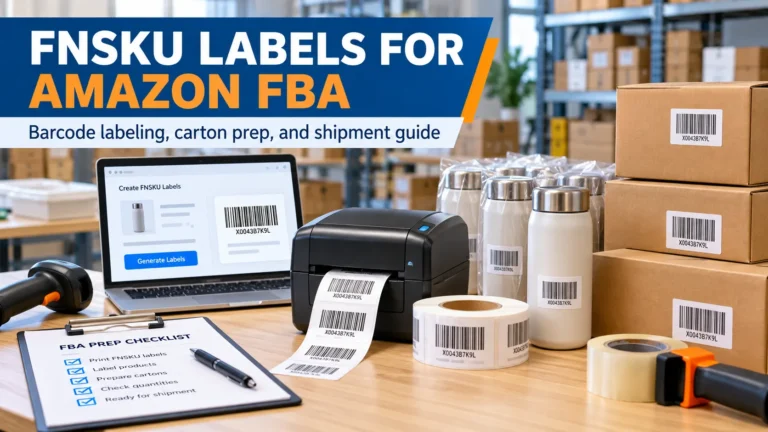
Related Guide
FNSKU Labels for Amazon FBA
FNSKU Labels for Amazon FBA: Requirements, Size & How to Print Verified & Reviewed · Last updated October 2026 FNSKU labels are used to identify...
Read guide →An added benefit for eligible new customers shipping with Tonlexing.
Check Eligibility & Get a Quote →Subject to cargo eligibility, insurer approval and policy terms.
Coverage and insured value depend on the cargo, route and written insurer confirmation before shipment. Policy exclusions, deductibles and claims terms apply. The US$500,000 figure is a maximum coverage limit, not a guaranteed claim payment. Insurance premiums are not represented as free unless expressly confirmed in your quote.


Shipping from China to Amazon FBA UK requires the right freight method, proper customs clearance, and Amazon-compliant packaging and labelling. Choose air freight, sea freight, express shipping, or Amazon SEND based on your cargo and delivery needs.
Compare shipping costs and transit times, understand UK import duties and VAT, and learn how to prepare and deliver inventory to Amazon fulfilment centres.
Shipping Costs
UK Customs & VAT
FBA Delivery
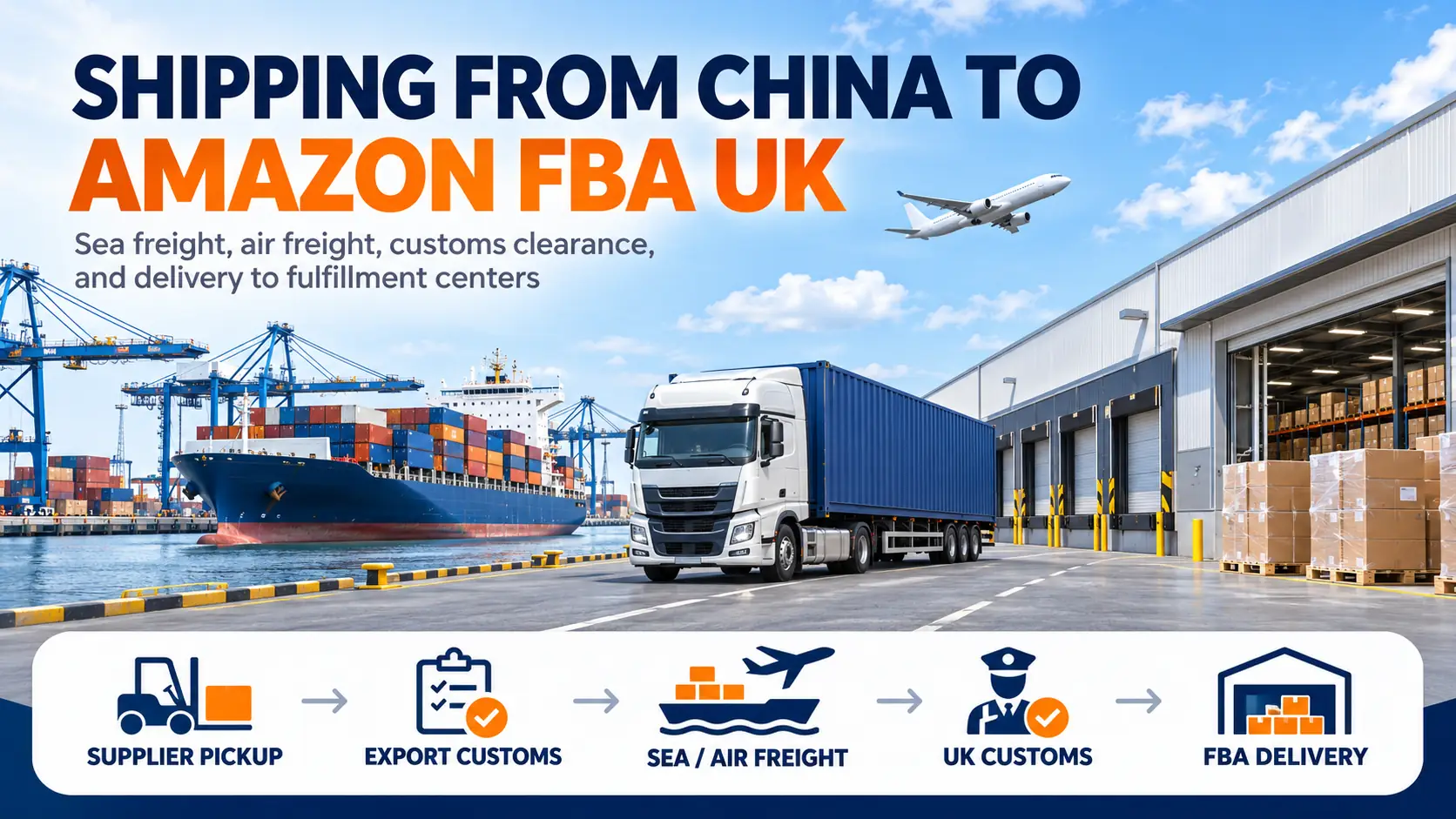
Shipping inventory from a Chinese supplier to an Amazon fulfilment centre involves several stages. Planning each stage in advance helps reduce customs delays, labelling errors, and unnecessary handling costs.
Start by using the Amazon FBA shipment creation process in Seller Central. Enter the product SKUs, quantities, packing details, and ship-from address.
Amazon assigns the receiving location according to the shipment arrangement. Inventory may be distributed between different fulfilment centres, so check the assigned destinations before booking transportation.
Download the required product and carton labels and share the shipment information with your supplier or freight forwarder.
Before cargo collection, confirm that the Chinese supplier has completed production, packaging, and labelling.
Check the following details:
Product quantities match the purchase order and Amazon shipment records.
Each unit has the correct barcode or FNSKU label.
Carton dimensions and gross weights have been measured.
Products are protected against damage during international transportation.
Required product compliance documents are available.
For higher-value or quality-sensitive products, arrange a pre-shipment inspection in China before dispatch.
Compare air freight, ocean freight, express courier, and Amazon SEND according to cargo volume, urgency, and total landed cost.
For larger orders, sea freight is generally more economical. Air freight is suitable for urgent replenishment, while express shipping is more practical for samples and smaller consignments.
The freight forwarder or customs broker checks the commercial invoice, packing list, product descriptions, quantities, and commodity codes before export.
Accurate documentation is essential for customs compliance. The declared value and product information must reflect the actual goods being exported.
When the cargo arrives at the UK destination port or airport, the importer or appointed customs representative submits the required customs declaration.
The importer must provide the correct EORI details, commodity codes, and customs values. Applicable customs duties and import VAT must be handled before the goods proceed to their final destination.
After customs clearance, the goods can move to the fulfilment centre specified in Seller Central.
The carrier must follow Amazon’s receiving procedures. For palletised LTL and FTL cargo, a delivery appointment must be arranged before the vehicle arrives.
Amazon FBA sellers can choose from air freight, sea freight, express courier, and Amazon SEND when shipping inventory from China to the UK. The best shipping method depends on shipment volume, product type, replenishment deadlines, and total transportation costs.
| Shipping Method | Cost Level | Best For | Main Advantage |
|---|---|---|---|
| Air Freight | High | Medium-sized and urgent shipments | Faster delivery |
| Sea Freight LCL | Low to Medium | Smaller shipments | Pay for the space used |
| Sea Freight FCL | Lower per unit for large volumes | Bulk orders | More control over container loading |
| Express Courier | Very High | Samples and small parcels | Convenient door-to-door service |
| Amazon SEND | Carrier-dependent | Eligible FBA shipments | Booking through Seller Central |
Air freight is suitable for sellers who need to replenish stock quickly, launch new products, or avoid inventory shortages. It is commonly used for lightweight consumer goods, electronics accessories, fashion products, and higher-value merchandise.
Charges are generally based on chargeable weight, which is the higher of actual weight and volumetric weight. A common air freight calculation is:
Volumetric Weight (kg) = Length × Width × Height (cm) ÷ 6,000
Carrier calculation rules may differ, so confirm the applicable divisor before booking.
Compare air freight from China to the UK based on the complete service scope, including pickup, export handling, customs clearance, and final delivery.
Sea freight is generally the most cost-effective option for larger orders. Cargo can depart from major Chinese ports and arrive at UK gateways such as Felixstowe, Southampton, and London Gateway.
Two main options are available:
LCL (Less than Container Load): Suitable for smaller shipments that do not require a full container. You pay for the cargo space used, making it practical for sellers testing new products or combining orders.
FCL (Full Container Load): Suitable for bulk orders that can fill a 20GP or 40HQ container. It offers greater control over loading and can reduce transportation costs per unit for larger volumes.
When comparing sea freight from China to the UK, consider origin handling, destination port charges, customs clearance, and final delivery to the assigned Amazon fulfilment centre.
Express shipping is best for product samples, small test orders, and urgent inventory replenishment. International courier companies provide collection, tracking, customs handling, and door-to-door transportation.
However, express shipping generally has a higher cost per kilogram than standard air freight. It is therefore less economical for large commercial orders. Before booking, confirm that the courier can handle the shipment according to Amazon’s delivery requirements.
Amazon SEND is an integrated shipping programme that allows eligible sellers to arrange international transportation through partnered carriers directly in Seller Central.
The programme supports air and ocean shipments from China to the UK. Sellers can manage shipment bookings, obtain carrier labels, and track transportation through the Amazon platform.
Amazon SEND can simplify shipping coordination, as partnered carriers handle transportation, customs clearance, and delivery to the fulfilment centre. However, sellers remain responsible for providing accurate customs information and meeting applicable import and export regulations.
Check the Amazon SEND programme for current carrier availability, product eligibility, and shipping requirements.
Transit time depends on the shipping method and the complete logistics process. International transportation is only one part of the schedule. Supplier preparation, export handling, UK customs clearance, and inland delivery can all affect the actual arrival date.
Typical planning ranges include:
Air freight: Around 5–12 days for door-to-door transportation.
Sea freight: Around 25–45 days, depending on the route and LCL or FCL arrangement.
Express courier: Around 3–7 days, depending on the service.
Amazon SEND: Depends on the selected carrier and transport mode.
These estimates are not guaranteed warehouse receiving dates. Customs inspections, port congestion, peak-season demand, and warehouse receiving schedules can extend the overall process.
For seasonal inventory, build a 2–3 week contingency buffer into your shipping timeline where possible.
Shipping costs depend on cargo volume, chargeable weight, delivery speed, and whether customs clearance and final delivery are included. The following table provides indicative 2026 reference rates.
| Shipping Method | Estimated Cost |
|---|---|
| Sea Freight FCL (40HQ) | $3,500–$4,500/container |
| Sea Freight LCL | $100–$250/CBM |
| Air Freight | $5–$9/kg |
| Express Courier | $8–$15+/kg |
Note: These are indicative planning rates, not guaranteed quotations. Actual prices vary by route, cargo specifications, season, and service scope. Port-to-port rates may exclude destination handling, customs clearance, duties, VAT, and UK inland delivery. DDP quotations generally include additional services.
Beyond international freight, Amazon sellers should budget for:
Import Duty and VAT: Import duty depends on the product’s commodity code. Standard UK import VAT is generally 20%.
Customs Clearance: Customs brokerage, declaration, and destination handling charges.
FBA Preparation: Product labelling, carton preparation, and palletising where required.
Final Delivery: UK inland transportation and applicable Amazon delivery appointment arrangements.
To obtain an accurate quotation, provide the product details, carton dimensions, gross weight, supplier location, and assigned Amazon fulfilment centre.
Understanding UK customs regulations is essential when importing goods for Amazon FBA. Sellers must arrange a compliant import process before the cargo arrives.
The Importer of Record (IOR) is responsible for ensuring that goods are legally imported into the UK, including customs declarations and payment of applicable taxes and duties.
Amazon does not act as the importer or exporter of record for FBA inventory. Sellers must arrange an eligible importer and appoint a customs broker or freight forwarder where necessary.
For imports into Great Britain (England, Scotland, and Wales), a GB EORI number is required. Shipments involving Northern Ireland may also require an XI EORI number.
Overseas sellers storing inventory in UK fulfilment centres should check their VAT registration obligations based on their sales arrangements and import activities.
Businesses can apply through the official GB EORI registration service.
When importing goods from China into the UK, Amazon sellers need to account for import duty and VAT.
Import Duty: The rate depends on the product’s commodity code, customs value, and country of origin. Check the applicable rate using the UK Trade Tariff.
Import VAT: The standard UK VAT rate is 20% for most products. It is generally calculated on the customs value, including applicable duties and relevant shipping and handling costs.
VAT Recovery: VAT-registered businesses may reclaim eligible import VAT through their VAT Returns. Eligible importers can also use Postponed VAT Accounting (PVA) to account for import VAT through their VAT Returns rather than paying it upfront at the border.
Before shipping, confirm the correct commodity code and estimated tax costs to avoid unexpected import expenses.
Delivered Duty Paid (DDP) shipping means that the agreed seller or delivery provider arranges transportation and handles the agreed import charges before delivery.
Amazon does not pay import duties, taxes, or transportation charges for FBA inventory. Shipments arriving with unpaid charges may be refused.
DDP shipping can simplify cost planning by combining agreed freight, customs clearance, import duties, and final delivery charges in one quotation.
Before booking, confirm:
Who is named as the importer of record.
Which company submits the UK customs declaration.
Whether customs duties and import VAT are included.
How customs values and commodity codes are determined.
Whether delivery to the assigned Amazon warehouse is included.
Whether the seller receives the relevant import and tax records.
DDP does not remove the seller’s responsibility to understand the legal import arrangement. Confirm VAT treatment and supporting customs documents before dispatch. You can also review this guide on choosing a reliable DDP freight forwarder in China.
A customs broker or appointed freight forwarder can submit the import declaration through HMRC’s Customs Declaration Service (CDS). The main documents and information include:
Commercial Invoice and Packing List: Product descriptions, quantities, declared values, importer and exporter details, country of origin, carton dimensions, and weights.
UK Commodity Codes: Correct 10-digit codes used to determine customs duty rates and import requirements.
Bill of Lading (BOL) or Air Waybill (AWB): Transportation documents showing shipment details.
GB EORI and VAT Details: The relevant importer identification and tax information.
Customs Representation Authorisation: Written authorisation allowing the appointed customs broker to submit declarations on the importer’s behalf.
Product Compliance Documents: Depending on the product category, UKCA or accepted CE marking, safety test reports, certificates, or import licences may be required.
For more details about UK customs clearance, check the documentation and import procedures before dispatch.

Before shipping inventory to Amazon UK, sellers must ensure that products, cartons, and pallets meet Amazon’s preparation and labelling requirements. Incorrect packaging or identification can cause receiving delays or additional handling costs.
Each product must have a scannable barcode that meets Amazon’s requirements. Apply an FNSKU label when an Amazon barcode is required.
Under Amazon’s barcode policy effective from 31 March 2026, eligible brand owners can continue using manufacturer barcodes, while resellers must use Amazon barcodes even when products already have manufacturer barcodes. Check the barcode requirements for each SKU in Seller Central.
Every carton must also carry the correct FBA Box ID label generated through the Send to Amazon workflow.
Before dispatch, check that:
Product barcodes are clear and scannable.
FNSKU labels cover conflicting manufacturer barcodes where required.
Each carton has the correct FBA Box ID label.
Labels are not damaged or placed over box seams.
Amazon ended its European FBA product preparation and labelling services on 1 July 2026. Sellers must therefore arrange the required product preparation and labelling at the Chinese factory or a third-party warehouse before shipment.
For more information, see the FNSKU labelling requirements for Amazon FBA.
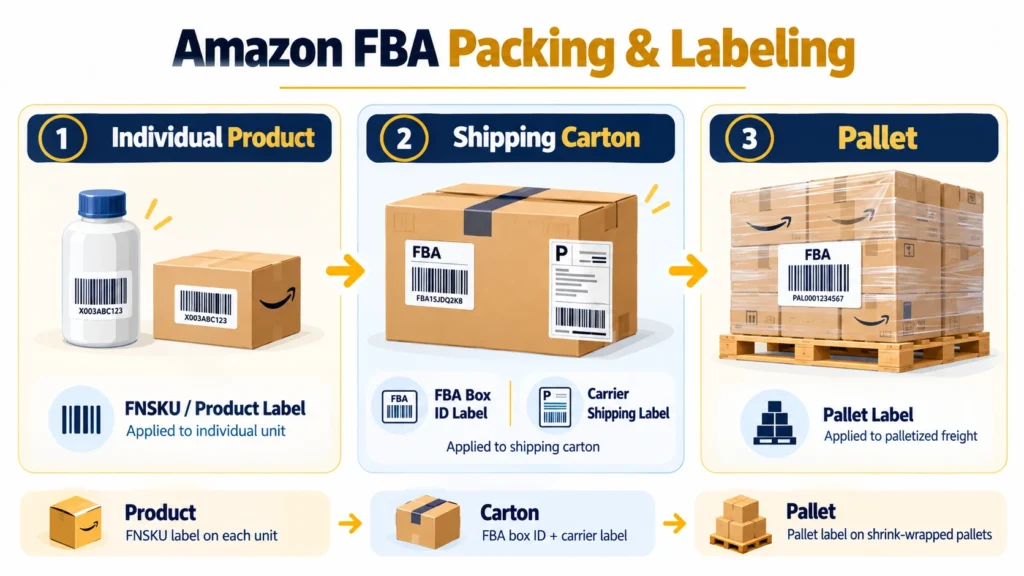
For cartons containing multiple standard-size items, follow these general UK FBA requirements:
Maximum dimensions: 63.5 cm on any side.
Maximum weight: 23 kg per carton.
Heavy cartons: Boxes weighing more than 15 kg require the appropriate Heavy Package or Team Lift warning labels on the top and sides.
Single oversized items may qualify for different limits under Amazon’s rules. Enter accurate carton dimensions and weights when creating the shipment in Seller Central.
Products must comply with applicable UK safety, packaging, and labelling regulations. Depending on the product category, UKCA or accepted CE marking and supporting compliance documents may be required.
Some products also need protective poly bags. Where Amazon’s preparation rules require a suffocation warning, bags with openings of 5 inches or more must display the appropriate warning.
Ensure that country-of-origin information is accurate and that product markings meet the relevant UK import requirements.
Palletised shipments must meet the receiving requirements of the assigned Amazon fulfilment centre.
For UK deliveries, Amazon specifies 1,000 × 1,200 mm four-way-access wooden pallets, GMA Grade B or higher, for applicable palletised shipments.
Key requirements include:
Maximum pallet height of 180 cm, including the pallet.
Maximum gross weight of 500 kg, including the pallet.
Internationally shipped wooden pallets must meet ISPM 15 heat-treatment requirements.
Pallets must be securely stretch-wrapped and suitable for warehouse handling.
Check the latest Amazon shipping and routing requirements before loading.
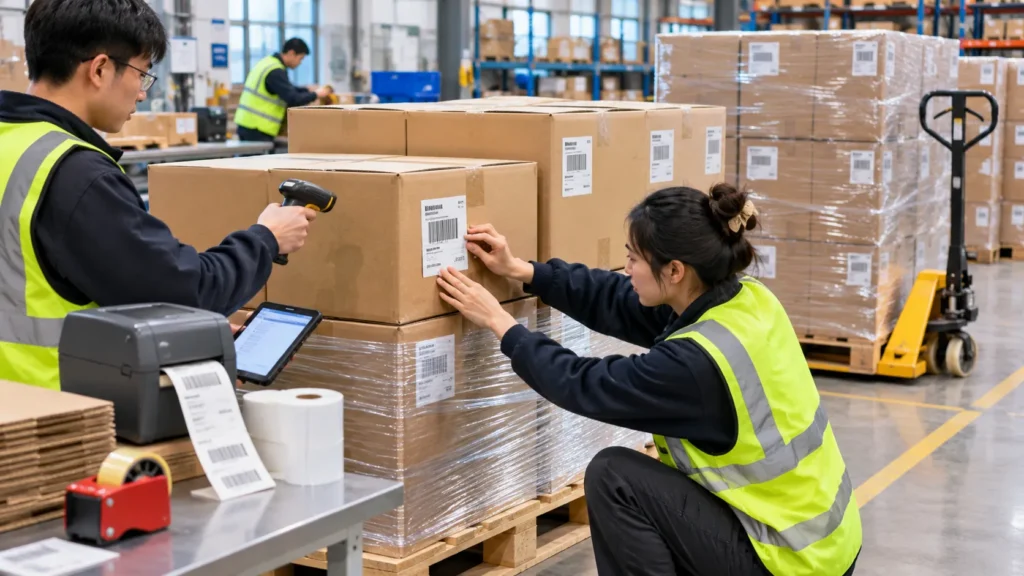
After UK customs clearance, goods can be transported to the Amazon fulfilment centre assigned in Seller Central. The delivery method depends on shipment size, carton quantities, and Amazon’s receiving requirements.
The main delivery arrangements include:
Small Parcel Delivery (SPD): Individual cartons are delivered by parcel carriers such as DHL, UPS, or other eligible courier companies. Each carton must have the correct shipping and FBA labels.
Less Than Truckload (LTL): Multiple cartons are consolidated onto pallets and transported by a freight carrier. This option is suitable for medium-sized shipments.
Full Truckload (FTL): A dedicated truck transports the shipment to the assigned fulfilment centre. It is commonly used for larger palletised orders.
LTL and FTL shipments require a confirmed delivery appointment before arriving at the Amazon warehouse. The carrier must follow Amazon’s appointment procedures through Carrier Central.
Before dispatch, confirm:
The delivery address matches the assigned Amazon fulfilment centre.
Carton and pallet labels match the shipment details.
Pallets meet Amazon’s receiving specifications.
The carrier has secured the required delivery appointment.
Customs clearance is complete and no import charges remain unpaid.
Proper coordination between the freight forwarder and final-mile carrier helps prevent missed appointments, additional storage fees, and rejected deliveries.
Amazon sellers often source inventory from several Chinese factories. Sending each supplier’s order separately can increase transportation costs and complicate customs procedures.
A practical solution is to use China warehousing and consolidation services before international shipping.
The process generally includes:
Collecting products from different suppliers.
Checking quantities, dimensions, gross weights, and cargo condition.
Confirming SKU information and FBA labelling.
Repacking or consolidating goods into suitable shipping units.
Arranging one LCL shipment or an appropriate FCL container load.
This approach can reduce duplicated pickup and export handling charges while giving sellers better control over their supply chain. For more details, see the guide to shipping from multiple suppliers in China.
All suppliers should deliver their goods before the agreed cargo cut-off. Missing items or incomplete preparation can delay the entire consignment.
Several mistakes can cause unnecessary expenses, customs delays, or rejected inventory.
Using Amazon as the importer of record: Amazon does not accept responsibility for importing FBA inventory.
Choosing DAP without confirming import arrangements: Unpaid customs charges can prevent successful delivery.
Incorrect customs declarations: Understated values or inaccurate commodity codes create customs compliance risks.
Missing FBA labels: Unreadable barcodes or incorrect carton labels can delay warehouse receiving.
Ignoring carton restrictions: Overweight or oversized cartons may incur additional handling charges or be refused.
Skipping delivery arrangements: LTL and FTL cargo must have the required receiving appointment.
Booking transportation too late: Port congestion, peak-season demand, and customs inspections can disrupt inventory replenishment.
A reliable shipping process should account for supplier preparation, customs compliance, transportation, and Amazon receiving requirements before the goods leave China.
Choosing a China freight forwarder with Amazon FBA experience can help sellers coordinate international logistics, customs clearance, and final delivery.
Before booking, compare the following factors:
Amazon FBA Experience: Confirm that the provider understands Seller Central shipment records, carton labels, pallet requirements, and receiving procedures.
UK Customs Capability: Check whether the provider can coordinate customs declarations, commodity classification, and import documentation.
IOR and DDP Arrangements: Ask who will act as the importer of record and how duties and import VAT will be handled.
Transparent Quotations: Request an itemised breakdown of origin charges, international freight, customs clearance, destination handling, and final delivery.
Shipment Tracking: A reliable freight forwarding provider should offer updates from supplier collection through customs clearance and warehouse delivery.
Multiple-Supplier Coordination: If you source from several factories, confirm that the forwarder can receive, inspect, consolidate, and prepare the goods before export.
For more information about shipping from China to Amazon FBA UK, contact Tonlexing for professional advice and a tailored shipping quotation.
Sea freight is generally the most economical option for large shipments. LCL is suitable for smaller cargo volumes, while FCL can offer a lower cost per unit for larger orders. Compare the complete landed cost, including customs clearance, duties, VAT, and inland transportation.
Yes. Amazon SEND supports eligible air and ocean shipments from China to UK fulfilment centres through partnered carriers. Sellers can book through Seller Central but must still meet applicable customs and product requirements.
A GB EORI is required for imports into Great Britain. Overseas sellers should also check their UK VAT registration and import VAT obligations based on their business and marketplace arrangements before dispatch.
Air freight generally takes around 5–12 days door to door, while sea freight may take approximately 25–45 days depending on the route and service. Customs clearance and warehouse receiving schedules can extend the overall timeline.
Yes. A freight forwarder can coordinate international transportation, customs clearance, and delivery to the assigned Amazon fulfilment centre. For LTL and FTL cargo, the carrier must arrange the required receiving appointment and follow Amazon’s delivery procedures.
Useful freight, customs and importing resources related to this shipping guide.
FNSKU Labels for Amazon FBA: Requirements, Size & How to Print Verified & Reviewed · Last updated October 2026 FNSKU labels are used to identify...
Read guide →
Selling on Amazon FBA (Fulfillment by Amazon) can be a lucrative business venture, but it’s essential to adhere to Amazon’s strict warehouse requ...
Read guide →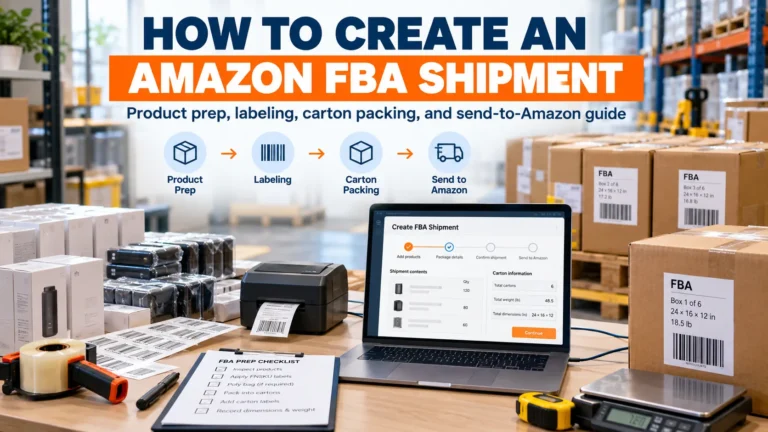
How to Create an Amazon FBA Shipment: Send to Amazon Step by Step (2026) Verified & Reviewed · Last updated October 2026 Creating an Amazon FBA s...
Read guide →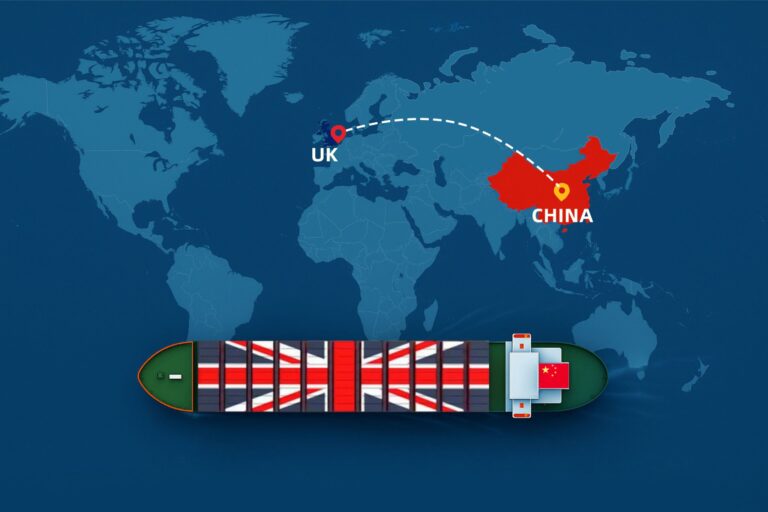
Shipping from China to the UK offers flexible air and sea freight solutions. Learn about delivery time, shipping costs, and customs clearance.
Read guide →Customs Clearance in the UK Verified & Reviewed · Last updated February 2026 Customs clearance in the UK is the process of declaring goods to HMR...
Learn more → Useful Resource Shipping Cost from China to UK (2026 Guide)Shipping Cost from China to UK (2026 Guide) Verified & Reviewed · Last updated June 2026 Shipping cost from China to UK in 2026 typically ranges...
Learn more →WhatsApp us