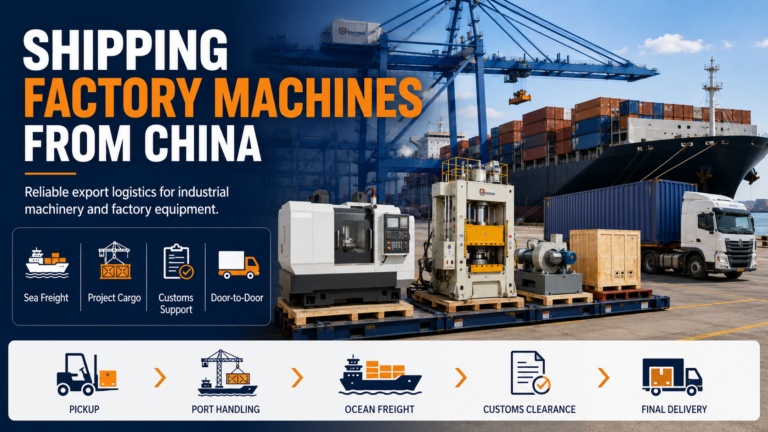
Related Guide
Shipping Factory Machines from China
Shipping Factory Machines from China Verified & Reviewed · Last updated July 2026 Shipping factory machines from China requires careful planning...
Read guide →

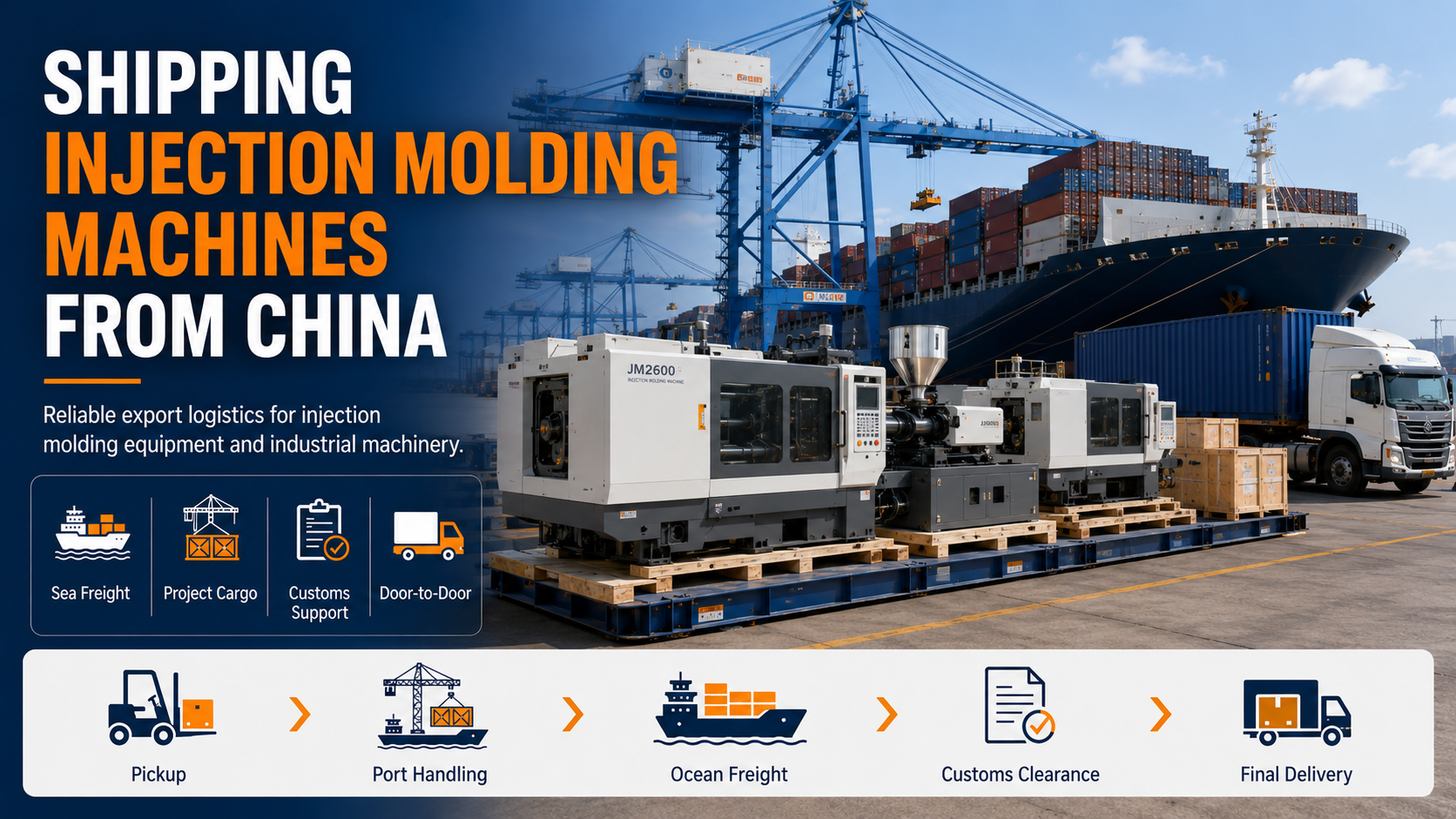
Shipping injection molding machines from China requires careful planning because these machines are heavy, high-value, and often include hydraulic systems, electrical cabinets, molds, and auxiliary equipment.
This guide explains how to ship injection molding machines from China, covering container options, packing requirements, customs clearance, import duties, shipping costs, transit time, and door-to-door delivery.
Shipping method
Packing & Inspection
Customs clearance
China is one of the world’s major manufacturing bases for injection molding machinery, plastic molds, auxiliary equipment, and complete production solutions. Many Chinese manufacturers produce machines for automotive parts, electronics, home appliances, packaging, medical products, consumer goods, and industrial plastic components.
One reason importers choose China is the complete supply chain. Buyers can source not only the injection molding machine, but also molds, chillers, dryers, loaders, robots, conveyors, mold temperature controllers, granulators, spare parts, and replacement parts from nearby suppliers. This makes it easier to build a full production line or upgrade an existing factory.
However, importers should not focus only on the factory price. A low-cost machine may become expensive if it has poor quality control, unstable operation, missing documents, weak packing, or limited after-sales support.
Common injection molding machines imported from China include:
Hydraulic injection molding machines
Servo injection molding machines
Electric injection molding machines
Hybrid injection molding machines
Vertical injection molding machines
Two-platen injection molding machines
PET preform injection molding machines
Rubber injection molding machines
Used injection molding machines
A reliable supplier should provide machine specifications, final packing details, operation videos, loading photos, and all required documents before shipment.
Injection molding machines are more difficult to ship than many other types of factory machinery because their structure is long, heavy, and unevenly balanced. The machine body may look strong, but several parts need careful protection during ocean freight, including the electrical cabinet, control panel, hydraulic system, tie bars, platens, screw, barrel, and mold mounting surfaces.
Another difference is that these machines are often shipped together with molds and auxiliary equipment. Molds are compact but extremely heavy, while dryers, loaders, hoppers, conveyors, and robots may take up more container space. If these items are not planned together, the shipment may exceed container limits or create customs declaration problems.
The main shipping challenges include:
Heavy machine weight and high loading pressure
Long machine body and limited container door access
Risk of rust on precision metal parts
Moisture damage to electrical cabinets and control systems
Possible hydraulic oil leakage during transport
Need for crane, forklift, or rigging equipment
Extra packing requirements for molds and auxiliary equipment
Because of these risks, injection molding machine shipping requires a more detailed logistics plan than standard cargo shipping.
Different injection molding machines have different shipping requirements. A small vertical injection machine may fit easily into a standard container, while a large two-platen machine may require open top, flat rack, or breakbulk shipping.
The machine type also affects the packing method. Hydraulic machines need careful oil leakage prevention. Electric machines may require stronger protection for motors, drives, and control systems. Large machines used for automotive or home appliance parts may have longer footprints and heavier clamping units.
Most injection molding machine manufacturers in China offer different models from different manufacturers for specific needs and production needs. The right machine depends on plastic materials, product size, mold design, shot weight, clamping force, and production efficiency.
Common machine types include, so buyers should match the machine to their specific needs:
Hydraulic injection molding machines for standard plastic parts production
Servo injection molding machines for stable operation and better energy efficiency
Electric injection molding machines for high precision and clean production
Hybrid injection molding machines combining hydraulic power and electric control
Vertical injection molding machines for insert molding and small precision parts
Two-platen injection molding machines for large plastic components
PET preform injection molding machines for bottle and packaging production
These machines are widely used in the injection molding industry, serving diverse sectors, especially for automotive parts, electronics housings, home appliances, packaging products, and industrial plastic components.
Many buyers ship related equipment in the same shipment to save time and reduce project coordination. This is common when setting up a new production process or buying a complete turnkey solution from Chinese manufacturers.
Common related items include:
Plastic molds and precision molds
Hopper dryers and vacuum loaders
Chillers and cooling towers
Mold temperature controllers
Conveyors and robots
Granulators and mixers
Spare parts and replacement parts
Tools, manuals, and control system components
These items should be listed separately on the packing list. Each package should show the product name, quantity, dimensions, gross weight, and value. This helps both customs clearance and destination delivery.
Before arranging shipping, importers should confirm whether the supplier is a reliable injection molding machine manufacturer. China has many manufacturers, trading companies, and plastic injection molding companies, so machine quality and service levels can vary widely.
An established supplier with real manufacturing and export experience is usually more reliable than a company that only provides a low quotation. Importers should check whether the supplier has a real workshop, assembly line, quality control team, export packing experience, and previous overseas projects.
As part of factory verification, check for ISO 9001 certification to confirm quality standards.
Important points to check include:
Business license, export experience, and technical expertise for overseas orders
Factory workshop and assembly process
Main products and machine range, including whether the factory can manufacture injection molding machines for export markets
Experience with overseas installation
Ability to provide custom solutions
Export packing and loading experience
For large projects, a factory visit or third-party inspection is recommended. This helps verify whether the manufacturer can meet your quality standards before the machine leaves China.
Quality control should be confirmed before shipment, not after the machine arrives. The supplier should provide test reports, operation videos, machine photos, and a clear list of accessories and spare parts.
Importers should check:
Machine model and final specifications
Clamping force and shot weight
Control system operation
Hydraulic and electrical performance
Safety device function
Test reports and certificates
Trial running videos if available
This step is especially important when buying used injection molding machines or ordering a complete production line.
Injection molding machines usually require installation, commissioning, and basic operator training after arrival. Some manufacturers can provide after-sales services, including installation, commissioning, training, spare parts supply, and remote support, sometimes through overseas partners.
Before placing the order, confirm whether installation support is included. Also check whether the machine’s electrical system, voltage, plug standard, safety protection, and control language match the buyer’s production setup and local market requirements.
Ocean freight is the main method for shipping injection molding machines from China because these machines are usually too heavy and bulky for air freight. The right method depends on the machine size, weight, value, destination country, and unloading conditions.
Full Container Load (FCL) is the most common shipping method for small and medium-sized injection molding machines. The equipment is loaded into a dedicated container, reducing cargo handling during transit and providing better protection than shared shipments.
A standard 20GP, 40GP, or 40HQ container can usually accommodate compact machines, while molds, auxiliary equipment, and spare parts are often loaded in the same container to maximize space and reduce shipping costs.
FCL shipping is recommended when:
The machine fits within standard container dimensions
Total cargo weight is within container limits
Molds and auxiliary equipment are shipped together
Lower handling risk is preferred
When an injection molding machine exceeds the loading limits of a standard container, special equipment is required. The choice between an Open Top container and a Flat Rack container depends mainly on the machine’s dimensions and loading method.
An Open Top container is suitable when the machine is too tall to enter through the container doors but can still fit inside the container after being lifted from above by a crane. Once loaded, the cargo is protected with a waterproof tarpaulin.
A Flat Rack container is used when the machine is too wide, too high, or too heavy for enclosed containers. Since the cargo remains partially exposed, proper blocking, steel lashing, waterproof covering, and anti-rust protection become especially important during ocean transport.
Open Top or Flat Rack shipping is commonly used for:
Large two-platen injection molding machines
High-clamping-force machines
Oversized machine frames
Heavy molds and auxiliary equipment
Equipment that cannot pass through standard container doors
For ultra-heavy-duty machinery exceeding 1,000 tons that cannot fit on unified flat rack assemblies, breakbulk cargo shipping is the only viable alternative.
Direct Hold Positioning: The independent components of the disassembled injection molding system are hoisted directly into the primary weather-protected cargo holds of specialized breakbulk vessels via heavy-lift shipboard cranes.
Custom Rigging Schemes: Every individual machine component requires a custom engineering lifting plan detailing center-of-gravity calculations, specialized spreader bar configurations, and dedicated high-tensile lifting eye locations.

Proper inspection and packing are essential before shipping an injection molding machine from China. Since these machines are high-value industrial equipment, any damage during transportation can result in costly repairs, production delays, and insurance claims. Completing quality checks before loading helps reduce these risks and ensures the machine arrives in good condition.
Before the machine is packed, importers should confirm that it has passed basic inspection and operational testing. Many manufacturers offer Factory Acceptance Testing (FAT), allowing buyers or third-party inspectors to verify the machine before shipment.
Key inspection items include:
Machine model and specifications
Clamping force and shot weight
Hydraulic and electrical system operation
Control system and safety devices
Machine accessories and replacement parts
Test reports and operation manuals
For high-value equipment, a third-party inspection is recommended if the buyer cannot visit the factory.
Injection molding machines should be packed to withstand long-distance ocean transportation. Exposed metal surfaces need anti-rust protection, while electrical components should be protected from moisture and vibration during transit.
Export packing typically includes:
Anti-rust coating on precision metal parts
Moisture-proof wrapping for electrical cabinets
Wooden crates, steel skids, or reinforced pallets
Protective packaging for molds and auxiliary equipment
Clear shipping marks and package labels
If the machine is partially disassembled, every package should be numbered and listed clearly on the packing list.
Correct loading is just as important as proper packing. The machine should be lifted from the designated lifting points and secured inside the container to prevent movement during ocean transport.
Before the container is sealed, the freight forwarder or loading team should confirm:
Cargo weight is evenly distributed
Wooden blocking and steel lashing are installed correctly
The machine is firmly secured to the container floor
Photos are taken before and after loading
The container and seal numbers are recorded
A well-planned loading process helps reduce the risk of cargo shifting, structural damage, and insurance disputes after arrival.
Customs clearance for injection molding machines depends on accurate documents, correct HS code classification, and local machinery compliance rules. If the invoice, packing list, or product description is unclear, customs may inspect the shipment or request document corrections.
Most importers need the following documents:
Bill of Lading
Certificate of origin if required
Product specification sheet
Operation manual
Test reports if required
Insurance certificate if purchased
CE or other compliance documents where applicable
The product name, model, quantity, weight, value, and HS code should match across all documents.
Plastic injection molding machines are commonly classified under HS Code 8477.10, but the final code should be confirmed with a customs broker. If molds, robots, chillers, conveyors, or spare parts are shipped together, they may need separate HS codes.
Importers may need to pay customs duty, VAT or GST, customs processing fees, port charges, broker fees, and inspection fees. Duty rates depend on the destination country, customs value, and current trade policy.
Before shipment, confirm whether the machine meets local safety and electrical standards. For Europe, CE documentation may be required. Other markets may request test reports, wiring diagrams, safety labels, voltage information, or operation manuals.
If the destination uses different voltage or electrical standards, the supplier should modify the control system or electrical cabinet before shipping.
The total cost of shipping injection molding machines from China depends on much more than ocean freight. Machine size, gross weight, container type, factory location, destination port, customs clearance, inland delivery, unloading requirements, and operating costs all affect the final landed cost, especially when comparing machine types.
Ocean freight rates change throughout the year depending on vessel capacity, seasonal demand, machine size, container type, and destination. The prices below are general budgeting estimates for injection molding machine shipping from China. Final rates may vary depending on packed dimensions, gross weight, carrier space, and whether special container handling is required.
| Destination | 20GP / 40HQ FCL | Open Top Container | Flat Rack Container |
|---|---|---|---|
| China to USA West Coast | USD 2,500–5,500 | USD 4,500–8,500 | USD 5,500–11,000 |
| China to USA East Coast | USD 3,500–7,200 | USD 6,000–10,500 | USD 7,500–14,000 |
| China to Northern Europe | USD 2,500–4,500 | USD 4,500–8,000 | USD 5,500–11,000 |
| China to Australia | USD 2,000–4,200 | USD 3,800–7,500 | USD 5,000–9,500 |
| China to Middle East | USD 1,800–3,800 | USD 3,500–6,800 | USD 4,500–8,500 |
For small and medium injection molding machines, standard FCL is usually the most cost-effective option. For machines that are too tall for door loading, open top containers may be required. For oversized or heavy-duty injection molding machines, flat rack containers or breakbulk shipping should be quoted separately based on the actual cargo dimensions and weight.
Transit time depends on the origin port, shipping line, vessel schedule, customs clearance, and final delivery location. While ocean transit is predictable, customs inspections and inland transportation may extend the overall delivery time.
| Shipping Route | Ocean Transit | Typical Door-to-Door Time |
|---|---|---|
| China to USA West Coast | 15–22 days | 25–35 days |
| China to USA East Coast | 28–40 days | 40–50 days |
| China to Northern Europe | 30–45 days | 45–55 days |
| China to Australia | 18–30 days | 25–40 days |
| China to Southeast Asia | 7–20 days | 15–25 days |
For oversized machinery shipped on flat rack containers or by breakbulk vessel, additional time may be needed because of cargo inspections, lifting arrangements, and special port handling procedures.
FOB is often a practical Incoterm for importing injection molding machinery because it allows the buyer to control the ocean freight and destination costs. EXW gives the buyer more control from the factory, but it requires a strong freight forwarder in China.
CIF may look simple, but destination charges should be checked carefully. DDP can be convenient, but the quotation should clearly state whether duties, taxes, unloading, crane service, and site delivery are included.
Yes. Many small and medium injection molding machines can be shipped in a 20ft, 40ft, or 40HQ container. The final decision depends on packed dimensions, gross weight, container door size, and loading method. Large machines may require open top, flat rack, or breakbulk shipping.
Not always. Small machines can often be shipped as complete units. Large machines may need partial disassembly if the injection unit, clamping unit, electrical cabinet, hydraulic station, or auxiliary equipment makes the cargo too large for standard container loading.
You should confirm the machine model, clamping force, shot weight, packed dimensions, gross weight, lifting points, center of gravity, number of packages, HS code, and final delivery address. For large machines, ask for drawings, loading photos, and packing photos.
Many plastic injection molding machines are commonly classified under HS code 8477.10. However, the final HS code should be confirmed with a customs broker because classification may vary by machine type, function, and destination country.
Yes. Cargo insurance is strongly recommended because injection molding machines are high-value equipment. Insurance can help protect against damage during loading, ocean freight, unloading, inland trucking, and port handling.
Useful freight, customs and importing resources related to this shipping guide.
Shipping Factory Machines from China Verified & Reviewed · Last updated July 2026 Shipping factory machines from China requires careful planning...
Read guide →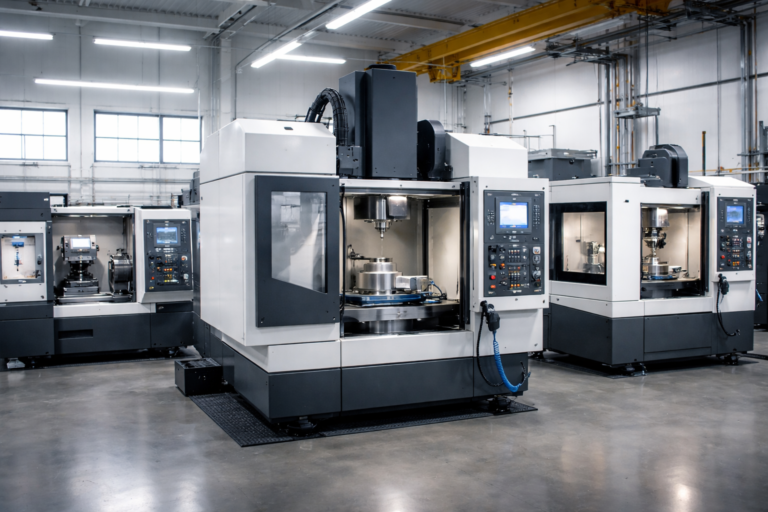
Shipping CNC Machines Verified & Reviewed · Last updated April 2026 Shipping CNC Machines from China is a complex process that requires proper pl...
Read guide →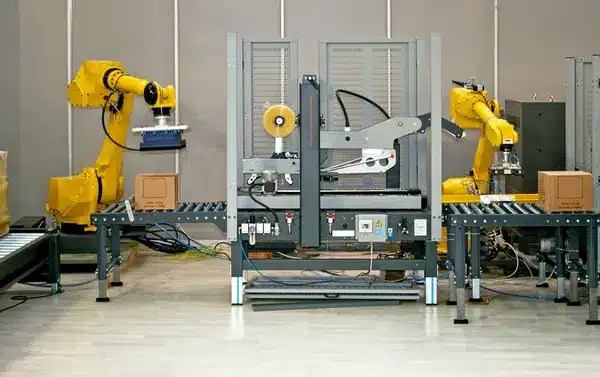
Packaging machines are vital for various industries, including food, beverages, pharmaceuticals, and consumer goods. As one of the world’s leadin...
Read guide →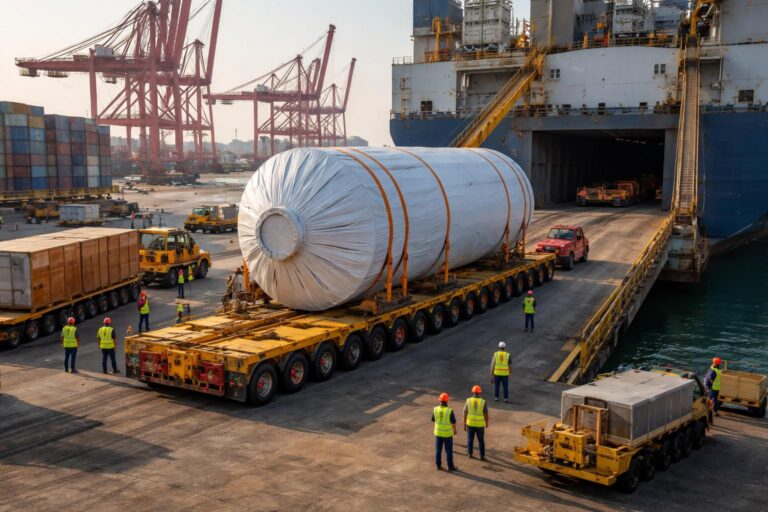
Shipping Oversized Cargo from China Verified & Reviewed · Last updated February 2026 Shipping oversized cargo from China depends on cargo dimensi...
Read guide →The United States is one of the largest importers of heavy machinery, sourcing equipment from China’s leading manufacturers to meet demands in in...
Learn more → Useful Resource Shipping Machinery From China to GermanyShipping Machinery From China to Germany Verified & Reviewed · Last updated March 2026 Shipping machinery from China to Germany varies depending...
Learn more →WhatsApp us