

How to Import from China to France
- Verified & Reviewed · Last updated June 2026
Importing goods from China to France requires careful planning across product sourcing, shipping methods, customs clearance, import duties, VAT, and EU compliance.
This guide explains how to import from China to France step by step, including sea freight, air freight, rail freight, express shipping, shipping costs, French customs procedures, import duties, VAT, and common mistakes to avoid.
Import process
Customs duties & VAT
Shipping methods
- Experienced China-based logistics specialists
Table of Contents
What You Need Before Importing Goods from China to France
To import goods from China to France successfully, you must prepare essential legal registrations, product compliance documents, and shipping paperwork before the goods leave China. France follows strict EU import regulations, and missing any key requirement can result in customs delays, fines, or cargo inspection.
Below are the five core areas every importer must prepare.
Legal & Tax Registrations
Before importing commercial goods into France, you must ensure your business is properly registered for EU customs operations. Without the correct identifiers, customs clearance cannot be processed.
Key requirements include:
EORI Number: Mandatory for all EU imports, used for customs declarations and tracking shipments
French VAT Number: Required for businesses importing goods for resale or commercial use in France
Business Registration: Needed if you are importing under a company structure within the EU
These registrations ensure your shipment can legally enter France and that customs duties and VAT are correctly processed.
Core Logistics & Commercial Documentation
Accurate shipping documents are essential for smooth customs clearance in France. Even small inconsistencies can cause delays or inspections.
You must prepare the following documents:
HS Code (Harmonized System Code): Defines product classification and determines import duty rate
Commercial Invoice: Shows product value, transaction details, and buyer/seller information
Packing List: Details cargo weight, dimensions, carton quantity, and packaging structure
Bill of Lading (B/L) or Air Waybill (AWB): Transport document proving shipment and ownership
These documents must match exactly to avoid customs discrepancies.
Defined Contract Terms (Incoterms)
Incoterms define responsibility between buyer and seller in international shipping. They determine who pays for freight, insurance, customs clearance, and delivery.
Common terms used for China to France shipping include:
FOB (Free on Board): Supplier delivers goods to the port in China; buyer handles international shipping and import clearance
EXW (Ex Works): Buyer is responsible for full logistics from factory pickup in China
DDP (Delivered Duty Paid): Supplier or freight forwarder handles shipping, customs, VAT, and final delivery in France
Choosing the right Incoterm directly affects your total shipping cost and control over logistics.
Freight Forwarder & Customs Broker Support
For most importers, especially beginners or e-commerce businesses, working with a freight forwarder in China is highly recommended. They manage logistics and ensure compliance with French customs procedures.
A freight forwarder typically provides:
Cargo pickup from Chinese suppliers
Export customs clearance in China
Sea freight, air freight, or rail freight booking
Shipment tracking and coordination
Import customs support in France
Final delivery arrangement
This reduces the risk of documentation errors, delays, and unexpected customs issues.
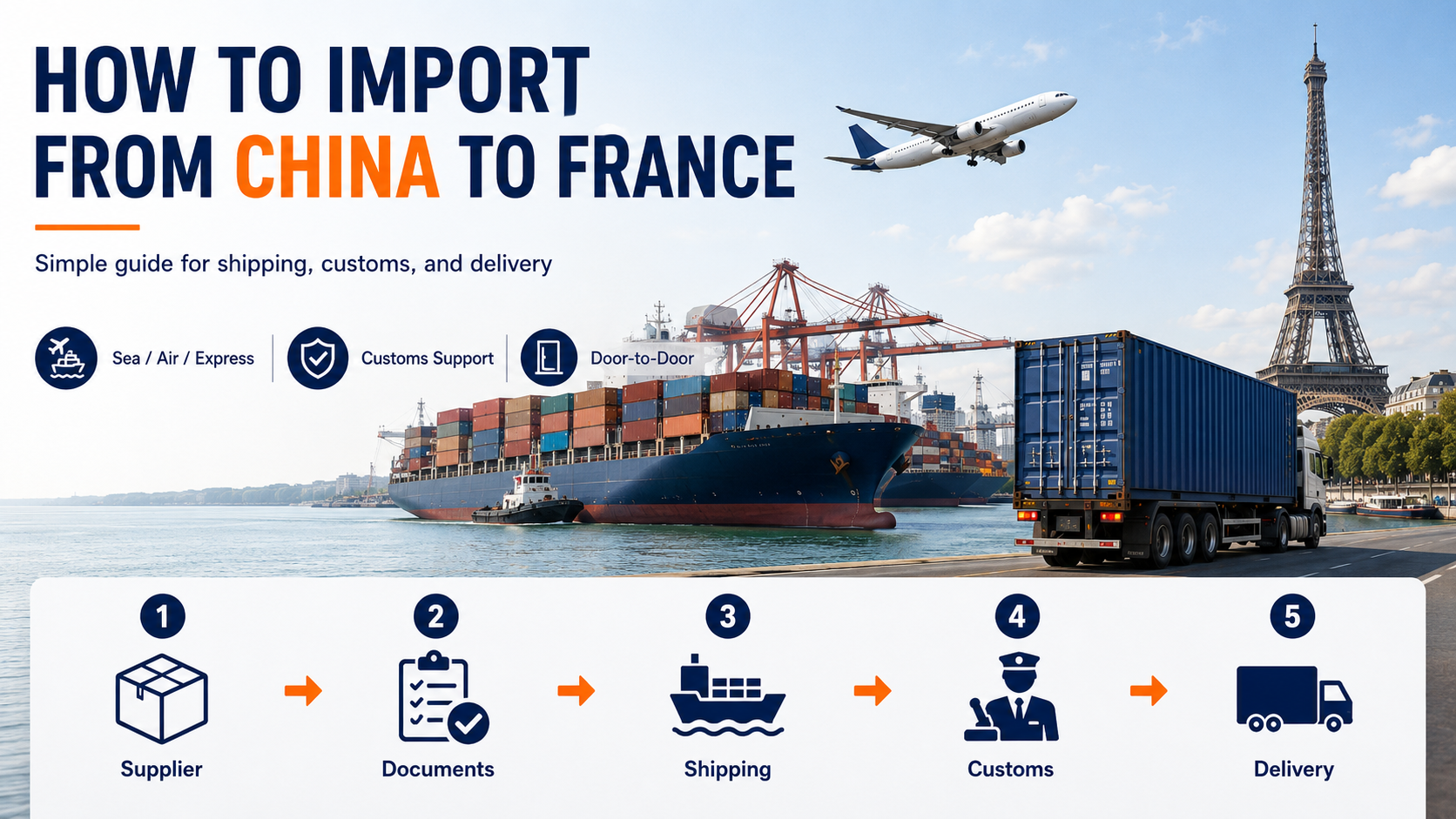
Step-by-Step Process for Importing from China to France
Importing goods from China to France involves a structured process that combines sourcing, logistics planning, customs preparation, and final delivery. Each step must be handled carefully to avoid delays at French customs and to control the total landed cost.
Below is a clear step-by-step breakdown of the entire import process.
Step 1: Product Sourcing and Supplier Selection
The first step is identifying reliable Chinese suppliers and confirming that the product meets your business requirements. At this stage, price is not the only factor—quality, compliance, and export capability are equally important.
Key actions include:
Search and compare verified Chinese suppliers
Request product samples for quality checking
Confirm production capacity and lead time
Verify export experience to Europe or France
Choosing the right supplier reduces the risk of defective goods, documentation errors, and shipping delays later in the process.
Step 2: Confirm Product Specifications and Compliance
Once the supplier is selected, you must confirm all product details and ensure compliance with EU regulations before production or shipment.
This includes:
Finalizing product specifications (size, material, packaging)
Confirming labeling and branding requirements
Checking CE, RoHS, REACH, or other EU certifications
Ensuring correct HS code classification
Compliance issues discovered after shipment can result in customs detention or rejection in France.
Step 3: Choose Shipping Method and Incoterms
At this stage, you decide how the goods will be transported from China to France and who is responsible for each part of the logistics chain, making sure the choice matches your shipping needs as well as your budget and timing.
Common shipping methods include:
Ocean shipping for large and cost-efficient shipments
Air transport for urgent or high-value goods
Rail freight for balanced cost and transit time
Express shipping for small parcels and samples
DDP door-to-door shipping for simplified import process
You also need to agree on Incoterms such as EXW, FOB, or DDP, which define responsibility for freight, insurance, and customs clearance.
Step 4: Prepare Export and Shipping Documents
Before goods leave China, all required documents must be prepared accurately to ensure smooth customs clearance in France.
Essential documents include:
Commercial Invoice with HS code and product details
Packing List showing weight, cartons, and dimensions
Bill of Lading or Air Waybill depending on shipping method
Certificate of Origin if required
Product compliance certificates if applicable
All documents must match exactly. Even small inconsistencies can trigger customs inspection.
Step 5: International Shipping from China to France
After documentation is ready, the cargo is shipped from major Chinese ports or airports to France as part of broader global trade.
Typical routes include:
Sea freight in shipping containers to ports such as Le Havre, Marseille, or Fos-sur-Mer
Air freight to Paris Charles de Gaulle or Lyon airports
Rail freight through Eurasian corridors into Europe
Transit time depends on the method chosen, ranging from a few days for air freight to several weeks for sea freight.
Step 6: French Customs Clearance
When the goods arrive in France, they must go through customs clearance before being released.
French customs will review:
HS code classification
Commercial invoice and declared value
Import duties and VAT calculation
Product compliance certificates
Importer EORI number
If everything is correct, the shipment is released quickly. If not, customs may request additional documents or inspection, which can delay delivery.
Step 7: Final Delivery in France
After customs clearance is completed, the goods are delivered to the final destination in France.
This may include:
Retail store delivery
Direct customer delivery
At this stage, the import process is fully completed and the goods are ready for sale or distribution.
Shipping Methods from China to France
There are several shipping methods available for importing goods from China to France, and each option serves different types of cargo, budgets, and delivery timelines. Choosing the right shipping method is essential because it directly affects shipping cost, transit time, customs clearance efficiency, and overall supply chain performance.
Importers usually select between sea freight, air freight, rail freight, express shipping, and DDP door-to-door shipping depending on their business needs.
Sea Freight from China to France
Sea freight is the most commonly used shipping method for large-volume and commercial cargo. It offers the best cost efficiency for full container shipments, container shipment, and standard containerized options for commercial imports.
It is suitable for products such as furniture, machinery, building materials, textiles, electronics, and general consumer goods.
Key characteristics include:
Transit time: around 30–45 days
Best for: large shipments and full container load cargo
Cost advantage: lowest cost per unit for heavy or bulky goods
Shipping options: FCL (Full Container Load) and LCL (Less than Container Load), with LCL shipments typically taking about 26–32 days to reach France.
Sea freight is the preferred option when cost control is more important than delivery speed.
Air Freight from China to France
Air freight is a fast and reliable option for urgent cargo, using air transport when delivery speed matters more than cost.
It is commonly used for electronics, fashion items, medical products, spare parts, and time-sensitive shipments.
Key characteristics include:
Transit time: around 3–7 days
Best for: urgent or high-value shipments
Pricing method: chargeable weight (actual vs volumetric weight)
Main routes: major Chinese airports to Paris Charles de Gaulle or Lyon
Standard air freight suits most urgent loads, while express air freight is used when shipments need even faster handling and delivery.
Air freight is ideal when delivery speed is more important than cost efficiency.
Rail Freight from China to France
Rail freight offers a balanced solution between sea freight and air freight. It is part of the Eurasian rail network and is increasingly used for shipments into Europe.
It is suitable for medium-volume cargo that requires faster delivery than sea freight but lower cost than air freight.
Key characteristics include:
Transit time: around 15–25 days
Best for: medium-volume and industrial goods
Route: China → Central Asia → Europe → France
Advantage: stable transit time compared to sea freight
Rail freight is a practical option for importers seeking a balance between speed and cost.
Express Shipping from China to France
Express shipping is handled by international courier companies and is mainly used for small parcels, samples, and urgent documents.
It provides fast delivery and simplified handling, but is not suitable for large or heavy shipments.
Key characteristics include:
Transit time: around 3–5 days
Best for: samples, documents, and small parcels
Advantage: door-to-door convenience with fast tracking
Limitation: higher cost per kilogram
Express shipping is often used for testing markets or urgent replacement shipments.
DDP Door-to-Door Shipping from China to France
DDP shipping is a comprehensive door to door service where the freight forwarder manages transportation, customs clearance, import duties, VAT, and final delivery.
It is widely used by e-commerce sellers and small importers who want a simplified import process.
Key characteristics include:
Includes: freight, customs clearance, duties, VAT, and delivery
Best for: e-commerce and small to medium importers
Advantage: one all-inclusive cost with simplified process
Shipping modes: air, sea, or rail DDP
DDP shipping reduces complexity and is useful for importers who want one provider to handle the entire process, including customs and delivery.
Shipping Costs from China to France
The cost of shipping goods from China to France depends on several practical factors, including the transportation method, shipment size, cargo weight, and how urgently the goods need to arrive. In most cases, the bigger the shipment, the more cost-efficient sea freight becomes, while smaller or time-sensitive cargo tends to rely on air or express services.
2026 Freight Cost Reference (China to France)
Compare offers from freight forwarders to find competitive rates for your route and cargo type.
| Shipping Method | Estimated Cost | Typical Use |
|---|---|---|
| Sea Freight (20ft Container) | $2,520 – $3,080 | Bulk or heavy shipments |
| Sea Freight (40ft Container) | $3,735 – $4,565 | Large commercial cargo |
| Sea Freight LCL | $30 – $150 per CBM | Smaller consolidated shipments |
| Rail Freight | $4,158 – $7,392 | Mid-speed delivery to Europe |
| Air Freight | $4 – $9 per kg | High-value or urgent goods |
| Express Courier | $10 – $15 per kg | Samples and small parcels |
What Affects the Total Shipping Cost?
Chargeable Weight vs. Volumetric Weight: Air and express freight use a dimensional calculation (Length x Width x Height in cm / 5000). You pay for whichever value is greater: the physical weight or the space it occupies.
Incoterms Allocation: Under FOB (Free on Board) terms, you only pay for international transport and French clearance. Under EXW (Ex Works), you must additionally pay for domestic trucking inside China.
Surcharges and Duties: Keep in mind that base freight rates exclude destination local port fees, customs broker fees, import duties, and French VAT (typically 20%).

Customs Clearance in France
Customs clearance in France is the process of checking and approving goods that enter the country from outside the European Union. When shipments arrive from China, they must be declared to French Customs (La Douane) before they can be released for delivery.
Crucial Customs Documents
French customs officers require a comprehensive paper trail to inspect and clear your shipment:
Commercial Invoice: Must display a clear product description, transaction value, currency, and the Incoterms used.
Packing List: Must detail the total number of cartons, gross/net weight, and structural dimensions.
Bill of Lading (B/L) or Air Waybill (AWB): Serves as the official transport contract and proof of ownership.
Certificates of Conformity: Documents proving the items meet EU safety mandates, such as CE certificates, test reports, or REACH compliance sheets.
Calculation of Import Taxes
When goods enter France, customs authorities calculate duties and taxes based on the customs value (Cost of Goods + Shipping + Insurance to the EU border):
Customs Duties: Determined by your product’s HS/TARIC Code. Shipments with an intrinsic value under €150 are completely exempt from customs duties. For goods over €150, the duty rate typically ranges from 0% to 15% depending on the item type.
French Import VAT: The standard rate is 20%.
Heavily Regulated & Prohibited Goods
Certain categories trigger automatic additional screening or require specific European certifications before they can legally cross the French border:
Electronics & Machinery: Must bear the CE Marking and possess a valid technical dossier demonstrating compliance with EU safety, RoHS, and WEEE directives.
Chemicals: Must comply with the stringent REACH regulations. Importers must ensure the chemical substances are properly registered.
Agricultural & Food Products: Subject to strict Sanitary and Phytosanitary (SPS) controls. They require Phytosanitary or Veterinary Certificates and must pass through designated Border Control Posts (BCPs) for inspection.
Compliance Tip: Ensure that your freight forwarder or customs broker holds an AEO (Authorized Economic Operator) certification. Utilizing an AEO-certified partner in France frequently grants priority processing, lower rates of physical inspections, and simplified custom clearance privileges.
How to Calculate the Final Landed Cost
The final landed cost refers to the total cost of importing goods from China to France, covering all expenses from the supplier’s factory to the final delivery location. It is a key figure for importers because it directly determines profit margins and pricing strategy.
Many importers underestimate total costs by focusing only on product price or freight. In reality, additional charges such as customs duties, VAT, and destination fees must also be included.
What Is Included in the Landed Cost
The landed cost is made up of all costs involved in moving goods from China to France.
It generally includes:
Product cost from the supplier
Domestic transport in China (factory to port or airport)
Export clearance fees in China
International freight (sea, air, or rail)
Insurance (if applicable)
Customs duties in France
Import VAT (usually 20%)
Destination handling and delivery charges
Each component can vary depending on product type, shipping method, and destination requirements.
Landed Cost Formula
A simple calculation used by most importers is:
Landed Cost = Product Cost + Freight Cost + Insurance + Customs Duty + Import VAT + Destination Charges
This formula provides a realistic estimate of the total import cost before the goods arrive in France.
Common Mistakes When Importing from China to France
Many importers face delays or extra costs because they do not prepare the shipping process correctly.
Common mistakes include:
Choosing suppliers only based on the lowest price
Not checking the HS code before shipment
Ignoring customs duties and VAT
Using vague product descriptions
Providing incorrect customs value
Not checking CE marking or European standards
Missing product certificates
Underestimating destination charges
Choosing CIF without understanding local costs
Not buying insurance for high value shipments
Shipping counterfeit goods or branded goods without authorization
Waiting until arrival to arrange customs clearance
The best way to avoid these problems is to prepare the entire process before the goods leave China. Confirm supplier details, documents, HS code, customs value, shipping method, and final destination in advance.
Why Choose Tonlexing for Shipping from China to France?
Choosing the right freight forwarder is one of the most important decisions when importing from China to France. The quality of logistics support directly affects shipping cost, transit time, customs clearance efficiency, and overall supply chain stability.
Tonlexing provides end-to-end freight forwarding services designed to help importers move goods from China to France in a more efficient and controlled way, whether for small shipments or full container loads.
Reliable China–France Shipping Solutions
We offer multiple shipping options to match different shipping needs, including sea freight, air freight, rail freight, express shipping, and DDP door-to-door solutions. This allows importers to choose the most suitable balance between cost and delivery time.
Our services cover:
FCL and LCL sea freight from major Chinese ports
Air freight for urgent and high-value shipments
Rail freight to Europe with delivery into France
DDP shipping including customs clearance and tax handling
These services support international trade between China and France across different cargo profiles.
Simplified Customs Clearance Process
Customs clearance is often the most challenging part of importing into France. Tonlexing supports importers by preparing accurate documentation and coordinating with customs brokers to reduce clearance delays.
We help ensure:
Correct HS code classification
Complete commercial invoice and packing list review
Support for EU compliance requirements
Coordination with French customs procedures
Cost Control and Transparent Shipping
One of the key advantages of working with Tonlexing is better cost visibility. We help importers understand the full logistics structure, including freight, customs duties, VAT, and destination charges, before shipment begins.
This allows for more accurate landed cost planning and reduces unexpected expenses during import.
Strong Experience in China–Europe Logistics
With experience in international logistics, we handle shipments across major trade routes between China and France. Strong international logistics support is important for making international trade between China and France more efficient. Our network includes major ports, airports, and inland delivery routes, helping ensure stable and predictable logistics performance.
End-to-End Support for Importers
From supplier pickup in China to final delivery in France, we provide full supply chain support, including:
Cargo collection and consolidation
Export customs clearance in China
International freight booking
Import customs support in France
Final delivery to warehouses or business addresses
A Practical Partner for Growing Import Businesses
Tonlexing is designed for importers who need more than just transportation. We focus on helping businesses reduce risk, improve efficiency, and maintain stable supply chains when sourcing from China.
Frequently Asked Questions
Import duty from China to France depends on the HS code, product category, customs value, and EU tariff rules. Many products may have customs duties from 0% to around 17%, but some goods may face additional duties, anti-dumping duties, or special controls. Duties usually apply to goods valued over €150.
Shipping costs depend on cargo volume, actual weight, chargeable weight, shipping method, departure port, French port, and final destination. Based on the provided reference data, sea freight may range from around USD 2,520 to USD 4,565 per container, air freight may cost around USD 6.30 per kilogram, and LCL shipping may cost around USD 30 per CBM.
Sea freight from China to France usually takes around 30–45 days door to door. Air freight typically takes 3–7 days. Rail freight averages 15–25 days. Express shipping can deliver in around 3–5 days for samples and small parcels.
Yes. France generally applies 20% VAT on imported goods. VAT is calculated based on the customs value, customs duties, and eligible import charges. Importers should include VAT when calculating the total shipping cost and final landed cost.
Sea freight is usually the cheapest option for large shipments and full container load cargo. LCL shipping is suitable for smaller shipments that do not fill an entire container. Express shipping is faster but usually more expensive per kilogram.
More China to France Shipping Guides
Get an Import Shipping Quote from China to France
Sea, air, rail, and DDP shipping options
Customs clearance, duties, and VAT support
Accurate landed cost planning before shipment
Get tailored shipping solutions, transparent pricing, and customs support for importing goods from China to France.