

How to Write an RFQ to Chinese Suppliers

When sourcing products from China, a clear RFQ helps buyers receive accurate supplier quotes and avoid pricing misunderstandings.

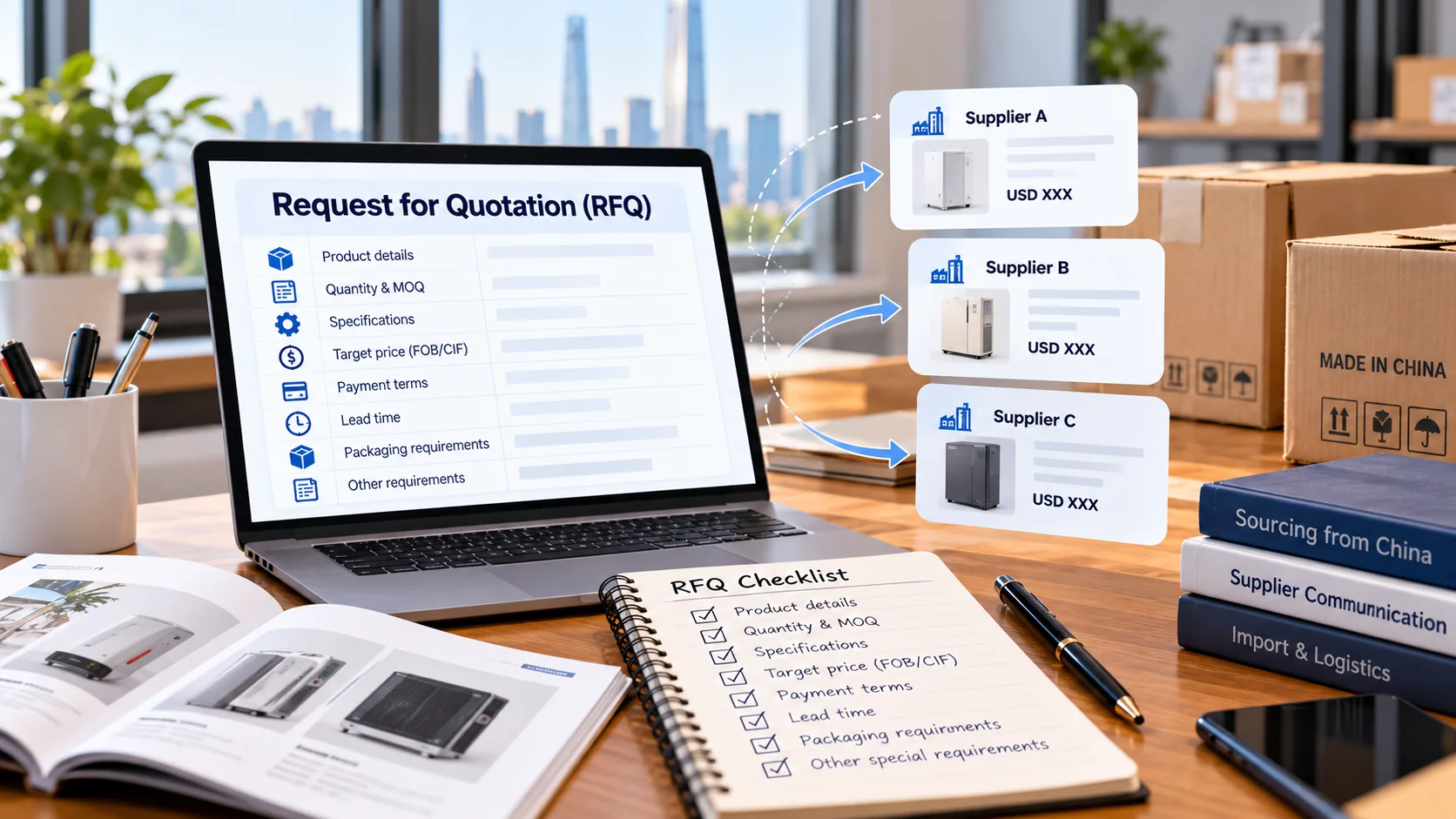
A professional Request for Quotation should include product specifications, quantity, quality requirements, packaging details, lead time, and shipping terms, allowing suppliers to provide comparable offers.

Product Specifications

Supplier Quotes

RFQ Template

How to write an RFQ to Chinese suppliers with product requirements and quotation documents
10,000+ international shipments handled    Global sea, air & DDP shipping solutions    24/7 shipment tracking & customer support

Table of Contents

What Is an RFQ for Chinese Suppliers?

A Request for Quotation (RFQ) is a formal document that buyers send to suppliers to request pricing and commercial information for a specific product or project.

Unlike a simple inquiry such as “How much is this product?”, an RFQ provides detailed requirements so suppliers can prepare a complete quotation based on the same standards.

A typical RFQ includes:

  • Product specifications and technical requirements

  • Required order quantity

  • Unit price and cost breakdown

  • Minimum Order Quantity (MOQ)

  • Sample cost and production time

  • Packaging requirements

  • Quality standards

  • Delivery terms and Incoterms

  • Production lead time

For international buyers sourcing from China, a structured RFQ is especially important because different suppliers may interpret product requirements differently. Clear information helps avoid inaccurate quotations, unexpected costs, and production misunderstandings.

Why a Detailed RFQ Matters When Sourcing From China

Chinese manufacturers usually calculate prices based on multiple factors, including materials, production processes, order volume, packaging methods, and quality requirements. If these details are missing, suppliers may provide different quotations that are difficult to compare.

A detailed RFQ helps buyers:

  • Receive quotations based on the same product requirements

  • Compare different suppliers more accurately

  • Identify hidden costs before placing an order

  • Reduce communication problems during production

  • Avoid quality issues caused by unclear specifications

For example, two suppliers may quote different prices for the same product name because they are using different materials, production methods, or packaging standards. A detailed RFQ ensures every supplier is pricing the same product.

What Information Should Be Included in an RFQ to Chinese Suppliers?

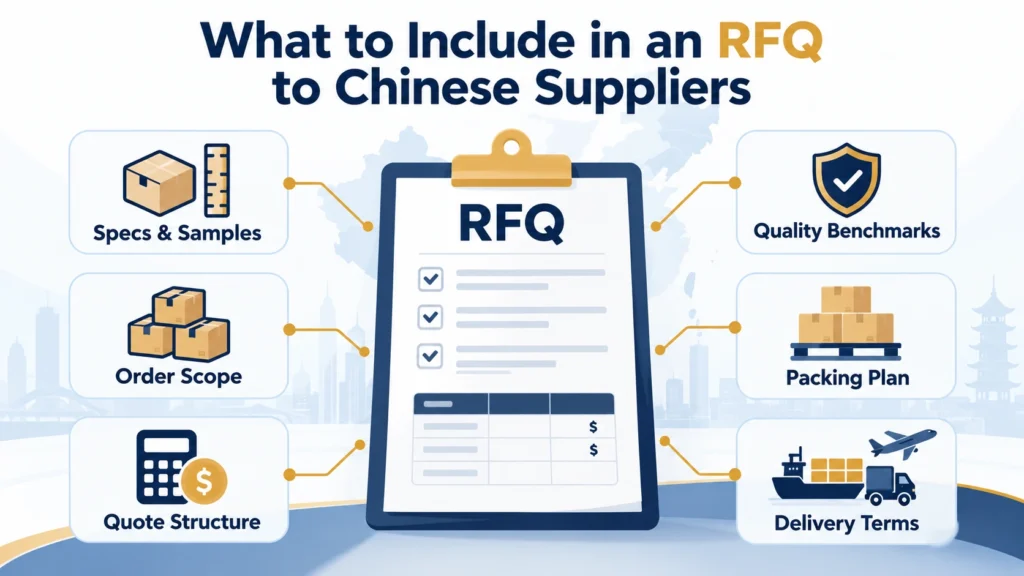
A professional RFQ should work as a complete purchasing document rather than a simple price request. The goal is to provide suppliers with measurable requirements that can be quoted accurately.

What to include in an RFQ to Chinese suppliers with product requirements and quotation details

Product Specifications and Technical Requirements

Product details are the foundation of an RFQ. Chinese suppliers need clear specifications to understand what they should manufacture or supply.

Include:

  • Product name and model

  • Material and dimensions

  • Weight, color, and finish

  • Technical drawings or product photos

  • Required standards or certifications

For customized products, provide drawings, samples, or detailed specifications whenever possible. Clear requirements help suppliers avoid assumptions and provide more accurate quotes.

Order Quantity and MOQ Requirements

Order volume directly affects unit price. Always specify your required quantity and expected purchasing volume.

Include:

  • Initial order quantity

  • Expected repeat orders

  • Required MOQ

For better price comparison, ask suppliers to quote different quantities, such as 500, 1,000, and 5,000 units.

Cost Breakdown and Pricing Requirements

A quotation should include more than just the product price. Ask suppliers to separate major costs so you can compare offers accurately.

Request:

  • Unit price

  • Tooling or mold cost

  • Sample cost

  • Packaging cost

  • Additional production fees

A detailed cost breakdown helps identify differences between suppliers and prevents unexpected charges later.

Packaging and Labeling Requirements

Packaging can affect both product costs and shipping arrangements. Include your packaging expectations in the RFQ.

Specify:

  • Individual packaging

  • Carton requirements

  • Labeling instructions

  • Export packing requirements

Clear packaging information allows suppliers to include the correct costs in their quotations.

Quality Standards and Compliance Requirements

Define your quality expectations before requesting supplier quotes.

Include:

  • Quality standards

  • Testing requirements

  • Inspection requirements

  • Required certifications

  • Reference samples if available

This helps suppliers understand your quality expectations and avoid differences during production.

Delivery Time and Trade Terms

Suppliers need clear delivery requirements to prepare realistic quotations.

Include:

  • Sample lead time

  • Mass production lead time

  • Preferred Incoterms (EXW, FOB, CIF, DDP)

  • Destination and shipping requirements

Clear trade terms and timelines help prevent misunderstandings when comparing supplier quotations.

RFQ Template Example for Chinese Suppliers

A clear RFQ template helps Chinese suppliers understand your requirements and prepare accurate quotations. The format below can be adapted for different products and sourcing projects.

Buyer Information

Provide basic company details so suppliers understand who they are quoting for.

  • Company name

  • Contact person

  • Country or market

  • Website

  • Business type

Product Requirements

Clearly describe the product you need suppliers to quote.

Include:

  • Product name

  • Model or item number

  • Material requirements

  • Dimensions and specifications

  • Product photos or drawings

  • Quality standards

  • Required certifications

Order Quantity and Pricing Request

Specify your purchasing requirements and ask suppliers to provide pricing based on different volumes.

Request:

  • Initial order quantity

  • MOQ

  • Unit price

  • Price tiers for different quantities

  • Tooling or mold costs if applicable

Production and Quality Requirements

Ask suppliers to confirm their production capability and quality standards.

Include:

  • Sample availability and sample cost

  • Production lead time

  • Quality inspection requirements

  • Testing documents or certifications

Packaging and Shipping Information

Provide packaging and delivery requirements to receive a complete quotation.

Include:

  • Packaging requirements

  • Carton details

  • Labeling requirements

  • Preferred Incoterms (EXW, FOB, CIF, DDP)

  • Destination country or city

Supplier Response Requirements

Ask suppliers to provide all quotation details in a clear format.

Request suppliers to confirm:

  • Complete quotation

  • Production timeline

  • Payment terms

  • Product alternatives (if any)

  • Validity period of the quotation

A well-structured RFQ template ensures every supplier receives the same requirements, making quotation comparison easier and reducing misunderstandings during the sourcing process.

How to Send an RFQ to Chinese Suppliers

Sending an RFQ effectively is not only about the document itself. The supplier selection process also affects the quality of quotations you receive.

A practical RFQ process includes:

Prepare Complete Product Information

Before contacting suppliers, collect all necessary information, including specifications, drawings, photos, quantity requirements, and quality expectations.

Incomplete information often leads to multiple clarification emails and delayed quotations.

Select Suitable Chinese Suppliers

Choose suppliers that match your product category and requirements.

When evaluating suppliers, consider:

  • Manufacturing experience

  • Production capabilities

  • Export experience

  • Product certifications

  • Communication quality

A supplier that understands your industry can usually provide more accurate recommendations and quotations.

Send the Same RFQ Document to Multiple Suppliers

To compare quotations fairly, send the same RFQ requirements to different suppliers.

Changing specifications between suppliers makes price comparison unreliable because each supplier may quote for a different product.

Compare suppliers based on:

  • Product price

  • MOQ

  • Production lead time

  • Quality requirements

  • Packaging

  • Trade terms

Review and Clarify Supplier Quotations

Do not compare only the unit price. A lower quotation may exclude important costs such as tooling, packaging, testing, or shipping preparation.

Review:

  • Whether all requested items are included

  • Whether specifications match your requirements

  • Whether delivery time is realistic

  • Whether additional fees apply

Common RFQ Mistakes When Contacting Chinese Suppliers

Many sourcing problems begin with incomplete RFQs. Avoiding these mistakes can improve quotation accuracy and supplier communication.

Asking Only for the Best Price

A request such as “Please give me your lowest price” does not provide enough information for suppliers to prepare a reliable quotation.

Price depends on:

  • Material

  • Quantity

  • Product specifications

  • Packaging

  • Production requirements

A complete RFQ produces more meaningful quotations than a simple price request.

Not Defining Product Specifications

Without clear specifications, suppliers may quote different versions of the product.

Common missing information includes:

  • Material requirements

  • Dimensions

  • Product quality standards

  • Color specifications

  • Packaging details

Clear specifications reduce misunderstandings during production.

Not Including Order Quantity

Suppliers calculate unit prices based on production volume. Without quantity information, they cannot provide accurate pricing.

Always include:

  • Current order quantity

  • Expected future volume

  • Target purchasing frequency if available

Ignoring Packaging Requirements

Packaging affects both product cost and international shipping costs.

Leaving packaging undefined may result in:

  • Different carton sizes

  • Unexpected packaging fees

  • Higher transportation costs

Accepting Alternative Materials Without Confirmation

Some suppliers may suggest alternative materials or production methods to reduce costs.

This is not necessarily a problem, but any changes should be clearly identified and approved before production.

Request suppliers to list alternatives separately instead of including substitutions in the main quotation.

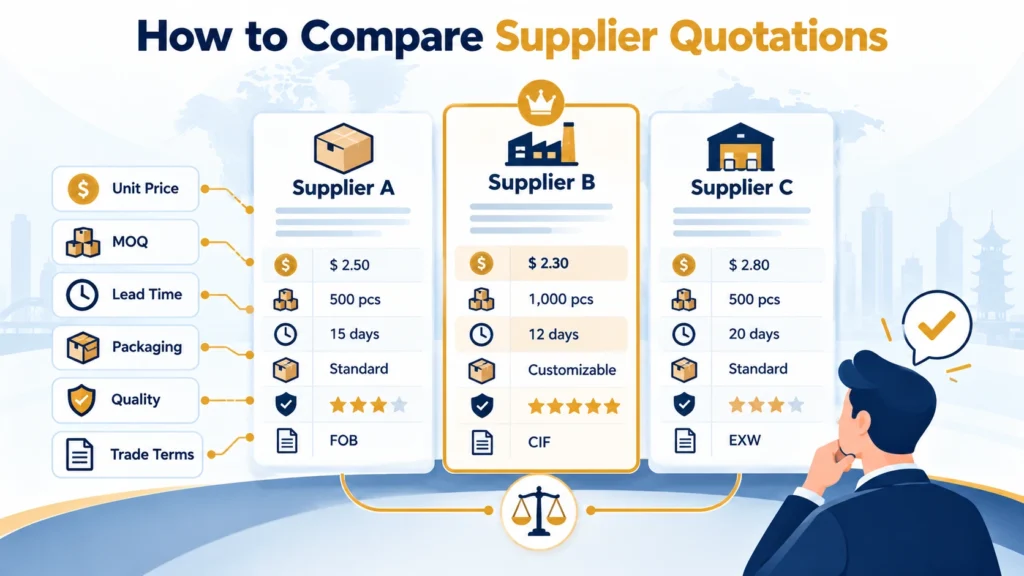
How to Compare Chinese Supplier Quotations

Receiving multiple supplier quotations is only the beginning of the sourcing process. The cheapest quotation is not always the most suitable option because different suppliers may include different specifications, production standards, packaging methods, or commercial terms.

To compare quotations effectively, make sure every supplier is evaluated based on the same RFQ requirements.

A supplier quotation comparison should include:

Evaluation ItemWhat to Check
Product specificationWhether the quoted product matches your requirements
Unit pricePrice based on the same quantity and specifications
MOQMinimum order quantity requirements
Tooling costAdditional mold or setup fees
Sample costSample production and approval costs
Lead timeProduction schedule and delivery timeline
PackagingPackaging materials and export requirements
Trade termsEXW, FOB, CIF, DDP or other Incoterms
Payment termsDeposit requirements and payment conditions

When comparing supplier quotes, pay attention to differences rather than focusing only on price.

For example, Supplier A may provide a lower unit price but exclude custom packaging or quality testing. Supplier B may have a higher quotation but include additional services required for your market.

A standardized RFQ makes this comparison much easier because every supplier is responding to the same requirements.

How to compare Chinese supplier quotations with price, MOQ, lead time, and trade terms

After Receiving Supplier Quotes: Next Steps

A supplier quotation is not the final step before purchasing. Buyers should verify supplier capability, confirm product details, and prepare for production and shipping.

The next steps usually include:

Confirm Product Details and Final Pricing

Review the quotation carefully and confirm:

  • Product specifications

  • Material requirements

  • Quantity

  • Packaging details

  • Production lead time

  • Payment terms

  • Shipping terms

If any supplier suggests changes, ask them to provide updated pricing based on the revised specifications.

Request Samples Before Mass Production

For customized products or new suppliers, samples help verify whether the product meets your expectations before placing a larger order.

Sample evaluation should focus on:

  • Product quality

  • Material consistency

  • Functionality

  • Appearance

  • Packaging quality

Once the sample is approved, make sure the supplier follows the approved standard during mass production.

Sample approval and quality inspection process for products from Chinese suppliers

Arrange Quality Inspection Before Shipment

Quality inspection can help identify production issues before goods leave China.

Inspection may include:

  • Product appearance checks

  • Quantity verification

  • Packaging inspection

  • Function testing

  • Documentation review

Defining inspection requirements early in the RFQ stage helps suppliers understand your quality expectations.

Prepare International Shipping Arrangements

After production is completed, buyers need to arrange export preparation and transportation.

Important shipping considerations include:

For buyers importing from China, coordinating supplier communication and freight arrangements early can help avoid delays during shipment.

Tips for Creating a Professional RFQ for Chinese Suppliers

A strong RFQ is not necessarily a long document. The key is providing the right information in a clear structure.

Follow these practices:

  • Use a clear RFQ format instead of sending scattered messages

  • Include photos, drawings, and specifications whenever possible

  • Define quantity requirements before requesting prices

  • Ask suppliers to separate additional costs

  • Specify packaging and labeling requirements

  • Confirm trade terms before comparing quotations

  • Send identical requirements to different suppliers

  • Keep communication records for future reference

A professional RFQ helps suppliers understand your expectations and allows you to build a more reliable sourcing process.

Frequently Asked Questions